Quick Answer: A reliable anti rust screws manufacturer should demonstrate more than an attractive coating or a successful salt spray test. OEM buyers need evidence that approved screw specifications can be reproduced across production batches. The most useful checks include material identification, manufacturing process control, coating specifications, dimensional inspection, representative sample testing, lot identification, and final packaging verification.
For furniture manufacturers, industrial equipment companies, and hardware distributors, inconsistent fastener quality can create assembly interruptions, rejected shipments, premature corrosion complaints, and costly rework.
A screw approved during sampling may behave differently in bulk production if the substrate, coating process, tooling, or inspection requirements change.
This guide explains how to audit anti-rust screw manufacturing, evaluate suppliers, identify production risks, and establish a practical quality-control plan before placing OEM orders.
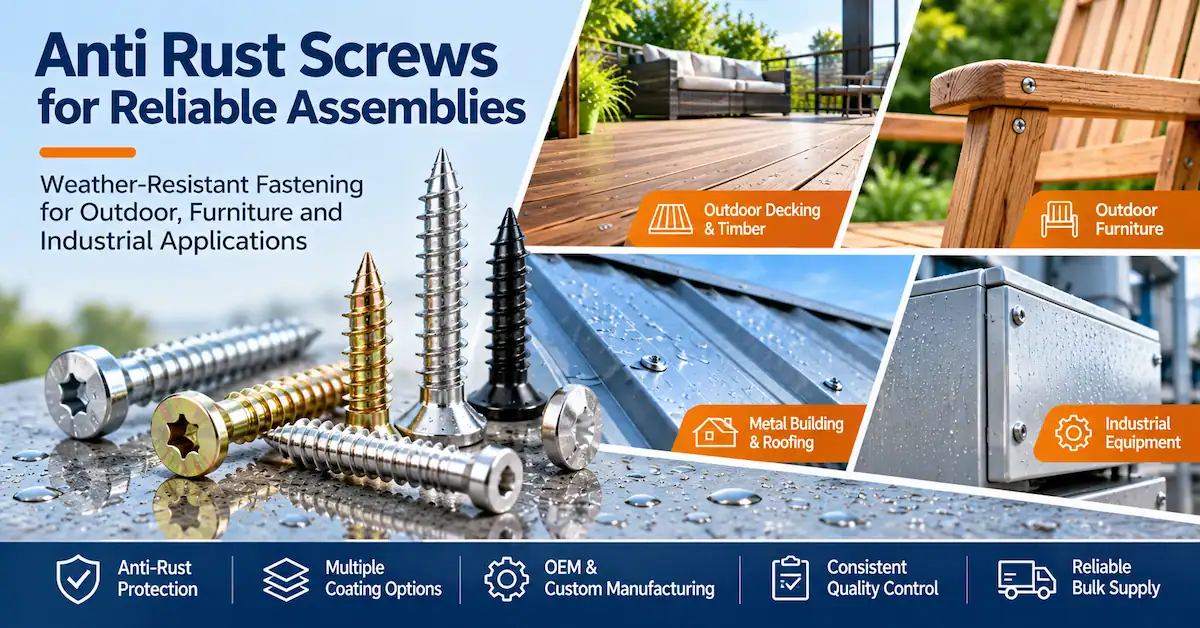
Key Takeaways
-
Manufacturing consistency matters as much as coating selection. A good sample does not guarantee that future production batches will perform identically.
-
Corrosion protection must be specified. Terms such as "anti-rust" and "weather-resistant" are insufficient without material, coating, and acceptance requirements.
-
Process control reduces variation. Material identification, forming accuracy, coating verification, and functional inspection should work together.
-
Lot traceability supports quality investigations. Buyers should be able to identify which approved specification and production batch apply to a shipment.
-
Salt spray testing has limits. Laboratory corrosion tests must be interpreted according to the agreed product requirements.
-
An effective RFQ reduces sourcing risks. Drawings, application conditions, inspection criteria, packaging, and order quantities should be confirmed before production.
1. What Does an Anti Rust Screws Manufacturer Actually Do?
An anti-rust screw manufacturer produces or coordinates the manufacture of screws designed to resist corrosion under defined operating conditions.
This involves more than applying a protective finish.
The supplier must consider how screw geometry, material selection, manufacturing operations, protective coatings, installation requirements, and quality inspections work together.
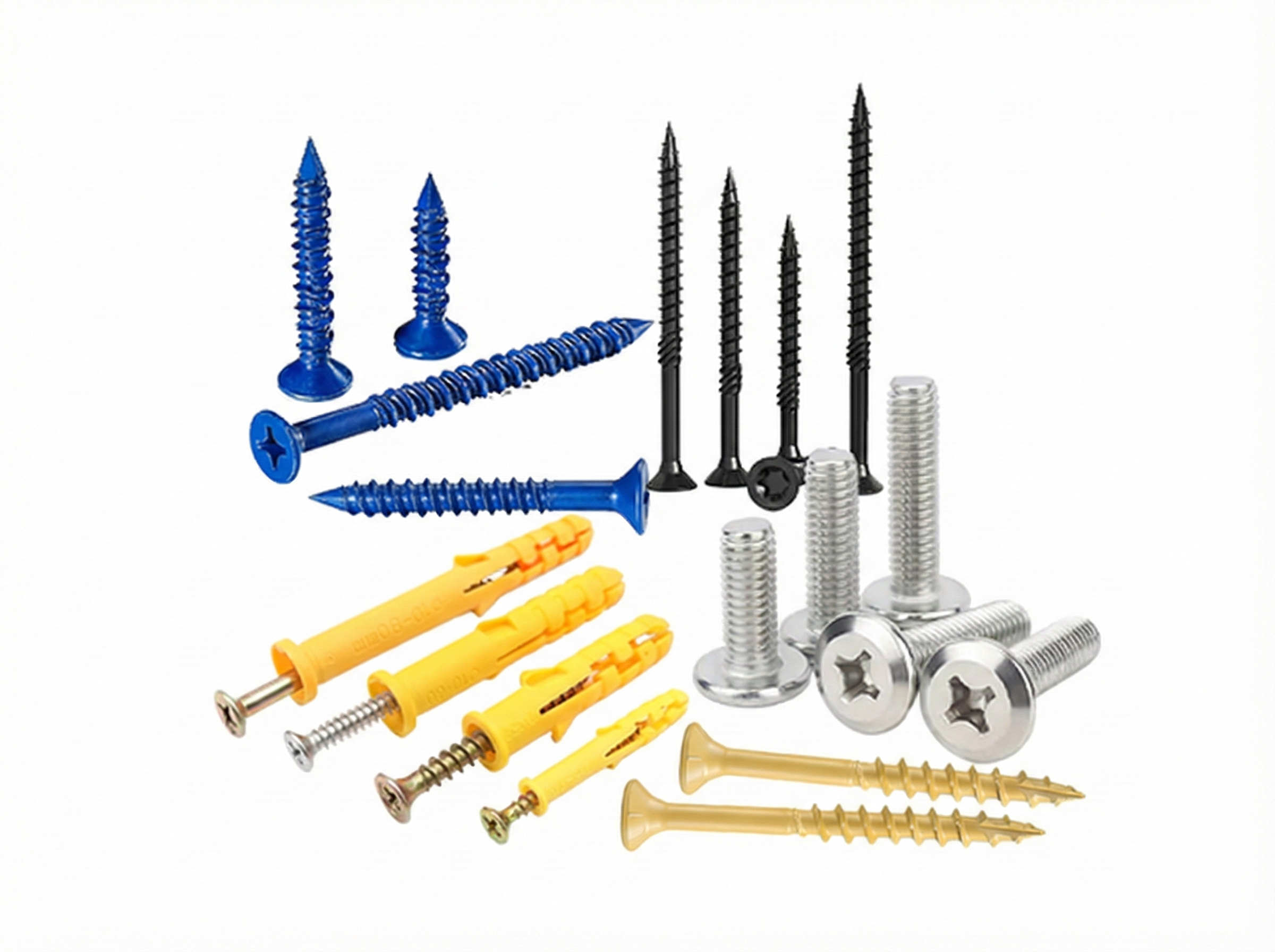
Typical product categories include:
-
Wood and timber screws.
-
Deck screws.
-
Self-tapping screws.
-
Self-drilling screws.
-
Machine screws.
-
Custom fastening components.
Different applications require different manufacturing and inspection priorities.
For example, a coated wood screw must maintain suitable thread geometry and installation performance. A self-drilling screw must retain adequate drilling capability. A machine screw must remain compatible with the mating thread after finishing.
Explore the JHFIX screw product range for related fastener configurations.
Manufacturer vs Distributor: What Should Buyers Verify?
The most important distinction is not simply whether a company owns every piece of equipment.
Buyers should establish which operations are performed by the manufacturer, which are subcontracted, and who is responsible for quality control.
A manufacturing company may produce screw blanks and coordinate specialized coating services through an external processor.
This can be an acceptable arrangement if technical requirements, supplier qualification, process changes, inspection records, and final product acceptance are properly controlled.
The key question is whether the supplier can consistently deliver the approved finished screw—not whether every process is advertised as in-house.
2. How Does Anti-Rust Screw Manufacturing Affect Corrosion Performance?
The final performance of an anti-rust screw depends partly on decisions made before the protective coating is applied.
Stage 1: Raw Material Selection
Production begins with selecting material suitable for the fastener design and intended application.
For carbon steel screws, material composition and condition influence forming, thread production, mechanical properties, and susceptibility to certain processing risks.
For stainless steel fasteners, the selected alloy affects corrosion resistance and manufacturing behavior.
Buyers should require clear material specifications rather than rely on product appearance.
Stage 2: Cold Forming and Head Production
Cold heading is commonly used to manufacture screw blanks and create head geometries.
Critical characteristics may include:
-
Head diameter and height.
-
Drive recess geometry.
-
Shank straightness.
-
Under-head transitions.
-
Dimensional consistency.
Poorly controlled geometry can affect installation and complicate finishing.
A corrosion-resistant coating cannot correct an incorrectly formed screw head.
Stage 3: Thread Manufacturing
Thread geometry influences how the screw engages the intended substrate.
Depending on the screw type, threads may be rolled, cut, or produced through another suitable method.
Important requirements include thread diameter, pitch or profile, threaded length, and compatibility with the application.
Finished dimensions must remain acceptable after coating.
Stage 4: Heat Treatment Where Required
Some carbon steel screw designs require heat treatment to achieve particular mechanical properties.
Heat-treatment requirements depend on the fastener type, material, and intended performance.
For susceptible high-strength or surface-hardened steel fasteners, the risk of hydrogen embrittlement deserves attention when selecting certain finishing processes.
Buyers should confirm applicable precautions rather than assume all screw materials have the same risk.
Stage 5: Surface Preparation and Coating
Protective finishing generally requires appropriate surface preparation.
Depending on the process, cleaning, coating application, supplementary treatment, curing, and final inspection may be necessary.
The coating system must be compatible with the material and screw geometry.
A manufacturer should establish who controls the finishing specification and how coating-related defects are identified.
Stage 6: Finished Screw Inspection and Packaging
Finished screws should be checked against the approved purchasing specification.
Inspection may cover critical dimensions, threads, coating appearance, coating measurements, and functional performance.
Packaging should also prevent part mixing and minimize avoidable handling damage.
Manufacturing control must extend from raw materials to the finished, packed product.
3. Which Anti-Rust Coating Systems Require Different Production Controls?
Different protective systems require different quality-control approaches.
The purpose of an OEM audit is to confirm that the selected process is appropriate and reproducible.
Electroplated Zinc
Zinc electroplating provides a protective coating on steel screws.
Supplementary treatments may influence corrosion performance and appearance.
ASTM F1941/F1941M-16(2025) addresses requirements for electrodeposited coatings on mechanical fasteners, including coating and dimensional considerations.
Purchasing checks should reflect the agreed coating specification.
Zinc-Flake Coatings
Zinc-flake systems are non-electrolytically applied protective coatings used on suitable steel fasteners.
ISO 10683:2018 covers specified zinc-flake coating systems for fasteners.
The coating process may include supplementary topcoats or lubrication where applicable.
Process control should address the approved coating system and finished fastener requirements.
Stainless Steel Fasteners
Stainless steel screws obtain much of their corrosion resistance from their alloy composition and passive surface film.
They are not simply carbon steel screws with a decorative finish.
Buyers should verify the required stainless grade and relevant mechanical properties.
Manufacturing Control Comparison
| Fastener protection type | Key process-control focus | Recommended buyer verification |
|---|---|---|
| Electroplated zinc steel | Surface preparation, coating specification, supplementary treatment | Finished dimensions, coating condition, agreed test results |
| Zinc-flake coated steel | Coating application, process conditions, topcoat where applicable | System specification, appearance, coating and functional checks |
| Stainless steel | Material grade, processing condition, surface integrity | Material identification, dimensions, application suitability |
| Custom protective system | Approved combination of substrate and finishing processes | Representative samples, defined tests, production change control |
For made-to-drawing projects, buyers can review JHFIX Specialty & Custom Screws.
No coating system should be approved solely because its name suggests high corrosion resistance.
4. What Should OEM Buyers Check During a Screw Factory Audit?
A practical supplier audit should focus on controls that influence finished-product quality.
Not every order requires a physical factory visit, but buyers should request appropriate evidence for the project's risk level.
Raw Material Controls
Ask how the manufacturer identifies incoming materials and prevents unintended substitutions.
Useful evidence may include material specifications, purchasing records, and applicable verification documents.
Manufacturing and Tooling Controls
Check whether critical dimensions are measured during production.
For custom screws, buyers should establish which dimensions are essential to assembly.
Tool wear, adjustment, and maintenance can influence finished screw geometry.
Finishing Process Controls
Ask whether finishing is completed internally or by an external processor.
If outsourced, clarify how the processor is qualified, how the coating specification is communicated, and who approves finished parts.
Quality Inspection Controls
Determine whether the inspection plan includes the characteristics that actually matter to the application.
For a self-drilling screw, inspection may need to cover both drilling performance and protective coating.
For a machine screw, thread compatibility may be critical.
Production Change Controls
A supplier should have a method to identify and communicate changes that may affect the approved product.
Examples include changes to material grade, screw tooling, coating system, critical dimensions, or packaging configuration.
Supplier Audit Checklist
| Audit area | Evidence to request | Risk being controlled |
|---|---|---|
| Material identification | Material specification and applicable records | Incorrect substrate |
| Drawing control | Approved drawing and revision | Uncontrolled product changes |
| Forming process | Critical dimensional checks | Head and shank variation |
| Thread production | Thread inspection records | Installation incompatibility |
| Coating specification | Approved finish and process requirements | Inconsistent corrosion protection |
| Coating verification | Agreed inspection and test results | Surface defects and nonconformity |
| Functional testing | Application-relevant test results | Assembly or drilling failure |
| Lot identification | Batch or shipment identification records | Difficult quality investigations |
| Packaging inspection | Packing specification and quantity checks | Mixed or damaged products |
A capable anti rust screws manufacturer should be able to explain which controls are available for the specific order and provide agreed evidence before shipment.
5. Why Can Approved Samples Differ From Bulk Production?
Sample approval is an important milestone, but it does not eliminate production risks.
A sample may be manufactured under conditions that differ from a later high-volume order.
Variation may arise from material substitutions, tooling adjustments, processing changes, coating differences, or inspection gaps.
First-Article Approval
For custom screws, buyers should consider a first-article inspection or an equivalent dimensional and functional approval process appropriate to the project.
A first-article review may compare the finished component with the approved drawing and record essential measurements.
Production-Representative Sampling
Samples should represent the intended material, manufacturing route, coating, and installation characteristics.
A similar-looking stock screw is not always an adequate substitute for a production-representative sample.
Batch Verification
Before shipment, an agreed inspection plan should identify which characteristics will be checked and how acceptance is determined.
Possible checks include critical dimensions, coating requirements, thread fit, and functional performance.
An Illustrative OEM Purchasing Scenario
Consider an outdoor furniture brand approving a coated deck screw.
The initial sample fits the timber and performs acceptably during installation.
A later order uses a different coating arrangement or production setup without the buyer's approval.
Even if the new screws look similar, their installation behavior or protective characteristics may differ.
This example is hypothetical, not a documented JHFIX customer case.
The purchasing lesson is clear: repeat orders should be controlled against the approved product specification, not only the appearance of an earlier sample.
6. How Should Anti-Rust Screw Quality Be Tested?
Quality verification should address both the protective system and the function of the finished screw.
Dimensional Inspection
Critical dimensions can include diameter, length, head geometry, thread profile, and drive recess.
The inspection plan should use the tolerances established for the particular product.
Coating Inspection
Depending on the coating system, checks may include thickness, coverage, appearance, adhesion, and supplementary treatment requirements.
The method must match the coating and substrate.
Corrosion Testing
ISO 9227:2022 specifies salt spray test methods, including neutral salt spray testing.
However, it does not prescribe one universal test duration for every screw.
The purchasing specification should identify the test method, exposure period, sample condition, and acceptance criteria.
Passing a salt spray test does not directly guarantee a specific number of years of outdoor service.
Functional Testing
The screw must remain suitable for its intended use.
For timber screws, this may involve installation and holding-performance checks in representative material.
For self-drilling screws, drilling capability and fastening performance may be important.
For machine screws, mating-thread compatibility and relevant mechanical requirements should be evaluated.
Packaging Inspection
Packing requirements may include part identity, quantities, lot information, packaging protection, and label accuracy.
The final inspection should confirm that the shipment matches the approved order.
7. Which Screw Types Need Different Quality-Control Priorities?
A manufacturer handling different screw categories should adapt inspection requirements to the product.
| Screw type | Main manufacturing concern | Important functional verification |
|---|---|---|
| Wood and deck screws | Thread profile, point geometry, head consistency | Driving behavior and timber compatibility |
| Self-tapping screws | Thread-forming geometry and material condition | Installation into the intended substrate |
| Self-drilling screws | Drill-point geometry, mechanical properties, finish | Drilling and fastening performance |
| Machine screws | Thread dimensions, head and drive accuracy | Mating-thread fit and assembly |
| Custom screws | Drawing compliance, tooling, material and finish | Application-specific sample approval |
For different fastening applications, explore JHFIX Wood, Timber & Deck Screws and Self-Drilling Screws.
Buyers should not assume that one generic corrosion test or inspection checklist is sufficient for every design.
8. How Can Lot Traceability and Packaging Reduce OEM Purchasing Risks?
For international purchasing, quality management should continue after manufacturing.
If a customer reports corrosion or assembly problems, accurate product identification makes investigation more effective.
Lot Identification
Depending on the project, suppliers may establish records connecting the shipment with the relevant material, drawing revision, finishing process, inspection results, and packing details.
The required traceability level should be agreed in advance.
Packaging Consistency
Bulk packaging should protect the approved product from unnecessary mixing and handling damage.
For products shipped through different climates, moisture management and storage conditions may also need consideration.
Private-Label and Hardware Kit Orders
A custom screw order may involve multiple lengths, finishes, or fastening components.
Clear identification, accurate counts, and approved packaging artwork can help prevent incorrect components from reaching the assembly line.
JHFIX provides hardware packaging options, including Bag Packaging, Box Packaging, and Plastic Bucket Packaging.
The appropriate packaging format and any specific protection requirements should be confirmed for each order.
9. How JHFIX Supports Custom Anti-Rust Screw Projects
JHFIX supplies fasteners, furniture hardware, custom screw products, and hardware packaging solutions for international B2B customers.
Its manufacturing company, Jiangmen Jinhe Hardware Products Co., Ltd., describes capabilities including cold heading, tapping, stamping, assembly, and quality inspection.
JHFIX also provides OEM/ODM development support for suitable custom hardware projects.
International purchasing communication and export coordination are supported by its authorized trading partner, Jiangmen Shenxin Trading Co., Ltd.
The company's product information describes selectable finishing options for certain screw designs, including zinc plating and Ruspert coatings. Their availability and suitability depend on the confirmed material, geometry, application, and acceptance requirements.
This should not be interpreted as a guarantee that every listed coating is manufactured in-house or available for every product.
A Practical OEM Development Workflow
Step 1 — Submit requirements: Provide drawings, samples, substrate information, finish requirements, and purchasing quantities.
Step 2 — Review feasibility: Confirm screw geometry, material, coating options, and relevant manufacturing conditions.
Step 3 — Prepare quotation: Discuss cost, sample requirements, MOQ, tooling where applicable, lead time, and packaging.
Step 4 — Approve samples: Verify dimensions, appearance, coating requirements, and functional performance.
Step 5 — Confirm production controls: Agree on the final specification, revision, inspection criteria, and order identification.
Step 6 — Inspect and arrange shipment: Review the agreed acceptance requirements and packaging before delivery.
For company background, visit JHFIX About Us.
10. What Affects the Price and Lead Time of Anti-Rust Screws?
Manufacturing cost depends on more than the base screw material.
Important factors include screw geometry, manufacturing complexity, protective coating, tooling, order volume, inspection requirements, and packaging.
A standard screw with an established production process may have different commercial requirements from a custom screw requiring new tooling and qualification.
Special inspection or testing requirements may also influence cost and lead time.
Buyers should include the potential cost of rejected parts, production interruptions, corrective actions, and repeat-order quality issues when comparing suppliers.
A low quotation is not necessarily the best purchasing decision if the product specification or quality controls remain unclear.
11. RFQ Checklist: What Should Buyers Send an Anti Rust Screws Manufacturer?
A clear RFQ helps the supplier evaluate the actual manufacturing requirements.
| RFQ information | What buyers should provide |
|---|---|
| Screw type | Wood, deck, self-drilling, self-tapping, machine, or custom |
| Technical drawing | Dimensions, thread, head, drive, point, revision |
| Base material | Required material grade or approved alternative |
| Surface protection | Coating specification and relevant processing requirements |
| Application | Furniture, timber, metal assembly, industrial equipment |
| Operating environment | Moisture, outdoor conditions, chemicals, or other exposure |
| Functional requirements | Installation conditions and required performance |
| Quality requirements | Inspection items, sampling, standards, acceptance criteria |
| Order quantity | Initial volume and expected repeat demand |
| Packaging | Bulk, bags, boxes, buckets, or private-label kits |
| Delivery | Destination, required timing, commercial terms |
For existing products experiencing rust, provide photographs, part information, coating details if known, and the conditions in which corrosion occurred.
For a new project, drawings and representative application materials can help avoid specification misunderstandings.
Looking for a manufacturing partner for custom anti-rust screws?
12. Frequently Asked Questions
1. What does an anti rust screws manufacturer provide?
An anti rust screws manufacturer produces or coordinates the production of screws designed for defined corrosion-resistance requirements. Depending on its capabilities, services may include custom designs, finishing coordination, samples, quality inspection, packaging, and OEM supply.
2. How can buyers verify anti-rust screw quality?
Buyers should check material specifications, critical dimensions, coating requirements, functional performance, and agreed inspection records. Testing should be appropriate for the particular screw and application.
3. Is an anti-rust coating enough to make screws suitable for outdoor use?
No. Outdoor suitability depends on the protective system, base material, substrate, installation conditions, and environmental exposure. A coating should not be approved based only on its name or appearance.
4. Why can bulk screws perform differently from approved samples?
Differences may result from material changes, tooling adjustments, finishing variation, uncontrolled specification revisions, or inadequate production checks. Representative sample approval and production control help reduce these risks.
5. Should screw manufacturers perform coating in-house?
Not necessarily. Qualified external finishing providers may be used. Buyers should establish who controls coating requirements, process changes, inspection, and final product acceptance.
6. Does salt spray testing guarantee outdoor service life?
No. Salt spray testing is a controlled laboratory evaluation. Results must be interpreted according to the specified test method and acceptance requirements, not treated as a direct service-life guarantee.
7. What is lot traceability in screw manufacturing?
Lot traceability is the ability to identify relevant product and production information associated with a batch or shipment. The required scope should be defined according to purchasing and quality requirements.
8. Can anti-rust screw coatings affect thread fit?
Yes. Coatings may change finished dimensions or affect threaded engagement. Buyers should verify functional fit after finishing when relevant.
9. Can JHFIX support customized anti-rust screws?
JHFIX describes custom screw manufacturing and OEM/ODM services. Buyers can submit drawings, samples, material and coating requirements for review. Specific coating processes, testing, MOQ, and delivery conditions require confirmation.
10. What should buyers confirm before placing a bulk OEM screw order?
Confirm the approved drawing, material, protective coating, application requirements, sample acceptance, inspection plan, order quantity, packaging, commercial terms, and production change-control expectations.
Conclusion
Choosing a dependable anti rust screws manufacturer is not simply about selecting a protective coating or comparing screw prices. For OEM purchasers, manufacturing consistency, technical communication, inspection controls, and repeatable production quality are equally important.
A properly managed sourcing process begins with material and drawing specifications, continues through manufacturing and finishing, and ends with verified products, controlled packaging, and clear shipment identification.
Buyers should assess how a supplier handles sample approval, production changes, coating requirements, functional testing, and quality records before committing to large or recurring orders.
JHFIX supports international B2B customers with standard and custom screws, furniture hardware, OEM manufacturing coordination, and hardware packaging solutions for suitable projects.
Contact JHFIX to discuss your anti-rust screw designs, manufacturing specifications, quality-control requirements, and bulk sourcing project.