
TL;DR: Choosing a reliable bulk hardware manufacturer requires evaluating effective production capacity, manufacturing bottlenecks, volume pricing, lot acceptance criteria, and replenishment schedules. For furniture factories, industrial OEMs, and hardware distributors, the best purchasing strategy is to align manufacturing output with actual consumption, rather than simply ordering the largest quantity at the lowest unit price.
A factory may have sufficient equipment to manufacture a large hardware order but limited capacity for secondary processing, finishing, inspection, or packaging.
Similarly, an attractive bulk quotation may require purchasing more inventory than the buyer can reasonably consume.
These challenges make high-volume hardware sourcing a production planning decision as much as a purchasing decision.
This guide explains how to evaluate bulk hardware manufacturing capabilities, compare purchasing quantities, manage production risks, and establish a sustainable supply program.
Key Engineering Takeaways
-
Effective capacity matters more than advertised capacity. Buyers should evaluate the output available for their specific products and production schedule.
-
Manufacturing bottlenecks determine delivery feasibility. Forming, threading, finishing, inspection, and packaging may have different production limits.
-
Larger orders do not automatically reduce total costs. Inventory carrying costs, storage, and changing demand must also be considered.
-
Different hardware products require different production plans. Screws, furniture connectors, threaded inserts, and stamped components have distinct manufacturing requirements.
-
Batch inspection must follow agreed acceptance criteria. Sampling inspection helps manage large-volume quality risks but cannot guarantee that every component is defect-free.
-
Replenishment planning supports repeat supply. Demand forecasts, reorder points, and scheduled releases help buyers coordinate purchasing with actual consumption.
1. What Is a Bulk Hardware Manufacturer?
A bulk hardware manufacturer produces hardware components in commercial quantities for industrial buyers, distributors, furniture manufacturers, and OEM purchasing programs.
Unlike retail hardware sourcing, bulk manufacturing typically involves larger production quantities, repeat purchasing requirements, standardized product specifications, and coordinated delivery schedules.
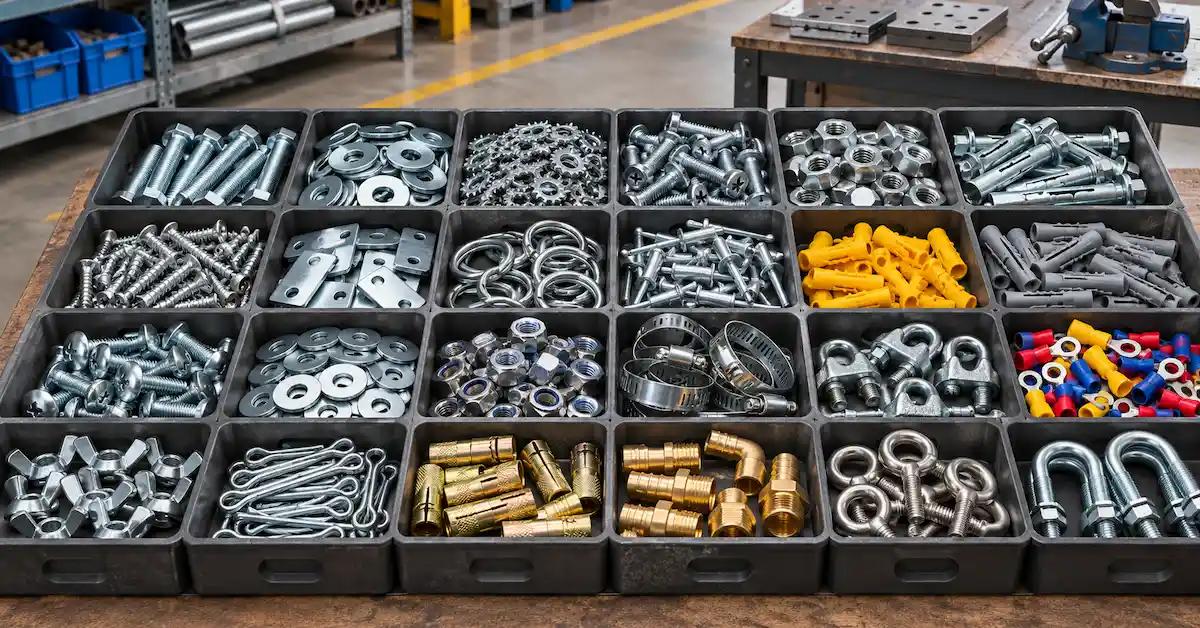
Common products include:
-
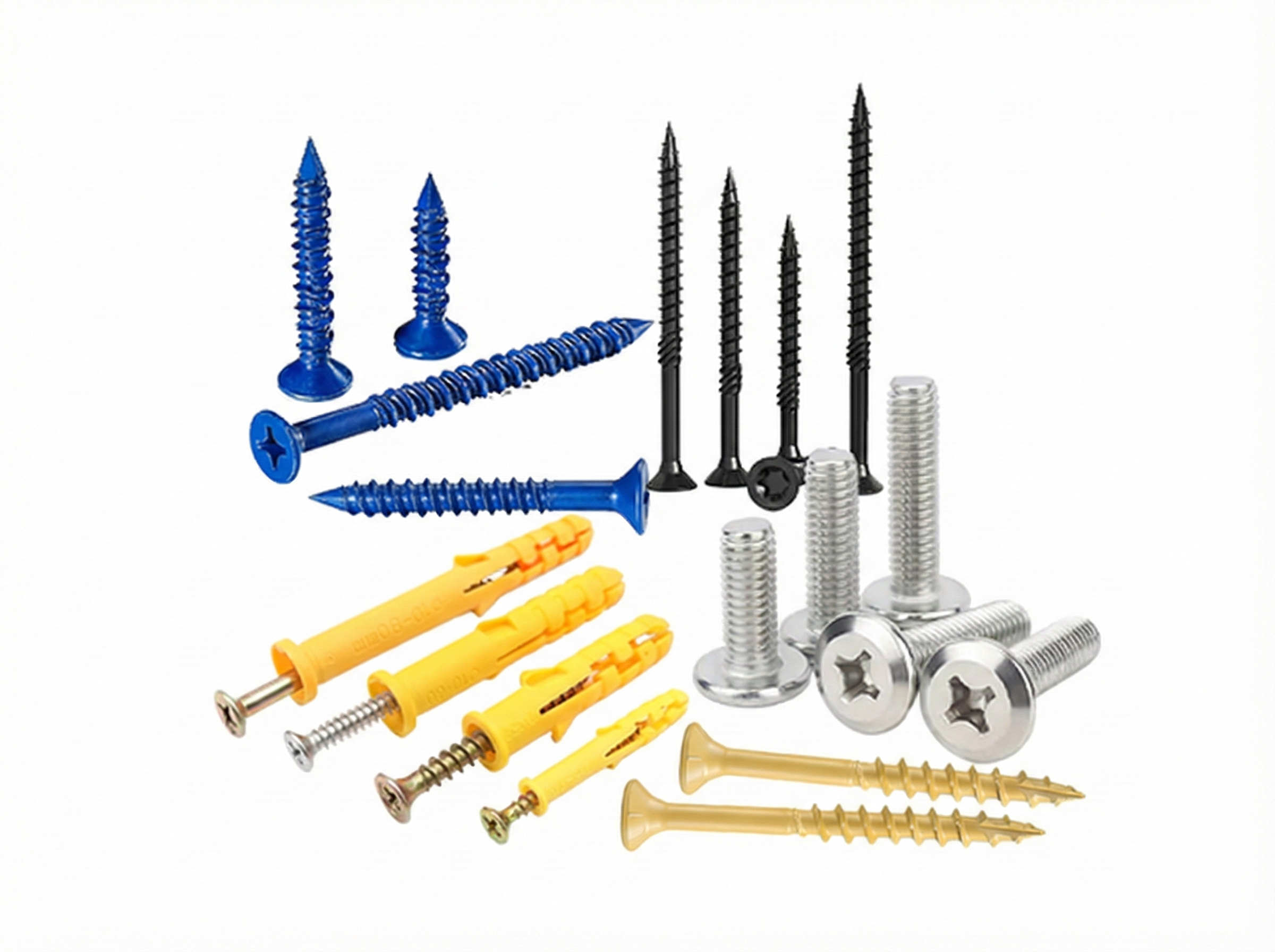
Machine screws and self-tapping screws.
-
Wood screws and furniture screws.
-
Nuts and threaded inserts.
-
Furniture cam locks and connectors.
-
Stamped metal brackets and mounting plates.
-
Hardware assembly kits.
The manufacturing objective is to produce acceptable components consistently across repeated production lots.
Bulk Manufacturing vs Small-Batch Hardware Supply
| Comparison factor | Small-batch hardware supply | Bulk hardware manufacturing |
|---|---|---|
| Purchasing purpose | Samples, repairs, limited projects | Recurring commercial demand |
| Production planning | Short or individual runs | Scheduled production batches |
| Unit pricing | Smaller quantity basis | Potential volume-based pricing |
| Quality management | Product-specific checks | Defined lot and production controls |
| Inventory requirements | Limited stock | Planned replenishment and storage |
| Customization | Often limited by economics | Greater potential for dedicated configurations |
| Supply continuity | Individual purchasing | Repeat-order coordination |
Bulk manufacturing is particularly suitable when product specifications are stable and purchasing demand can be reasonably forecast.
It may be less appropriate for prototype development, highly uncertain demand, or specialized components requiring manufacturing capabilities outside the supplier's scope.
Engineering takeaway: Bulk purchasing should support a repeatable supply program rather than simply increase order quantities.
2. Which Hardware Products Are Suitable for High-Volume Manufacturing?
Different hardware components require different materials, manufacturing processes, and inspection priorities.
The production economics of a standard wood screw may differ significantly from those of a customized stamped bracket.
Bulk Hardware Product and Specification Matrix
| Hardware category | Key specifications | Manufacturing priorities | Typical buyers |
|---|---|---|---|
| Machine screws | Diameter, pitch, length, head, material | Thread consistency and dimensional control | Equipment OEMs |
| Self-tapping screws | Thread profile, point, material, finish | Forming and functional installation | Industrial manufacturers |
| Wood and furniture screws | Thread geometry, length, drive | Substrate compatibility and batch consistency | Furniture factories |
| Nuts and threaded inserts | Thread size, body geometry, material | Mating fit and installation performance | Furniture and equipment OEMs |
| Furniture connectors | Component geometry and compatibility | Assembly accuracy and part identification | Cabinet and RTA furniture brands |
| Stamped brackets | Thickness, hole position, bends, finish | Forming consistency and dimensional control | Furniture and industrial buyers |
| Hardware kits | Component list, quantities, packaging | Counting and complete-set verification | Retailers and furniture manufacturers |
These are purchasing considerations rather than fixed specifications for every available product.
JHFIX supplies related product categories, including Screws and Fasteners, Furniture Hardware, and Stamping Hardware.
Standard vs Custom Hardware in Bulk Orders
Standard components may offer simpler sourcing when their existing specifications meet the application requirements.
Custom hardware may require additional tooling, material confirmation, sampling, and production approval.
Before increasing order volume, buyers should confirm whether customization creates a measurable functional benefit.
3. How Should Buyers Evaluate Hardware Manufacturing Capacity?
One of the most important questions when selecting a bulk hardware manufacturer is whether the factory can support the required volume within the agreed production window.
However, manufacturing capacity should not be evaluated solely by equipment numbers or general factory descriptions.
Installed Capacity vs Effective Capacity
Installed capacity refers to the potential output associated with available manufacturing resources under specified operating assumptions.
Effective capacity reflects practical production constraints, including setup changes, maintenance, product mix, labor availability, and other commitments.
For purchasing purposes, buyers should focus on the quantity of conforming products that can realistically be allocated to their orders.
Identify the Production Bottleneck
Hardware production may involve several stages:
-
Raw material preparation.
-
Cold heading, stamping, or other forming operations.
-
Thread production or secondary processing.
-
Heat treatment or surface finishing where required.
-
Quality inspection.
-
Assembly and packaging.
The operation with the lowest available throughput may restrict the overall production output.
For example, a factory may form screws faster than its finishing process can handle them.
Increasing forming capacity alone would not necessarily improve finished-product availability.
Capacity Assessment Checklist
| Capacity factor | Questions to ask |
|---|---|
| Product-specific output | What volume can be allocated to this part number? |
| Manufacturing schedule | Which production windows are available? |
| Tooling availability | Are dedicated or shared tools required? |
| Secondary processing | Which operations may limit throughput? |
| Finishing capacity | Can the required finish support the target volume? |
| Inspection capacity | Can quality verification keep pace with production? |
| Packaging capacity | Can finished goods be packed within the required schedule? |
| Existing commitments | How will other production orders affect availability? |
Actual production capacity and allocation should be confirmed during quotation.
Engineering takeaway: Evaluate available finished-product output instead of relying on theoretical machine speed.
4. How Do Manufacturing Bottlenecks Affect Bulk Hardware Delivery?
High-volume hardware manufacturing requires coordination between multiple production stages.
A delay at one stage may create unfinished inventory even when other operations continue producing components.
Cold Heading and Forming
Cold heading is commonly used for suitable screws and fasteners.
Tool condition, setup requirements, material compatibility, and product geometry influence production efficiency.
Thread Production
Thread rolling, cutting, tapping, or other suitable operations must produce the approved thread characteristics.
Excessive production variation can increase inspection and sorting requirements.
Stamping and Secondary Processing
Stamped hardware may require controlled blanking, punching, bending, or forming.
Complex geometries and secondary operations can affect production schedules.
Surface Finishing
Coating and finishing requirements may introduce additional batch processing and coordination.
When external processors are involved, their availability should be included in the production plan.
Inspection and Packaging
Finished hardware still requires appropriate verification, counting, identification, and packaging.
For hardware kits, assembling several component types can create additional throughput constraints.
Production Bottleneck Example
The following figures are illustrative and do not represent JHFIX's actual production capacity.
| Manufacturing stage | Illustrative available weekly capacity |
|---|---|
| Screw forming | 60,000 pieces |
| Thread production | 54,000 pieces |
| Surface finishing | 36,000 pieces |
| Inspection and packaging | 45,000 pieces |
Assuming comparable finished-unit capacity across the stages, surface finishing limits theoretical weekly output to approximately 36,000 pieces before additional losses or scheduling disruptions.
If the buyer requires 40,000 pieces per week, the production plan has a potential weekly shortage of 4,000 pieces.
Possible responses include adjusting production allocation, qualifying additional finishing capacity, revising release schedules, or building inventory in advance.
Any proposed solution must be technically and commercially approved.
Engineering takeaway: The slowest required operation can determine the actual delivery capability of the complete production process.
5. What Determines MOQ and Lead Time for Bulk Hardware Orders?
Minimum order quantity, or MOQ, is influenced by the economics and practical requirements of manufacturing a particular product.
There is no universal MOQ for all hardware components.
Factors Affecting MOQ
| Factor | Potential effect on purchasing quantity |
|---|---|
| Raw material procurement | Material purchasing quantities may influence batch size |
| Machine setup | Larger runs may distribute setup costs across more parts |
| Dedicated tooling | Custom tooling can increase initial order requirements |
| Surface finishing | Processing batch requirements may affect economical volume |
| Packaging | Customized packaging may introduce separate minimum quantities |
| Product variety | Multiple variants may require separate production runs |
Understanding Bulk Hardware Lead Time
Production lead time may include material procurement, tooling preparation, manufacturing, finishing, inspection, and packaging.
Custom projects may also require drawing approval and sample verification.
Buyers should establish whether a quoted lead time starts from order confirmation, material availability, sample approval, or another agreed milestone.
A production completion date should not be confused with the final delivery date.
For repeat orders, buyers should confirm whether approved tools, materials, and product specifications remain available.
6. How Does Bulk Hardware Pricing Change With Order Volume?
Volume pricing is often influenced by the relationship between fixed production costs and variable manufacturing costs.
A larger production batch may reduce the setup cost allocated to each component.
However, larger orders can also increase inventory exposure and working-capital requirements.
Illustrative Setup Cost Comparison
Assume a hardware production run requires a fixed setup cost of $600.
| Production quantity | Total setup cost | Setup cost per unit |
|---|---|---|
| 10,000 pieces | $600 | $0.060 |
| 50,000 pieces | $600 | $0.012 |
| 100,000 pieces | $600 | $0.006 |
These figures illustrate setup-cost allocation only. They are not JHFIX quotations or actual production costs.
Material, labor, finishing, tooling wear, inspection, packaging, and transportation must also be included when determining the total price.
Why the Lowest Unit Price May Not Be the Best Choice
A large order may offer a lower unit price while creating several additional costs:
-
Warehouse storage.
-
Inventory financing.
-
Excess or obsolete stock.
-
Additional handling.
-
Product specification changes.
-
Slow-moving hardware variants.
Buyers should request volume-based quotations for realistic purchasing quantities rather than assume the largest available order is the most economical option.
Compare Total Purchasing Costs
A practical comparison should include:
Total purchasing cost = Product cost + tooling and setup + inspection + transportation + inventory costs
Additional applicable costs should be included according to the actual purchasing arrangement.
Commercial takeaway: Optimize order quantity according to total procurement cost and expected consumption, not unit price alone.
7. How Should Quality Control Be Managed in Bulk Hardware Manufacturing?
High-volume production magnifies the impact of small manufacturing deviations.
An incorrect screw thread, unsuitable bracket dimension, or inconsistent finish may affect an entire production lot.
A structured quality plan should therefore identify important characteristics before manufacturing begins.
Material Verification
Confirm the approved material and any relevant grade or mechanical requirements.
Material substitutions should follow the agreed approval procedure.
In-Process Inspection
Monitor characteristics that may change during production, including thread dimensions, head geometry, hole positions, and other critical features.
The inspection frequency should reflect process stability and product risk.
Finished-Product Verification
Check the finished component against its approved drawing and functional requirements.
Where appropriate, verification may include thread gauging, dimensional measurements, finish inspection, and representative assembly testing.
Quality Control Matrix
| Inspection stage | Main verification | Risk being controlled |
|---|---|---|
| Incoming materials | Material identity and requirements | Incorrect substrate |
| Forming | Critical geometry | Dimensional variation |
| Thread production | Thread specification and fit | Assembly incompatibility |
| Surface finishing | Approved finish requirements | Surface or dimensional variation |
| Final inspection | Drawing and functional conformity | Nonconforming finished parts |
| Packaging | Product identity and quantity | Mixed or incomplete orders |
AQL Sampling Inspection for Bulk Hardware
Inspecting every characteristic of every component may not be practical for some high-volume orders.
Acceptance sampling can provide a structured method for determining whether a production lot meets agreed acceptance criteria.
The international standard ISO 2859-1:2026 describes attribute-based sampling schemes indexed by acceptance quality limit (AQL) for lot-by-lot inspection.
When applying a sampling plan, buyers should define the lot, inspection level, defect classifications, applicable acceptance criteria, and sampling procedure.
AQL is not a guarantee that every accepted lot contains no defects, nor should it be interpreted as permission to supply a fixed percentage of defective products.
Safety-critical characteristics may require additional verification or different inspection arrangements.
Any certification, test report, or standard-specific manufacturing requirement must be confirmed for the particular product and supplier.
Engineering takeaway: Bulk hardware quality depends on production control and appropriate verification, not final sampling alone.
8. Which Bulk Hardware Purchasing Model Is Most Suitable?
A high-volume hardware program does not necessarily require receiving the entire annual quantity in one shipment.
Depending on demand and commercial arrangements, buyers may consider different order and replenishment models.
| Purchasing model | Best suited for | Main advantage | Main limitation |
|---|---|---|---|
| Single large order | Stable, immediate demand | Potential production and purchasing efficiencies | Higher inventory exposure |
| Scheduled batch orders | Predictable recurring consumption | Better alignment with production demand | Requires scheduling coordination |
| Blanket order with releases | Established long-term purchasing programs | Combines commercial planning with phased releases | Requires clear commitment terms |
| Forecast-based replenishment | Variable but recurring demand | Supports inventory planning | Forecast errors may affect availability |
| Dedicated inventory arrangement | Selected established supply programs | Potentially shorter replenishment response | Requires agreed stock ownership and costs |
The availability of these arrangements depends on supplier capabilities and negotiated commercial terms.
How to Select the Right Purchasing Model
A buyer with stable monthly demand may benefit from scheduled production batches.
A distributor with seasonal demand may prefer a forecast-based purchasing plan.
An OEM launching a new product may initially require smaller approved production releases before committing to larger quantities.
The objective is to match purchasing commitments with actual consumption and manufacturing feasibility.
9. How Can Buyers Build a Hardware Replenishment Plan?
A replenishment plan defines when additional inventory should be ordered and how much stock is required to support ongoing production or sales.
For hardware distributors and furniture manufacturers, purchasing too late may interrupt operations, while purchasing too early may create unnecessary inventory.
Establish Expected Consumption
Start with the average quantity consumed during a defined period.
Consider seasonal variation, planned production increases, and demand uncertainty.
Calculate the Reorder Point
A simplified purchasing model is:
Reorder point = Expected demand during replenishment lead time + Safety stock
Safety stock should reflect demand variability, lead-time uncertainty, and the desired service level.
Illustrative Replenishment Example
Consider a furniture manufacturer using 8,000 screws per week.
Assume a six-week replenishment lead time and an illustrative safety stock of 12,000 pieces.
| Planning factor | Illustrative value |
|---|---|
| Average weekly demand | 8,000 pieces |
| Replenishment lead time | 6 weeks |
| Expected lead-time demand | 48,000 pieces |
| Safety stock | 12,000 pieces |
| Reorder point | 60,000 pieces |
Under these assumptions, a replenishment order would be triggered when the inventory position reaches 60,000 pieces.
Inventory position should account for available stock, outstanding supply orders, and applicable backorders.
This example is a simplified planning calculation, not a recommended universal inventory level or a documented JHFIX customer case.
Actual replenishment planning should use the buyer's demand records and confirmed supplier lead times.
Purchasing takeaway: Reliable repeat supply depends on combining manufacturing availability with inventory planning.
10. How to Evaluate a Bulk Hardware Manufacturer for Long-Term Supply
A suitable manufacturing partner should be able to review the buyer's product requirements, expected demand, production schedule, and quality expectations.
Manufacturer Evaluation Checklist
| Evaluation area | Key questions |
|---|---|
| Product range | Can the required hardware categories be supplied? |
| Manufacturing capability | Which production processes are available? |
| Capacity allocation | What output can be committed to the order? |
| MOQ | What quantities are economical for each product? |
| Quality control | How will critical characteristics be verified? |
| Volume pricing | Are quantity-based quotations available? |
| Repeat orders | Can approved specifications and tooling be maintained? |
| Packaging | Are suitable bulk or customized formats available? |
| Replenishment | Can production be coordinated with the required schedule? |
Buyers should distinguish confirmed production commitments from estimated capacity.
A supplier should also communicate material shortages, manufacturing constraints, and proposed specification changes before they affect approved orders.
11. How JHFIX Supports Bulk Hardware Manufacturing
JHFIX supplies screws, furniture fittings, threaded components, stamped hardware, and packaging products for international B2B purchasing requirements.
Its manufacturing company, Jiangmen Jinhe Hardware Products Co., Ltd., describes operations covering cold heading, tapping, punching, injection molding, assembly, inspection, packaging, and warehousing.
The company also supports OEM/ODM development for suitable custom hardware projects.
International purchasing communication and export coordination are handled through its authorized trading partner, Jiangmen Shenxin Trading Co., Ltd.
Relevant JHFIX Product Categories
| Purchasing requirement | Related product category |
|---|---|
| Industrial machine fasteners | Machine & Socket Screws |
| Customized fastening components | Specialty & Custom Screws |
| Furniture assembly components | Furniture Hardware |
| Stamped metal parts | Stamping Hardware |
| Bulk fastener packaging | Plastic Bucket Packaging |
For recurring purchasing programs, buyers can discuss product specifications, estimated annual demand, initial order quantities, inspection requirements, and packaging options with JHFIX.
Specific manufacturing capacity, MOQ, pricing, delivery schedules, and replenishment arrangements require project-level confirmation.
12. RFQ Checklist for Bulk Hardware Manufacturing
A complete request for quotation helps a bulk hardware manufacturer assess both technical feasibility and production demand.
| RFQ field | Recommended information |
|---|---|
| Product category | Screws, inserts, brackets, connectors, or kits |
| Product specification | Drawings, dimensions, material, finish |
| Application | Furniture, industrial equipment, retail distribution |
| Initial order quantity | Required quantity per product |
| Annual demand | Estimated yearly consumption |
| Release schedule | Monthly, quarterly, or project-based requirements |
| Quality requirements | Inspection methods and acceptance criteria |
| Customization | Special dimensions, tooling, or finishes |
| Packaging | Bulk cartons, bags, buckets, or customized packs |
| Delivery | Destination and required delivery schedule |
| Replenishment | Forecasts and preferred reorder arrangements |
For repeat purchasing programs, provide estimated demand for each part number rather than only the combined order quantity.
This allows the manufacturer to evaluate product-specific production requirements.
Planning a high-volume hardware purchasing program?
Request a bulk hardware quotation from JHFIX with your product specifications, expected purchasing quantities, and delivery requirements.
13. Frequently Asked Questions
1. What does a bulk hardware manufacturer produce?
A bulk hardware manufacturer produces commercial quantities of hardware components such as screws, nuts, connectors, brackets, and hardware kits for industrial buyers, OEMs, and distributors.
2. How can buyers verify hardware manufacturing capacity?
Request product-specific production estimates, available production schedules, manufacturing process details, and information about potential bottlenecks. General equipment counts alone are insufficient.
3. Do bulk hardware orders always have lower prices?
Not necessarily. Larger orders may reduce certain setup costs per unit, but material costs, tooling, packaging, inspection, and inventory requirements also influence total purchasing costs.
4. What determines MOQ for bulk hardware?
MOQ depends on materials, manufacturing setup, tooling, processing requirements, packaging, and the economic production quantity of the specific product.
5. Can different hardware products be ordered in one purchasing program?
Yes, suitable hardware categories may be coordinated within one purchasing program. However, individual product quantities, production requirements, and schedules should be confirmed separately.
6. What is AQL inspection in hardware manufacturing?
AQL-based inspection uses defined sampling schemes to support lot acceptance decisions. It helps manage inspection effort and quality risk but does not guarantee that every accepted component conforms.
7. How can manufacturers support recurring hardware orders?
Manufacturers may support recurring orders through approved product specifications, production scheduling, agreed inspection procedures, and coordinated purchasing arrangements. Specific services depend on the supplier.
8. What is the best order quantity for bulk hardware?
The appropriate quantity depends on manufacturing economics, consumption rates, storage costs, available production capacity, lead time, and demand uncertainty.
9. Does JHFIX offer custom bulk hardware manufacturing?
JHFIX offers standard and custom screws, furniture hardware, stamped components, and OEM/ODM development support. Specific product feasibility, order quantities, and manufacturing requirements must be confirmed.
10. How do I request a bulk hardware quotation?
Provide product drawings or samples, required materials and finishes, initial order quantities, estimated repeat demand, inspection requirements, packaging instructions, and delivery destination.
Conclusion
Selecting a dependable bulk hardware manufacturer requires more than comparing quotations or purchasing the largest available quantity.
For furniture manufacturers, hardware distributors, and industrial OEM buyers, sustainable supply depends on effective manufacturing capacity, realistic production schedules, batch quality, purchasing economics, and inventory replenishment.
Understanding production bottlenecks helps buyers assess delivery feasibility. Appropriate sampling and inspection procedures support batch acceptance, while volume-based purchasing and replenishment planning help manage long-term sourcing costs.
JHFIX supports international B2B buyers with standard and custom screws, furniture hardware, threaded components, stamped metal parts, OEM/ODM development, and hardware packaging solutions.
Contact JHFIX to discuss your bulk hardware specifications, annual purchasing demand, production requirements, and wholesale quotation.