
Cabinet Hardware Kit Manufacturer: What Buyers Are Really Sourcing
A cabinet hardware kit does not look impressive when it is spread out on a workbench.
A few screws. Some cam connectors. Dowels, brackets, washers, shelf supports, maybe a small tool or two. Nothing looks difficult at first. Then the cabinet goes into production, and those small parts start deciding whether the whole job feels controlled or messy.
One screw length is wrong.
One connector does not match the drilling pattern.
A shelf support is missing from the bag.
A bracket looks almost right but forces the worker to adjust the panel by hand.
That is where buyers realize a cabinet hardware kit manufacturer is not only supplying hardware.
The supplier is supplying part control, assembly logic, packing accuracy, and repeatability. For flat-pack cabinets, wardrobes, drawer units, storage modules, and casework, the kit is often the difference between a clean assembly process and a product that creates trouble after the panels are already made.
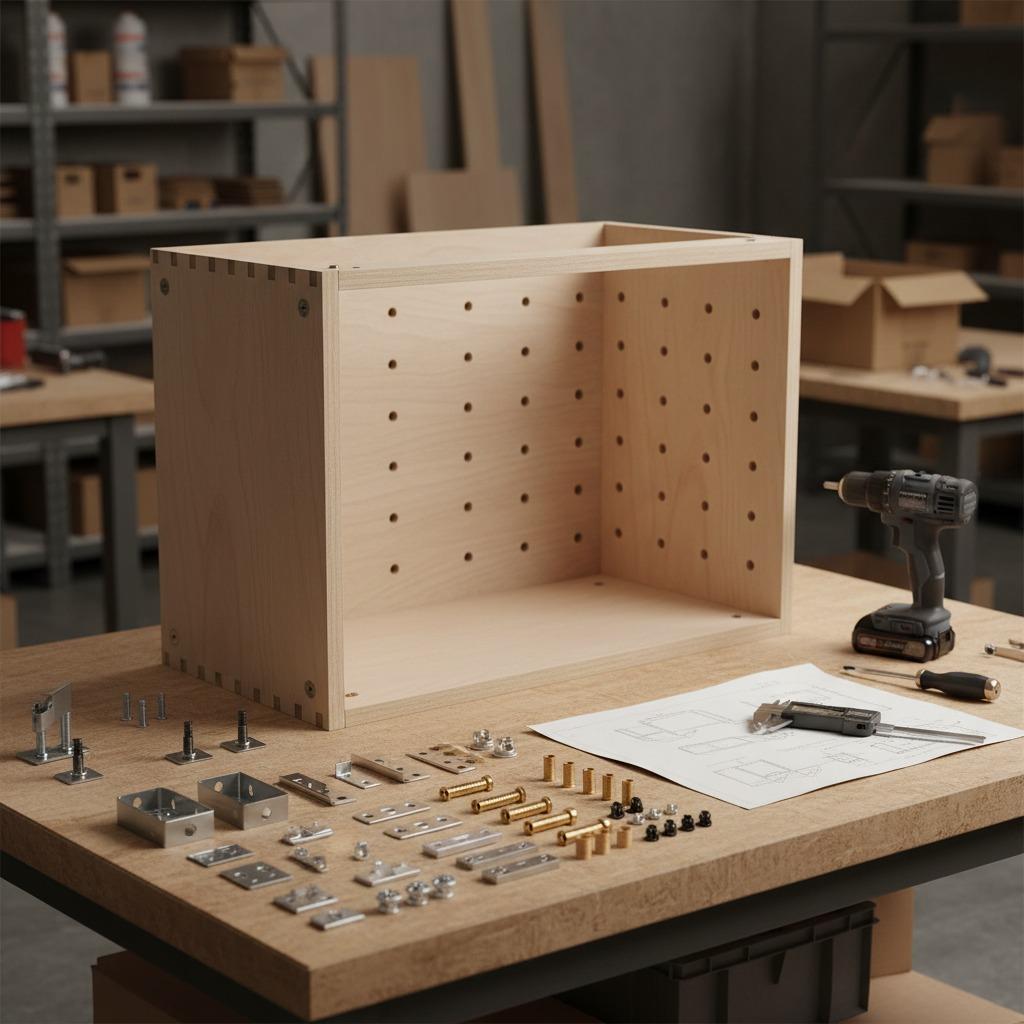 A cabinet kit should be built around the panel system
A cabinet starts with panels, but it does not become a usable product until the hardware does its job.
The side panels, shelves, base, top, back board, and doors may all be cut correctly. The edges may be finished well. The drilling may look accurate. Still, if the hardware kit is poorly matched, the cabinet will not assemble the way it should.
That is why the hardware kit should follow the panel system, not the other way around.
Before confirming a kit, buyers should check:
- Panel material
- Panel thickness
- Hole diameter
- Hole depth
- Edge distance
- Shelf adjustment pattern
- Connector location
- Door or drawer hardware requirement
- Assembly sequence
- Whether the cabinet ships flat-packed or pre-assembled
A kit for a wardrobe carcass is not always suitable for a drawer module. A storage shelf kit may not work for an under-counter cabinet. Even if the fasteners look similar, the assembly logic may be different.
A good cabinet hardware kit manufacturer should ask about the cabinet structure before quoting the kit.
More parts do not make a better kit
Some buyers assume a bigger hardware assortment is safer.
In practice, extra parts often create confusion.
A cabinet kit should contain what the product actually needs. Not less, not much more. If workers or end users have to decide which screw belongs to which step, the kit is already asking too much from them.
For production, unnecessary parts slow down picking and packing. For customer assembly, they create doubt. If the user finishes the cabinet and several parts remain on the floor, they may wonder whether something was missed.
A useful cabinet hardware kit should be specific:
- Correct screw types
- Correct quantities
- Correct connector parts
- Correct shelf supports
- Correct brackets
- Correct washers or spacers
- Correct caps or covers
- Correct spare-parts policy
The value is not in the number of components.
The value is in whether every component belongs to the cabinet.
Fasteners decide whether the cabinet feels stable
Cabinet hardware depends heavily on fasteners.
A connector plate, bracket, shelf support, hinge base, or drawer fitting may all fail if the screw behind it is wrong. The fastener must match the board material, the hole size, the tightening force, and the final load.
This is where cabinet buyers sometimes underestimate the risk.
A screw that works well in plywood may loosen in lower-density particleboard. A self-tapping screw that is acceptable in one panel thickness may damage a thinner board. A machine screw may require the right insert or mating component. A small washer may be necessary to spread load.
For cabinet hardware kits, buyers should not approve fasteners only by appearance.
They should test them in the actual panel.
Jiangmen Jinhe Hardware Co., Ltd. focuses on machine screws, self-tapping screws, micro screws, precision screws, standard fasteners, and non-standard customized parts. For cabinet and furniture buyers, this kind of fastener background is relevant because a hardware kit often depends on several fastening types working together.
A cabinet kit is only as reliable as the small fasteners inside it.
Drilling patterns and hardware must be checked together
Many cabinet systems use repeated hole patterns.
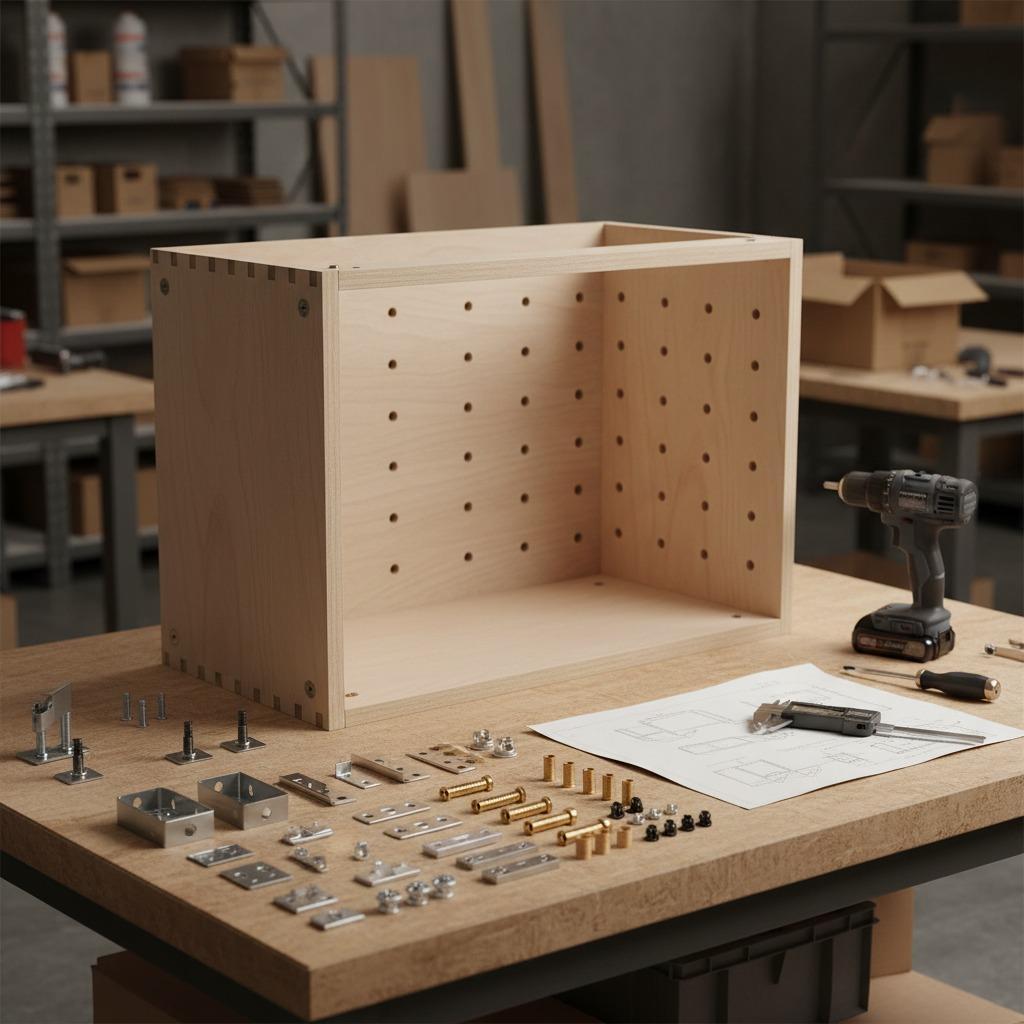
Adjustable shelf rows, connector holes, hinge positions, drawer slide holes, and bracket mounting points may all be prepared before the hardware is packed.
That makes the drilling pattern part of the hardware decision.
If the hole position is slightly off, the connector may not pull the panels tight. If the hole depth is wrong, the screw may bottom out or break through. If the shelf support does not match the hole diameter, the shelf may feel loose.
For flat-pack furniture, this is even more important.
The customer may not have tools to correct a mismatch. They expect the pre-drilled panels and the hardware kit to work together.
Before bulk ordering, buyers should test:
- Connector fit
- Screw engagement
- Shelf support stability
- Bracket alignment
- Door or drawer hardware position
- Tool access
- Final cabinet squareness
- Whether the assembly steps feel natural
A drawing can look correct. The assembly bench will tell the truth faster.
Different buyers need different cabinet hardware kits
Not every cabinet hardware kit is used in the same way.
A flat-pack furniture producer usually needs repeatable assembly and clear part separation. The kit must be easy to pack with each cabinet carton and simple enough for end users to understand.
A custom joinery shop may need more flexibility. The hardware may change by project, size, or site condition. The kit may need custom fasteners or adjusted quantities.
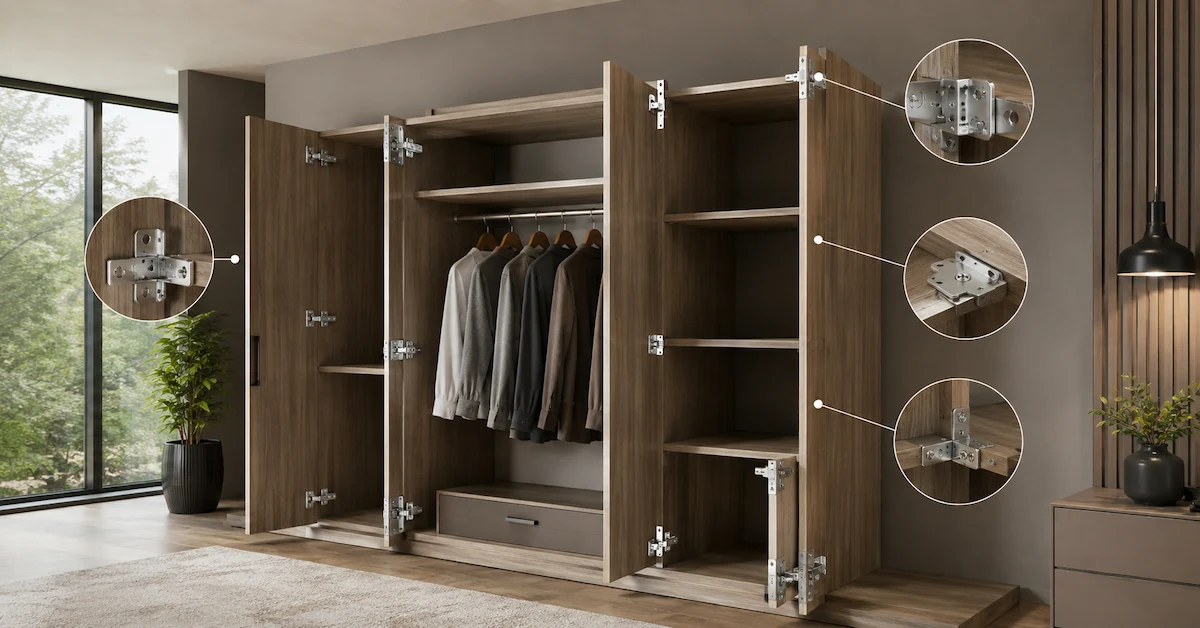
A wardrobe hardware kit manufacturer may need to consider shelf supports, hanging rail brackets, drawer fittings, door hardware, and larger connector systems.
A drawer hardware kit manufacturer may care more about screws, slide mounting parts, adjustment pieces, and replacement hardware.
Commercial furniture teams often think about serviceability. If a bracket or fastener is missing during installation, the delay can affect an entire project.
The same supplier may support all these needs, but the kit format should not be identical.
The better question is not “Can you supply cabinet hardware?”
It is “Can you supply the kit in the way this cabinet program actually uses it?”
Packaging is part of the product
Cabinet hardware kits are often packed with finished furniture.
That means packaging is not only a shipping detail. It becomes part of the assembly experience.
A good kit should help the worker or customer identify the parts quickly. Similar screws may need separate bags. Shelf supports may need their own small pack. Brackets should not scratch visible parts. Labels should match the cabinet model or assembly step.
Poor packaging creates avoidable problems.
The parts may be correct, but if they are mixed together, someone has to sort them. The carton may include every component, but if the label is unclear, the wrong kit may be packed with the wrong cabinet. A polished fitting may be acceptable when produced, but scratched by the time the customer opens the bag.
Buyers should confirm:
- Quantity per kit
- Bag or tray format
- Part separation method
- Label content
- Cabinet model number
- Barcode or QR code needs
- Spare-part quantity
- Carton packing method
- Final kit inspection
For cabinet hardware kits, packaging accuracy can prevent as many problems as part accuracy.
Customization should support the cabinet, not complicate it
Standard cabinet hardware is often the best choice when it fits well.
Standard parts are easier to reorder, easier to replace, and usually more cost-effective. If the cabinet design can use existing screws, connectors, brackets, and shelf supports without compromise, that is usually a good thing.
But some projects need customization.
A cabinet may use an unusual panel thickness. A wardrobe may require a special bracket. A storage module may need a specific screw length. A drawer system may need a non-standard fastener because the installation space is tight.
In those cases, custom cabinet fasteners or customized hardware can reduce assembly problems.
Jiangmen Jinhe Hardware supports standard parts and non-standard customization. For furniture buyers, that can be useful when a kit needs both regular fasteners and project-specific components.
Still, customization should have a reason.
A custom part creates drawings, samples, approval steps, inspection requirements, and repeat-order control. If a standard part works reliably, it may be the better long-term decision.
The goal is not to make the kit special.
The goal is to make the cabinet assemble correctly every time.
Inspection should cover the complete kit
A hardware kit can fail even when every individual fastener is acceptable.
The screw may be well made, but the wrong screw length is packed. The bracket may meet the drawing, but the quantity is short. The shelf support may be correct, but the label belongs to another cabinet model.
This is why inspection needs to cover both parts and kits.
For cabinet hardware kits, buyers should ask how the supplier checks:
- Fastener dimensions
- Thread quality
- Surface finish
- Bracket or connector dimensions
- Quantity per kit
- Part separation
- Label accuracy
- Packaging condition
- Carton marking
- Repeat-order consistency
Jiangmen Jinhe Hardware states that its products undergo inspection before delivery and are supplied with necessary documentation. For cabinet buyers, documentation is useful, but the inspection plan should match the real risk.
If missing parts are the biggest problem, kit completeness should be checked closely.
If panel damage is the risk, screw length and head style matter more.
If several cabinet models use similar hardware, labeling and part separation become critical.
Supplier capability should include repeat supply
A first sample kit can look perfect.
The hard part is repeating it.
Cabinet programs often run across multiple batches. The buyer needs the same screw, same bracket, same connector, same label, and same packing method in later shipments.
If one batch quietly changes, the assembly line may discover the problem too late.
Before choosing a cabinet hardware kit manufacturer, buyers should ask how repeat orders are controlled:
- Is there an approved BOM?
- Are drawings and revisions recorded?
- Is a reference sample kept?
- Are substitutions allowed without approval?
- Are labels version-controlled?
- Can lot or batch information be traced?
- How is the final kit checked before delivery?
Repeatability is not exciting, but it is exactly what cabinet buyers need.
A hardware kit should not become a new project every time it is reordered.
Common mistakes buyers should avoid
One common mistake is treating cabinet hardware as interchangeable.
A connector that works in a wardrobe may not suit a shallow drawer box. A screw that works in plywood may not hold well in particleboard. A shelf support that fits one hole pattern may feel loose in another.
Another mistake is focusing on the visible cabinet finish while ignoring hidden fasteners.
The customer may notice the finish first, but the hardware decides whether the unit feels stable.
A third mistake is approving loose hardware samples without testing the full kit.
The parts may look fine on a desk but create problems during real assembly.
Buyers also sometimes discuss packaging too late.
If the kit must be packed by cabinet model, assembly step, or retail channel, that should be included in the quotation from the beginning.
The final mistake is choosing only by unit price.
A cheaper kit can become expensive through sorting labor, rework, missing-part complaints, replacement shipments, and delayed production.
What buyers should ask before placing an order
Before choosing a cabinet hardware kit manufacturer, ask:
Can you provide the exact hardware breakdown?
Can the kit match our cabinet drawing and drilling pattern?
What fastener types are included?
Can you support custom screws or non-standard parts?
How are similar parts separated?
What materials and finishes are available?
What inspection documents are provided?
How do you verify kit completeness?
Can labels, barcodes, or model numbers be added?
Can the same kit format be repeated in future orders?
Can you support warehousing, logistics, or export delivery?
Good answers should connect the kit to the cabinet structure.
A supplier that only quotes loose parts may not be ready to support a repeatable cabinet hardware program.
Frequently Asked Questions
What does a cabinet hardware kit usually include?
A cabinet hardware kit may include screws, cam connectors, dowels, brackets, shelf supports, washers, spacers, plastic caps, inserts, drawer hardware, and small installation tools, depending on the cabinet design.
Is a cabinet hardware kit different from loose cabinet hardware?
Yes. A kit is organized around a specific cabinet model or assembly process. Loose hardware may need sorting, counting, and repacking before it can be used.
Can cabinet hardware kits be customized?
Yes. Screw length, connector type, bracket design, finish, quantity mix, labels, packaging, and included parts can be customized when the cabinet design requires it.
Why does the drilling pattern matter?
The hardware must match the hole diameter, depth, spacing, and panel thickness. A small mismatch can create loose joints, panel damage, or slow assembly.
Should buyers test the kit before bulk ordering?
Yes. The full kit should be tested with actual panels, tools, and assembly steps before volume production.
What makes a cabinet hardware kit manufacturer worth shortlisting?
A strong supplier should support fastener selection, kit matching, customization, inspection, packaging, documentation, repeat supply, and delivery coordination.
A good cabinet hardware kit keeps assembly predictable
The best cabinet hardware kit does not make the assembly team stop and think.
The parts are correct. The screws fit the panels. The connectors pull the joints tight. The shelf supports match the drilling pattern. The labels are clear. The next shipment matches the approved sample.
That is what buyers are really sourcing from a cabinet hardware kit manufacturer.
For cabinet hardware kits, wardrobe hardware kits, drawer hardware kits, furniture hardware kits, custom cabinet fasteners, and non-standard hardware support, Jiangmen Jinhe Hardware Co., Ltd. can discuss fastener selection, kit structure, material options, packaging, inspection, and supply requirements.
For direct inquiries:
Tel/WeChat: +86 13729150102
WhatsApp: +86 13322893939
Email: sharon@hkhomeideas.com
Start with the cabinet drawing, panel material, drilling pattern, hardware list, packaging method, and expected order quantity.