
Cabinet Hardware Kit Manufacturer: What Buyers Are Really Paying For
A cabinet hardware kit looks simple when it is packed in a small bag.
A few screws. Some connectors. Maybe shelf supports, brackets, washers, caps, or drawer-related fittings. Nothing looks especially difficult. Then the cabinet reaches the assembly bench, and the small parts start deciding whether the product feels professional or poorly prepared.
One connector is missing.
One screw is too long for the board.
A bracket does not match the pre-drilled holes.
The installer opens the kit and has to guess which part belongs to which step.
That is when buyers realize they are not just buying hardware.
They are buying control.
A capable cabinet hardware kit manufacturer is really supplying a repeatable assembly package. The kit has to match the cabinet structure, the drilling pattern, the packaging plan, and the people who will actually build the unit. For flat-pack cabinets, workshop storage, shelving bays, wardrobes, drawer modules, and commercial fixtures, this matters more than a low unit price on loose fasteners.
The cabinet may be made from panels. But the assembly experience is often decided by the kit.
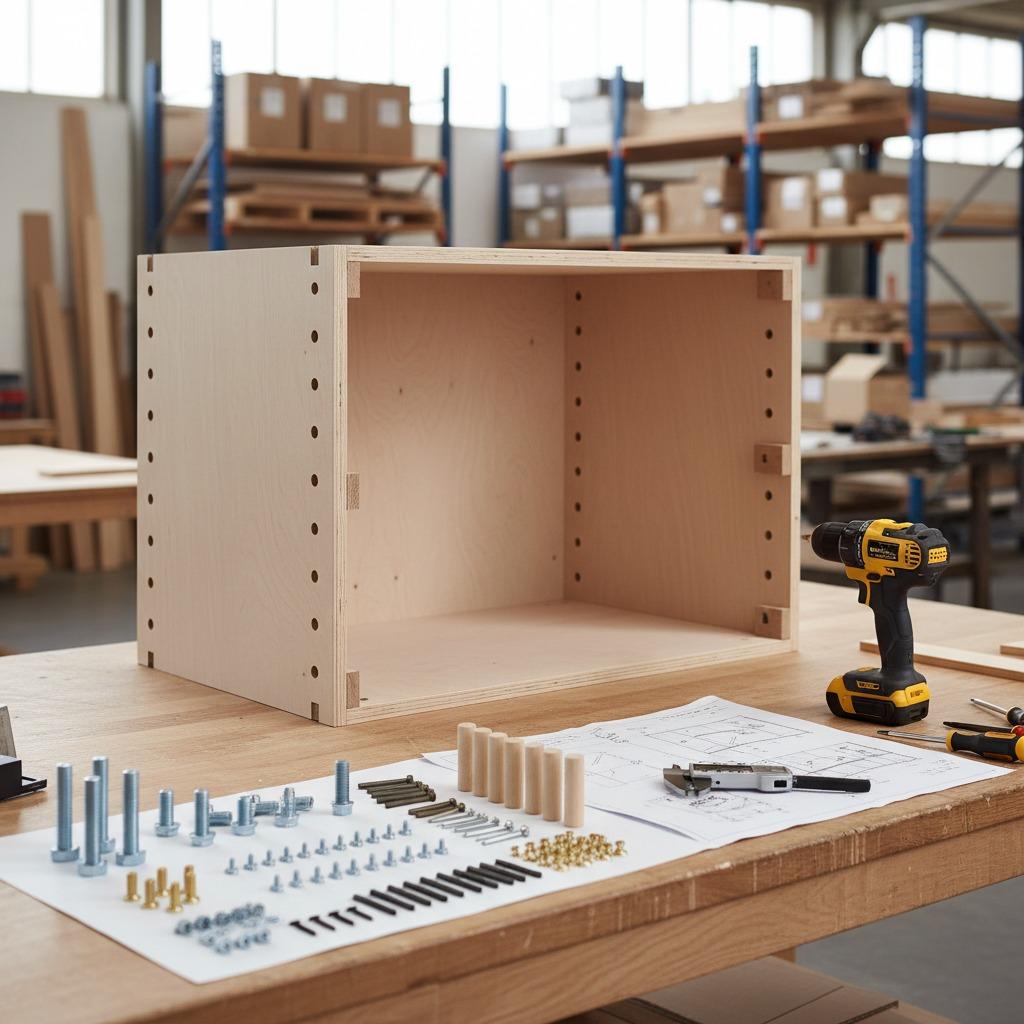 A cabinet kit should follow the build, not the catalog
Many sourcing problems begin when buyers select hardware from a catalog before reviewing the real assembly sequence.
A cabinet is not just a box. It may include adjustable shelves, side panels, a back panel, top and bottom boards, corner supports, drawer fittings, hanging sections, or special installation points. Each part changes what the hardware kit needs to do.
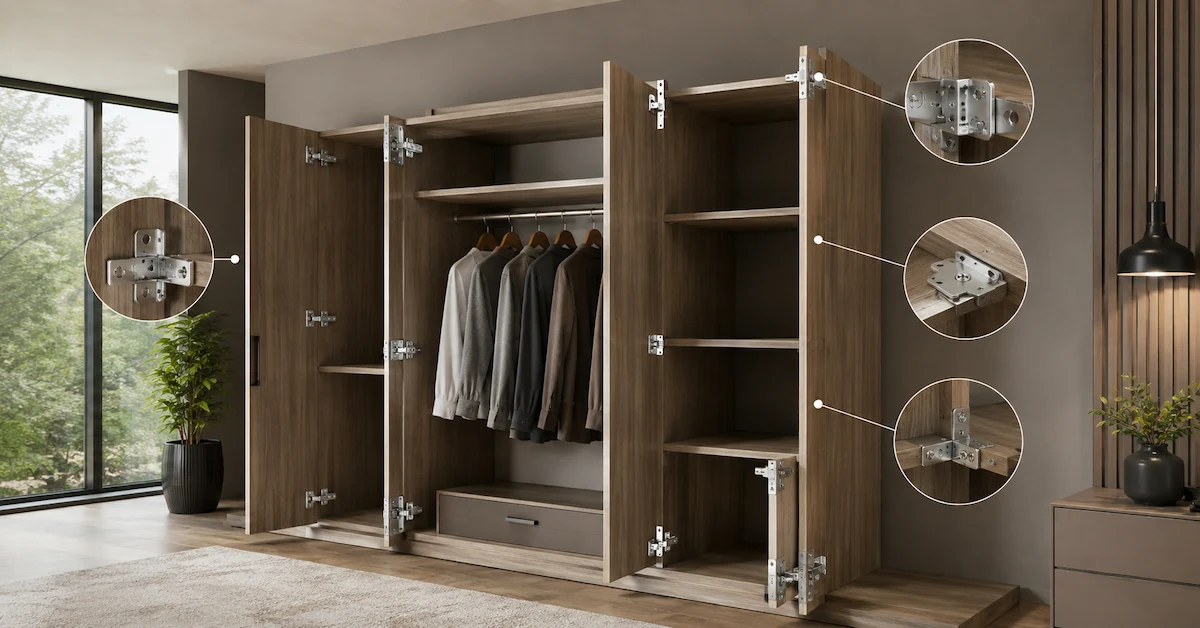
A drawer hardware kit manufacturer may focus on slide screws, runner fixings, adjustment pieces, and replacement fasteners. A wardrobe hardware kit manufacturer may need to consider hanging rail brackets, shelf supports, heavier connectors, and long-term load. A simple storage module may only need basic fasteners and shelf pins.
These kits are not interchangeable just because they all belong to “cabinet hardware.”
A useful kit should be built around:
- Cabinet type
- Panel thickness
- Board material
- Drilling pattern
- Hole diameter and depth
- Corner structure
- Shelf or drawer layout
- Load requirement
- Assembly method
- Packing format
The closer the kit follows the cabinet structure, the fewer surprises appear later.
The hardware kit is part of the product design
Buyers sometimes treat the hardware kit as an accessory added near the end.
That is risky.
Once the panel layout is fixed, the hardware choices become limited. A screw that is too long can damage the panel. A connector that needs a different hole position may require rework. A bracket that looks acceptable on a drawing may be awkward to install once the carcass is partly assembled.
For flat-pack furniture, the risk is even higher because the final assembly may happen outside the factory.
A customer or installer does not care that the panel was cut accurately if the connector does not fit. They only see a cabinet that is hard to build.
That is why the hardware kit should be reviewed while the cabinet design is still flexible.
The best time to discuss fasteners, connectors, shelf supports, drawer parts, and packaging is before bulk production, not after the cartons are printed and the instruction sheet is finished.
The drilling pattern decides more than many buyers expect
A cabinet with repeated pre-drilled holes looks efficient.
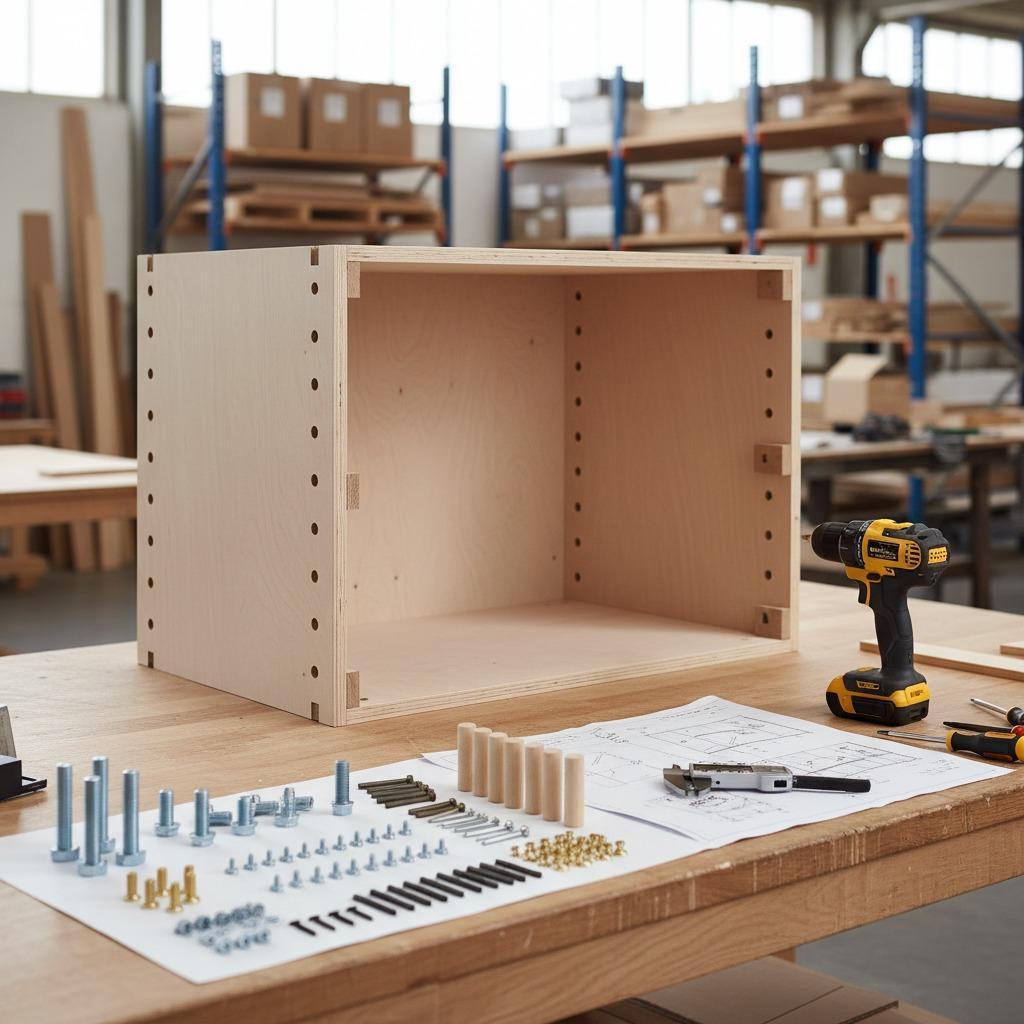
It allows adjustable shelves, modular layouts, quick assembly, and cleaner production. But those holes also create a strict requirement: the hardware must match them.
If the shelf support is slightly loose, the shelf may feel unstable.
If the connector hole is too shallow, the panel may not pull tight.
If the screw does not match the hole and board material, stripping can appear quickly.
If the bracket does not align, workers start adjusting parts by hand.
That hand adjustment is where production loses time.
For cabinet hardware kits, buyers should test the hardware with the actual panel layout. Drawings are useful, but they cannot fully show installation feel.
The supplier should understand whether the holes are for shelf adjustment, connectors, drawer hardware, wardrobe fittings, or mixed use. A repeated hole row is helpful only when the hardware system has been selected around it.
Fasteners are small, but they carry the load
Cabinet hardware kits often depend on ordinary-looking fasteners.
Machine screws, self-tapping screws, precision screws, washers, brackets, and custom fasteners may all appear in one project. They may be hidden after assembly, but they decide whether the cabinet feels tight and stable.
A screw that works in plywood may not perform the same way in particleboard. A fastener that feels secure in a thick panel may be risky in a thinner board. A bracket may need a specific screw head to sit flat. A washer may be necessary to spread force.
This is why the fastener supplier’s background matters.
Jiangmen Jinhe Hardware Co., Ltd. focuses on machine screws, self-tapping screws, micro screws, precision screws, standard parts, and non-standard customization, with materials such as stainless steel, iron, and aluminum. For cabinet buyers, that type of fastener experience can be useful when a kit needs standard screws plus project-specific hardware.
A cabinet hardware kit is not stronger because it has more parts.
It is stronger when the right fasteners match the right panel and assembly method.
More hardware can create more problems
A larger kit may look safer in a quotation.
In production, extra parts can slow everything down.
If workers receive more fasteners than they need, they must identify which ones belong to the current step. If end users see leftover parts after assembly, they may wonder whether they missed something. If similar screws are packed together, the wrong one may be used in the wrong hole.
A good cabinet hardware kit should be complete, but not messy.
The buyer should define:
- Required parts
- Exact quantity per unit
- Spare parts, if needed
- Which parts must be separated
- Which parts can be packed together
- Which parts need labels
- Which parts are used for each assembly step
The goal is not to impress the buyer with a full bag.
The goal is to make assembly clear.
Packaging is not a small detail
Cabinet hardware kits usually travel inside the same carton as the panels.
That means the packaging affects both logistics and assembly. A poorly packed kit can create scratches, missing parts, mixed hardware, and unnecessary sorting work.
For cabinet and shelving systems, packaging should answer practical questions:
Can workers identify the parts quickly?
Are similar screws separated?
Does the label match the cabinet model?
Are shelf supports protected from loss?
Are brackets packed so they do not scratch visible fittings?
Can the kit be checked before shipment?
Can the same kit format be repeated next order?
A simple polybag may be fine for a basic cabinet. A drawer module may need separate bags for slide screws and adjustment pieces. A wardrobe kit may need heavier brackets packed separately. A commercial fixture may need part labels for installers.
There is no single best packaging style.
The correct packaging is the one that reduces mistakes at the next step.
Custom hardware should solve a real issue
Non-standard customization can be valuable in cabinet projects.
A cabinet may need a special screw length. A shelf support may need a different pin size. A bracket may need a custom hole position. A drawer module may need a fastener that works in a tight installation space.
These are good reasons to customize.
But customization should not be added without purpose. Custom parts require drawings, samples, inspection standards, minimum order planning, and repeat-order control. If a standard part works well, it may be easier to manage over the life of the product.
A good cabinet hardware kit manufacturer should help buyers decide where customization is truly needed.
Sometimes the best solution is a custom fastener. Sometimes it is a better standard part. Sometimes it is changing the drilling pattern slightly so the cabinet can use a more reliable hardware family.
Good sourcing is not always about adding complexity.
Often, it is about removing future trouble.
Inspection should cover the kit, not only the parts
A screw can pass inspection and still be packed into the wrong kit.
A bracket can meet the drawing and still arrive short in quantity.
A shelf support can be correct but mislabeled for the wrong cabinet model.
That is why cabinet hardware kit inspection must include both part quality and kit accuracy.
Buyers should ask how the supplier checks:
- Fastener dimensions
- Thread quality
- Surface finish
- Bracket or connector dimensions
- Quantity per kit
- Part separation
- Label accuracy
- Packaging condition
- Carton marking
- Repeat-order consistency
Jiangmen Jinhe Hardware states that its products undergo inspection before delivery and are supplied with necessary documentation. For buyers, documentation is useful because cabinet hardware problems are often found late, sometimes after the panels are already packed.
Still, buyers should be clear about what must be inspected.
If the main risk is missing parts, kit count matters most.
If the main risk is panel damage, screw length and head style matter most.
If the project has many similar cabinet models, label accuracy becomes critical.
Inspection should match the real production risk.
Different cabinet buyers need different support
A flat-pack furniture producer usually wants stable kits, clear labels, simple assembly, and easy packing.
A custom casework shop may need flexibility because every project changes slightly.
A commercial furniture contractor may care more about replacement parts, installation speed, and documentation.
A storage system supplier may need repeatable shelf supports, brackets, and fasteners across several product sizes.
A cabinet hardware kit manufacturer should understand these differences.
The same parts may be used in several markets, but the kit structure may need to change. Factory assembly, end-user assembly, site installation, and repair service do not use hardware in exactly the same way.
This is where broad category language can become misleading.
“Cabinet hardware kit” is not enough. Buyers should explain how the kit will be used.
Supplier capability should include repeat production
A first sample kit is important.
Repeat production is more important.
Cabinet programs often run for months or years. The buyer needs the same screw, same bracket, same connector, same label, and same packing method across multiple batches. A quiet change can create big problems later.
Before choosing a supplier, buyers should ask:
Is there an approved BOM?
Are drawings and revisions recorded?
Is a reference sample kept?
Are substitutions allowed without approval?
Are labels version-controlled?
Can lot or batch information be traced?
How is the final kit checked before shipment?
A cabinet hardware kit should not change just because the next batch is packed on a different day.
Repeatability is one of the main things buyers are paying for.
Common mistakes buyers should avoid
One common mistake is buying cabinet hardware by category name.
A kit for a wardrobe, drawer module, open shelf, and workstation enclosure may all sound similar, but the hardware requirements are different.
Another mistake is over-specifying.
Heavier hardware is not always better. It may increase cost, complicate assembly, and add weight without improving the cabinet in real use.
Under-specifying is just as risky.
A lightweight connector may look fine in a sample but loosen after repeated use, especially in commercial or workshop environments.
Buyers also sometimes ignore the installer.
If the kit requires awkward tool access, unclear sequencing, or frequent tool changes, labor cost rises even when the hardware price looks attractive.
The final mistake is approving loose parts without testing the complete kit.
The real product is the finished assembly experience, not the hardware bag.
What buyers should ask before placing an order
Before selecting a cabinet hardware kit manufacturer, ask:
Can you provide the exact hardware breakdown?
Can the kit match our cabinet drawing and drilling pattern?
What fastener types are included?
Can you support custom cabinet fasteners?
How are similar parts separated?
What materials and finishes are available?
What inspection documents are provided?
How do you verify kit completeness?
Can labels, barcodes, or model numbers be added?
Can the same kit format be repeated later?
Can you support warehousing, logistics, or export delivery?
Good answers should connect the kit to the cabinet build.
A supplier that only sells loose parts may not be ready for a repeatable cabinet hardware program.
Frequently Asked Questions
What does a cabinet hardware kit usually include?
A cabinet hardware kit may include screws, cam connectors, brackets, shelf supports, dowels, washers, spacers, plastic caps, inserts, drawer hardware, or small installation tools.
Is a cabinet hardware kit better than buying loose hardware?
For repeatable cabinet production, yes. A kit reduces sorting, helps control quantities, supports labeling, and makes assembly more predictable.
Can cabinet hardware kits be customized?
Yes. Screw length, connector type, bracket shape, finish, quantity mix, labels, packaging, and included parts can be customized when the cabinet design requires it.
Why does the panel drilling pattern matter?
The hardware must match hole diameter, depth, spacing, and panel thickness. A small mismatch can cause loose joints, panel damage, or slower assembly.
Should buyers test the full kit before bulk orders?
Yes. The complete kit should be tested with real panels, tools, and assembly steps before volume production.
What makes a cabinet hardware kit manufacturer worth shortlisting?
A strong supplier should support fastener selection, BOM matching, customization, inspection, packaging, documentation, repeat supply, and delivery coordination.
A good cabinet kit makes assembly feel controlled
The best cabinet hardware kit does not make the installer pause.
The screws match the panels. The connectors fit the holes. The shelf supports sit firmly. The labels are clear. The parts are packed in a way that makes sense. The next shipment looks and works like the approved sample.
That is what buyers are really sourcing from a cabinet hardware kit manufacturer.
For cabinet hardware kits, wardrobe hardware kits, drawer hardware kits, furniture hardware kits, custom cabinet fasteners, and non-standard hardware support, Jiangmen Jinhe Hardware Co., Ltd. can discuss fastener selection, kit structure, material options, packaging, inspection, and supply requirements.
For direct inquiries:
Tel/WeChat: +86 13729150102
WhatsApp: +86 13322893939
Email: sharon@hkhomeideas.com
Start with the cabinet drawing, panel material, drilling pattern, hardware BOM, packaging method, and expected order quantity.
Once the assembly process is clear, the right hardware kit becomes much easier to build and repeat.