
Why cabinet screws deserve more attention than they do now.
Cabinet screws are easily overlooked until the doors start to sag, the side panels crack, or the flat-pack modules loosen after a few quarters of use. For anyone sourcing furniture hardware, the real issue isn't just which screw looks right, but which fasteners can be securely installed on MDF, particleboard, plywood, or solid wood without damaging the board or slowing down assembly on the production line.
This is crucial because the success of cabinet production hinges on repeatability. A screw that holds well in solid wood may not perform well on a rough particleboard core. Even if the screw head is perfectly flush with melamine-faced panels, problems can still arise if the screwdriver is not handled carefully or the countersunk holes are not the correct size. In reality, buyers often have to choose between speed, appearance, grip strength, and the less-than-glaring issue of on-site failure.
Changes in base material during cabinet assembly
The type of board material greatly influences the choice of fastening method. This article compares four common substrates: medium-density fiberboard (MDF), particleboard, plywood, and solid wood. Each type of board behaves differently under screw action.
Medium density fiberboard
Medium-density fiberboard (MDF) has a dense, smooth texture, and its fine fiber structure allows it to securely fasten threads when screws are properly matched. It is also well-suited for flat-head mounting. However, MDF is not as forgiving as it seems. Overtightening screws can crush the surface and reduce the screw's fixing strength, so screw placement during assembly is crucial.
Particleboard
Particleboard has a relatively coarse sheet structure. Due to its practicality and economy, it is commonly used in cabinet and furniture production, but requires the use of hardware screws that can firmly engage the core of the board. Coarse threads are generally a safer choice, especially in situations requiring repeated tightening.
plywood
Plywood has a multi-layered veneer structure, which is quite different from ordinary wood. Because screws can penetrate multiple layers, they generally provide strong grip, but edge treatment is crucial. For certain joints, using screws or threaded inserts/connectors specifically designed for plywood may be better than using ordinary wood screws alone.
solid wood
Solid wood can still provide excellent holding power if the screws are the right size and screwed in properly. This is usually the best choice for long-term durability, but differences in wood grain direction and tree species may result in a final result that is not as stable as the buyer expects.
How does screw geometry affect performance?
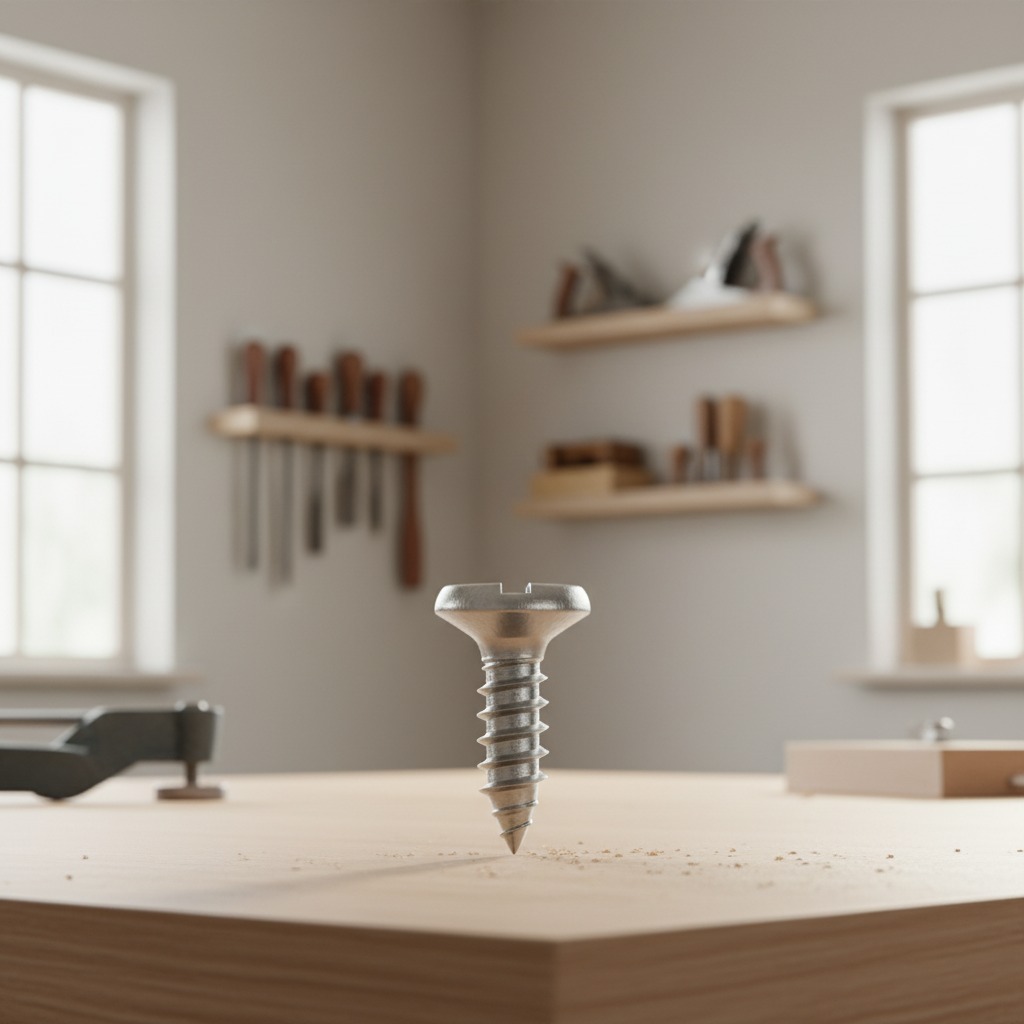
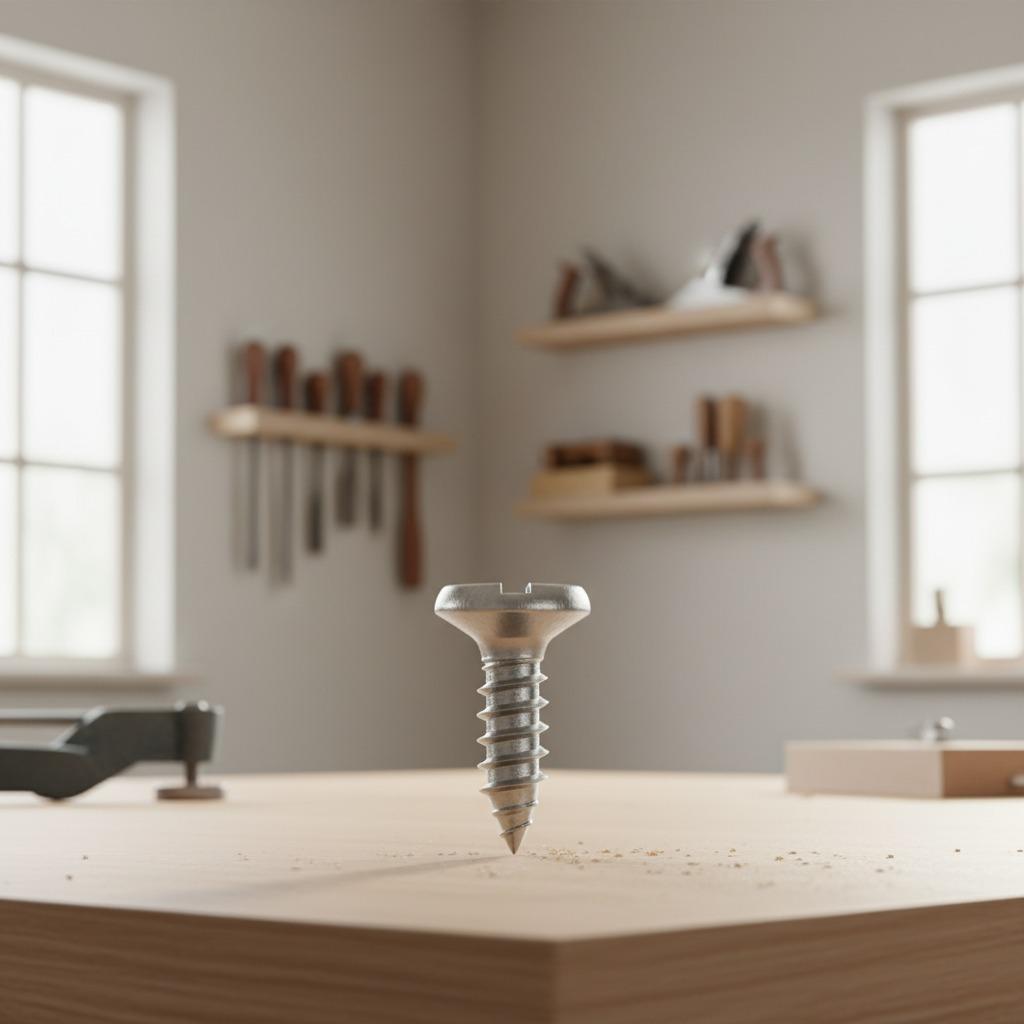
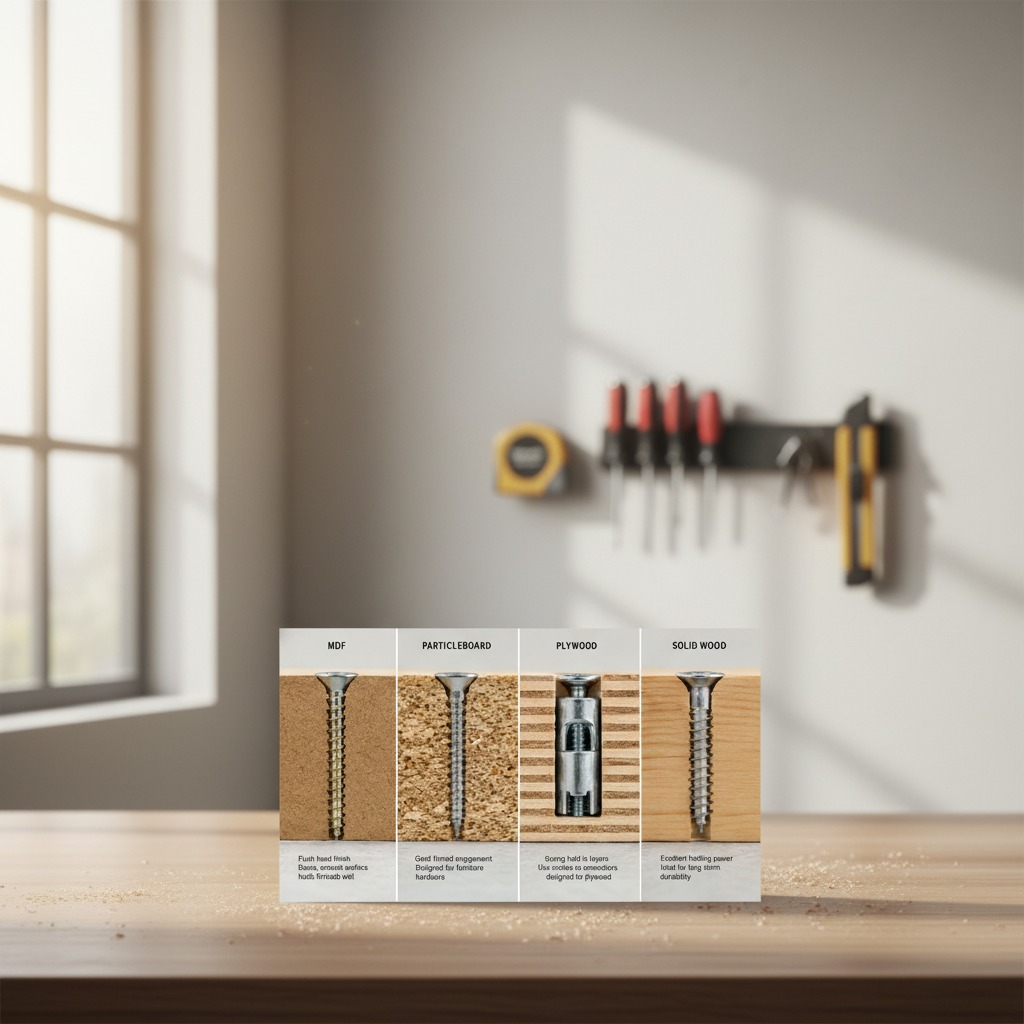
The product comparison image shows countersunk screws (also known as flathead screws), which have coarse threads and sharp heads. This combination is commonly used in cabinet installations and general woodworking connections because it helps fasteners screw in quickly and embed smoothly into surfaces. For veneered or melamine-finished panels, a flush installation is crucial, as protruding screw heads can interfere with the installation and create visible defects.
Surface treatment is also important, although it is often considered a minor detail and only given attention when corrosion or appearance problems occur. The comparison images show that one MDF sample uses a yellow zinc coating, while the others use a bright zinc coating. Buyers should always consider the furniture's intended use environment when choosing a coating, but without specific specifications, it's best not to speculate on performance characteristics beyond the surface treatment.
Flat-head gimbals and pan/tilt heads: Which is more practical?
Flat-head cabinet screws are usually the first choice when a flush surface is required. They can be inserted into countersunk holes, making them especially suitable for visible parts of furniture. In contrast, pan-head cabinet screws are typically chosen when a larger bearing surface is needed or when the screw head needs to protrude from the surface. There is no absolute superiority or inferiority between the two; the way the panels are stacked is a better indicator of screw selection than the product catalog.
If pre-drilled holes are used during assembly, please confirm whether these holes are for countersunk screws, connectors, or other types of hardware. Using the wrong screw type reduces production efficiency and generates waste, a subtle but costly problem on furniture production lines.
Practical Procurement Checklist for Procurement Teams
For procurement and engineering teams, the basic selection logic is simple:
First, match the screws to the substrate. Then, select the appropriate screw head based on the surface requirements. Finally, confirm that the surface treatment and drive method meet your production process requirements. In cabinet production, this sequence avoids a lot of trial and error.
Considering the workflow is also helpful. For example, a factory using drills/screwdrivers to assemble stacked cabinet panels requires quick insertion and predictable installation accuracy. In this case, repeatability is more valuable than a radical thread shape that only looks solid in a sample.
Jiangmen Jinhe Hardware Co., Ltd. mainly deals in fasteners and standard parts, including machine screws, self-tapping screws, miniature screws, and precision screws, and provides customized services for the furniture and related industries. This supplier combination is particularly important when buyers need both standard cabinet hardware screws and non-standard customization for specific panel designs.
Common mistakes that lead to avoidable failures
A common mistake is assuming that all cabinet screws behave the same on all types of boards. This is not the case. Another common mistake is over-tightening screws on engineered wood products (especially MDF and particleboard), causing the surface of the board to damage before the joints.
The third mistake is neglecting the preparation of the holes. In mass-produced cabinets, pre-drilling, guide diameters, and countersunk holes are not optional details, but essential components of the fastening system. The image of repeatedly drilling holes during panel assembly serves as a good reminder that furniture production relies more on consistency than brute force.
When should connectors be considered instead of standard screws?
For plywood and certain modular cabinet systems, threaded inserts or connectors may be more suitable than using ordinary screws alone. In the comparison image, the plywood section includes a cylindrical metal connector, reflecting a common issue in furniture hardware: some connectors need to facilitate disassembly, maintenance, or improve alignment. This is especially important in flat-pack furniture and applications requiring repeated assembly.
What questions should buyers ask before placing an order?
Inquire about the screw geometry, head type, coating, compatible substrates, and any available documentation. If you are in mass production, confirm that the fasteners are compatible with your drive tools and pre-drilled panel design. If you are exporting or selling across borders, verify the standard language and documentation before (not after) shipping the first batch of goods.
Even if a project sounds simple, be cautious. Cabinet fasteners are one example; even a "good enough" approach can lead to on-site complaints.
Next steps for furniture manufacturers and purchasing managers
If your production line uses medium-density fiberboard (MDF), particleboard, plywood, or solid wood, the safest approach is to test cabinet screws on actual laminated boards before scaling up production. Fasteners that perform well on sample boards may perform differently on production boards that have undergone lamination, edge banding, or repeated assembly.
For buyers looking for standard or custom fasteners for furniture assembly, it is worthwhile to talk to suppliers who understand hardware and its manufacturing process.
For product selection support or customization inquiries, please contact Jiangmen Jinhe Hardware Co., Ltd. by phone/WeChat: +86 13729150102, WhatsApp: +8613322893939 or email: sharon@hkhomeideas.com.