
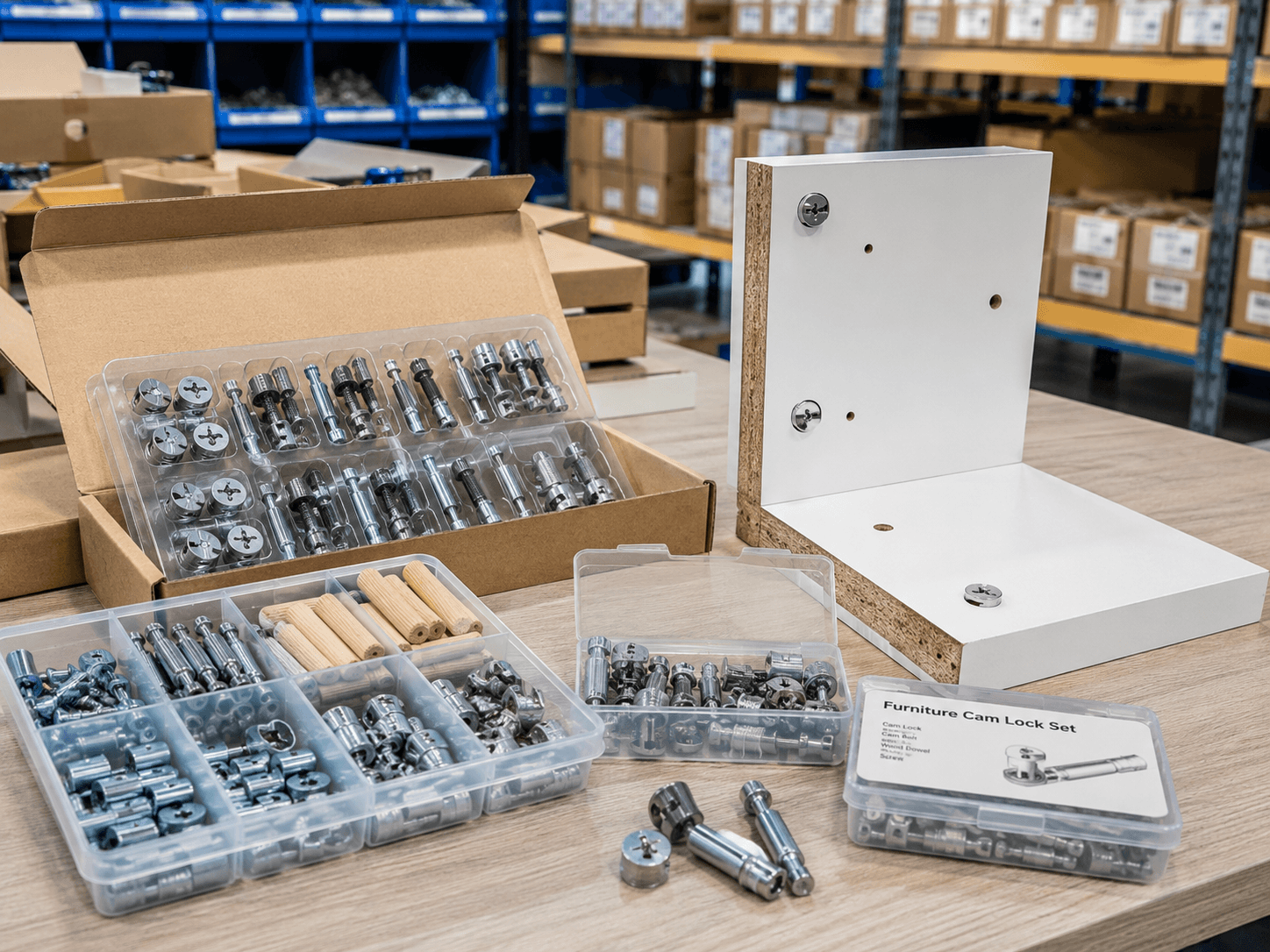
Cam Lock Fasteners Wholesale: Why This Small Furniture Connector Still Matters
Cam lock fasteners are not new.
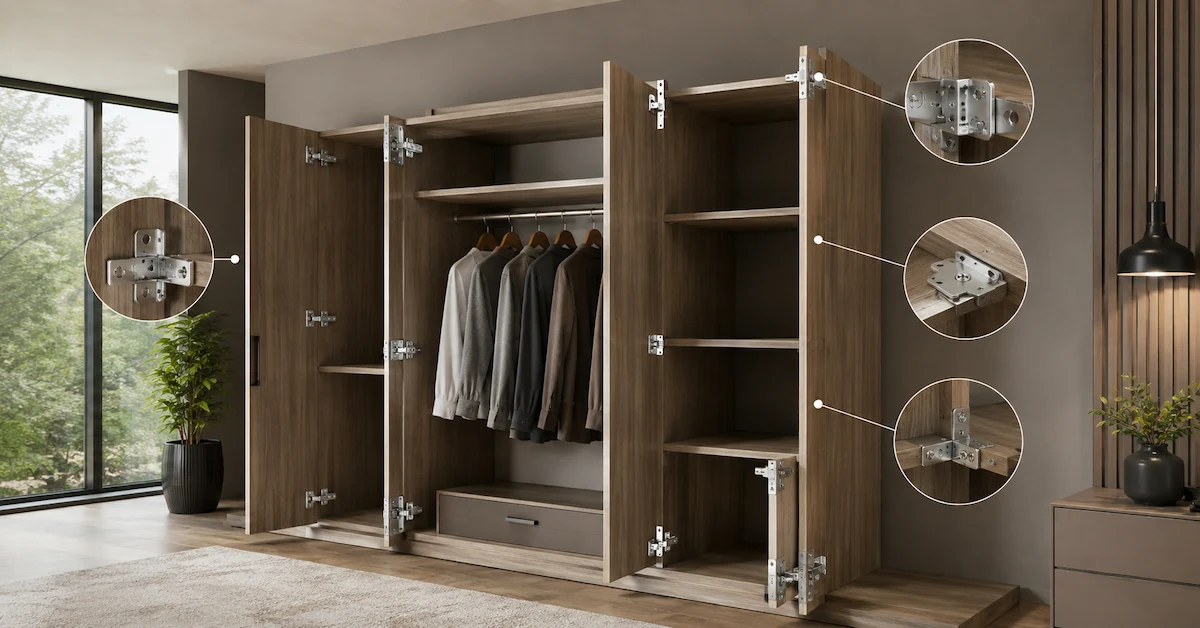
Most furniture buyers have seen them many times: the round metal cam, the matching bolt, sometimes a dowel, sometimes a screw, all packed together in a small hardware bag or compartment box. They are common in flat-pack cabinets, shelving units, wardrobes, desks, and simple storage furniture.
Still, they keep coming back into sourcing discussions.
The reason is practical. Furniture makers want fast assembly. Retailers want cleaner hardware kits. E-commerce sellers want replacement packs that customers can understand. Contract packagers want small parts that can be counted, separated, and shipped without creating complaints.
That is why cam lock fasteners wholesale is not just a low-cost hardware search term. For many buyers, it is part of a bigger question: how do we keep panel furniture easy to assemble, easy to pack, and consistent across repeat orders?
A cam lock fastener looks simple. Buying it well is not always simple.
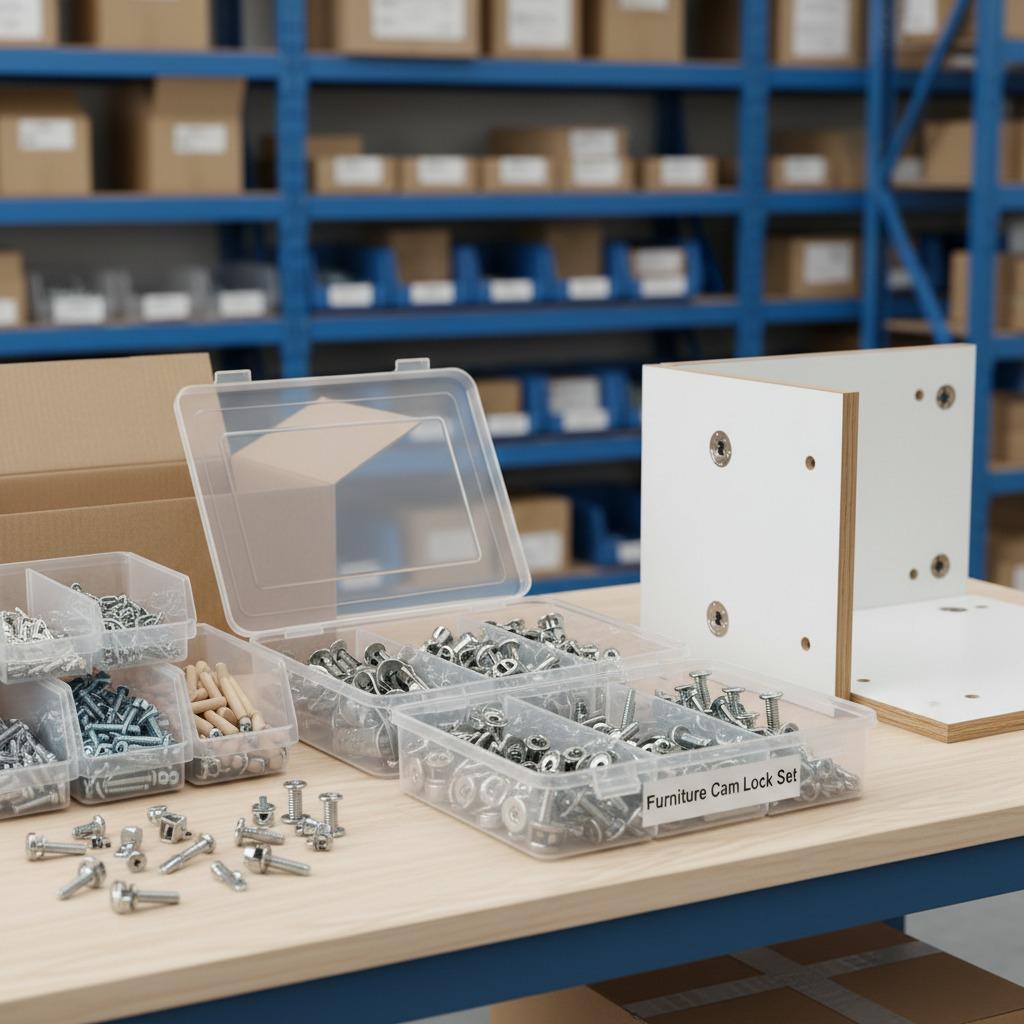 Why cam lock fasteners still fit modern furniture production
Flat-pack furniture depends on one basic promise: the product should arrive compact, then assemble without too much trouble.
Cam lock fasteners support that promise.
They allow panels to be shipped flat. They create a mechanical joint without large exterior brackets. They help cabinets and shelves look cleaner after assembly. They are familiar to many factories, installers, and end users.
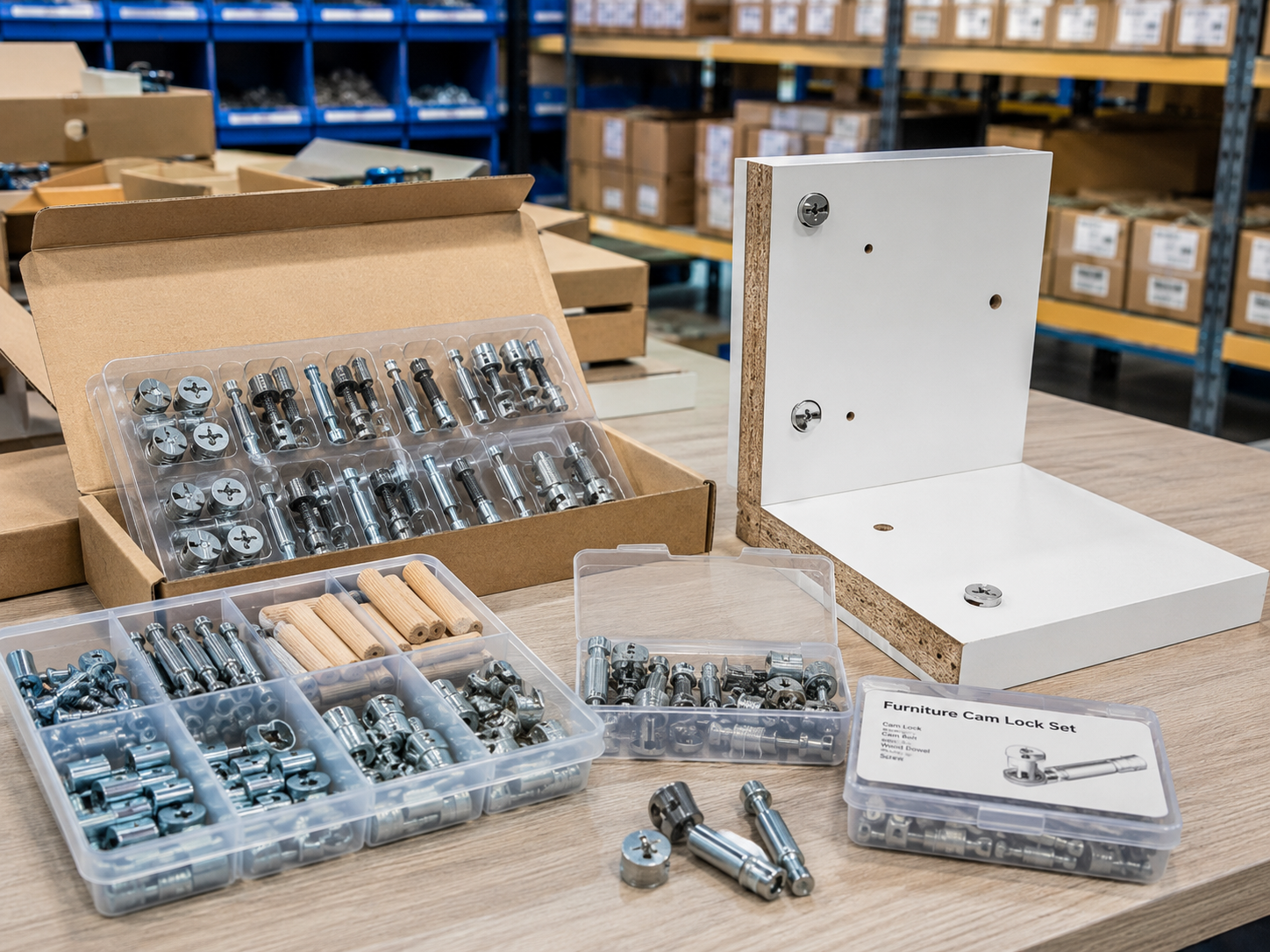
A typical cam lock connection works like this: the connector bolt goes into one panel, the cam sits in a drilled hole in the mating panel, and a turn of the cam pulls the two panels together.
It is a small movement, but it does a lot of work.
For cabinet factories, this helps speed up assembly. For RTA furniture brands, it keeps cartons compact. For replacement hardware sellers, it creates a recognizable repair item that customers often need after moving, losing parts, or damaging old furniture.
That usefulness explains why cam lock fasteners remain common, even as furniture hardware options keep changing.
The real product is the complete kit
Buyers sometimes talk about cam locks as if the round cam itself is the whole product.
It is not.
A useful cabinet connector hardware kit may include:
- Round cam locks
- Connector bolts
- Screws
- Wooden dowels
- Plastic or metal sleeves
- Washers or spacers
- Small fittings
- Labels or kit cards
- Compartment trays or bags
The cam lock only works when the matching parts are correct.
The bolt head must fit the cam. The bolt length must match the board thickness. The dowel must align the panels before tightening. The screw or sleeve must suit the substrate. The drilled holes must be positioned accurately.
If one part is wrong, the whole joint can feel wrong.
That is why buyers should evaluate the cam lock set as a system, not as separate metal pieces. A low price on one component may not help if the matching bolts are inconsistent or the packaging mixes two similar sizes together.
Packaging is not just presentation
In wholesale furniture hardware, packaging can decide whether the kit is useful.
A compartmented plastic tray makes it easier to see the contents. A labeled bag may be enough for factory use. A retail box may help e-commerce or repair customers understand what they are buying. Bulk cartons may work for manufacturers with their own internal sorting process.
None of these formats is automatically best.
The right choice depends on how the hardware will be used.
For furniture factories, speed matters. Workers need the correct cam locks, bolts, and dowels ready for the line.
For distributors, stock control matters. The kit should be easy to count, store, and replenish.
For repair sellers, clarity matters. Customers need to know whether the set fits their furniture.
For export and e-commerce, protection matters. The pack should survive handling without spilling or mixing parts.
A cam lock fastener distributor that understands packaging can often save buyers more labor than a supplier offering only a cheaper loose-part price.
Board compatibility should be checked early
Cam lock fasteners are widely used in particleboard, MDF, plywood, and other wood-based panels.
But those materials do not behave the same.
Particleboard is common in flat-pack furniture, but it can be unforgiving if the hole is loose or the bolt length is wrong. MDF machines cleanly, yet it still needs controlled drilling. Plywood may hold fasteners differently because of its layered structure.
Before placing a wholesale order, buyers should confirm:
- Panel material
- Panel thickness
- Cam diameter
- Cam depth
- Bolt length
- Bolt thread
- Dowel size
- Hole diameter
- Hole depth
- Edge distance
- Assembly sequence
This sounds basic, but many sourcing problems start here.
A “standard” cam lock kit may work well in one cabinet line and fail in another. The difference may be only a few millimeters, but that is enough to create loose joints, poor alignment, or frustrated end users.
Testing should happen with the real board, not only with loose hardware samples.
Drilling accuracy makes the connector feel easy
Cam lock systems are simple for the user because the panel preparation has already done most of the work.
If the drilling is accurate, the cam catches the bolt and pulls the panels together neatly. If the drilling is off, the user may feel like the hardware is defective.
That is why the cam lock, bolt, dowel, and panel drilling pattern should be reviewed together.
A good test is straightforward: assemble the actual panel sample with the complete kit. Tighten the cam. Check whether the joint closes cleanly. Move the cabinet. Check whether the corner stays square.
Then repeat the test.
One successful sample is useful, but it does not prove repeatability.
For factories, this step prevents line delays. For repair-kit sellers, it helps avoid returns from customers who ordered a kit that looked right but did not fit the original furniture.
Materials and finishes should not be guessed
Many cam lock fasteners use bright silver or zinc-like finishes. That appearance is common, but buyers should still confirm the actual specification.
A cam may be zinc alloy, plated steel, or another material. A connector bolt may use a different finish from the cam. Dowels may be wood, plastic, or metal.
For most indoor furniture, a standard plated finish may be suitable. Still, the supplier should confirm the base material, coating, dimensions, and intended use.
Buyers should ask about:
- Base material
- Surface finish
- Corrosion resistance
- Cam size
- Bolt type
- Bolt length
- Thread specification
- Finish consistency
- Packaging protection
If the hardware is for retail resale, repair kits, or humid storage conditions, finish and corrosion behavior become more important.
A clean-looking sample does not always tell the full story.
Wholesale sourcing is about repeatability
A first sample kit can be prepared carefully.
The harder question is whether the supplier can repeat the same kit across bulk orders.
For cam lock fasteners wholesale, repeatability means the cam size stays the same, the matching bolt does not change, the dowels remain consistent, and the packaging format matches the approved sample.
A small change may not seem serious to the supplier. To the buyer, it can create assembly trouble.
For example, a slightly different bolt length may stop the cam from locking properly. A different cam depth may require a different hole. A packaging change may cause similar parts to mix.
Buyers should ask how the supplier controls:
- Approved part list
- Drawing revisions
- Kit quantities
- Substitute parts
- Packaging layout
- Label content
- Batch inspection
- Repeat orders
A reliable supplier should not treat every order as a fresh guess.
Where Jiangmen Jinhe Hardware fits
Jiangmen Jinhe Hardware Co., Ltd. works in the broader fastener and standard-parts field, with products such as machine screws, self-tapping screws, micro screws, precision screws, and non-standard customized hardware. Its materials include stainless steel, iron, and aluminum.
For buyers sourcing furniture cam lock fasteners, that fastener background is relevant because a cam lock kit often includes more than the round cam. It may require matching screws, connector bolts, dowels, packaging, labels, and repeat supply control.
The company also notes support for inspection, documentation, logistics, warehousing, export handling, and supply chain services. For wholesale buyers, those details matter when the order is not only about parts, but about kitting, shipment, and replenishment.
A good supplier in this category should be able to discuss the cam lock set as a complete furniture hardware solution, not only as loose hardware.
Common sourcing mistakes buyers should avoid
One common mistake is assuming all cam locks are interchangeable.
They are not.
Cam diameter, cam depth, bolt length, bolt head shape, thread, panel thickness, and hole position all affect performance.
Another mistake is buying by product photo.
Two kits may look similar online but differ in material, finish, dimensions, or matching parts.
A third mistake is ignoring packaging.
A low-cost kit can become expensive if bolts, cams, and dowels are mixed or difficult to identify.
Buyers also sometimes approve the hardware without testing the real board. That is risky, especially in particleboard or MDF furniture where hole quality directly affects the joint.
The final mistake is accepting vague specifications.
If the supplier cannot confirm dimensions, materials, packaging, or kit contents clearly, the buyer should not fill in the missing information by guessing.
What buyers should ask before placing an order
Before choosing a cam lock latch fastener supplier, buyers should ask:
What cam sizes are available?
Which bolt types match each cam?
What panel thickness is the kit designed for?
What materials and finishes are used?
Can the set be tested with our board?
Are dowels, screws, or sleeves included?
How are similar parts separated?
Can the kit be packed for retail, repair, or factory use?
Can OEM labeling be supported?
How are quantities checked before shipment?
What inspection documents are available?
Can the same kit be repeated in future orders?
Can logistics or warehousing support be provided?
The answers should connect the hardware to the furniture assembly process.
A supplier that understands panel furniture will talk about fit, drilling, kit structure, packaging, and repeatability—not only price per piece.
Frequently Asked Questions
What are cam lock fasteners used for?
Cam lock fasteners are used to join panels in flat-pack furniture, cabinets, shelves, wardrobes, desks, storage units, and modular furniture systems.
Are cam lock fasteners suitable for repair kits?
Yes. They are commonly used in furniture repair and replacement packs, especially when supplied with matching bolts, dowels, or screws.
Are all cam locks interchangeable?
No. Cam locks vary by diameter, depth, bolt type, bolt length, finish, and panel compatibility. Buyers should confirm specifications before ordering.
Can cam lock kits be packed for retail sale?
Yes. Cam locks, bolts, dowels, and screws can be packed in compartment trays, polybags, blister packs, or retail boxes depending on the sales channel.
What should buyers test before bulk orders?
Test the cam size, bolt length, drilling pattern, board material, assembly sequence, packaging format, and kit completeness.
Why does packaging matter for cam lock fasteners?
Because cam lock systems include several small matching parts. If one component is missing, mixed, or mislabeled, assembly can stop.
A good cam lock kit keeps assembly predictable
Cam lock fasteners remain useful because they solve a real furniture problem.
They help panels ship flat, join cleanly, and assemble without exposed brackets. But the system only works when the cam, bolt, dowel, board, drilling pattern, and packaging all match.
That is what buyers should look for when sourcing cam lock fasteners wholesale.
For furniture cam lock fasteners, cabinet connector hardware kits, repair hardware packs, custom fastener kits, and export-ready hardware supply, Jiangmen Jinhe Hardware Co., Ltd. can discuss fastener selection, kit structure, packaging formats, inspection, warehousing, logistics, and repeat supply needs.
For direct inquiries:
Tel/WeChat: +86 13729150102
WhatsApp: +86 13322893939
Email: sharon@hkhomeideas.com
Start with the cam size, bolt length, panel material, drilling pattern, packaging channel, and expected order volume.
Once those details are clear, the right cam lock kit becomes much easier to source and repeat.