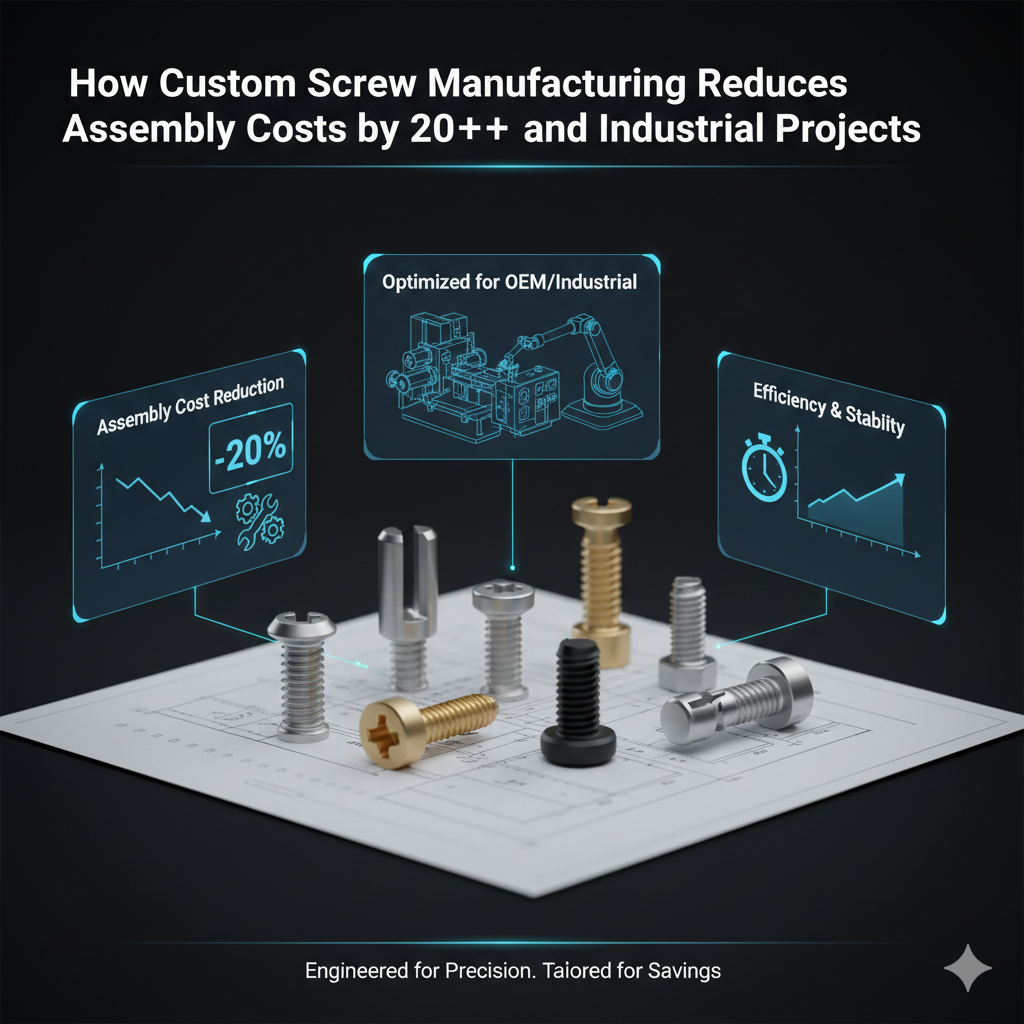

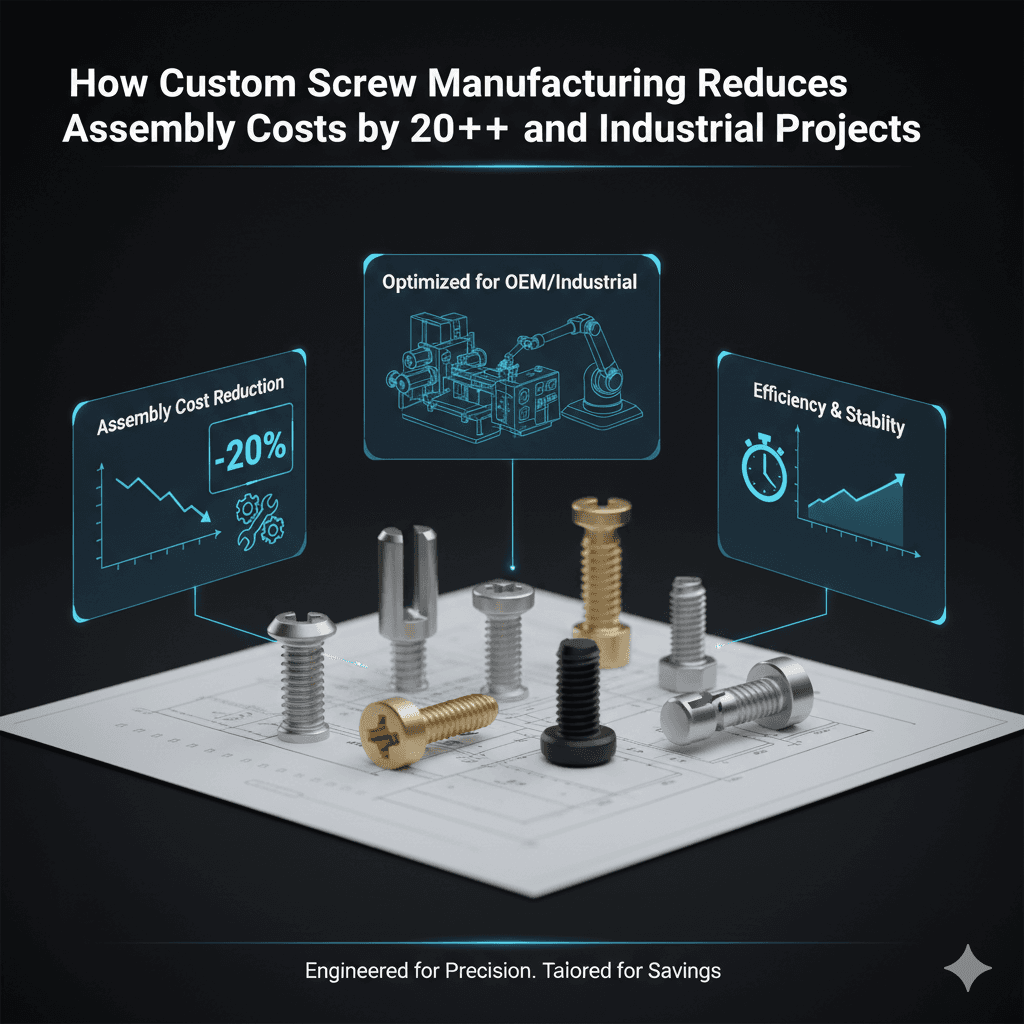
In many OEM and industrial projects, cost optimization often begins with supplier price comparisons. Buyers negotiate cents per unit, switch vendors, or consolidate orders. Yet in practice, these efforts rarely produce meaningful savings at the system level. The reason is simple: the largest cost drivers are not the screws themselves, but how they perform during assembly.
This is where working with a custom screw manufacturer changes the equation. Instead of optimizing price per piece, the focus shifts toward reducing total assembly cost—labor time, rework, material loss, and process interruptions. When these factors are addressed together, cost reductions of 20% or more are not unusual. They are the result of improved process alignment, not cheaper components.
Where Assembly Costs Actually Come From
To understand the impact of custom screw manufacturing, it is necessary to break down real assembly costs. In most production environments, screws represent a small fraction of total product cost, but they influence multiple cost layers:
-
Labor time per installation
-
Tool wear and maintenance frequency
-
Rework caused by stripping or incorrect fastening
-
Production interruptions due to shortages or miscounts
-
Material waste from damaged or lost fasteners
According to industrial assembly benchmarks and lean manufacturing studies (e.g., McKinsey manufacturing productivity reports), indirect inefficiencies such as rework and downtime can account for 15–30% of total operational cost. Fasteners, due to their high usage frequency, are a key contributor to these inefficiencies.
How Custom Screw Design Improves Installation Efficiency
One of the most direct ways custom screw manufacturing reduces cost is through improved installation performance.
Standard screws are designed for broad compatibility. Custom screws are designed for specific materials and use cases.
For example:
-
Optimized thread geometry reduces driving resistance
-
Adjusted screw length improves engagement without over-penetration
-
Head design ensures better tool alignment and reduces slipping
In furniture assembly, where screws are installed into MDF or particleboard, optimized thread profiles can increase installation speed by 10–20%. In industrial environments using torque-controlled tools, consistent thread engagement reduces cycle time variability and improves process stability.
These gains accumulate across thousands of installations per shift.
Reducing Rework and Defect Rates Through Consistency
Rework is one of the most underestimated cost drivers in manufacturing.
When screw quality varies between batches, the following issues occur:
-
Inconsistent torque leads to under- or over-tightening
-
Increased stripping rates in softer materials
-
Joint instability requiring reassembly
-
Additional inspection and quality control time
custom screw manufacturer Industry data shows that inconsistent fasteners can increase rework rates to 10–15%. With controlled custom screw manufacturing, this can be reduced to below 3–5%.
| Quality Level | Standard Supply | Custom Controlled Supply |
|---|---|---|
| Rework rate | 10–15% | 3–5% |
| Defect-related downtime | Moderate | Low |
| Assembly stability | Variable | Consistent |
Reducing rework does not just save materials—it frees up labor capacity and stabilizes production flow.
Packaging Optimization: A Hidden Cost Lever
Packaging is often treated as a logistics detail, but it directly affects assembly efficiency and cost.
Loose bulk screws introduce several problems:
-
Counting inaccuracies
-
Mixed fasteners
-
Increased handling time
-
Higher risk of loss during transport
Custom packaging solutions, developed by a custom screw manufacturer, align packaging with real usage scenarios.
| Packaging Type | Loose Bulk | Standard Pack | Custom Packaging |
|---|---|---|---|
| Counting accuracy | ~90% | ~97–98% | 99%+ |
| Material loss | 5–8% | 2–3% | <1% |
| Assembly efficiency | Baseline | +10–15% | +20–30% |
For example, in flat-pack furniture production, pre-sorted screw kits eliminate the need for manual picking. This alone can reduce line-side preparation time by 15–25%.
The cost of packaging increases slightly, but the reduction in labor and error offsets it significantly.
Labor Efficiency Gains in Real Production Scenarios
Labor is often the largest variable cost in assembly.
When screws are optimized for installation and packaging is aligned with workflow:
-
Operators spend less time adjusting tools
-
Installation becomes more predictable
-
Fewer interruptions occur due to missing or incorrect parts
-
Training requirements decrease due to simplified processes
In practical terms, these improvements typically result in:
-
15–25% reduction in assembly time per unit
-
10–20% reduction in operator fatigue-related errors
-
More stable production output across shifts
These gains are not theoretical—they are consistently observed in optimized OEM production environments.
Total Cost Comparison: Standard vs Custom Screw Supply
To illustrate the combined impact, consider the following aggregated comparison:
| Cost Factor | Standard Screws | Custom Screw Manufacturing |
|---|---|---|
| Unit price | Lower | Slightly higher |
| Assembly labor cost | Baseline | -15% to -25% |
| Rework cost | High | Reduced by 50–70% |
| Material loss | 5–8% | <1–2% |
| Total project cost | Baseline | -20%+ overall |
This table reflects a key insight: unit price and total cost are not the same thing.
Even when custom screws cost more per unit, the overall project cost decreases due to efficiency gains.
Why OEM Buyers Are Shifting Toward Custom Screw Manufacturing
Across furniture, industrial equipment, and export manufacturing, more buyers are shifting toward custom screw solutions for one reason: predictability.
Predictable installation
Predictable packaging
Predictable supply
When production becomes predictable, planning improves, inventory levels stabilize, and unexpected costs decrease.
This shift is not driven by innovation trends—it is driven by operational necessity.
Frequently Asked Questions
Q1: Is a 20% cost reduction realistic with custom screw manufacturing?
Yes, when considering total assembly cost (labor, rework, and loss), reductions of 20% or more are achievable in optimized production environments.
Q2: What type of projects benefit most from custom screws?
High-volume OEM projects, furniture manufacturing, and industrial assembly lines benefit the most due to repetitive processes.
Q3: Does custom screw manufacturing increase complexity?
No. It reduces complexity at the assembly level by shifting optimization upstream to design and packaging stages.
Moving Toward a Cost-Optimized Screw Supply Strategy
Reducing assembly cost requires looking beyond unit pricing and understanding how components perform in real production environments. Custom screw manufacturing addresses inefficiencies at multiple levels—design, consistency, and packaging—creating measurable cost savings across the entire process.
To explore how custom screw design, manufacturing control, and packaging solutions can be applied to your production environment, you can review our full capabilities on the JHFIX homepage. This provides a detailed overview of how screw solutions are developed for OEM and industrial applications.
If you are currently evaluating ways to reduce assembly cost, improve efficiency, or eliminate recurring production issues, a focused discussion can help identify practical opportunities. Our team works with buyers to align screw specifications, packaging formats, and supply strategies with real production needs. You are welcome to contact us through our Contact Us page to discuss your project and explore a more cost-efficient solution.