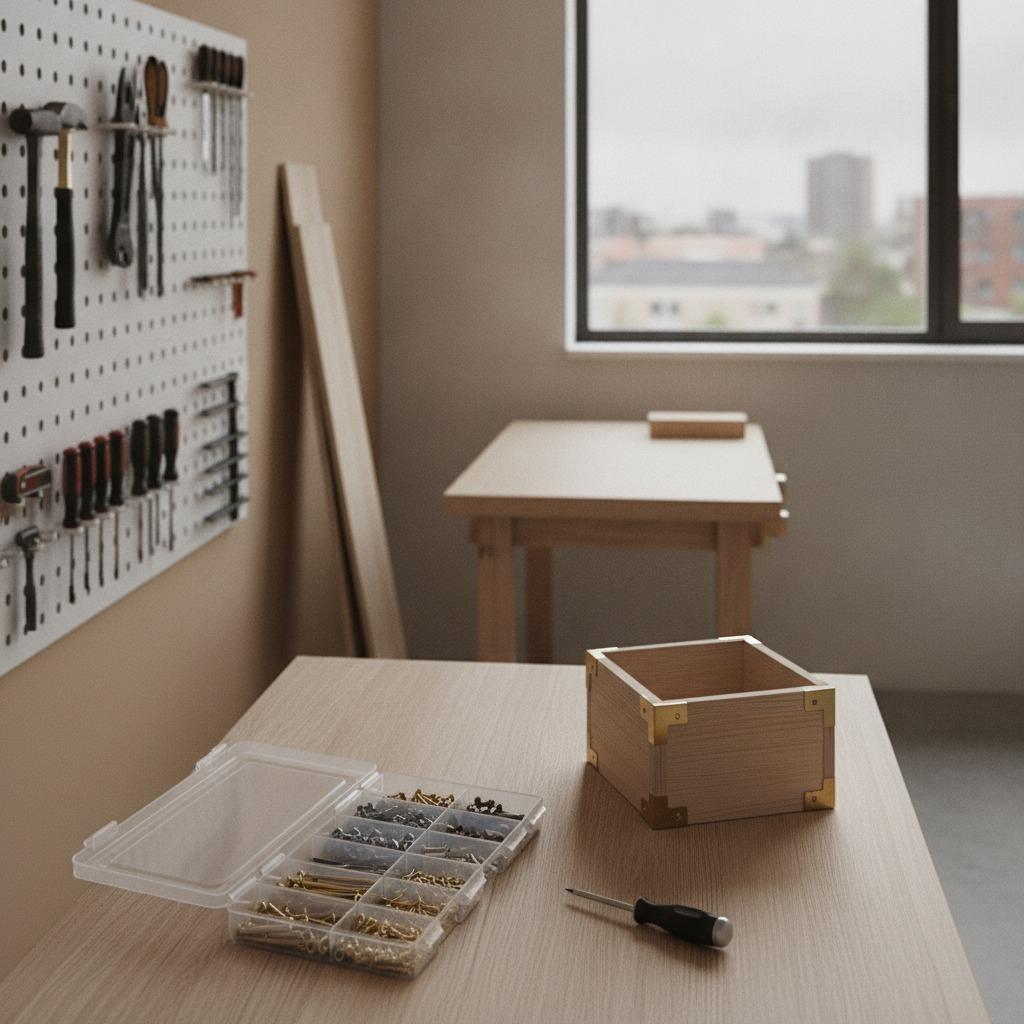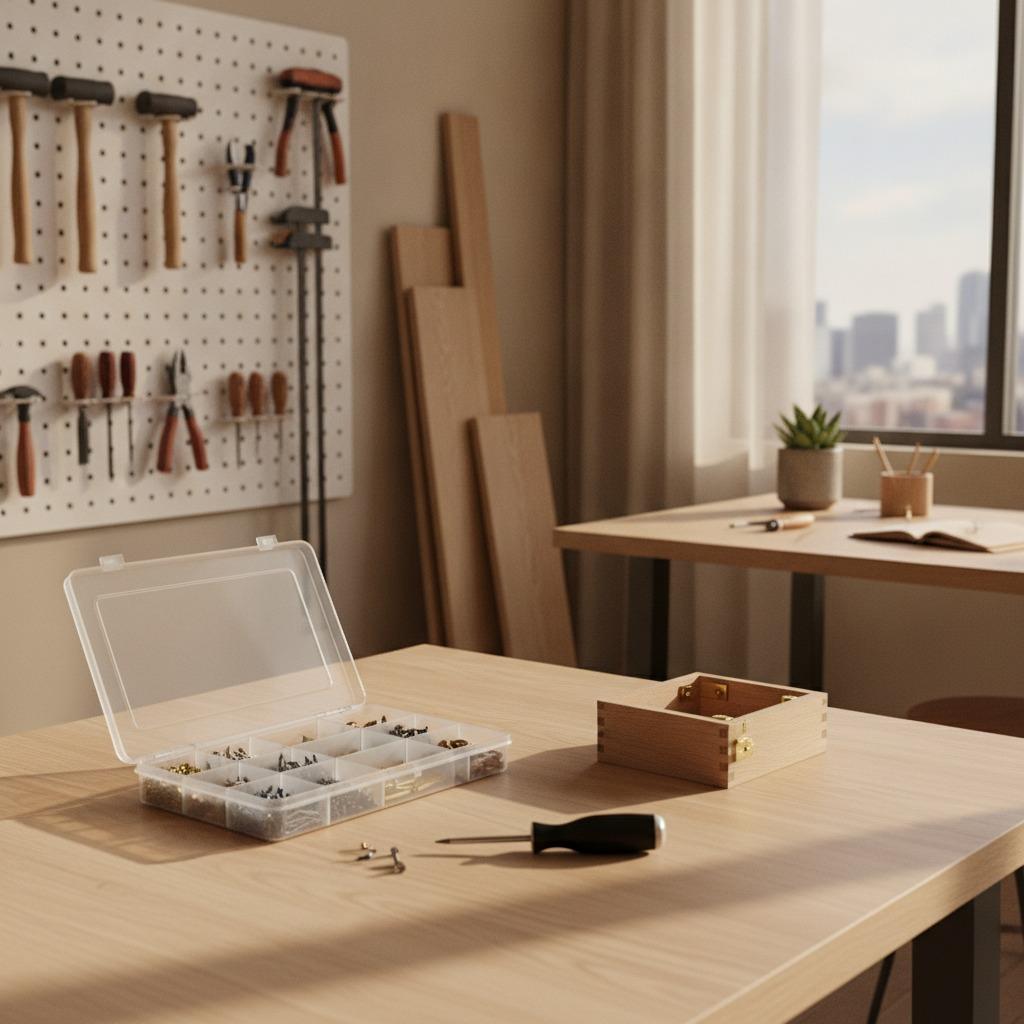

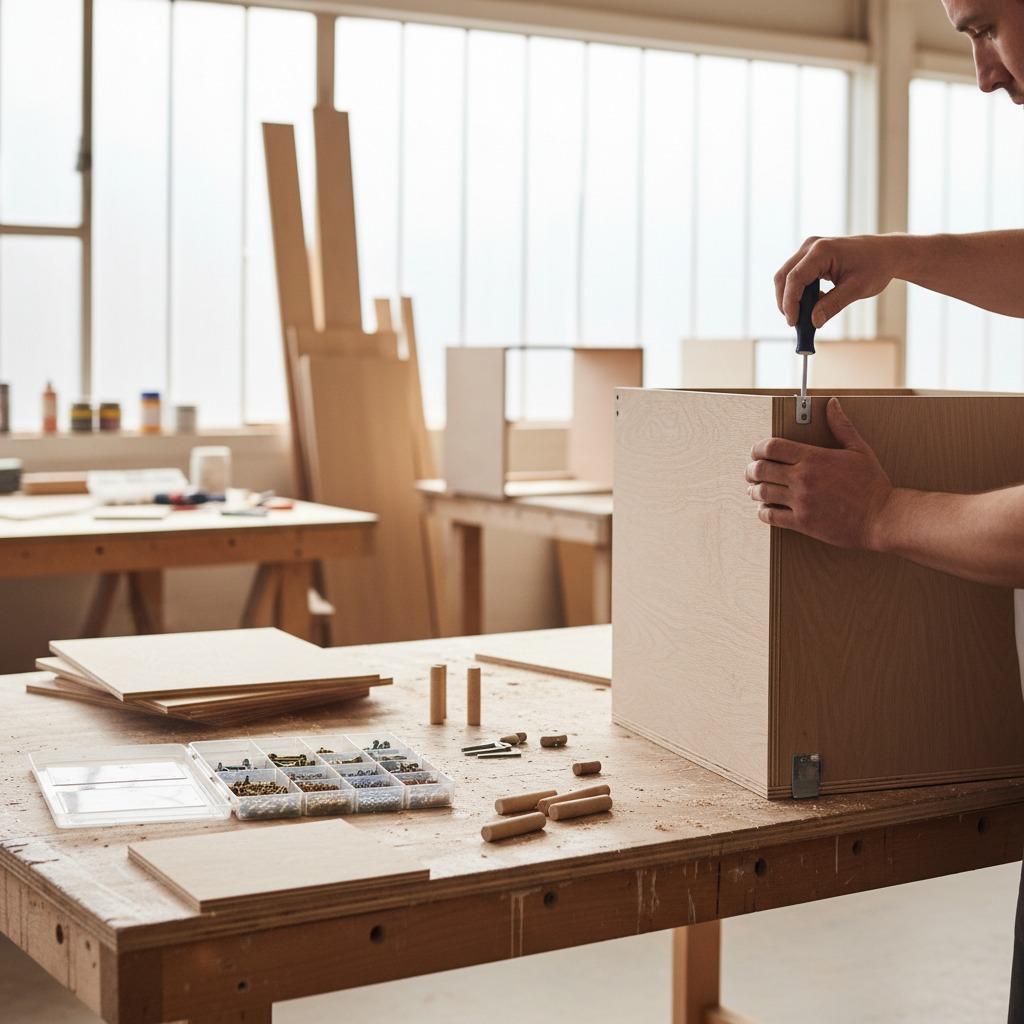
Custom Stamping Hardware Manufacturer: Why Flat-Pack Furniture Buyers Should Care About the Parts Behind the Panel
A flat-pack cabinet usually gets judged by what people can see first.
The panel color. The edge finish. The shape of the storage box. The way the shelf sits inside the frame.
But anyone who has assembled furniture for production knows the quieter truth: the visible panels are only half of the product. The rest depends on the hardware hidden behind them.
A small bracket, connector plate, stamped support piece, screw, dowel, insert, or fastener can decide whether the cabinet pulls square, whether the shelf feels stable, and whether the end user finishes assembly without frustration.
That is why working with a custom stamping hardware manufacturer is not just a side decision for furniture buyers.
For flat-pack furniture, cabinet kits, modular shelving, workshop storage, and private-label furniture programs, stamped hardware affects the full assembly experience. It controls alignment, reinforcement, fixing points, packaging logic, and repeat production.
The part may be small. The impact is not.
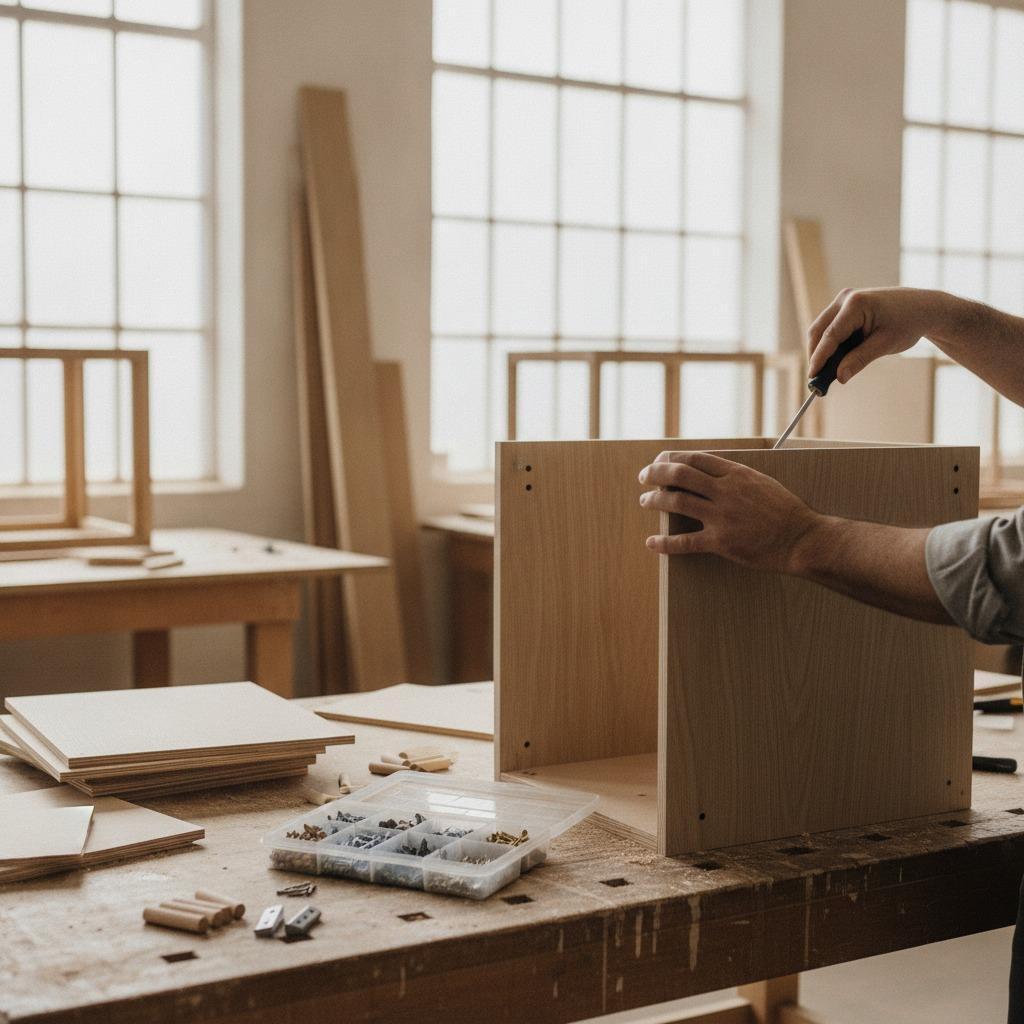 Flat-pack furniture fails at the small contact points
A cabinet panel can be cut cleanly and still assemble badly.
The reason is usually found at the joint.
Maybe the bracket hole is slightly off. Maybe the stamped connector does not sit flat against the panel. Maybe the screw strips because the hardware and substrate were not matched properly. Maybe the panel pulls together on one side but leaves a small gap on the other.
To the buyer, these problems look like production defects. To the customer, they feel like poor furniture quality.
That is the danger with small hardware. It does not look important until it interrupts assembly.
In flat-pack furniture, every small contact point has to work repeatedly. The hardware must fit the panel, accept the fastener, hold under normal use, survive packing and transport, and still be simple enough for a worker or customer to install.
A custom stamped hardware part should not only be shaped correctly.
It should support the real assembly method.
What stamped hardware does in furniture assembly
Stamped hardware is used in furniture because wood-based panels cannot always do the job alone.
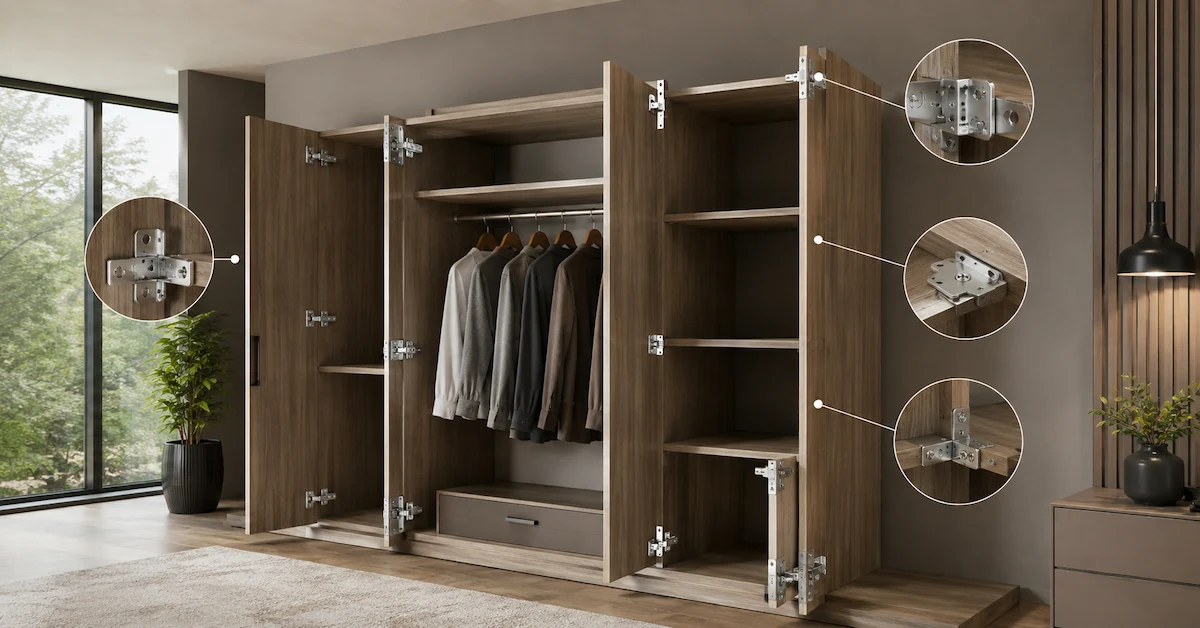
A stamped part may reinforce a corner, support a shelf, connect two panels, guide a fastening point, or distribute load across a wider area. In some designs, it may be visible inside the cabinet. In others, it may sit behind the panel or under a fitting where the customer hardly notices it.
Common furniture stamping parts may include:
- Corner brackets
- Connector plates
- Mounting tabs
- Shelf supports
- Reinforcement plates
- Flat metal washers
- Special clips
- Custom brackets
- Small fixing plates
- Panel joining components
These parts may look simple, but they need the right material thickness, hole position, bending accuracy, surface finish, and compatibility with matching screws or bolts.
A bracket that is “almost right” can still create a crooked cabinet.
A stamped plate that is too thin may flex. One that is too thick may add cost and make assembly awkward. A hole that drifts slightly from the panel drilling pattern may force workers to adjust the part by hand.
That is why custom stamping hardware should be reviewed as part of the furniture structure, not only as a metal component.
Start with the panel material
Furniture buyers sometimes send a hardware drawing and expect the supplier to quote immediately.
That can work for simple parts, but it leaves out one important detail: the substrate.
Particleboard, MDF, plywood, veneered board, and solid wood all behave differently. A screw that holds well in plywood may loosen in a softer board. A bracket that works on a thick side panel may be too aggressive for a thinner divider. A stamped part that performs well in a workshop sample may behave differently after repeated assembly or transport vibration.
Before approving a stamped hardware design, buyers should check:
- Panel material
- Panel thickness
- Hole diameter
- Hole depth
- Edge distance
- Screw type
- Load direction
- Whether the furniture ships flat-packed
- Whether the user will assemble it at home
- Whether the joint may need to be reopened later
The hardware does not work in isolation.
It works inside a panel system.
A capable custom stamping hardware manufacturer should be willing to discuss the board, the fastener, and the assembly method before finalizing the part.
The assembly sequence matters more than the drawing alone
A stamped bracket may look correct on paper.
The problem appears when someone tries to install it.
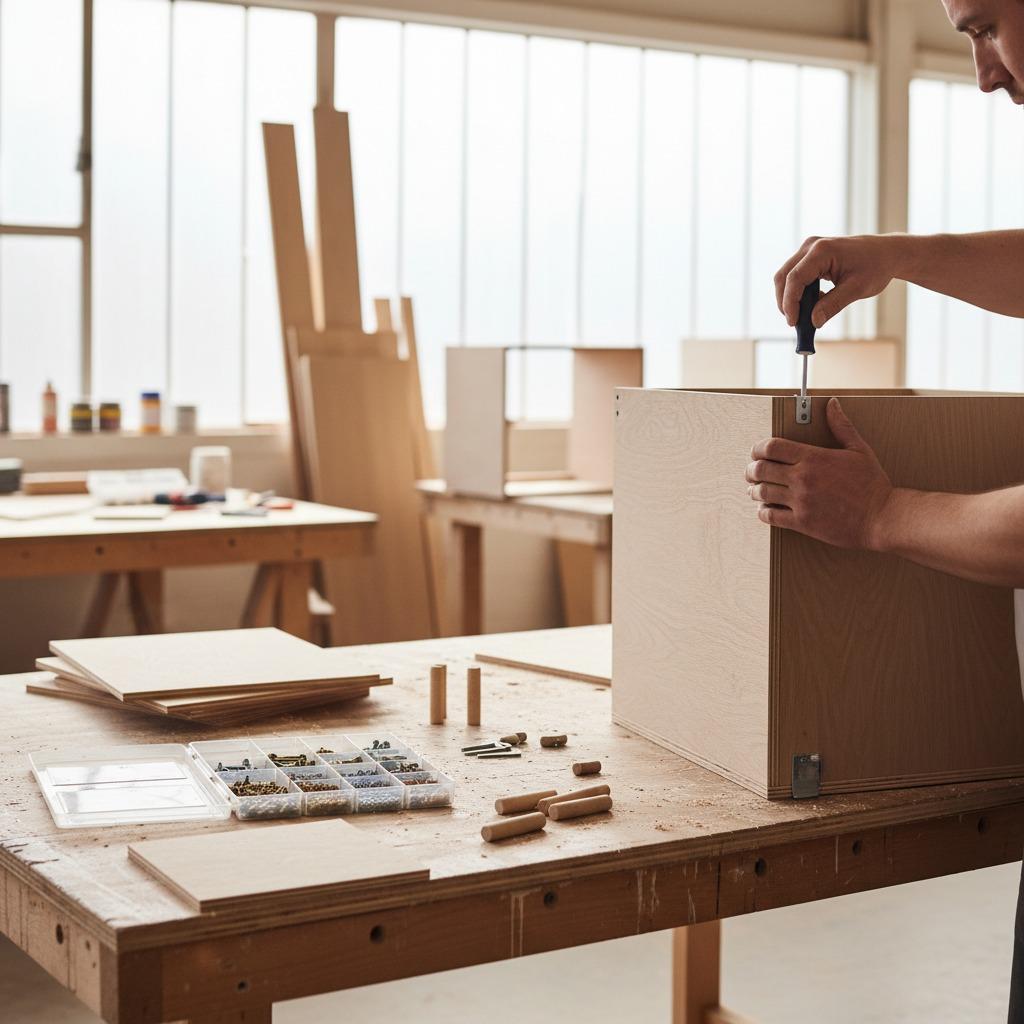
Can the worker reach the screw position? Does the bracket stay in place before tightening? Does the part require two hands when only one can fit inside the cabinet? Does the screwdriver angle damage the finish? Can the end user understand which direction the part should face?
These questions matter in flat-pack furniture.
Factory workers may have jigs, benches, and experience. DIY customers may only have a screwdriver and a printed instruction sheet. A part that is acceptable on a production line may be annoying in home assembly.
That does not mean every kit must be simplified to the lowest level. It means the hardware should match the user.
For factory assembly, speed and repeatability may be the priority. For retail flat-pack furniture, clarity and foolproof installation become more important. For workshop storage or repair kits, durability and easy replacement may matter most.
A good stamped hardware design supports the assembly sequence instead of fighting it.
Custom does not always mean complicated
Custom stamped hardware is useful when standard parts cannot solve the problem.
A furniture project may need a bracket with a special hole spacing. A connector plate may need a specific bend angle. A support tab may need to match a narrow panel. A part may need a different finish to match exposed hardware. A flat-pack program may need a stamped component designed around an existing drilling pattern.
These are practical reasons to customize.
But customization should not be added just to make the part look special.
Every non-standard component brings extra work: drawings, samples, tooling, approval records, dimensional checks, packaging control, and repeat-order management.
The best furniture hardware programs often use a mixed approach.
Standard screws and fasteners are used where they work well. Custom stamped hardware is used where the furniture structure truly needs it.
Jiangmen Jinhe Hardware Co., Ltd. focuses on fasteners, standard parts, and non-standard customization, with products including machine screws, self-tapping screws, micro screws, and precision screws. For furniture buyers, that combination can be useful when a project needs both normal fasteners and customized metal hardware support.
The goal is not to make every part custom.
The goal is to make the cabinet assemble correctly and stay stable.
Tolerance control is where production gets serious
A first sample can be made carefully.
Bulk production is different.
When a furniture line moves into volume, small tolerance changes become more visible. A hole position shifts. A bend angle changes slightly. A stamped edge catches on the panel. A bracket sits flat in one batch but rocks slightly in the next.
These are the problems buyers need to prevent before placing repeat orders.
For custom stamped hardware, buyers should ask how the supplier controls:
- Material thickness
- Hole diameter
- Hole position
- Bend angle
- Flatness
- Burrs and sharp edges
- Surface finish
- Plating consistency
- Batch inspection
- Drawing revisions
In furniture assembly, tolerance is not only an engineering number.
It affects whether workers can install the part quickly without correction. If every tenth bracket needs hand adjustment, the low unit price no longer looks attractive.
A reliable custom stamped hardware manufacturer should be able to explain which dimensions are critical and how they are checked.
Fasteners and stamped parts should be reviewed together
Stamped parts rarely work alone.
They usually need screws, bolts, nuts, washers, inserts, dowels, or plastic fittings. If the stamped part is well made but the matching fastener is wrong, the assembly can still fail.
A screw may not sit properly in the stamped hole. A washer may be needed to spread force. A bolt may require a specific clearance. An insert may be necessary when the panel material cannot hold repeated tightening.
This is why furniture buyers should review the full hardware set.
For example, a small cabinet kit may include:
- Stamped corner brackets
- Self-tapping screws
- Flat washers
- Wooden dowels
- Connector bolts
- Plastic caps
- Panel inserts
- A small installation tool
Each part has a role. Each part also has to match the others.
Jiangmen Jinhe Hardware works with multiple fastener categories, including machine screws, self-tapping screws, micro screws, and precision screws in materials such as stainless steel, iron, and aluminum. That background is useful when a furniture project needs custom stamped hardware plus compatible fastening parts.
A bracket is only as useful as the hardware that installs it.
Surface finish is not just appearance
Furniture hardware may be hidden, semi-visible, or fully visible after assembly.
That changes the finish requirement.
A hidden internal bracket may only need practical corrosion resistance. A visible support piece may need a cleaner surface. A retail furniture kit may need consistent color because customers will see the parts before assembly.
Common finish concerns include:
- Corrosion resistance
- Scratch resistance
- Color consistency
- Burr control
- Plating thickness
- Surface cleanliness
- Compatibility with screws and washers
- Storage and shipping conditions
Buyers should confirm the material and finish clearly before bulk orders.
Do not rely only on photos. A silver part may be zinc plated, nickel plated, stainless steel, or another treatment. A black part may be coated steel, plastic, or another material entirely.
If the furniture will be used in kitchens, bathrooms, garages, workshops, or humid storage areas, finish selection becomes more important.
A stamped part may be structurally acceptable but still create complaints if it rusts, scratches, or looks inconsistent.
Packaging is part of the hardware decision
Flat-pack furniture depends on organized hardware.
The customer or worker opens the carton and expects the parts to make sense. If brackets, screws, washers, dowels, and caps are mixed together, assembly slows down. If one part is missing, the product may not be completed.
For custom stamped hardware, packaging should be discussed early.
Buyers should confirm:
- Quantity per furniture unit
- Whether stamped parts are separated from screws
- Whether similar parts need labels
- Whether parts are packed by model or assembly step
- Whether sharp edges need protection
- Whether plated surfaces can rub during transit
- Whether spare parts are included
- Whether the kit matches the instruction sheet
A compartmented organizer or separated hardware bag is not only a convenience. It reduces picking errors and helps the user identify the correct part quickly.
For furniture brands, better packaging can reduce service calls and replacement requests.
Inspection should include function, not only dimensions
Dimensional inspection matters, but it is not the whole story.
A stamped part may meet the drawing and still be awkward in assembly. It may fit the screw but not the panel. It may look acceptable but leave a small gap once installed.
Buyers should test function before volume approval.
Useful checks include:
- Does the part sit flat against the panel?
- Do the holes align with the drilling pattern?
- Are there burrs that may scratch the board?
- Does the screw seat properly?
- Does the part flex under load?
- Does the joint remain square after tightening?
- Does the part fit the packaging method?
- Can workers install it without special handling?
Jiangmen Jinhe Hardware states that its products undergo inspection before delivery and are supplied with necessary documentation. For furniture buyers, documentation is useful, but it should be paired with real assembly testing.
A stamped part should be checked on the bench, not only on the measurement table.
Supply support matters when hardware must arrive with the panels
Flat-pack furniture schedules are often tight.
Panels, cartons, instruction sheets, labels, hardware bags, and packaging materials all need to arrive together. If the stamped hardware is delayed, the whole product may sit unfinished.
This is especially true for export orders, cross-border e-commerce, and private-label furniture programs.
Jiangmen Jinhe Hardware notes support for logistics, warehousing, supply chain services, and foreign trade. For buyers managing several SKUs or recurring orders, that support can reduce coordination pressure.
The value is not only transportation.
It is the ability to keep hardware supply aligned with production and packing.
A good part delivered late is still a problem.
Common sourcing mistakes buyers should avoid
One mistake is assuming a generic stamped part is close enough.
In furniture assembly, “close enough” can mean a loose shelf, a tilted bracket, a stripped hole, or a cabinet that does not sit square.
Another mistake is reviewing the stamped part without the matching screw.
The part and fastener work together. Approving them separately can hide problems until assembly.
A third mistake is ignoring the user.
A part that is easy for a trained worker may frustrate a home user. If the product is flat-packed, the assembly experience matters.
Buyers also sometimes focus too much on panel finish and not enough on the hidden hardware.
A clean surface cannot compensate for a weak joint.
Finally, packaging is often left too late.
If stamped parts have sharp edges, visible finishes, or similar shapes, they need proper separation and labeling before the kit reaches the user.
What buyers should ask before placing an order
Before choosing a custom stamping hardware manufacturer, ask:
What material and thickness do you recommend for this application?
Can the part match our panel thickness and drilling pattern?
What bend and hole tolerances can be controlled?
Can burrs and sharp edges be removed or controlled?
What finishes are available?
Can the stamped part be tested with our screws and panels?
Can you support non-standard customization?
What inspection documents are provided?
How are drawing revisions managed?
Can parts be packed by furniture model or hardware kit?
Can you support repeat orders and delivery coordination?
The answers should be practical.
A supplier that understands furniture will talk about panels, screws, assembly order, tolerance, packaging, and repeat production—not only metal thickness and price.
Frequently Asked Questions
What does a custom stamping hardware manufacturer provide for furniture buyers?
A custom stamping hardware manufacturer can provide brackets, connector plates, support tabs, reinforcement pieces, fixing plates, and other stamped metal parts designed for furniture assembly.
Are stamped hardware parts only used in heavy-duty furniture?
No. They are used in light cabinets, modular shelves, storage boxes, workshop organizers, office furniture, and flat-pack products when reinforcement or accurate connection is needed.
Should stamped hardware be customized for every furniture project?
Not always. Standard parts are often better when they fit reliably. Customization is useful when the panel design, hole pattern, load requirement, or assembly method requires a special part.
Why should screws and stamped parts be reviewed together?
Because the stamped part depends on the matching fastener. Screw length, head type, thread, washer use, and tightening force can all affect the final joint.
How can buyers reduce assembly problems?
Test the stamped part with real panels, real screws, and the actual assembly sequence before approving bulk production.
Why does packaging matter for stamped furniture hardware?
Packaging prevents mixing, scratching, missing parts, and user confusion. In flat-pack furniture, the hardware kit is part of the customer’s assembly experience.
Good stamped hardware makes the cabinet feel better than it looks
A well-made cabinet does not rely only on attractive panels.
It relies on the hidden parts that pull those panels together, hold them square, and keep the assembly process under control.
That is why sourcing from a capable custom stamping hardware manufacturer matters. The right supplier helps buyers connect the metal part to the panel, the screw, the packaging, and the production schedule.
For custom stamped hardware, furniture stamping parts, cabinet connector hardware, standard fasteners, and non-standard customized components, Jiangmen Jinhe Hardware Co., Ltd. can discuss materials, dimensions, fastener matching, sample testing, inspection, packaging, and supply support.
For direct inquiries:
Tel/WeChat: +86 13729150102
WhatsApp: +86 13322893939
Email: sharon@hkhomeideas.com
Start with the panel material, joint type, hardware drawing, screw requirement, packaging method, and expected order quantity.
Once the assembly conditions are clear, the right stamped hardware becomes much easier to define.