
Flat Pack Furniture Hardware Supplier: What Buyers Should Check Before Bulk Orders
Flat pack furniture hardware looks easy to buy until production depends on it.
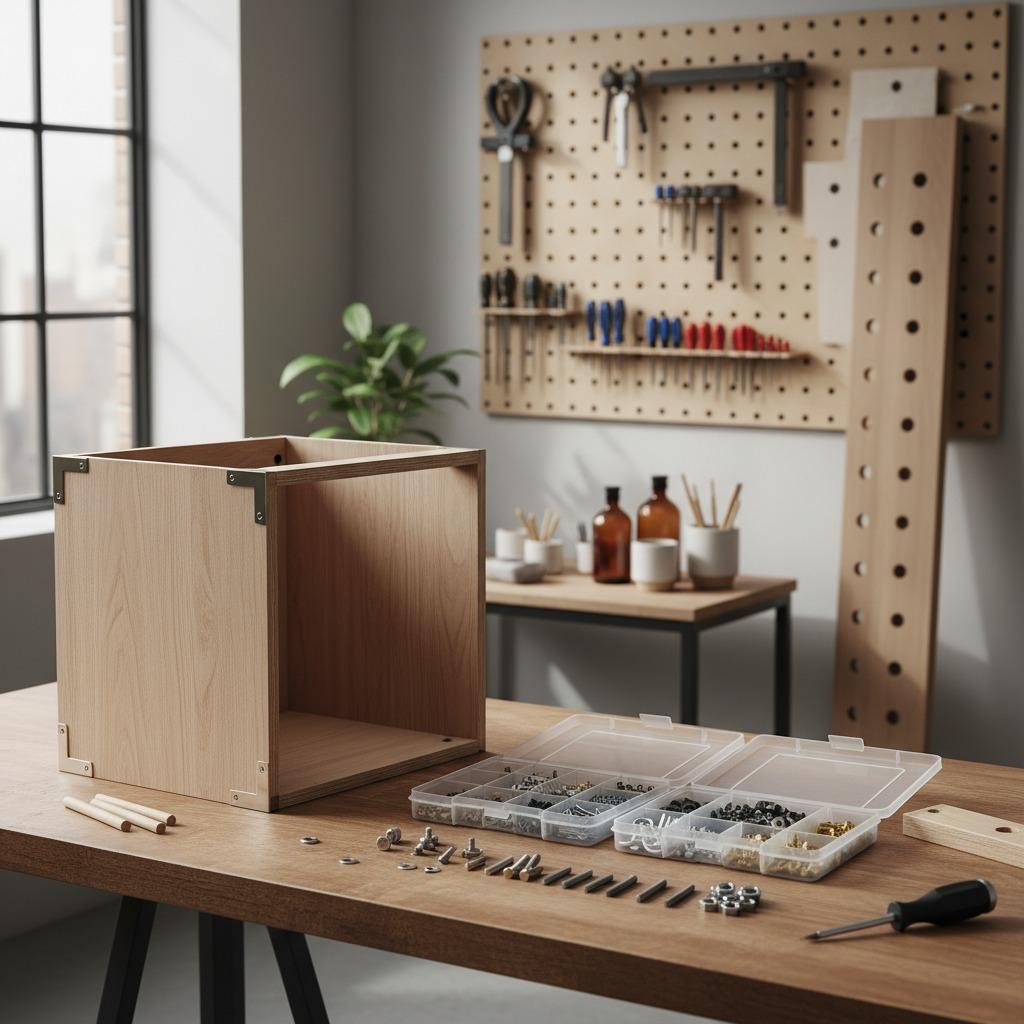
On a sample table, the parts seem harmless enough: a few screws, washers, brackets, spacers, caps, maybe a connector or two. Nothing looks complicated. Then the first batch reaches the assembly line, and the small details begin to show their teeth.
One screw is a little too long for the panel. A black plastic spacer is missing from one kit. Two brackets look almost the same, but only one fits the drilling pattern. Workers start opening bags to compare parts. A packing team waits for clarification. Later, a customer writes that the cabinet cannot be finished because one small fitting was not included.
That is the point where a low-cost hardware item becomes an expensive problem.
Choosing a flat pack furniture hardware supplier is not only about finding someone who can sell fasteners. It is about finding a supplier who understands how those parts move through furniture production, packing, shipping, and final assembly.
For cabinet makers, OEM furniture brands, wholesalers, and cross-border sellers, the right supplier helps keep the furniture program orderly. The wrong one may still ship parts on time, but the buyer ends up paying for sorting, rework, replacements, and complaints.
The difficult part is not always the fastener
Many sourcing problems begin because buyers treat flat pack furniture fittings as ordinary loose hardware.
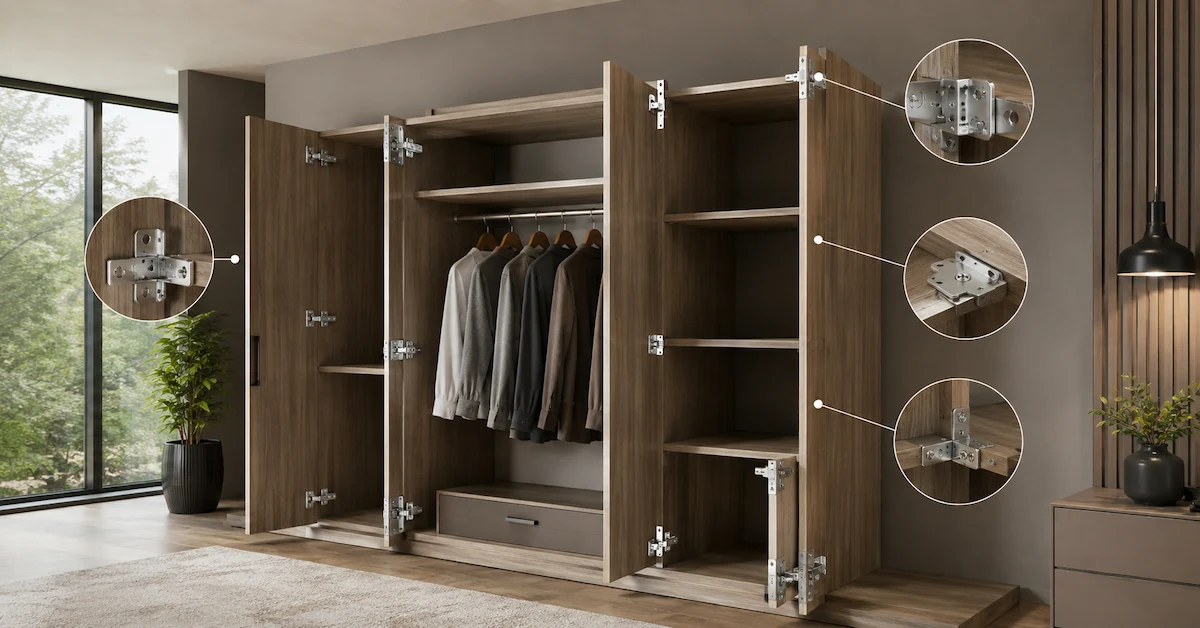
In reality, these parts belong to a system.
A screw has to match the panel thickness. A washer has to fit the bracket. A spacer has to sit in the correct place. A connector must work with the hole depth and the matching component. If the furniture is customer-assembled, the hardware also has to make sense to someone who may only have a printed instruction sheet and a small tool.
That makes the buying decision more specific than it first appears.
The supplier needs to know how the product is assembled, not only which parts are required. A factory-assembled drawer box, a retail flat-pack cabinet, and an after-sales repair kit may use similar components, but the packing logic is different.
A production line may accept bulk cartons if workers pull from organized bins. A DIY furniture product needs clear bags, accurate labels, and fewer chances for the user to choose the wrong screw. A repair program may need small replacement packs with model numbers and part identification.
Same hardware family. Different job.
What an organized workbench tells you
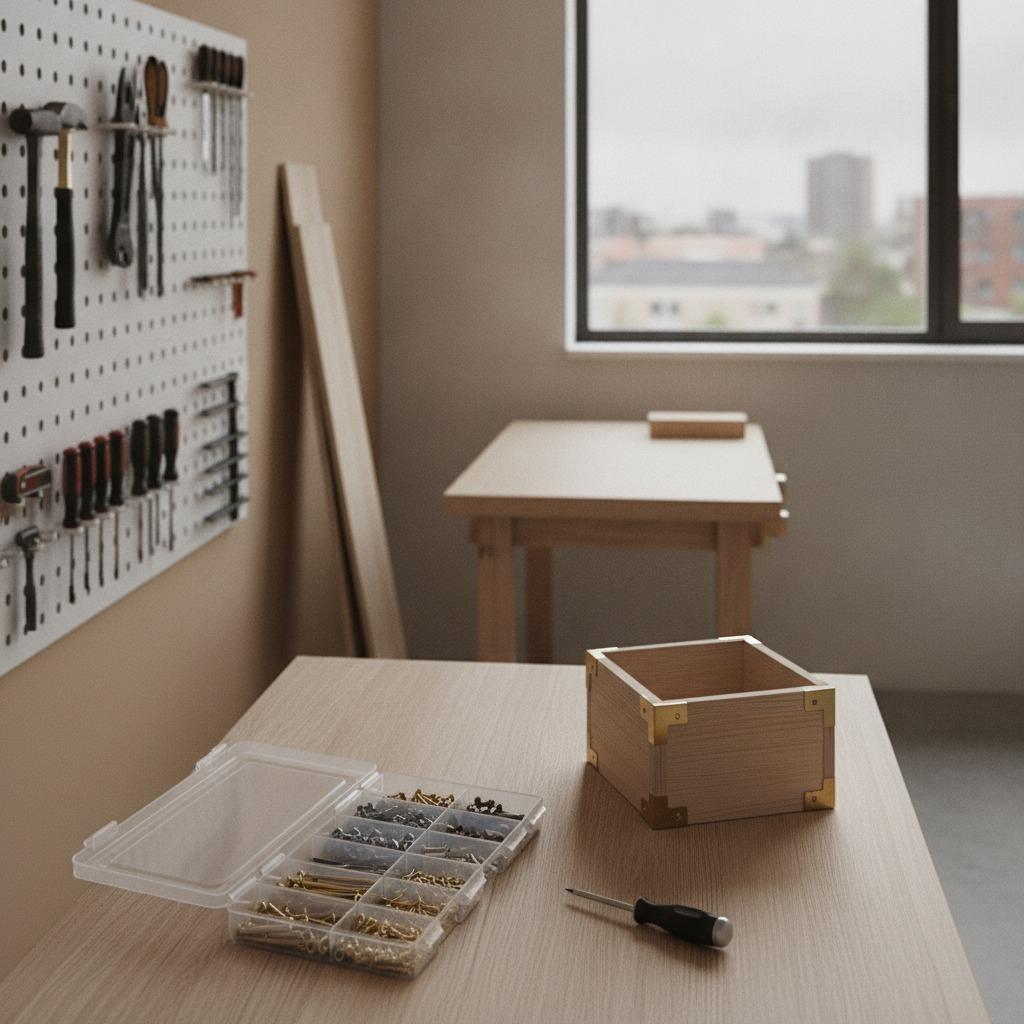
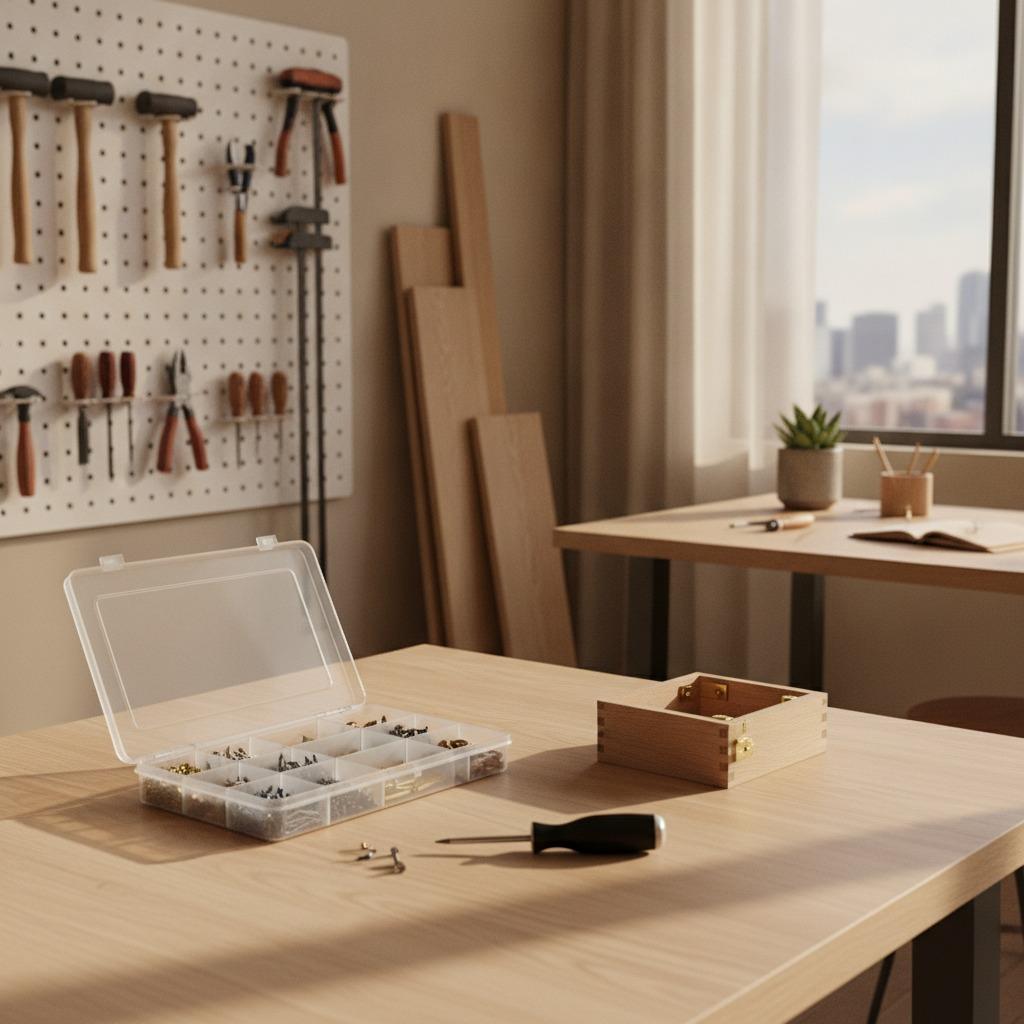
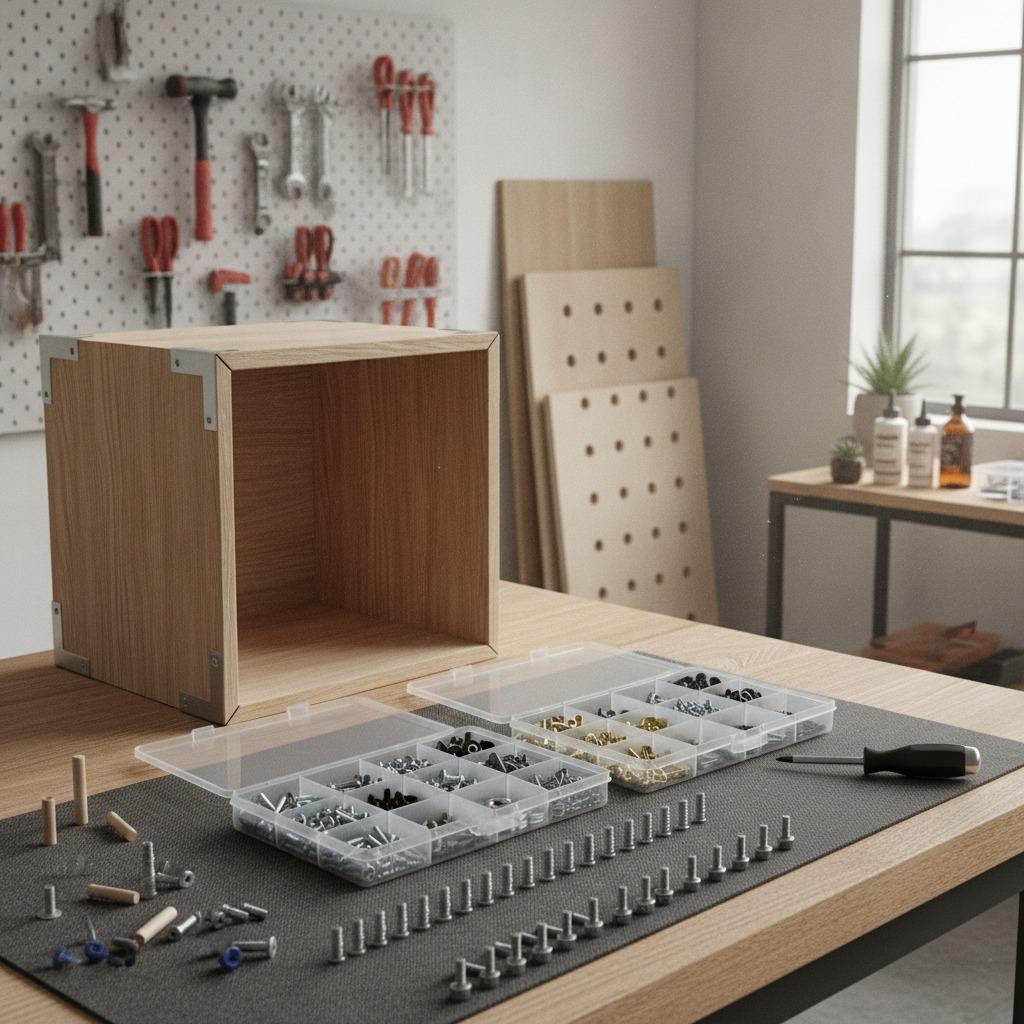
A workbench with clear compartment trays says more than it seems to.
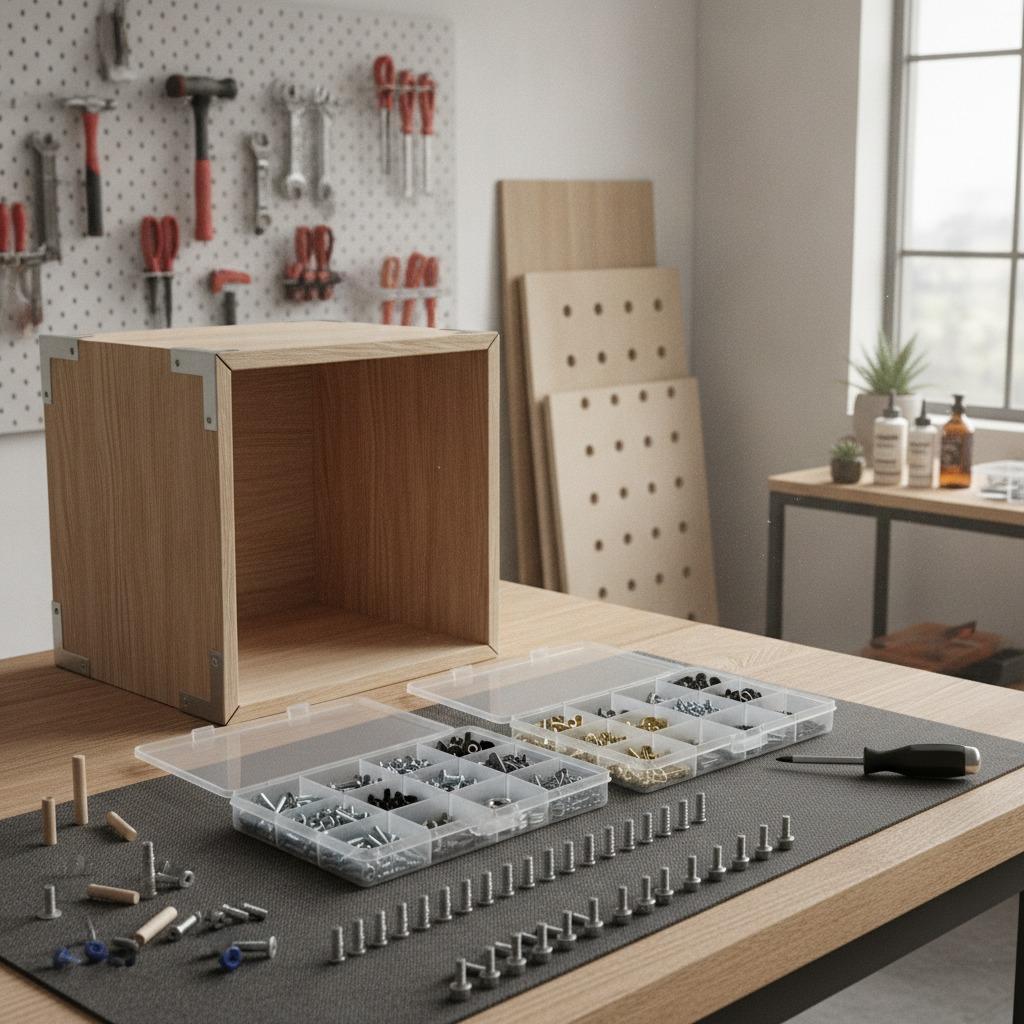
In flat pack production, people need to find small parts quickly. Clear boxes, separated bins, and visible assortments reduce the number of guesses workers make during assembly. That sounds minor, but it matters when several furniture models share similar screws or caps.
One short screw and one slightly longer screw may look nearly identical in poor lighting. A black cap for one cabinet series may not fit another. A brass-colored insert may be easy to confuse with a similar fitting if the tray is not separated.
The organizer tray is not just a neat storage choice. It reflects a production habit: keep similar parts apart before they create trouble.
Good flat pack furniture accessories should be handled with the same discipline. Whether the parts are packed in polybags, trays, retail kits, or bulk cartons, the layout should reduce mistakes rather than push the sorting work onto the buyer.
A supplier that understands kitting can save labor after the shipment arrives.
Why the kit format matters as much as the parts
A furniture hardware kit can fail even when every individual component is acceptable.
The reason is simple: the kit has to be complete, readable, and repeatable.
A screw may meet its drawing. A bracket may have the right finish. A spacer may be made from the right material. But if the wrong quantity enters the bag, the customer still cannot finish the cabinet.
This is why buyers should review the kit as a finished product.
A useful kit should answer several questions before anyone starts assembling:
What furniture model is this for?
How many pieces should be inside?
Are similar fasteners separated?
Which parts belong to which step?
Is there a spare-part policy?
Can the same packing format be repeated next month?
These questions may sound basic, but they are exactly where many wholesale hardware programs become messy.
A supplier may prepare a beautiful sample kit by hand. The real test is whether the same structure can be repeated in bulk production without mixing part numbers, changing finishes, or substituting similar-looking components.
Standard parts are helpful when they truly fit
Standard fasteners are often the best choice for flat pack furniture.
They are easier to replace, easier to reorder, and usually faster to produce. For many cabinets, tables, shelves, and drawer boxes, standard screws, nuts, washers, brackets, and spacers are enough.
But “standard” does not mean “universal.”
A screw that works well in one panel thickness may be too long for another. A bracket that fits one hole pattern may force rework in the next design. A washer may seem unimportant until the joint no longer tightens evenly without it.
Buyers should confirm the actual application before approving a standard part.
That means checking panel material, hole diameter, drilling depth, edge distance, installation tool, and tightening force. It also means testing the fastener in the furniture, not only measuring it on a desk.
A supplier that only asks for quantity and finish may quote quickly. A supplier that asks about the panel and assembly method is more likely to prevent problems before they reach production.
Customization should solve a real assembly issue
Custom furniture fasteners are useful when the product design genuinely requires them.
Maybe the cabinet uses a thinner panel. Maybe the screw head needs to sit lower. Maybe the bracket needs a different hole spacing. Maybe the kit needs a special label or model-specific bag. These are practical reasons for customization.
Customization is less useful when it adds complexity without improving the assembly result.
A custom part brings drawings, samples, tooling, minimum quantities, approval records, and replacement planning. If a standard fastener works reliably, it may be the better long-term choice.
The best approach is usually mixed: standard parts wherever possible, customized parts only where the furniture design requires them.
Jiangmen Jinhe Hardware Co., Ltd. works with machine screws, self-tapping screws, micro screws, precision screws, and non-standard customized fasteners. For flat pack furniture buyers, that kind of range can be useful when a project needs both ordinary fasteners and a few project-specific parts.
The key is to define the problem first. Then decide whether customization is worth it.
Finish and material should not be guessed from a photo
Furniture hardware often uses familiar finishes: zinc plating, nickel-like silver finishes, black coating, brass-colored plating, stainless steel, plastic caps, or nylon spacers.
In a photo, these details can look clear. In a specification, they are not clear enough.
A bright silver screw may be zinc plated or treated another way. A black piece may be plastic, coated metal, or rubber-like material. A brass-colored insert may not be solid brass.
Buyers should confirm the base material and finish in writing.
This is especially important when the furniture will be stored in humid warehouses, shipped internationally, used in bathrooms or utility rooms, or sold into markets where corrosion resistance matters.
For visible flat pack furniture accessories, appearance consistency matters too. A cap or bracket does not need to be decorative, but if one batch looks noticeably different from another, customers may read that as poor quality.
The finish should match the product environment, not only the sample photo.
Inspection should include the full hardware set
Fastener quality control is important. Kit quality control is just as important.
A supplier may inspect length, diameter, thread, head shape, finish, and material. That is useful. But a flat pack furniture program also needs inspection of the finished kit.
The buyer should know how the supplier checks:
- Quantity per bag or tray
- Similar fastener separation
- Label accuracy
- Furniture model number
- Packaging condition
- Carton marking
- Lot or batch traceability
- Repeat-order consistency
A tidy kit can still fail if the wrong screw length is packed inside it.
Jiangmen Jinhe Hardware states that products undergo inspection before delivery and are accompanied by necessary documentation. For B2B buyers, documentation helps with incoming inspection, traceability, and internal quality records.
Still, the buyer should make sure the documents match the actual risk.
If the main risk is missing parts, a dimensional report alone is not enough. If the main risk is panel damage, screw length and head style need closer attention. If the main risk is mixed SKUs, label and packing checks become critical.
Packaging is where small mistakes become customer complaints
Flat pack furniture usually reaches the end user as a promise: open the carton, follow the steps, assemble the product.
The hardware bag either supports that promise or breaks it.
If the customer has to sort ten similar fasteners before starting, the product already feels less professional. If one small part is missing, the assembly stops completely. If a longer screw is used in the wrong location, the panel may be damaged.
Packaging should therefore be designed around the person who opens it.
For factory use, bulk hardware may be acceptable when workers have bins and experience. For customer assembly, the kit should be clearer. Similar screws should be separated. Labels should be readable. The bag should not tear during transport. The parts should match the instruction sheet.
Buyers should confirm:
- Bag or tray format
- Quantity per furniture unit
- Part separation method
- Spare-part quantity
- Label content
- Barcode or QR code requirement
- Carton quantity
- Counting method
- Final inspection process
A slightly more expensive kit format may cost less than after-sales replacement work.
Logistics support matters because hardware arrives last too often
Small parts can hold up large shipments.
A furniture factory may have panels ready, cartons printed, and production space scheduled. If the hardware arrives late or incomplete, everything waits.
This is common in export and cross-border furniture programs, where panels, instructions, labels, packaging, and hardware may come from different sources.
A flat pack furniture hardware supplier with warehousing, domestic logistics, international freight coordination, or supply chain support can reduce friction. Jiangmen Jinhe Hardware notes support for logistics, warehousing, freight forwarding, and related services.
For buyers managing several SKUs, that can matter.
The value is not only shipping. It is timing, replenishment, and fewer emergency conversations when one small component becomes urgent.
Supplier response time is part of the cost
Hardware problems are rarely discovered at a convenient moment.
They appear when the line is running, when a shipment is being packed, or when customers begin reporting the same missing part.
At that point, slow communication costs money.
A useful supplier should be able to check drawings, confirm part numbers, review kit records, and propose a correction quickly. Jiangmen Jinhe states that customer support responds within 30–60 minutes and provides solutions within two hours for issues. Buyers should verify service expectations during real cooperation, but the point is practical.
When hardware affects production, response speed is not a soft service feature.
It is part of the supply risk.
Common mistakes in flat pack hardware sourcing
The first mistake is assuming similar-looking parts are interchangeable.
They are not. A slight difference in length, thread, finish, head style, or bracket geometry can change assembly performance.
The second mistake is testing loose parts without testing the kit.
A screw may be acceptable. A bracket may be acceptable. A spacer may be acceptable. But the complete furniture may still assemble poorly if the parts do not work together.
The third mistake is choosing the lowest unit price without counting the hidden cost.
Sorting, rework, repacking, customer complaints, replacement shipments, and delayed production can erase a small price advantage quickly.
The fourth mistake is approving a sample without checking repeat supply.
A sample kit packed carefully by hand does not prove that the supplier can repeat the same component mix in larger volumes.
The last mistake is discussing packaging too late.
If the hardware must be packed by furniture model, assembly step, or retail SKU, that should be part of the quotation from the beginning.
What buyers should ask before ordering
Before choosing a flat pack furniture hardware supplier, ask direct questions:
Can you provide the exact hardware breakdown?
Can you pack kits by furniture model?
Can similar screws be separated?
What materials and finishes are available?
Can you support non-standard fasteners?
What inspection documents are provided?
How do you verify kit completeness?
Can labels, barcodes, or model numbers be customized?
Can the same kit format be repeated later?
What logistics or warehousing support is available?
What happens if a shortage or mismatch is found?
The answers should not be vague.
A good supplier can explain how the hardware will be controlled from production to packing to shipment.
Frequently Asked Questions
Are flat pack furniture fittings interchangeable?
No. Similar fittings may differ in length, thread, head shape, finish, material, or geometry. These small differences can affect assembly and joint strength.
What should buyers request first from a supplier?
Request samples, product specifications, inspection documents, packaging details, and a full kit breakdown if the parts will be supplied as an assembly set.
Can flat pack furniture hardware be customized?
Yes. Screw length, head style, thread type, finish, spacers, brackets, labels, and kit packaging can be customized when the furniture design requires it.
Why is packaging important for flat pack furniture accessories?
Packaging helps prevent missing parts, mixed fasteners, sorting delays, and customer assembly problems. For flat pack furniture, the hardware bag is part of the user experience.
Should buyers test the hardware before bulk orders?
Yes. Test the parts in the actual panel material and assembly sequence. Loose component inspection is not enough.
Is the cheapest supplier always the best option?
No. Buyers should consider total cost, including sorting labor, rework, missing-part complaints, replacement shipments, delivery reliability, and supplier response speed.
A good supplier makes small parts feel manageable
A dependable flat pack furniture hardware supplier does not make the buying process more complicated.
It makes the assembly process more predictable.
The correct parts arrive. The kit matches the furniture model. Similar screws are separated. Labels are clear. Replacement quantities are available. The next order matches the approved sample.
That is what buyers are really purchasing.
For flat pack furniture fittings, flat pack furniture accessories, OEM hardware kits, standard fasteners, and custom furniture fasteners, Jiangmen Jinhe Hardware Co., Ltd. can discuss product specifications, kit formats, inspection, warehousing, logistics, and export support.
For direct inquiries:
Tel/WeChat: +86 13729150102
WhatsApp: +86 13322893939
Email: sharon@hkhomeideas.com
Start with the assembly requirements, panel details, hardware list, packaging format, and delivery schedule.
When those details are clear, supplier comparison becomes much easier—and much more honest.