
Flat Pack Furniture Hardware Supplier: Why Organized Kits Matter in Production
A flat pack cabinet can be well designed, accurately drilled, and neatly packed, yet still fail at the last step because of one small hardware problem.
A screw is missing. A washer is mixed with another size. The wrong fastener is packed for one panel. The customer opens the carton, follows the instruction sheet, and suddenly cannot finish the product.
That is why choosing a flat pack furniture hardware supplier is not just about buying screws, nuts, washers, spacers, and connectors at a lower unit price.
For furniture manufacturers, wholesalers, OEM buyers, and cross-border sellers, hardware controls far more than the joint itself. It affects packing speed, assembly accuracy, warehouse handling, replacement service, and how customers judge the finished furniture.
The supplier is not only selling metal parts.
A reliable supplier helps keep order inside the furniture program.
Flat pack furniture depends on small parts being exactly right
Flat pack furniture works because every component arrives ready for a predictable assembly process.
The panels are cut and drilled. The instructions show a sequence. The hardware bag contains the fittings required for each step. When everything matches, the product feels simple.
When the hardware does not match, the entire product becomes frustrating.
This is why flat pack furniture fittings must be selected and packed around the actual furniture design. A generic assortment may look useful, but production furniture rarely needs a random mix of fasteners. It needs the correct fasteners in the correct quantity, packed in a format that supports the next stage.
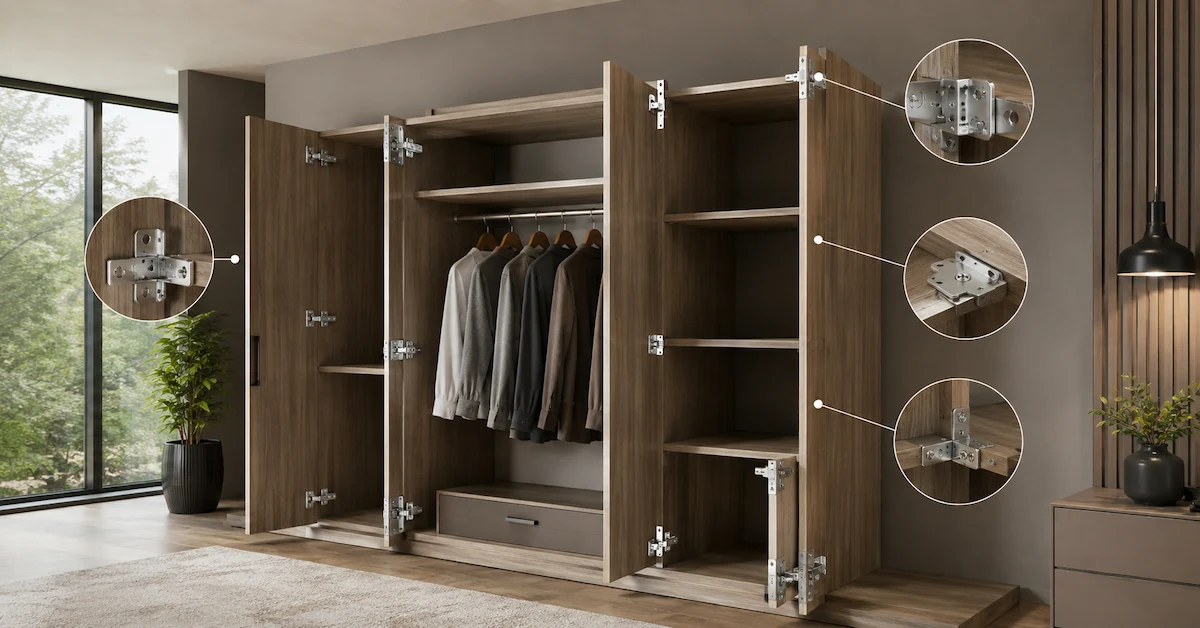
For example, a wardrobe hardware kit may include:
- Connector bolts
- Cam fittings
- Self-tapping screws
- Machine screws
- Washers
- Plastic caps
- Spacers
- Brackets
- Threaded inserts
- Dowels
- A small installation tool
Each part may be inexpensive. Each part may also be essential.
If one connector is absent, the product cannot be assembled. If two similar screw lengths are mixed, the wrong one may damage the panel. If the kit label is unclear, warehouse workers may send the wrong hardware set with the right furniture panels.
Small parts create large consequences when they are not controlled.
A supplier should understand kitting, not only fasteners
Many companies can sell fasteners in bulk.
That does not automatically make them suitable for flat pack furniture programs.
A flat pack furniture hardware supplier needs to understand how furniture hardware moves through production. The parts are not always poured into a carton and shipped loose. They may need to be counted, separated, labeled, packed by model, packed by assembly step, or prepared for after-sales replacement.
This is where kitting discipline becomes important.
A good supplier should be able to work from a bill of materials, confirm quantities, control part numbers, and repeat the same kit format across future orders.
For OEM furniture production, that matters more than many buyers expect. Once a kit format is approved, the buyer needs the next shipment to match the same structure. The same screw length. The same finish. The same packaging. The same label. The same spare-part policy.
A supplier that treats each order as a loose fastener shipment may not be prepared for that level of control.
What the workshop organizer shows about real production needs
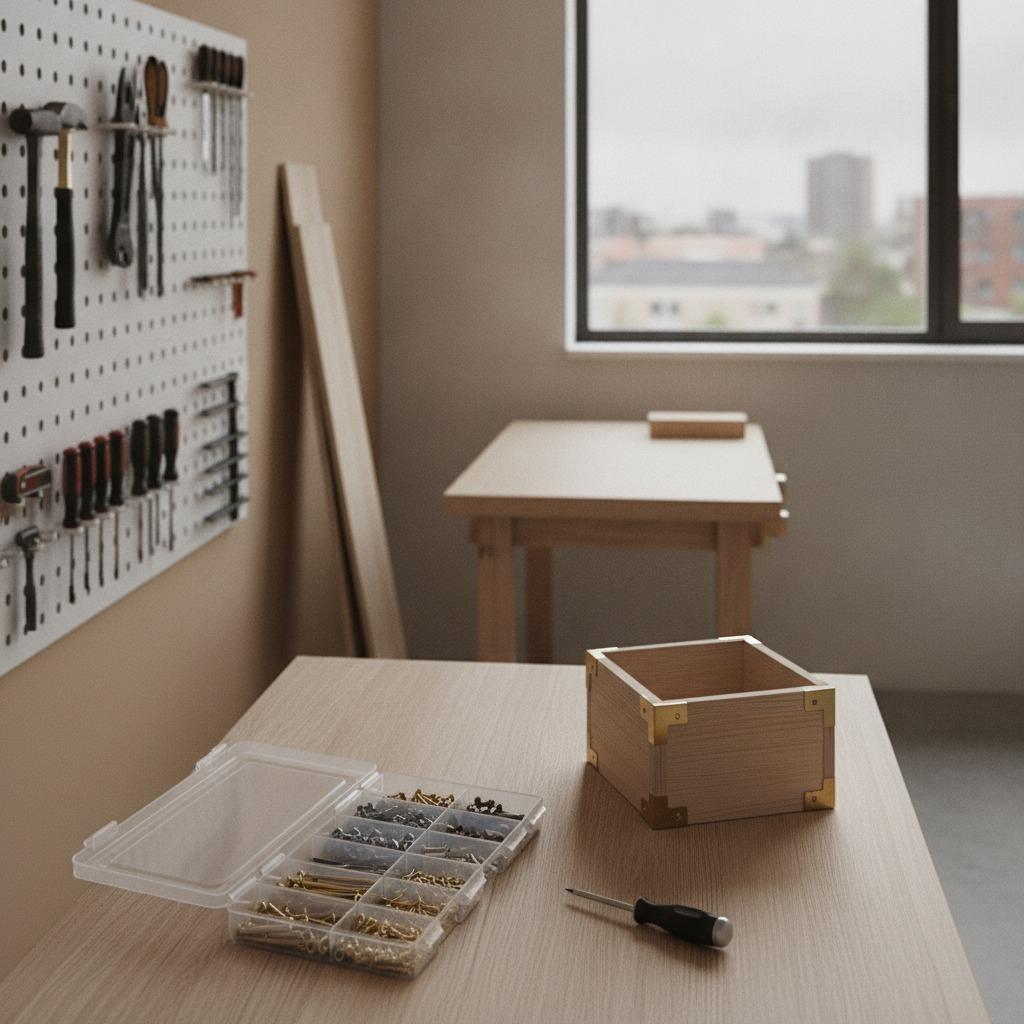
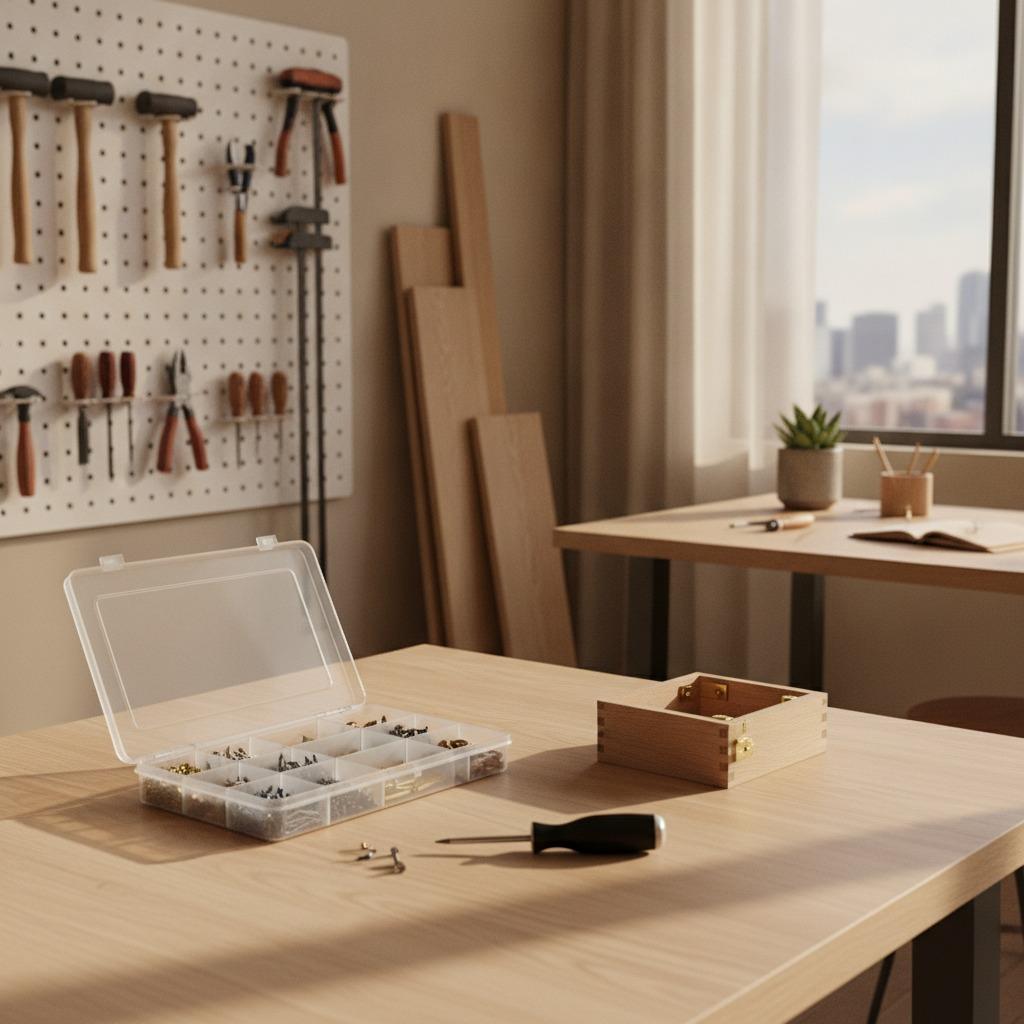
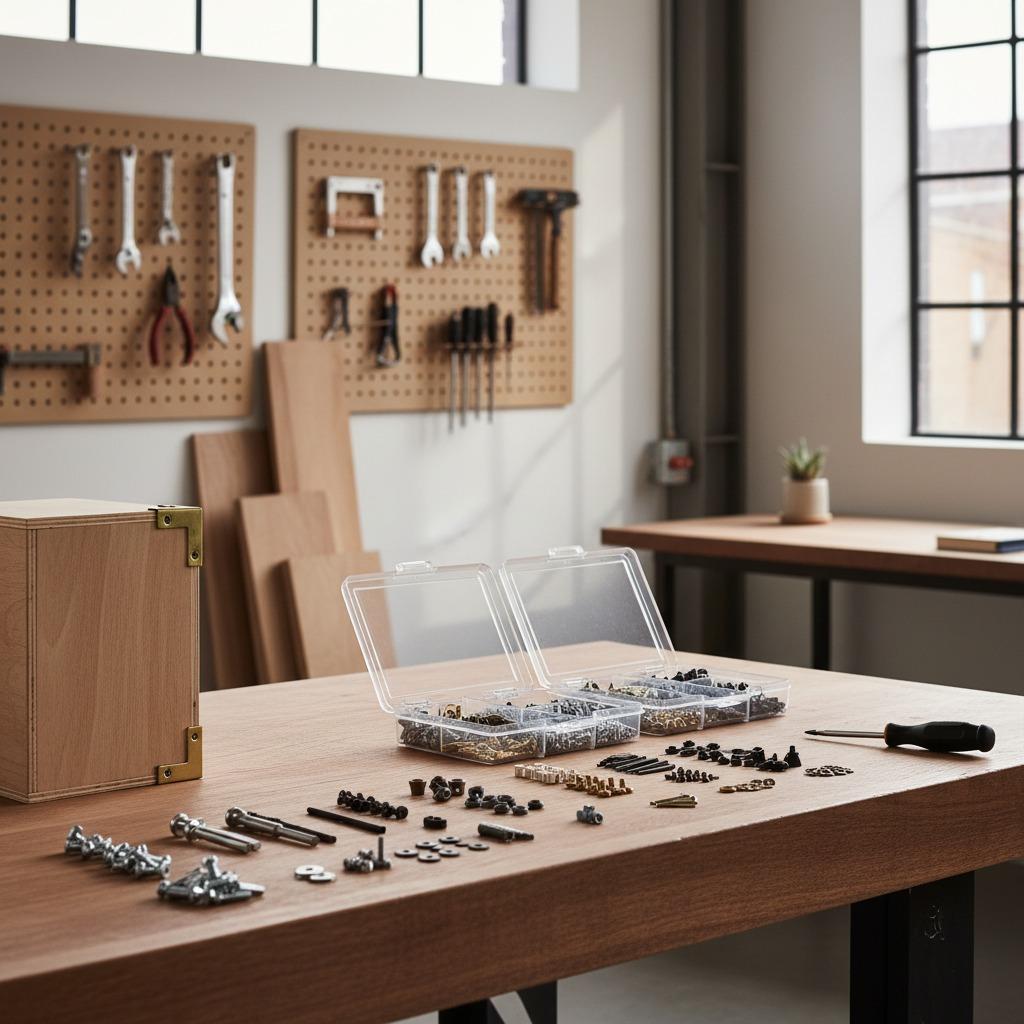
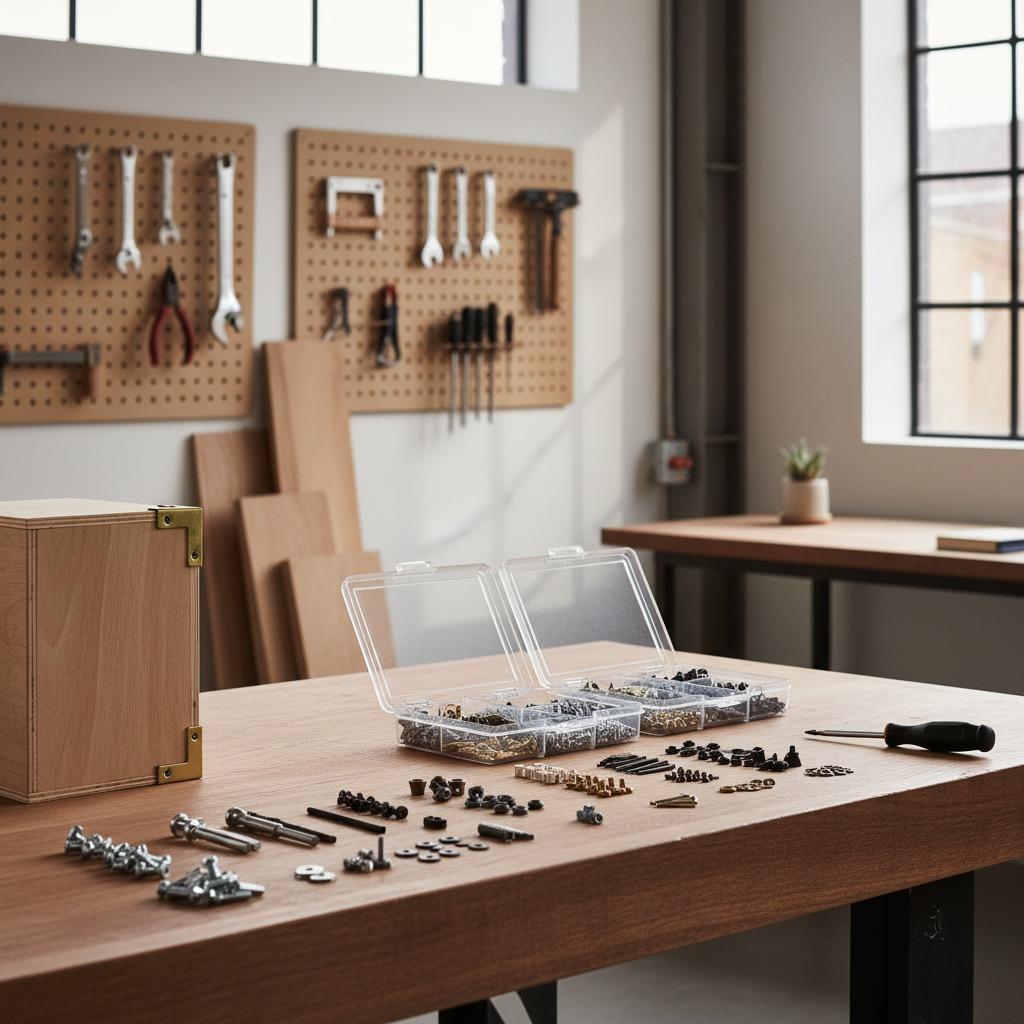
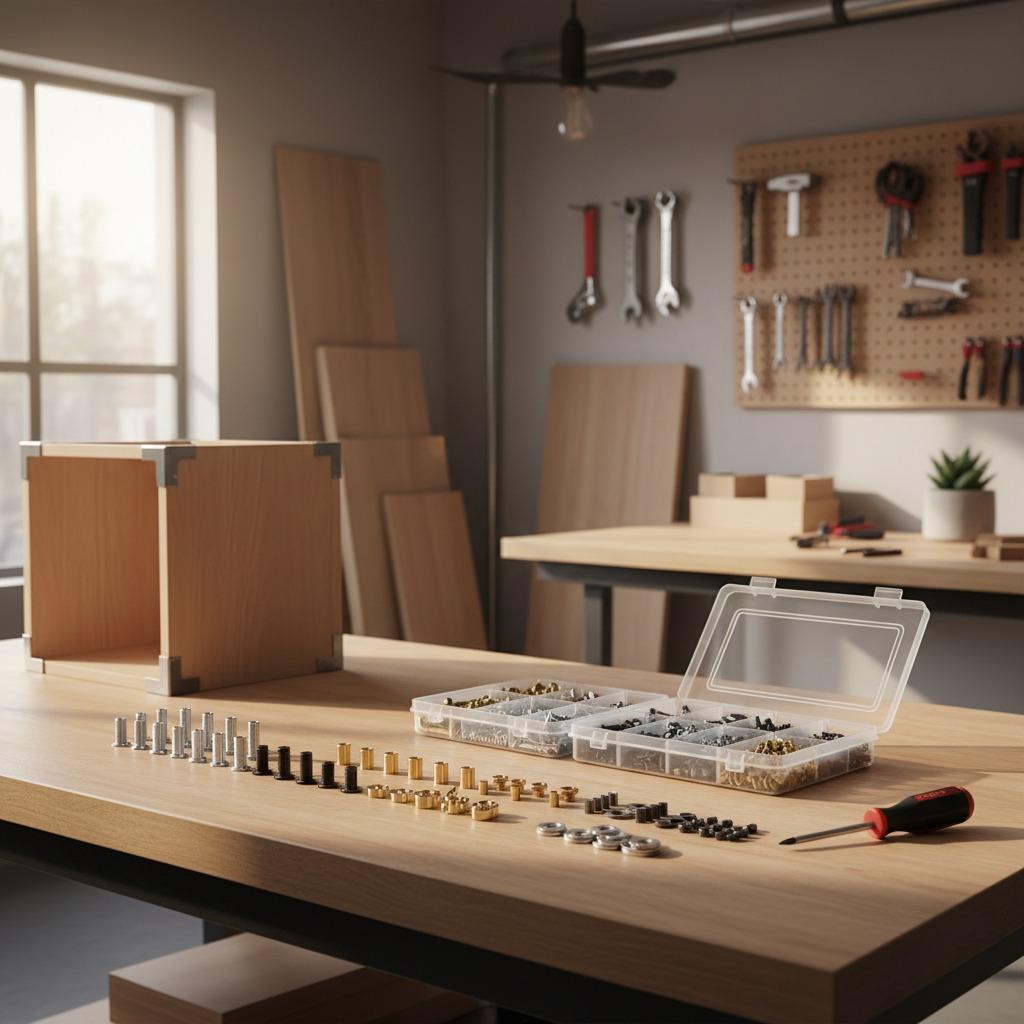
A workbench with clear compartment boxes tells a practical story.
In furniture assembly, people need to identify small parts quickly. Clear lids, separated sections, and visible assortments help workers avoid opening every bag or tray to find one size of screw.
This looks simple, but it saves time.
When several furniture models share similar hardware, mixed fasteners can easily create confusion. A silver screw may look almost identical to another silver screw that is only a few millimeters longer. A black cap may belong to one cabinet line, while a similar cap fits another.
Clear sorting reduces those mistakes.
The same logic applies to production kits.
A compartmented tray, labeled polybag, or model-specific hardware set gives workers and customers fewer decisions to make. The kit does not only hold parts. It guides the assembly process.
That is why packaging format should be discussed early with the supplier, not treated as a final detail after the hardware is already ordered.
Standard parts are useful, but furniture often needs controlled variation
Flat pack furniture often uses standard screws, washers, nuts, and connector parts.
Standard components can reduce cost, shorten lead times, and simplify replacement. When they fit the application, they are usually the safest option.
But not every furniture design follows the same hardware logic.
A panel may be thinner than usual. A bracket may need a special hole spacing. A screw may require a specific head style because the installation space is narrow. A plastic spacer may need to match a hinge or drawer slide position.
In these cases, customization becomes useful.
A capable OEM furniture hardware supplier should be able to discuss both standard parts and non-standard requirements. The buyer should not have to choose between a fixed catalog assortment and a completely new hardware program.
Jiangmen Jinhe Hardware Co., Ltd. produces machine screws, self-tapping screws, micro screws, precision screws, and customized non-standard fasteners. For flat pack furniture projects, that type of range can be useful when the hardware set includes both ordinary screws and project-specific fastening parts.
Customization should still solve a real problem.
If a standard part works reliably, it may offer better long-term stability. If the product design requires a special length, thread, finish, or head type, then custom furniture fasteners may prevent assembly problems before they start.
Hardware consistency matters more than the first sample
A sample kit can be prepared carefully by hand.
The true test begins with repeat production.
Can the supplier maintain the same screw length across batches? Can the finish remain consistent? Can the same component mix be packed again three months later? Can the supplier prevent one model’s hardware from being mixed into another model’s carton?
This is where many low-cost sourcing decisions become expensive.
A flat pack furniture hardware supplier should be able to control:
- Component dimensions
- Thread type
- Head style
- Surface finish
- Material
- Quantity per kit
- Label information
- Packaging format
- Lot traceability
- Repeat-order records
For furniture buyers, repeatability is often more important than a slightly lower price.
A cheap screw is not cheap if workers have to inspect every bag again. A low-cost mixed carton is not economical if the buyer must sort the hardware internally before packing furniture kits.
The best supplier reduces work after the parts arrive.
Packaging is part of the product, not just the shipment
Flat pack furniture accessories can be packed in many ways.
Some buyers need loose bulk cartons for line-side bins. Others need small polybags for each furniture unit. E-commerce sellers may need labeled kits with barcodes. Repair programs may require spare-part packs that customers can identify easily.
There is no single best packaging method.
The correct format depends on the channel and the assembly process.
For factory assembly, bulk supply may be acceptable if workers pull parts from organized bins. For customer-assembled furniture, every kit should be easy to understand. For export furniture, packaging must survive handling, storage, and long-distance transit.
Buyers should confirm:
- Quantity per kit
- Whether parts are mixed or separated
- Label content
- Furniture model number
- Barcode or QR code
- Bag thickness
- Carton quantity
- Spare-part allowance
- Counting method
- Final inspection process
One missing screw can create a customer complaint. One mislabeled hardware bag can delay an entire shipment.
That is why packaging discipline is not a decorative service. It is part of quality control.
Inspection should cover the parts and the kit
Fasteners are small, but small deviations can interrupt furniture assembly.
A screw with the wrong thread may not bite properly. A washer with the wrong outside diameter may not fit the bracket. A spacer with poor dimensional control may affect alignment. A surface finish that scratches easily can make visible parts look cheap.
Buyers should ask what the supplier checks before delivery.
Useful inspection points may include:
- Length
- Diameter
- Thread quality
- Head shape
- Surface finish
- Material confirmation
- Quantity accuracy
- Packaging accuracy
- Label correctness
- Kit completeness
Jiangmen Jinhe Hardware states that its products are inspected before delivery and supplied with necessary documentation. For buyers, that is a useful baseline, especially when the hardware is tied to scheduled furniture production or export delivery.
Still, buyers should match supplier documentation with their own incoming inspection process.
A tidy kit can still fail if the wrong fastener length is packed inside it.
Logistics support can reduce pressure on furniture programs
Flat pack furniture production often depends on timing.
Panels, cartons, instructions, labels, and hardware all need to arrive in the right sequence. If the furniture hardware is late, the rest of the product may sit unfinished.
This is especially important for exporters, wholesalers, and cross-border e-commerce sellers.
A supplier with warehousing, freight forwarding, and logistics coordination can help reduce friction. Jiangmen Jinhe Hardware notes support for international freight forwarding, domestic logistics, warehousing, and supply chain services.
For buyers managing several SKUs or replenishment cycles, this can be valuable.
The hardware may be small, but delivery timing can decide whether a furniture shipment leaves on schedule.
Common mistakes buyers should avoid
One mistake is treating all fasteners as interchangeable.
They are not.
Two screws may look similar but have different threads, head styles, coatings, or lengths. Those differences can affect assembly speed, joint strength, and panel safety.
Another mistake is focusing only on unit price.
A cheaper fastener may cost more if the buyer must sort the shipment, replace missing parts, or handle customer complaints. In flat pack furniture, the total cost includes rework, labor, replacement shipments, and delayed assembly.
A third mistake is assuming a mixed assortment box is ready for production.
An organized-looking tray is useful, but buyers still need to know how the assortment is built, how parts are counted, how labels are controlled, and whether the same kit can be repeated on future orders.
The final mistake is asking for customization too late.
If the panel design requires a special screw, spacer, bracket, or insert, the supplier should know before the kit is approved. Changing hardware after cartons, instructions, and packing rules are finalized can create unnecessary waste.
When organized hardware kits make the most sense
Organized kits are especially useful when the same assembly process repeats across many units.
They are commonly used for:
- Flat pack cabinets
- Wardrobes
- Modular shelving
- Office furniture
- Tables
- Storage units
- Repair programs
- Prototype builds
- E-commerce furniture
- OEM and ODM furniture lines
A kit is most valuable when sorting would cost more than organized packaging.
If workers constantly pull from mixed bins, count small parts manually, or correct packing mistakes, a prepared kit can save time quickly.
For after-sales service, kits also make replacement easier. A customer can receive the correct small hardware set instead of a loose bag of parts that may or may not match the product.
How to evaluate a flat pack furniture hardware supplier
A buyer should look beyond the catalog.
The supplier should be able to discuss the furniture application, not just the part number. Ask whether the hardware is intended for factory assembly, customer assembly, export packing, or repair service.
A practical supplier review should cover:
- Product range
- Standard fastener availability
- Non-standard customization
- Material options
- Surface finishes
- Dimensional control
- Kitting capability
- Packaging formats
- Labeling support
- Inspection process
- Repeat-order control
- Logistics support
- Response speed for shortages or discrepancies
Jiangmen Jinhe Hardware works with machine screws, self-tapping screws, micro screws, precision screws, and non-standard customized components. The company also serves furniture manufacturers and other industrial customers.
For furniture buyers, that combination may be useful when a hardware program requires both regular fasteners and application-specific support.
The buyer should still confirm the exact part mix, packaging style, inspection documents, and delivery arrangement before placing a bulk order.
Questions to ask before placing an order
Before choosing a supplier, ask:
- Can you provide the exact hardware breakdown?
- Can you pack parts by furniture model?
- Can similar fasteners be separated?
- What materials and finishes are available?
- Can you support non-standard fasteners?
- What inspection documents are provided?
- How do you verify kit quantity?
- Can the same kit format be repeated on future orders?
- Can labels, barcodes, or model numbers be added?
- Can you support export packing or logistics?
- What happens if a shortage or mismatch is found?
The supplier’s answers should be specific.
A vague promise that the products are “quality checked” is not enough for a furniture program that depends on repeatable assembly.
Frequently Asked Questions
What does a flat pack furniture hardware supplier provide?
A supplier may provide screws, nuts, washers, spacers, cam fittings, brackets, inserts, plastic caps, tools, and organized hardware kits for flat pack furniture assembly.
Why are organized hardware kits better than loose bulk parts?
Organized kits reduce sorting time, prevent missing-part issues, support model-specific packing, and make assembly easier for workers or end users.
Can flat pack furniture fittings be customized?
Yes. Screw length, thread type, head style, material, finish, packaging, labels, and kit structure can be customized when the furniture design requires it.
What should buyers inspect before approval?
Buyers should check dimensions, thread quality, surface finish, quantity accuracy, packaging method, labels, and how the parts perform during actual assembly.
Is the cheapest supplier always the best option?
No. Buyers should consider total cost, including sorting labor, rework, missing-part complaints, replacement shipments, and delivery reliability.
When should buyers request sample kits?
Sample kits should be requested before bulk production, especially when the project uses model-specific packaging, custom fasteners, or new furniture designs.
The right supplier keeps flat pack production orderly
A good flat pack furniture hardware supplier makes the assembly process feel ordinary.
The correct parts arrive. The kit matches the furniture model. Workers do not waste time sorting similar screws. Customers do not stop halfway through assembly because one small component is missing.
That ordinary result takes real control behind the scenes.
It requires accurate fasteners, stable finishes, reliable counting, clear packaging, practical inspection, and repeatable supply.
For furniture manufacturers, wholesalers, e-commerce sellers, and OEM buyers, Jiangmen Jinhe Hardware Co., Ltd. can discuss standard fasteners, non-standard customization, organized hardware kits, packaging formats, warehousing, logistics, and export support.
For direct inquiries:
Tel/WeChat: +86 13729150102
WhatsApp: +86 13322893939
Email: sharon@hkhomeideas.com
Start with the hardware list, furniture model, packaging requirement, and delivery schedule.
Once those details are clear, the right supplier proposal becomes much easier to build.