
Furniture Joiner Connector Supplier: Why Small Connectors Deserve More Attention
 Furniture connectors are easy to underestimate.
They are small, often hidden, and usually cheaper than panels, hinges, drawer slides, or packaging. Because of that, many teams leave connector selection until late in the project. The cabinet shape is already decided. The panel drilling is nearly fixed. The production team is already thinking about packing.
Then the connector becomes a problem.
The part does not sit cleanly. The finish looks different under real lighting. The hole fit is too loose. Installation takes longer than expected. Or the finished cabinet feels slightly less solid than it should.
That is why choosing a furniture joiner connector supplier is not just a small purchasing task.
For cabinet makers, furniture brands, engineers, and sourcing managers, the connector affects assembly feel, visible quality, repeatability, and long-term use. A good connector disappears into the product. A poor one keeps showing up in complaints, rework, and awkward assembly steps.
A connector is part of the furniture experience
A cabinet may look like a wood product, but the user often judges it through the hardware.
Does the shelf sit level?
Does the joint close tightly?
Does the visible metal part look intentional?
Does the connector loosen after the furniture is moved?
Does the assembly step feel simple or frustrating?
These small moments shape how the product is perceived.
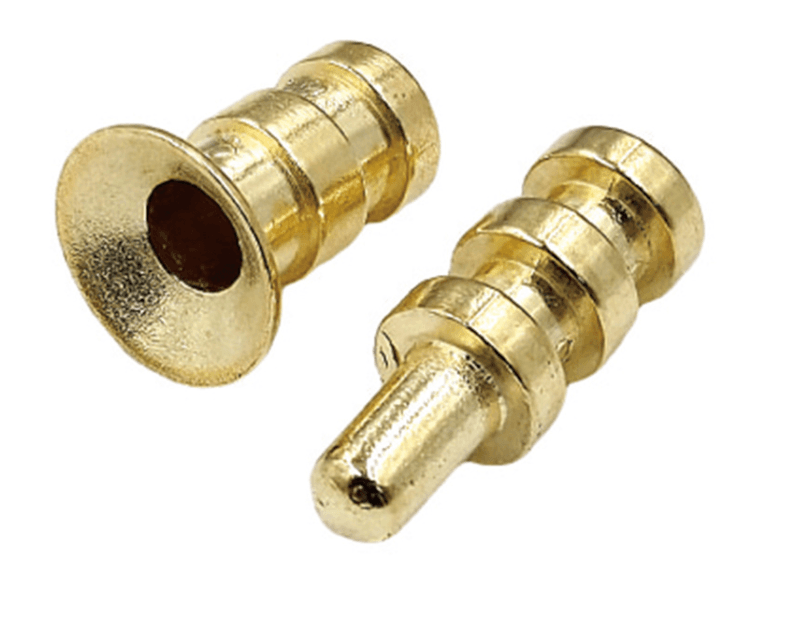
A compact brass-colored connector, for example, may not only hold or guide a panel. It may also become part of the product’s appearance. If the finish is clean and consistent, it can make the cabinet feel more refined. If the finish scratches easily or looks cheap, the same part becomes a weak point.
This is especially true for visible or semi-visible connectors used in shelving, open cabinets, storage boxes, and interior joinery.
The connector is not decoration only. It is not structure only either.
It sits somewhere between both.
Do not choose by appearance alone
A polished connector can look excellent in a sample photo.
That does not prove it will work in production.
A buyer still needs to confirm the material, finish, diameter, groove design, flange size, seating depth, installation method, and matching hole tolerance. A brass-colored part may be solid brass, brass-plated steel, zinc alloy with a decorative finish, or another material with a warm metallic surface.
Those differences matter.
A connector used only as a light support may not need the same material as one carrying repeated load. A visible part may need stronger finish consistency. A part used in flat-pack furniture may need to tolerate handling, shipping vibration, and installation by end users.
The first question should not be, “Does it look nice?”
A better question is, “Will it still look and work correctly after production, packing, shipping, and assembly?”
What the connector geometry tells buyers
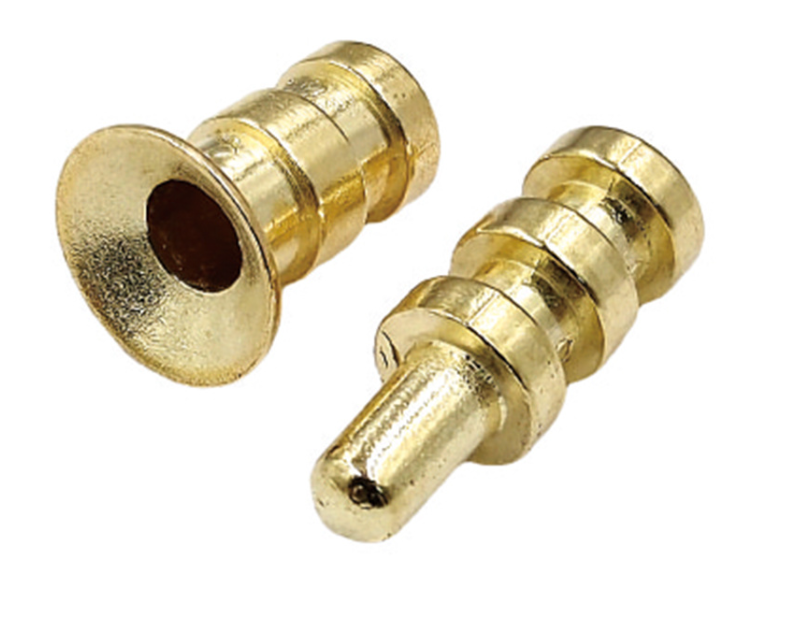
A connector with a flanged head and grooved cylindrical body usually suggests a part designed to seat into a panel or mating hole.
The flange can help create a stopping surface, keeping the part from going too deep. The grooves may help with grip, retention, or alignment depending on how the connector is installed.
That geometry can be useful in cabinets, shelving, storage units, and panel furniture.
But it must be matched carefully.
If the mating hole is too loose, the connector may move. If the hole is too tight, installation may damage the board. If the flange does not sit flat, the visible face may look uneven. If the grooves are not suitable for the panel material, the part may not hold as expected.
This is where a wood furniture connector manufacturer needs to understand more than metal.
The supplier should understand how the connector behaves in MDF, particleboard, plywood, solid wood, veneer-faced board, or mixed-material panels.
A connector does not work alone. It works inside a material.
Panel material changes the result
Furniture panels may look similar, but they do not respond the same way to hardware.
MDF can machine cleanly but may not hold certain fittings the same way as plywood. Particleboard may be cost-effective but less forgiving around holes. Solid wood may grip well, but movement and grain direction can affect long-term behavior. Veneered panels may look premium but require care during installation to avoid surface damage.
Before approving a connector, buyers should test it in the actual board.
Useful checks include:
- Does the connector seat at the intended depth?
- Does the flange sit evenly?
- Does the hole edge remain clean?
- Does the connector stay firm after handling?
- Does the finish scratch during installation?
- Does the part loosen after repeated movement?
- Can workers install it without special handling?
Loose samples on a desk tell only part of the story.
The real test happens in the cabinet.
Flat-pack furniture makes connector selection harder
Flat-pack furniture raises the pressure on small hardware.
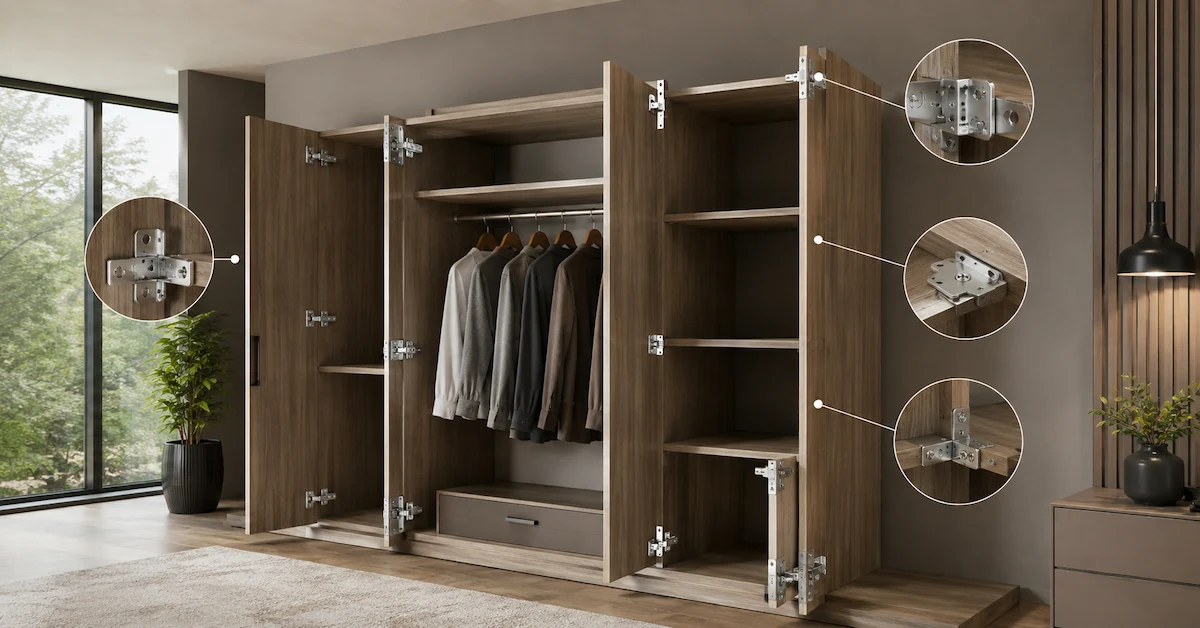
The connector has to support compact packing, clear assembly, and reliable joint performance after shipping. It may be installed by factory workers, installers, or customers at home. That means the part must be understandable, repeatable, and forgiving enough for normal assembly conditions.
A connector that works perfectly in a controlled workshop may be frustrating in a customer’s hands.
If the fit is too tight, the user may force it. If the part is too loose, the cabinet feels weak. If the installation step is unclear, the product may receive complaints even when the hardware is technically correct.
For a flat-pack furniture connector manufacturer, the connector should be reviewed together with:
- Panel drilling pattern
- Assembly instructions
- Tool access
- Packaging method
- Matching screws or fittings
- Expected user skill level
- Replacement or spare-part policy
A strong connector is useful only when people can install it correctly.
Visible finish should be checked under real conditions
A brass-colored connector can add warmth and detail to a furniture product.
It can also become distracting if the tone does not match the rest of the design.
Buyers should review visible connectors under real lighting and against the actual panel finish. A warm metallic tone may look elegant beside dark wood, but too bright beside pale matte boards. A polished finish may look premium in a showroom but show scratches easily after handling.
Finish checks should include:
- Color consistency
- Surface smoothness
- Scratch resistance
- Plating or coating type
- Corrosion resistance
- Compatibility with nearby hardware
- Batch-to-batch consistency
Do not rely only on supplier photos.
Photos can hide color shifts, surface marks, and finish differences that become obvious once the part is installed in furniture.
Standard connector or customized part?
Standard connectors are often the best option when they fit the product well.
They are easier to source, easier to replace, and usually less risky in repeat orders. If the hole pattern, panel thickness, load, and appearance all match, there may be no need to customize.
Customization becomes useful when the product needs something more specific.
A buyer may need a different flange diameter, a special groove structure, a shorter body length, a specific finish, a tighter tolerance, or a connector designed around an existing panel hole.
In those cases, non-standard customization can prevent assembly problems.
Jiangmen Jinhe Hardware Co., Ltd. focuses on fasteners, standard parts, and non-standard customization. Its product range includes machine screws, self-tapping screws, micro screws, and precision screws in materials such as stainless steel, iron, and aluminum. For furniture buyers, that type of manufacturing background can be useful when a connector project also needs matching screws, modified dimensions, or custom fastening support.
Still, customization should solve a real problem.
A custom part brings drawings, samples, approvals, and repeat-order control. If a standard connector works reliably, it may be the cleaner choice.
Supplier capability should match the application
A good furniture joiner connector supplier should understand the difference between ordinary fasteners and furniture-specific hardware.
Furniture connectors need to consider touch, finish, panel fit, tool access, and assembly behavior. The part may be small, but it often interacts directly with the customer’s perception of quality.
When comparing suppliers, buyers should ask:
- Can the supplier confirm the base material?
- Can the finish be controlled across batches?
- Can dimensions be adjusted if needed?
- Can the connector be tested with the target panel?
- Can matching screws or related parts be supplied?
- Can parts be packed to protect visible surfaces?
- Can inspection documents be provided?
- Can repeat orders match the approved sample?
Jiangmen Jinhe Hardware was founded in 2016 in Jiangmen, Guangdong, and its company information describes a 4,000-square-meter operation focused on fasteners, standard parts, precision screws, and non-standard customization. For sourcing teams, this kind of background is worth reviewing when a project needs both fastener knowledge and application-specific adjustment.
The buyer should still confirm the exact connector requirements before bulk production.
General capability is useful. Project fit is what matters.
Packaging affects visible connectors more than buyers expect
Decorative or semi-visible connectors need careful handling.
If brass-colored parts are packed loosely with screws, brackets, or washers, the finish may scratch before the product is even assembled. If similar connectors are mixed, workers may install the wrong part. If the package is unclear, flat-pack customers may not know which fitting belongs to which step.
Packaging should protect both function and appearance.
Buyers should confirm:
- Quantity per kit
- Part separation method
- Surface protection
- Label information
- Furniture model number
- Spare-part quantity
- Final inspection method
- Whether the connector is packed with matching fasteners
For visible furniture hardware, packaging is not just logistics.
It protects the final look of the product.
Inspection should focus on fit and finish
Connector inspection should not stop at basic dimensions.
For furniture applications, the supplier should also check the features that affect assembly and appearance.
Important checks may include:
- Body diameter
- Flange diameter
- Seating depth
- Groove consistency
- Surface finish
- Burrs or sharp edges
- Material confirmation
- Plating or coating quality
- Packaging condition
- Quantity accuracy
Jiangmen Jinhe Hardware states that it provides inspection before delivery and responsive support for customer issues. For buyers, that is useful, but the smarter approach is to test the supplier early with drawings, samples, and clear technical requirements.
If a connector is visible, the inspection should include visual standards.
If it is structural, the inspection should include fit and function.
If it is used in flat-pack furniture, the inspection should also include packaging and assembly testing.
Common mistakes buyers should avoid
One common mistake is assuming all grooved metal connectors behave the same way.
They do not. Small changes in groove shape, body diameter, flange height, or material can change installation and holding performance.
Another mistake is over-focusing on finish while under-specifying fit.
A connector may look beautiful but still fail if the mating hole is wrong.
A third mistake is approving samples without testing real panels.
The connector should be tested in the same board material, hole size, and assembly method planned for production.
Buyers also sometimes overlook packaging.
Decorative finishes can be damaged by poor packing, even when the part itself is well made.
The final mistake is choosing only by unit price.
A cheaper connector may cost more if it creates rework, customer complaints, visible defects, or repeat-order inconsistency.
What buyers should ask before ordering
Before placing an order with a furniture joiner connector supplier, ask:
What is the base material?
Is the brass color plated, coated, or solid material?
What hole size does the connector require?
What panel materials has it been tested with?
Can the flange and body dimensions be customized?
How is the finish protected during packing?
Can matching screws or related hardware be supplied?
What inspection documents are available?
Can samples be tested before bulk production?
How are repeat orders controlled?
What happens if the connector fit is not correct?
Good answers should be specific.
A supplier that understands furniture will discuss panel fit, visible finish, installation, packaging, and repeatability—not only the part price.
Frequently Asked Questions
Is a brass-colored connector always made from brass?
No. It may be solid brass, brass-plated steel, zinc alloy with a decorative finish, or another material. Buyers should confirm the base material and surface treatment before approval.
Can a screw manufacturer supply furniture connectors?
Yes, if the supplier has the right machining, finishing, inspection, and customization capability. The key is whether the supplier understands furniture application requirements.
Are visible furniture connectors structural or decorative?
They can be either, or both. The exact role depends on the product design, panel material, installation method, and load requirement.
Should buyers test connectors in real panels?
Yes. Loose samples are not enough. The connector should be tested in the actual panel material and hole pattern planned for production.
Why does packaging matter for furniture connectors?
Packaging prevents scratches, mixing, missing parts, and installation confusion. This is especially important for visible finishes and flat-pack furniture kits.
When is customization useful?
Customization is useful when a standard connector cannot match the panel thickness, hole size, finish requirement, or assembly method.
The right connector makes the furniture feel intentional
A good furniture connector does not fight for attention.
It fits the hole. It sits cleanly. It holds properly. The finish looks intentional. Workers can install it without hesitation. Customers see the furniture as well designed, not as a collection of parts.
That is what buyers should expect from a capable furniture joiner connector supplier.
For furniture connectors, cabinet connector hardware, custom furniture fasteners, visible metal fittings, standard parts, and non-standard hardware support, Jiangmen Jinhe Hardware Co., Ltd. can discuss materials, dimensions, finish options, sample testing, inspection, packaging, and supply requirements.
Start with the application, panel material, hole size, finish expectation, installation method, and order quantity.
Once those details are clear, the right connector becomes much easier to source and repeat.