
Furniture Joining Hardware Supplier: Why Small Connectors Decide the Whole Assembly
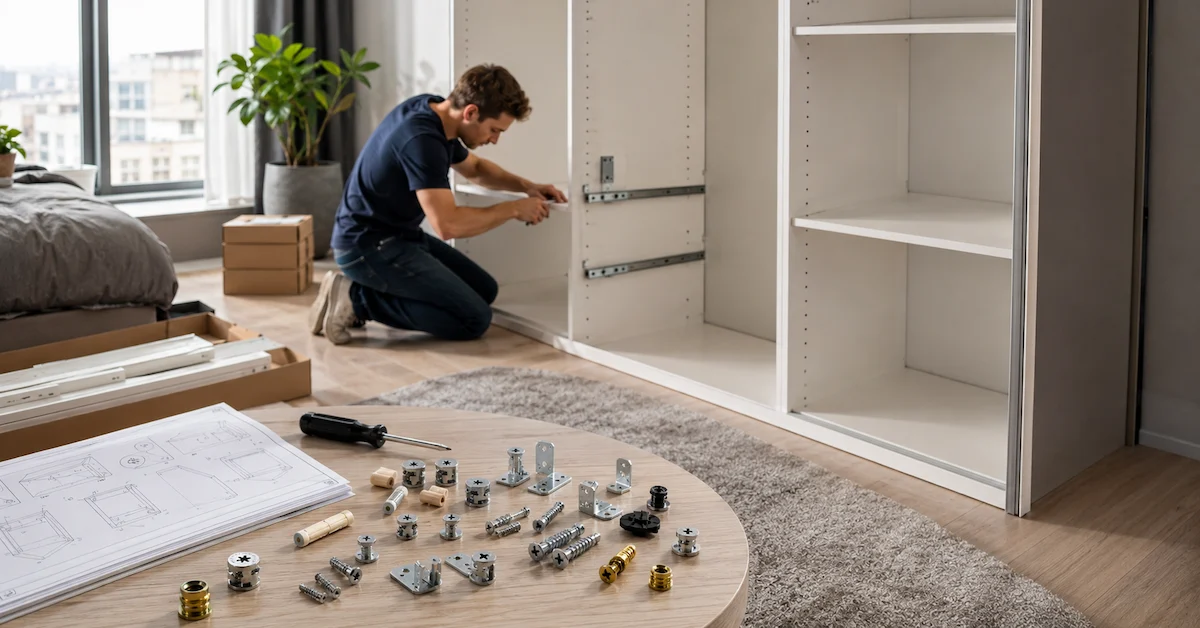 A wardrobe does not fail because the panel looks slightly boring.
A cabinet does not feel cheap because the screw is small.
The problem usually appears later, when the customer starts assembling the product, when an installer tries to pull two panels tight, or when a shelf begins to wobble after the unit has been moved once or twice.
That is where furniture joining hardware starts to matter.
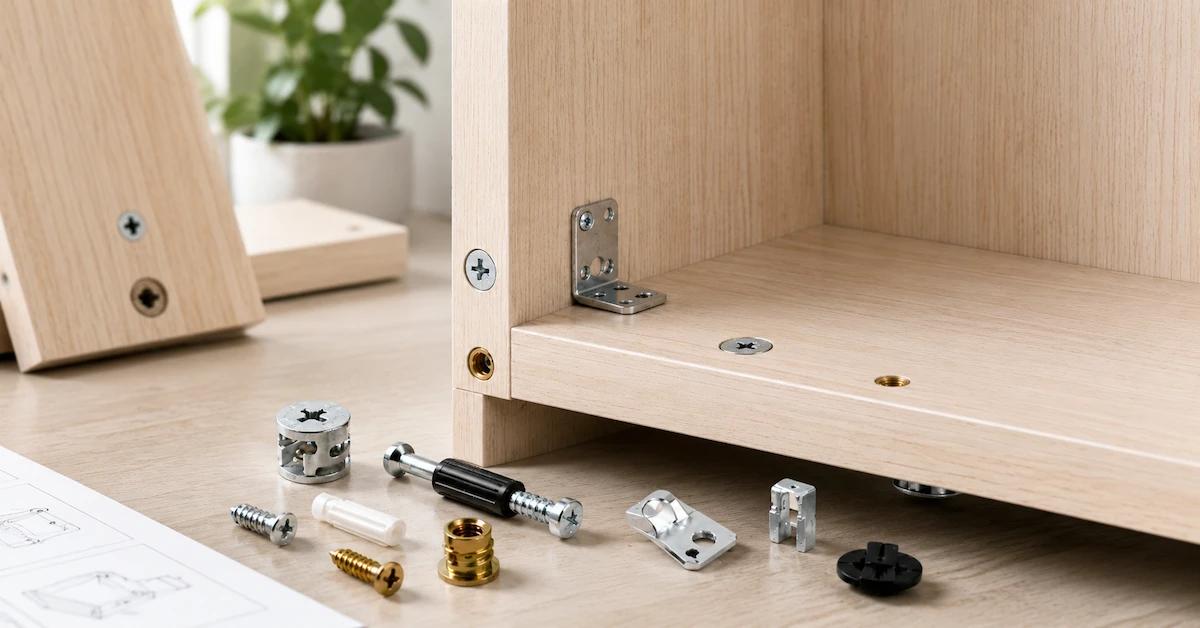
For flat-pack wardrobes, modular cabinets, shelving units, storage systems, and repair kits, the small connectors inside the hardware bag often decide whether the product feels solid or frustrating. A cam lock that does not catch properly, a threaded insert that strips, a dowel that sits loose, or a screw that looks almost right but damages the panel can turn a simple assembly into a service problem.
That is why choosing a furniture joining hardware supplier is not only a purchasing task.
It is part of product design, production control, packaging planning, and after-sales support.
Furniture hardware is part of the user experience
Most buyers focus first on the visible furniture.
Panel finish. Edge banding. Door alignment. Color. Packaging design. Assembly instructions.
All of those matter. But the customer’s real judgment often happens when the hardware is used.
Does the connector fit the hole?
Does the screw tighten smoothly?
Do the panels pull together without gaps?
Does the shelf support feel stable?
Can the user identify the right part without guessing?
If the answer is yes, the hardware disappears into the product. Nobody thinks about it.
If the answer is no, the hardware becomes the problem everyone remembers.
This is especially true for flat-pack furniture and modular systems. The customer or installer may never see the production line, but they will touch every connector, screw, insert, and bracket during assembly.
Small hardware becomes the handshake between the brand and the user.
A connector kit is not just a bag of parts
Furniture joining hardware usually includes several parts working together.
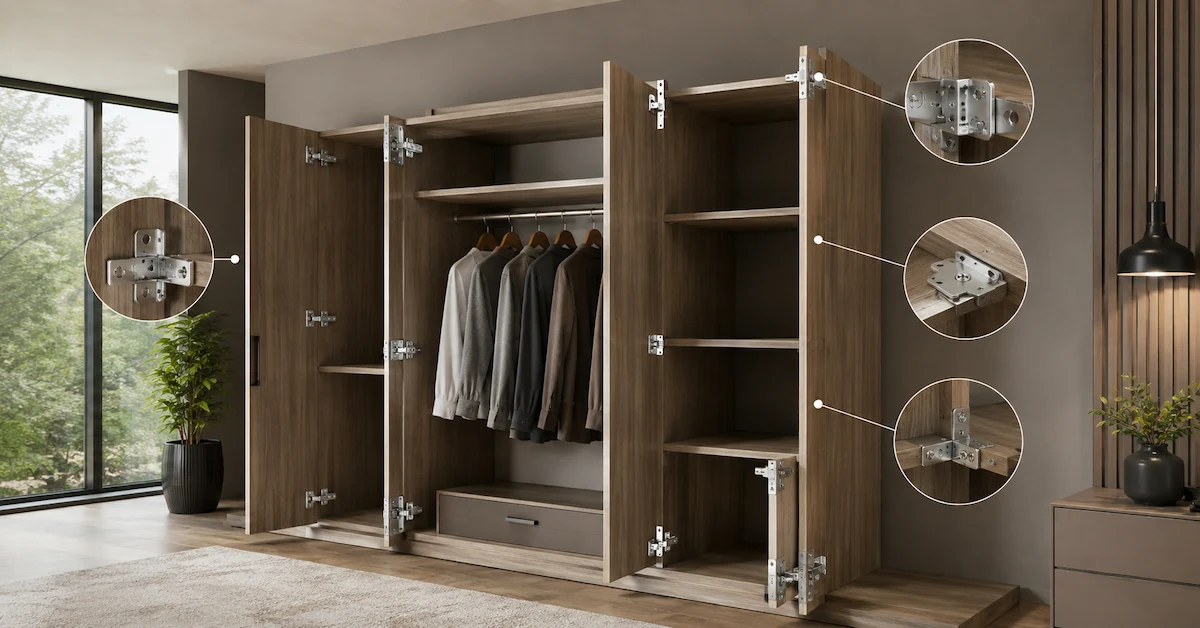
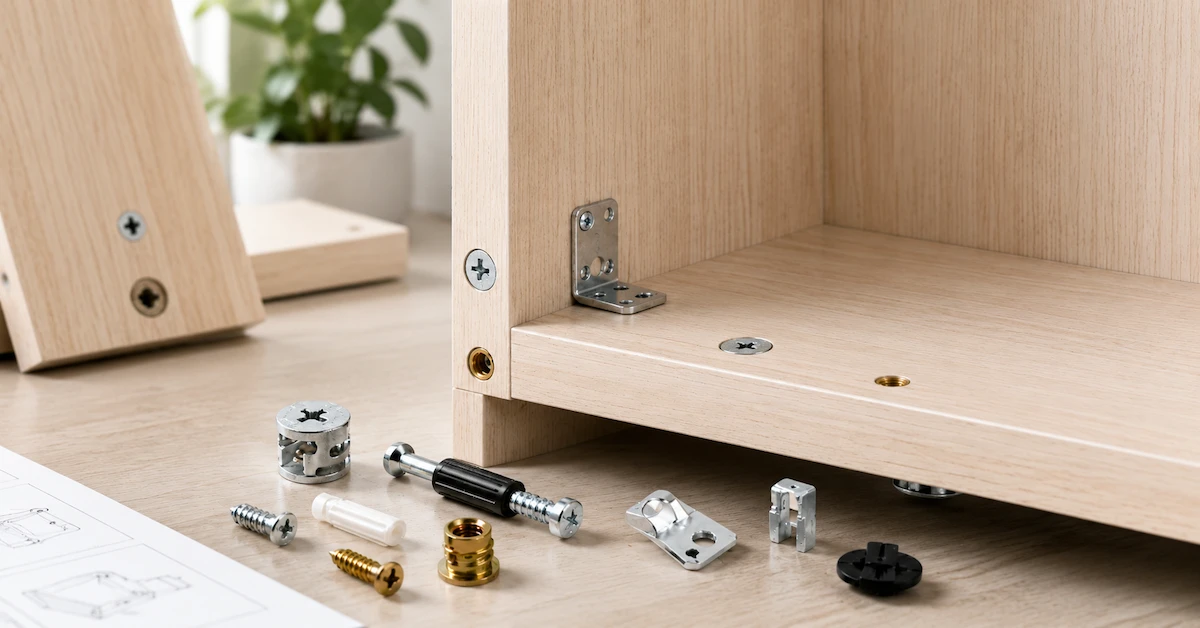
A typical kit may include screws, dowels, threaded inserts, cam locks, connector bolts, brackets, plastic caps, shelf supports, washers, or guide components. Some parts are visible. Some are hidden. Some carry load. Some help alignment. Some only make the finished product look cleaner.
The important point is that they do not work alone.
A screw must match the panel.
A cam lock must match the bolt.
A dowel must match the hole.
A threaded insert must hold in the board.
A bracket must line up with the drilling pattern.
If one part is wrong, the whole joint may feel wrong.
That is why a cabinet connector supplier should understand the complete assembly, not only the individual fastener. A low-cost screw or connector may look fine in isolation, but the real test is whether it works with the board, hole pattern, tool, packaging, and assembly sequence.
Panel material changes the hardware decision
Wood furniture connector sourcing is never separate from the board material.
Particleboard, MDF, plywood, laminated panels, veneered board, and solid wood all behave differently. Some hold screws well. Some need larger thread engagement. Some are sensitive near the edge. Some machine cleanly but may not tolerate repeated assembly.
A connector that works in plywood may not perform the same way in particleboard. A threaded insert that feels secure in one board may loosen in another. A screw that is safe in a thick panel may break through a thinner one.
Before approving furniture assembly hardware, buyers should confirm:
- Panel material
- Board thickness
- Hole diameter
- Hole depth
- Edge distance
- Connector type
- Screw length
- Installation tool
- Whether the furniture will be disassembled later
This may sound basic, but many sourcing problems begin when hardware is chosen from a photo or catalog without enough information about the actual panel.
A wood furniture connector supplier should ask about the board before recommending the part.
Flat-pack furniture makes hardware consistency more important
Flat-pack furniture leaves little room for confusion.
The panels are already drilled. The hardware is packed inside the carton. The user follows the instruction sheet and expects everything to fit. There is usually no technician nearby to correct a mistake.
That means the hardware kit has to be consistent.
One wrong screw length can damage the panel. One missing cam bolt can stop assembly. One unclear bag can make the customer use the wrong fastener in the wrong hole.
For manufacturers, this creates a simple rule: the hardware should make assembly easier, not ask the customer to solve a puzzle.
A good furniture joining hardware supplier should support:
- Stable part dimensions
- Clear packaging
- Accurate counts
- Matching fasteners and connectors
- Repeatable finish
- Replacement hardware supply
- OEM labels or model-based packing when needed
In flat-pack furniture, the hardware kit is not an accessory.
It is part of the product.
Visible and hidden hardware both matter
Buyers sometimes pay more attention to visible hardware and ignore hidden connectors.
That can be risky.
Visible parts affect appearance. Hidden parts affect structure. Both influence the customer’s opinion.
A brass-colored insert may look premium, but if it strips during assembly, appearance no longer matters. A black plastic guide may seem minor, but if it helps align the connector, the assembly becomes easier. A zinc-plated screw may be hidden after installation, but if the head strips, the worker loses time and the panel may be damaged.
Furniture hardware should be judged by function first, then appearance.
For visible or semi-visible components, finish consistency matters. For hidden fasteners, dimensional control and assembly behavior matter more. For parts packed together in a kit, separation and labeling become important too.
The best supplier understands all three: function, finish, and packaging.
Standard parts are useful, but customization has its place
Many furniture programs can use standard connectors and fasteners.
That is often the smartest option. Standard parts are easier to source, easier to replace, and usually more stable across repeat orders.
But furniture projects do not always stay standard.
A panel thickness changes. A customer asks for a cleaner exterior. A connector needs a different length. A bracket hole must move slightly. A repair kit needs matching parts for an older model. A flat-pack product needs hardware packed by assembly step.
That is where non-standard customization becomes useful.
Jiangmen Jinhe Hardware Co., Ltd. works with machine screws, self-tapping screws, micro screws, precision screws, standard parts, and non-standard customization. The company’s materials include stainless steel, iron, and aluminum, with work aligned to standards such as GB, DIN, ANSI, BS, JIS, and ISO.
For furniture buyers, this kind of background can help when a standard fastener is not enough or when a connector kit needs to match a specific furniture structure.
Customization should not be added for decoration.
It should solve a real assembly problem.
Packaging can prevent many assembly complaints
A furniture hardware kit can contain the correct parts and still create trouble if the packaging is poor.
Loose mixed hardware may save a little money at first, but it can increase sorting time, picking mistakes, and customer confusion. If similar screws are packed together, the wrong one may be used. If small inserts are not separated, they may be missed. If the label does not match the instruction sheet, the user may hesitate at every step.
Good packaging makes the hardware easier to trust.
For furniture and cabinet kits, buyers should consider:
- Separate bags for similar parts
- Clear labels by part type or assembly step
- Model numbers or SKU references
- Quantity checks
- Surface protection for visible parts
- Replacement kit format
- Packaging that does not open during transit
A cabinet connector supplier that understands packaging can reduce many small problems before they reach the customer.
Replacement parts should be planned early
Furniture hardware does not stop mattering after the first assembly.
Customers lose screws. Installers misplace connectors. Furniture gets moved. Panels get replaced. A repair team may need matching parts months or years after the original order.
That is why replacement support should be part of the sourcing discussion.
A supplier that can provide spare connector kits, labeled repair packs, or repeat hardware supply helps protect the furniture brand after sale. This is especially useful for cross-border e-commerce sellers, cabinet brands, and flat-pack furniture distributors.
A missing connector should not become a long customer service case.
If the replacement kit is easy to identify and ship, the problem stays small.
Supplier discipline matters more than a low quote
Price matters, of course.
But a very low hardware quote can become expensive if the supplier cannot keep specifications stable.
Buyers should ask how the supplier controls drawings, samples, materials, finishes, packaging, substitutions, and repeat orders. If a connector changes slightly between batches, the assembly line may discover the problem too late.
Jiangmen Jinhe Hardware notes support for inspection, documentation, logistics, warehousing, foreign trade, and supply chain services. For furniture manufacturers, distributors, and export buyers, those services can matter when hardware supply needs to stay coordinated across production and shipping schedules.
A good supplier should not only provide parts.
It should help keep the hardware system repeatable.
Common mistakes buyers should avoid
One common mistake is treating all furniture connectors as interchangeable.
They are not.
A cam connector, dowel, insert, screw, bracket, and plastic support part all solve different problems. They may sit in the same hardware kit, but they do not perform the same job.
Another mistake is buying from appearance alone. Two connectors may look similar but differ in size, material, thread, finish, or installation behavior.
A third mistake is ignoring the panel. Hardware must match the board material, hole pattern, and assembly sequence.
Buyers also sometimes approve loose samples without testing the full furniture build. That is risky. The real test is not how the connector looks on a desk. The real test is how it performs in the cabinet.
The final mistake is discussing packaging too late.
If the furniture is sold flat-packed, packaging is part of the assembly experience.
What sourcing teams should ask before ordering
Before choosing a furniture joining hardware supplier, buyers should ask:
What panel material is the hardware designed for?
What board thickness and hole pattern are required?
Which parts are included in the connector kit?
Can the hardware be tested with our actual panel?
Can standard and non-standard parts be supplied together?
What material and finish options are available?
How are similar parts separated in packaging?
Can OEM labels or model numbers be added?
What inspection documents are available?
Can replacement kits be supplied later?
Can the same specification be repeated in future orders?
Can logistics or export support be included?
Good answers should connect the hardware to the furniture structure.
A supplier that only quotes loose screws and brackets may not be ready for a complete furniture assembly program.
Frequently Asked Questions
What does a furniture joining hardware supplier provide?
A furniture joining hardware supplier may provide screws, cam locks, connector bolts, dowels, threaded inserts, brackets, shelf supports, plastic caps, and custom fasteners for furniture assembly.
Are cabinet connectors and wood furniture connectors the same?
Not always. Cabinet connectors are often designed for panel-to-panel assembly, while wood furniture connectors may include a wider range of inserts, screws, brackets, and joining parts for different furniture structures.
Can one connector fit every furniture panel?
Usually not. Panel material, board thickness, hole size, edge distance, and load requirement all affect connector selection.
Why does packaging matter for furniture hardware?
Packaging helps prevent missing parts, mixed fasteners, scratched finishes, and confusion during assembly. For flat-pack furniture, it directly affects the customer experience.
Can furniture joining hardware be customized?
Yes. Screw length, connector size, finish, material, packaging, labels, and kit contents can be customized when the furniture design requires it.
What makes a supplier worth choosing?
A strong supplier should support part selection, standard and custom hardware, inspection, documentation, packaging, repeat supply, logistics, and clear communication.
The right hardware makes assembly feel calm
Good furniture joining hardware does not need to look impressive.
It needs to fit.
The panels align. The connectors tighten. The screws hold. The parts are easy to identify. The packaging makes sense. The next shipment matches the approved sample.
That is what buyers should expect from a reliable furniture joining hardware supplier.
For furniture joining hardware, cabinet connectors, wood furniture connectors, custom furniture fasteners, flat-pack furniture hardware kits, and organized assembly packaging, Jiangmen Jinhe Hardware Co., Ltd. can discuss material options, standard parts, non-standard customization, inspection, packaging, logistics, warehousing, and repeat supply requirements.
For direct inquiries:
Tel/WeChat: +86 13729150102
WhatsApp: +86 13322893939
Email: sharon@hkhomeideas.com
Start with the panel material, board thickness, hole pattern, joint design, hardware list, packaging method, and expected order quantity.
Once the assembly system is clear, the right furniture hardware becomes much easier to source and repeat.