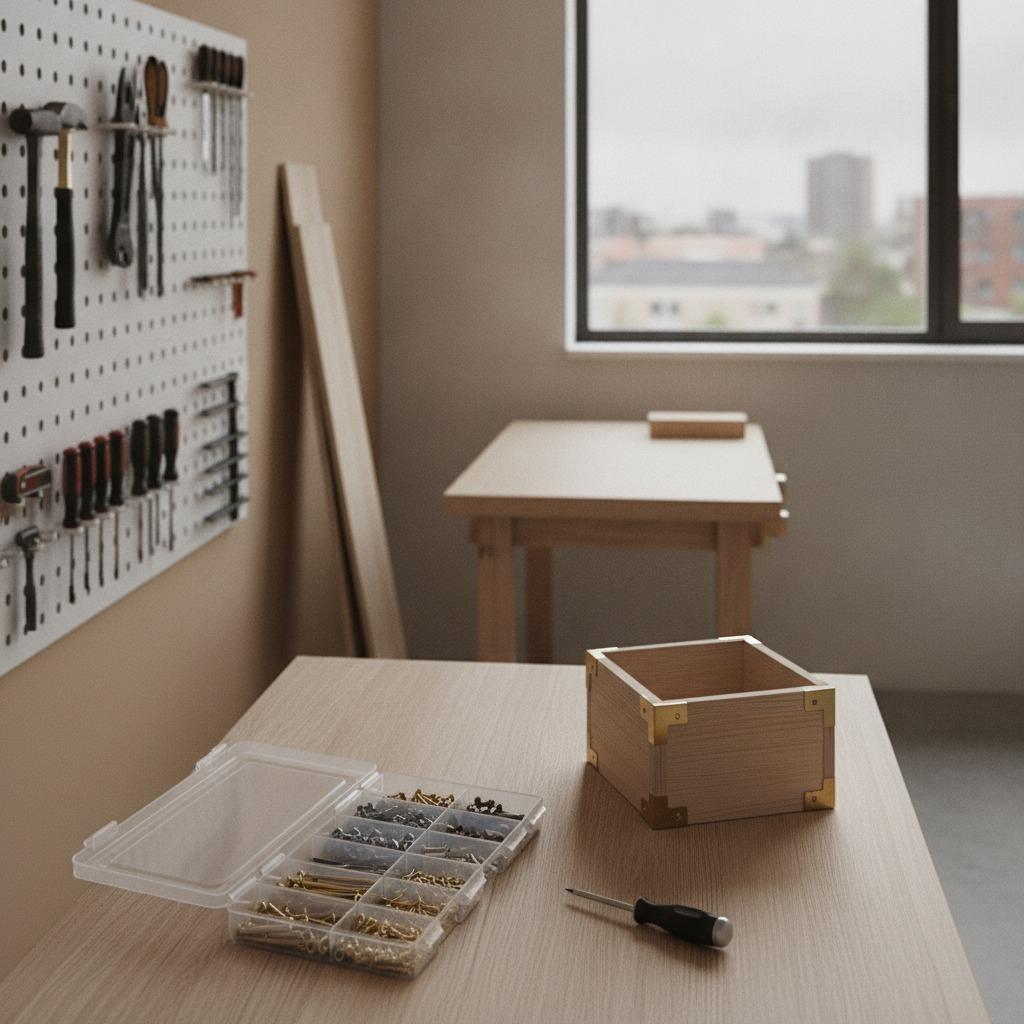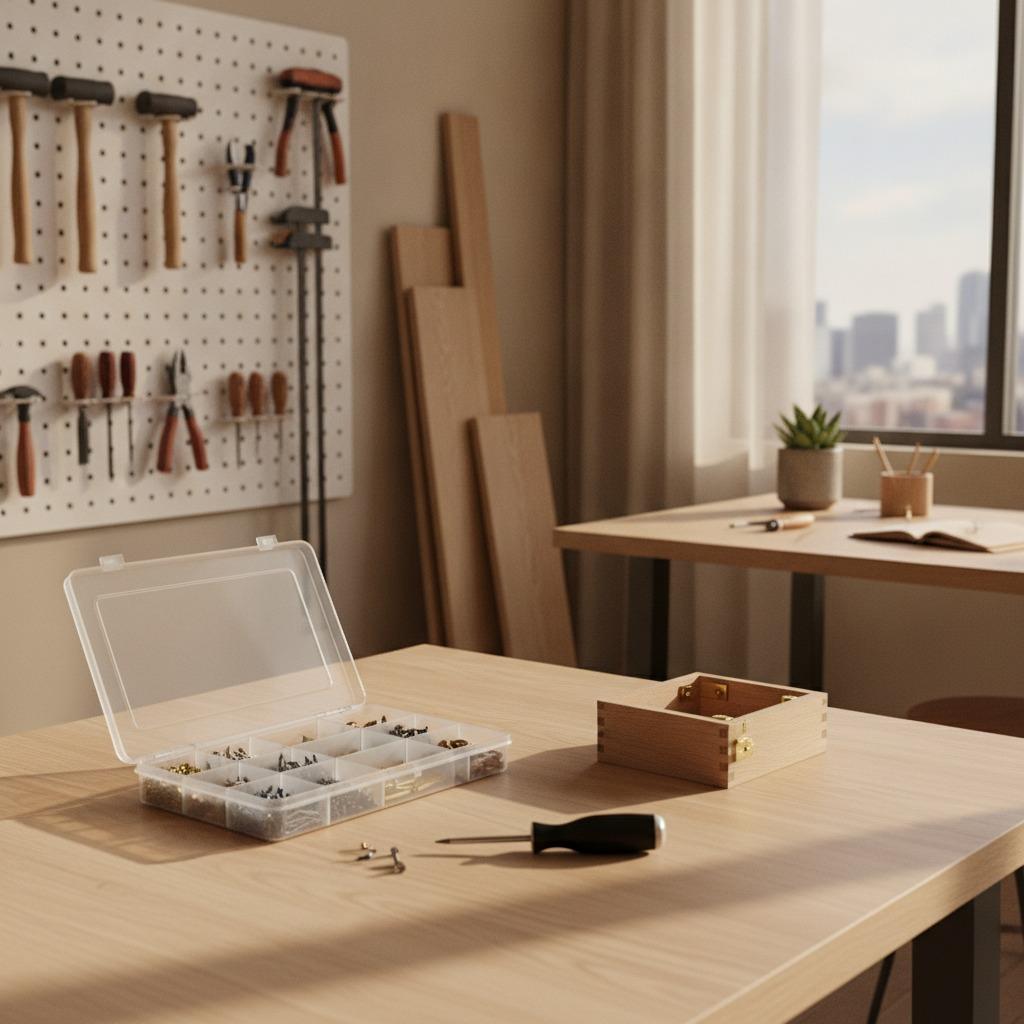



Furniture Joining Hardware Supplier: Why the Right Partner Matters in Flat-Pack Assembly
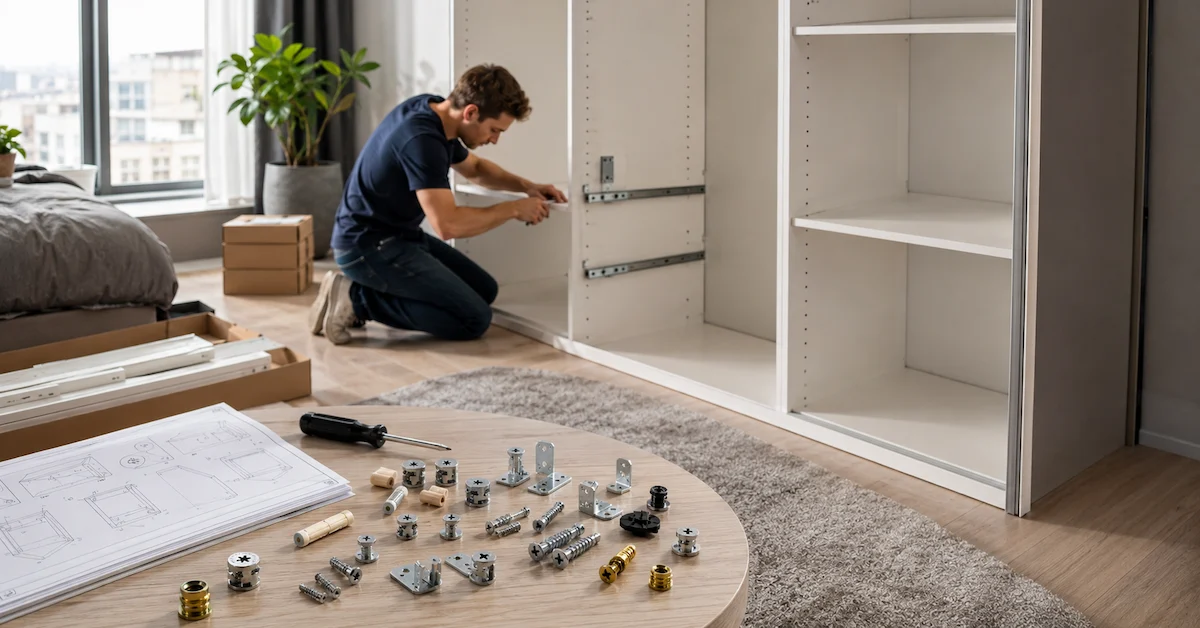 Choosing a furniture joining hardware supplier is not the same as buying a few screws from a catalog.
At first, the parts look ordinary. Cam locks, dowels, shelf pins, brackets, inserts, rails, small plates, screws. Nothing dramatic. Nothing that seems likely to decide the success of a cabinet or wardrobe program.
Then assembly starts.
A connector does not pull the panels tight. A dowel is loose. A shelf pin does not sit cleanly. A small bracket is slightly off, and the rail no longer lines up. The hardware bag is technically complete, but the installer has to stop and sort parts by hand.
That is where small hardware becomes a real production issue.
For flat-pack wardrobes, modular cabinets, shelving units, repair kits, and cross-border furniture programs, the supplier is not only providing metal parts. It is supplying a joining system that has to work inside a real panel structure, with real workers, real packaging, and repeat orders that cannot drift from the approved sample.
Furniture joining hardware is the hidden structure
Most customers notice panels first.
They see the surface finish, the color, the edge banding, and whether the cabinet looks straight after assembly. What they do not always see is the hardware system holding everything in place.
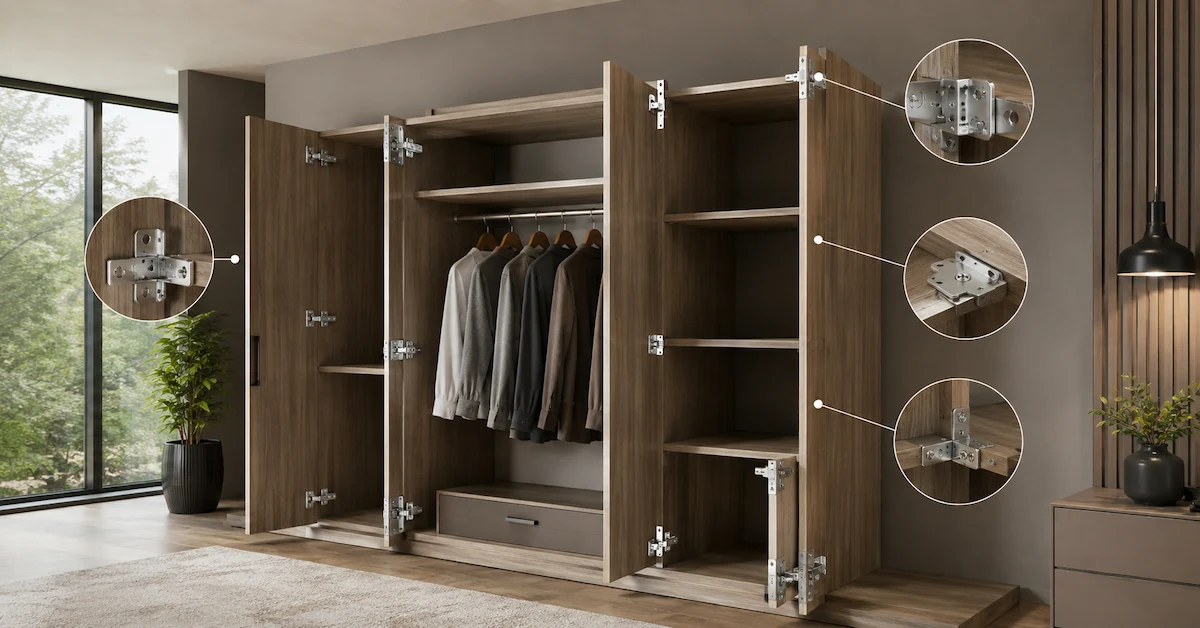
Behind a simple wardrobe or storage cabinet, there may be cam-lock connectors, threaded inserts, dowels, screws, mounting plates, shelf supports, metal rails, and plastic guide parts all working together. One part aligns the panel. Another pulls the joint tight. Another supports the shelf. Another fixes the internal rail or bracket.
The system only feels simple when every piece fits.
A good cabinet connector supplier understands that. It does not treat every screw, insert, and bracket as an isolated SKU. It looks at how the parts behave together during assembly.
That difference matters in real furniture production.
Panel material should guide the hardware choice
Wood furniture connectors do not perform the same way in every board.
MDF, particleboard, plywood, laminated board, and veneered panels all respond differently to screws, inserts, dowels, and brackets. A connector that works in plywood may feel weak in low-density particleboard. A threaded insert may hold well in one panel but strip in another. A screw that looks normal may still damage the edge if the hole pattern is too close.
Before choosing a wood furniture connector supplier, buyers should confirm the basic construction details:
- Panel material
- Board thickness
- Hole diameter
- Hole depth
- Edge distance
- Connector type
- Screw length
- Shelf or rail load
- Assembly sequence
- Whether the furniture may be moved or reassembled
These details are not paperwork. They decide whether the hardware will feel solid in the finished product.
A supplier that recommends connectors without asking about the panel is leaving too much to chance.
A furniture kit needs more than standard parts
Standard fasteners are useful. In many furniture programs, they are still the best choice.
They are easier to source, easier to reorder, and easier to replace. But furniture assembly rarely depends on one standard part alone. A wardrobe kit may need screws, inserts, dowels, shelf pins, brackets, rails, and caps in one controlled set.
The challenge is not only whether each part can be supplied.
The challenge is whether the whole mix can be repeated.
The screw must match the insert.
The bracket must match the hole pattern.
The shelf pin must match the panel row.
The cam lock must match the bolt.
The packaging must keep all of them separated and countable.
That is why a furniture joining hardware supplier should be judged on integration, not only catalog size.
A large catalog is helpful. A stable, usable kit is better.
When non-standard customization becomes necessary
Furniture designs do not always stay inside standard hardware ranges.
A panel may be thicker than usual. A cabinet may need a cleaner visible surface. A rail bracket may require a different hole position. A shelf support may need more stability. A flat-pack product may need special packaging for e-commerce or retail distribution.
In those cases, non-standard customization can help.
Jiangmen Jinhe Hardware Co., Ltd. works with machine screws, self-tapping screws, micro screws, precision screws, standard parts, and non-standard customization. Its materials include stainless steel, iron, and aluminum, with work aligned to standards such as GB, DIN, ANSI, BS, JIS, and ISO.
For furniture buyers, that kind of fastener background can be useful when a standard connector set is close but not quite right.
Still, customization should solve a clear problem. It should not be added just to make the kit look unique. Custom parts require drawings, samples, testing, inspection standards, and repeat-order control.
Used properly, customization can remove assembly trouble. Used casually, it can create more part numbers to manage.
Packaging can make or break flat-pack assembly
Flat-pack furniture depends on kitting.
The customer or installer opens the carton and expects the hardware to make sense. If the bag is mixed, unclear, or missing one small part, the whole product experience changes quickly.
A good hardware kit should help the user identify each part without guessing.
For furniture assembly, useful packaging may include:
- Separate bags for similar screws
- Labels that match the instruction sheet
- Compartment boxes for mixed hardware
- Model numbers or SKU references
- Quantity checks before shipment
- Surface protection for visible parts
- Spare parts where appropriate
- Replacement kit options
Packaging is not just presentation.
It is assembly control.
A cabinet connector supplier that can pack hardware clearly can prevent many complaints before the product reaches the customer.
Supplier discipline shows up in repeat orders
A sample kit can look good.
The harder question is whether the supplier can repeat it after several batches.
For furniture programs, consistency matters more than many buyers expect. A small change in screw length, finish, bracket thickness, insert thread, or packaging layout can cause problems on the assembly line or in the field.
Buyers should ask how the supplier controls:
- Approved samples
- Drawings and revisions
- Material records
- Finish consistency
- Part substitutions
- Kit quantities
- Label content
- Packing instructions
- Final inspection
- Repeat-order traceability
Jiangmen Jinhe Hardware notes support for inspection before delivery, documentation, logistics, warehousing, foreign trade, and supply chain services. For furniture manufacturers, distributors, and export buyers, those services can matter when hardware supply needs to stay coordinated across production and shipping.
A good supplier should not make every repeat order feel like a new project.
Response speed matters when production is waiting
Hardware projects often move slowly during early development, then suddenly become urgent.
A sample is approved. Packaging is confirmed. The customer wants shipment. Then someone notices a detail: one connector needs revision, one bag label is unclear, or one screw should be separated from another part.
At that moment, response speed matters.
Jiangmen Jinhe states that it can respond to product issues within 30 to 60 minutes and provide solutions within 2 hours. Buyers should still test this service level during actual sampling and order communication, but the point is important: hardware supply is not only about making parts. It is also about solving small problems before they stop production.
A supplier that answers clearly and quickly can save more time than a slightly cheaper quotation.
Replacement hardware should not be an afterthought
Furniture hardware often needs to be supplied again after the original sale.
Customers lose parts. Installers misplace connectors. Furniture is moved. A repair team needs a matching insert, dowel, or bracket. E-commerce sellers may need to ship replacement kits quickly.
That is why replacement hardware should be discussed early.
A supplier that can support spare kits, labeled replacement packs, or repeat supply for older furniture lines helps reduce after-sales pressure. For flat-pack furniture and cross-border sales, this can be especially useful.
A missing connector should not become a long customer service case.
The easier the replacement kit is to identify and ship, the smaller the problem stays.
How to compare suppliers without getting lost in product names
Furniture hardware catalogs can be confusing.
Many connectors look similar. Product names vary from supplier to supplier. A bracket may be called by one name in one catalog and another name somewhere else. A cam connector may look standard but use a different bolt. A shelf pin may seem simple until the hole size changes.
The best way to compare suppliers is to start with the assembly process.
Ask:
Can this hardware support our panel material?
Does it match our hole pattern?
Can it be packed as a complete kit?
Can the supplier provide standard and custom parts together?
Can the same set be repeated later?
Can replacement packs be supplied?
Can documentation and inspection records be provided?
This approach is more useful than comparing catalog pages alone.
The hardware has to work inside the product, not only look correct on a screen.
Common mistakes buyers still make
One mistake is treating furniture joining hardware as commodity fasteners.
Some parts may be standard, but the assembly system is not random. A cam lock, dowel, insert, screw, shelf pin, bracket, and rail mount all perform different jobs.
Another mistake is approving samples without testing them in the actual panel stack-up. Hardware that looks fine on a desk may behave differently once it meets real MDF, particleboard, plywood, or laminated board.
A third mistake is ignoring packaging until late in the project. For flat-pack furniture, packaging is part of the assembly experience.
Buyers also sometimes focus only on visible metal parts and forget small support pieces, such as plastic guides, washers, caps, or matching screws. In practice, the smallest missing part may be the one that stops the build.
The final mistake is chasing the lowest price without checking repeatability.
A cheap connector kit becomes expensive if it causes rework, returns, missing-part claims, or field repairs.
What sourcing teams should ask before ordering
Before choosing a furniture joining hardware supplier, buyers should ask:
What panel material is the hardware designed for?
What board thickness and hole pattern are required?
Which parts are included in the kit?
Can standard and non-standard parts be supplied together?
Can samples be tested in our actual cabinet or wardrobe design?
What material and finish options are available?
How are similar parts separated in packaging?
Can OEM labels or model numbers be added?
What inspection documents are available?
Can replacement kits be supplied later?
Can the same specification be repeated in future orders?
Can logistics, warehousing, or export support be included?
Good answers should connect the hardware to the assembly method.
A supplier that only quotes loose parts may not be ready to support a real furniture hardware program.
Frequently Asked Questions
What does a furniture joining hardware supplier provide?
A furniture joining hardware supplier may provide screws, cam locks, connector bolts, dowels, threaded inserts, brackets, shelf supports, metal rails, mounting plates, plastic caps, and custom fasteners for furniture assembly.
What is the difference between a cabinet connector supplier and a general fastener supplier?
A cabinet connector supplier should understand panel-to-panel assembly, hole patterns, connector matching, packaging, and kit organization. A general fastener supplier may only provide individual screws or bolts.
Can one supplier cover standard and custom furniture hardware?
Yes, in many cases. Buyers often prefer suppliers that can provide standard parts and non-standard customization together, especially when the furniture design changes over time.
Why does packaging matter for flat-pack furniture hardware?
Packaging helps prevent missing parts, mixed fasteners, unclear assembly steps, and customer complaints. For flat-pack furniture, the hardware kit is part of the user experience.
Should buyers test hardware in the real panel?
Yes. The connector should be tested with the actual board material, hole pattern, assembly sequence, and tools before bulk ordering.
Is finish important for hidden hardware?
Yes. Even hidden hardware needs suitable plating or surface treatment because finish can affect corrosion resistance, thread behavior, handling, and perceived quality during assembly.
The right supplier makes assembly feel easier
Good furniture joining hardware does not need to look impressive.
It needs to fit, tighten, align, and repeat.
The panels come together cleanly. The shelf pins sit firmly. The rail brackets line up. The screws hold. The hardware kit is easy to understand. The next shipment matches the approved sample.
That is what buyers should expect from a reliable furniture joining hardware supplier.
For furniture joining hardware, cabinet connectors, wood furniture connectors, flat-pack furniture hardware kits, custom furniture fasteners, and organized assembly packaging, Jiangmen Jinhe Hardware Co., Ltd. can discuss material options, standard parts, non-standard customization, inspection, packaging, logistics, warehousing, and repeat supply requirements.
For direct inquiries:
Tel/WeChat: +86 13729150102
WhatsApp: +86 13322893939
Email: sharon@hkhomeideas.com
Start with the panel material, board thickness, hole pattern, joint design, hardware list, packaging method, and expected order quantity.
Once the assembly system is clear, the right hardware supplier becomes much easier to choose.