
Hardware Kitting Services: Why Organized Fastener Packs Are Becoming a Real Supply Chain Tool
Hardware kitting used to sit quietly at the end of the process.
The parts were already made. Someone counted them, packed them, sealed the bag, and moved the carton out. For a long time, many buyers treated that as enough.
That approach is starting to feel old.
Factories now want shorter assembly time. Retailers want small hardware packs that look clean on a shelf. E-commerce sellers need parts to arrive without broken bags or loose screws rolling around inside cartons. Maintenance teams want repair kits that technicians can recognize quickly. OEM buyers want fewer complaints about missing washers, wrong screws, or mixed fasteners.
So hardware kitting services are becoming more than a packaging detail.
They are becoming a way to control small parts before those small parts create bigger problems.
A kit is not just a bag. It is a decision about how hardware moves through production, storage, sale, shipping, installation, and after-sales support.
 Small parts are cheap until they are missing
A screw may cost very little. A washer costs even less.
But when one piece is missing from a kit, the cost changes.
A worker stops at the assembly bench. A customer cannot finish the product. A technician opens a repair pack and finds the wrong fastener. A warehouse team has to search for another bag, recheck stock, or ship a replacement.
The lost time is usually worth far more than the missing part.
That is why fastener kitting has become useful for more buyers. It reduces the number of times someone has to pick, count, compare, and confirm small parts by hand.
Loose hardware gives flexibility, but it also creates decisions at every step.
A proper kit removes many of those decisions.
The right parts are already together. The quantity is already checked. The label explains what the kit is for. The packaging keeps the parts usable until they reach the person who needs them.
That sounds simple. In real work, it saves time.
A kit should be built around the next user
A good hardware kit is not designed only to look tidy.
It should match the person who opens it.
For a production worker, speed matters. The kit should open easily, and the parts should be ready for the next assembly step.
For a retail customer, visibility matters. The buyer wants to see what is inside, understand the quantity, and know whether the pack suits the job.
For an e-commerce order, durability matters. The package must survive shipping without tearing, spilling, or scratching the parts.
For a maintenance technician, identification matters. The kit needs a clear model number, part number, or job reference so there is no guessing on-site.
This is where many hardware kitting programs go wrong. They use one packaging idea for every channel.
But a retail blister pack, an OEM assembly bag, a warehouse refill carton, and a field repair kit are not the same thing.
They may contain similar screws, brackets, bolts, nuts, washers, or hinges. But they do not serve the same workflow.
Why blister packaging keeps showing up in hardware programs
Blister packaging is common in retail hardware because it makes small parts easier to see and easier to sell.
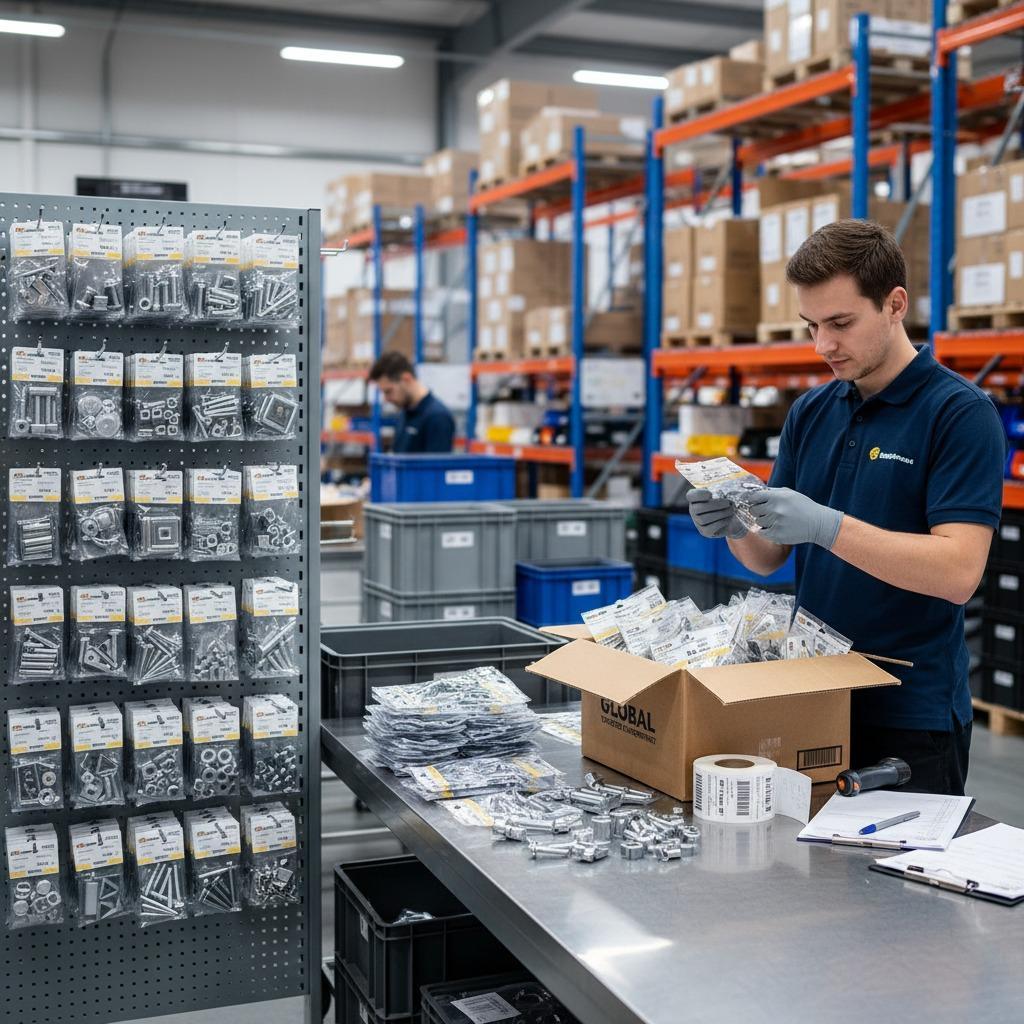
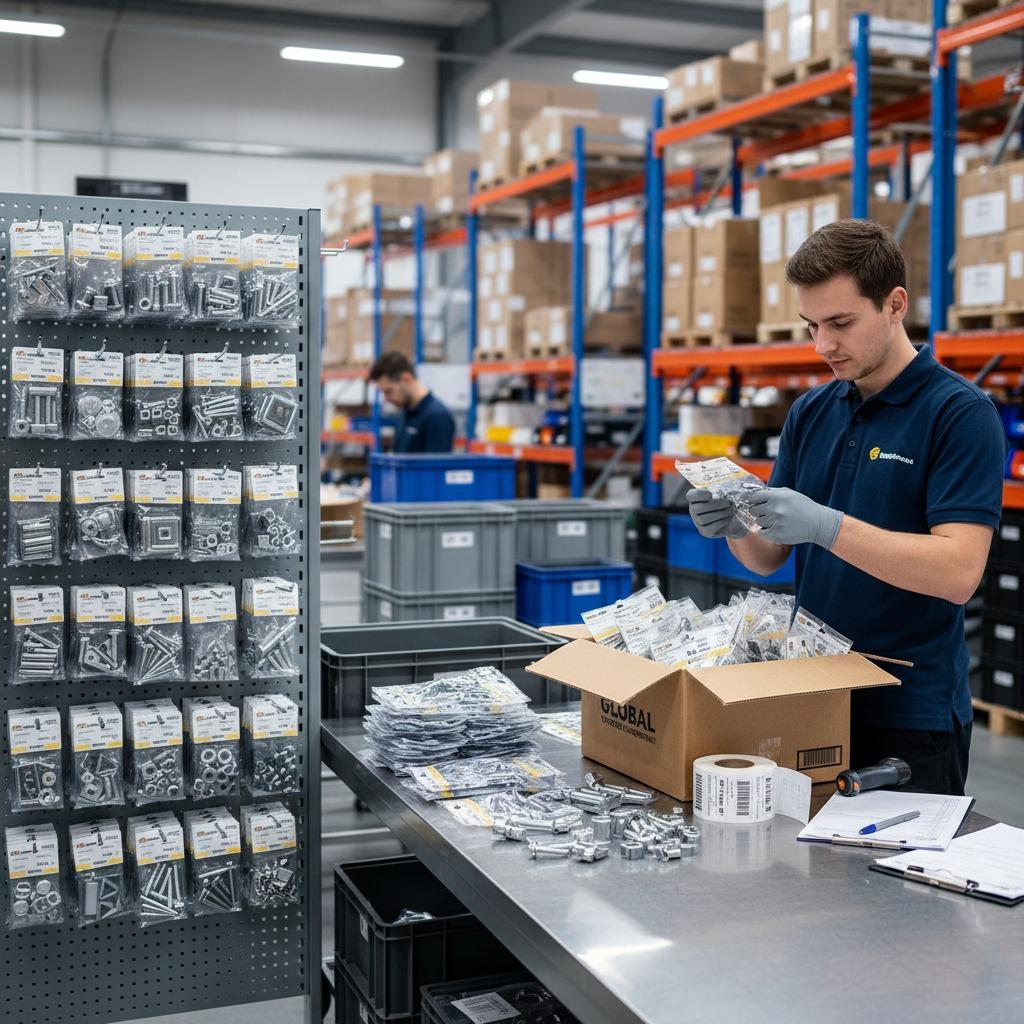
A clear blister pack can display screws, hinges, brackets, latches, spacers, washers, bolts, or fittings without opening the package. It can hang on a pegboard, carry a barcode, protect mixed parts, and help the customer understand the product quickly.
For retailers, that matters.
A loose bag may be cheaper, but it does not always present the hardware clearly. A blister pack gives the product shape. It turns small parts into something easier to stock, scan, display, and compare.
Blister packaging can also help internal teams. A warehouse worker can see the contents. A quality inspector can check the general assortment without opening the pack. A distributor can handle the SKU more cleanly.
Still, blister packaging is not always the best answer.
For factory line supply, a blister pack may be too slow to open. For heavy industrial hardware, it may not provide enough protection. For high-volume internal use, a labeled polybag, tray, or divided carton may work better.
The packaging format should follow the channel.
A good pack for retail may be a bad pack for assembly.
The BOM is the real starting point
Hardware kitting does not begin with the bag or blister.
It begins with the bill of materials.
The BOM should tell the supplier exactly what belongs in the kit: part name, quantity, material, finish, size, label information, packaging format, inspection method, and whether substitutions are allowed.
Without that control, the pack may look correct while still being wrong.
For example, a custom fastener kit may include two screw lengths, four nuts, several washers, one bracket, plastic spacers, an instruction card, and a barcode label. If one screw length changes during a product revision but the kit file does not change, the wrong fastener may keep appearing in the pack.
That is how small errors become repeat errors.
A reliable kitting program needs version control. The supplier should know which kit belongs to which product, which part has changed, and which sample is the approved reference.
A kit without a controlled BOM is just an assortment.
Counting is where many kits fail
Counting fasteners sounds easy.
Then the parts get small. Or similar. Or mixed.
A short screw and a long screw may differ by only a few millimeters. A zinc-plated bolt may look close to a stainless one under poor lighting. A small washer can hide under a bracket. A black-coated part may be placed with another black component because the shape looks similar at a glance.
That is why buyers should ask how the supplier checks the count.
Manual counting may be fine for simple kits. Mixed hardware kits may need automatic counting, weighing, divided trays, barcode scanning, visual inspection, or final pack verification.
Weight checks are useful, but they are not perfect. One missing washer can be hidden by one extra heavier screw. Two similar parts may pass the weight check but still be wrong.
For custom fastener kits and bolt and nut kits, count accuracy is not a minor detail.
It is part of the product.
Mixed finishes need more care than buyers expect
Many hardware kits contain different finishes in one package.
A single kit may include zinc-plated screws, brass-colored fittings, black-coated brackets, stainless washers, and plastic spacers. This is normal in furniture hardware, repair packs, retail hardware kits, and installation sets.
But mixed finishes create handling risks.
Polished pieces can scratch. Black-coated parts can mark lighter components. Brass-toned parts may vary slightly between batches. Stainless and plated steel may look similar but perform differently.
If the kit is customer-facing, appearance matters.
A part may function correctly and still make the kit look poor if it arrives scratched, dull, or inconsistent.
Good hardware packaging should consider which parts can touch and which parts need separation. Sometimes a separate cavity in the blister is enough. Sometimes a small inner bag is better. Sometimes a divider tray prevents the problem.
The point is simple: a kit should not damage itself during shipping.
Different channels need different kit logic
Retail buyers, OEM buyers, plant managers, and e-commerce sellers do not judge a kit the same way.
A retail buyer may care about the card design, hanging hole, barcode, product visibility, and whether the customer can understand the contents quickly.
An OEM buyer may care about part accuracy, repeat supply, assembly speed, and whether the kit matches the product BOM.
A warehouse team may care about carton efficiency, SKU control, and how fast workers can identify the pack.
An e-commerce seller may care about shipping durability, product photos, and whether the customer receives a clean-looking kit.
Trying to use one format for all of these needs usually creates problems.
A retail-ready blister pack may look professional but slow down workers on an assembly line. A plain polybag may work well in a factory but look weak in a retail aisle. A heavy divider box may protect parts well but increase shipping cost.
The right question is not, “Which package looks best?”
The better question is, “Who opens this kit, and what do they need to do next?”
A supplier should understand the parts, not only the packaging
A hardware kitting supplier should know more than how to seal a pack.
It should understand the hardware inside.
Screws, bolts, nuts, hinges, brackets, washers, spacers, clips, and precision fasteners do not all behave the same way during packing and shipping. Some need surface protection. Some must be separated because they look too similar. Some require tight quantity control. Some need clear labeling because the wrong part can stop an assembly step.
Jiangmen Jinhe Hardware Co., Ltd. focuses on fasteners and related standard parts, including machine screws, self-tapping screws, micro screws, and precision screws in stainless steel, iron, and aluminum. The company also works with GB, DIN, ANSI, BS, JIS, and ISO standards.
For sourcing teams, that background matters because a hardware kit depends on the quality of the parts inside it.
A clean blister pack cannot fix poor fastener consistency.
A useful supplier should be able to talk about the part specification, kit structure, packaging format, label content, inspection method, and repeat-order control together.
Kitting should remove work, not move it somewhere else
The best hardware kitting services reduce handling.
A warehouse should not need to open every pack to confirm the contents. A production worker should not need to sort screws before assembly. A retailer should not need to repackage the goods before display. A customer should not receive a pack that looks like leftover loose hardware.
If the kit creates extra work, the system is not finished.
Sometimes the issue is not the package itself. The assortment may be too broad. The label may be unclear. The BOM may include too many similar parts. The chosen format may not match the channel.
A smaller kit can be better than a large one.
A clear label can be better than a crowded label.
A plain bag can be better than blister packaging when the kit is meant for internal production.
Good kitting is not about making the package fancy.
It is about making the next step easier.
Where kitting programs usually go wrong
Most kitting failures are ordinary.
The BOM is unclear.
The count check is weak.
The label does not match the contents.
Similar fasteners are mixed.
The packaging format does not fit the channel.
A packaging change is made without approval.
The first sample is packed carefully by hand, but bulk production follows a different process.
These problems happen when kitting is treated as simple packing instead of controlled supply.
Buyers can reduce the risk by requesting real packed samples before volume orders.
Not loose parts. Not a photo. Not a general reference.
The real kit.
Open it. Count it. Store it. Shake it. Ship it. Let the warehouse team, assembly team, or retail team handle it. They will often find problems faster than a meeting room review.
Questions buyers should ask before placing an order
Before choosing a hardware kitting supplier, ask practical questions.
Can you work from our exact BOM?
How do you count small parts?
Can similar fasteners be separated?
Can mixed finishes be protected from scratches?
Do you support blister packaging, polybags, trays, cartons, or divider boxes?
Can labels include barcodes, SKUs, batch numbers, or model numbers?
Can you prepare retail hardware kits and OEM assembly packs?
How are packed kits inspected?
How are packaging changes approved?
Can the same kit be repeated in future orders?
What documents come with shipment?
The answers should be specific.
“We can pack it” is not enough for a serious hardware kitting program.
Frequently Asked Questions
Is hardware kitting only for retail packaging?
No. Hardware kitting is also used for OEM assembly, warehouse picking, maintenance kits, spare-part programs, e-commerce fulfillment, installation hardware, and industrial repair packs.
What can be included in a hardware kit?
A kit may include screws, bolts, nuts, washers, brackets, hinges, spacers, clips, plastic fittings, tools, labels, instruction cards, or other small hardware parts.
Are blister packs always the best packaging choice?
No. Blister packs are useful for retail display and visibility, but polybags, trays, cartons, or divider boxes may work better for production, warehouse, or maintenance use.
What should buyers check first?
Start with the BOM, part accuracy, count method, label clarity, packaging durability, and whether the kit format fits the sales or assembly channel.
Can one supplier handle both parts and packaging?
Sometimes. It depends on whether the supplier can support component supply, sorting, counting, labeling, packaging, inspection, documentation, and logistics.
Why do hardware kitting programs fail?
They usually fail because of unclear BOMs, poor count control, mixed similar parts, weak labels, uncontrolled packaging changes, or a format that does not match the workflow.
Less handling, more control
Hardware kitting is becoming more valuable because buyers want fewer touchpoints.
They want parts to arrive ready for the next step. They want clearer retail packs, fewer missing-component complaints, and less time spent sorting small hardware in warehouses, factories, service vans, or customer homes.
When done well, kitting supports all of that.
It turns screws, brackets, hinges, bolts, nuts, washers, and fittings into a ready-to-use unit that can be sold, shipped, stocked, installed, or assembled with less friction.
For custom fastener kits, bolt and nut kits, blister packaging, retail hardware kits, OEM spare-part packs, and hardware packaging programs, Jiangmen Jinhe Hardware Co., Ltd. can discuss fastener selection, kit structure, packaging formats, inspection, logistics, warehousing, and repeat supply requirements.
For direct inquiries:
Tel/WeChat: +86 13729150102
WhatsApp: +86 13322893939
Email: sharon@hkhomeideas.com
Start with the use case, BOM, packaging channel, label needs, and expected order volume.
Once the workflow is clear, the right hardware kitting program becomes much easier to build and repeat.