
Hydrogen embrittlement in fasteners is a delayed brittle fracture caused by hydrogen absorbed during acid cleaning or electroplating. A zinc-plated 10.9 or 12.9 screw can pass dimensional inspection, torque correctly on the line, and snap hours or weeks later under a load it was designed to carry. The fix is a specification, not an inspection: control the plating route, bake inside a qualified window, and prove it with a sustained-load test.
This is the failure mode that makes buyers distrust paperwork. Nothing in the goods-in report looks wrong, because nothing measurable is wrong yet. The part is dimensionally correct, the coating thickness is in tolerance, and the certificate is genuine. The damage was done at the plating line, and it only shows up when the joint sits under sustained load.
This guide explains what hydrogen embrittlement in fasteners actually is, which parts are at risk, how the requirement belongs in a drawing and purchase order, how to verify it without a metallurgy lab of your own, which coating routes change the risk, and the questions that separate a supplier who understands the problem from one who has merely heard the term.
What is hydrogen embrittlement in fasteners?
Hydrogen embrittlement in fasteners is the loss of ductility in a high-strength steel part after atomic hydrogen diffuses into the steel and collects at stress concentrations. The hydrogen does not need to be present in large quantities. A few parts per million trapped at grain boundaries, inclusions or the thread root is enough to let a crack start and grow under a load the part would normally carry without difficulty.
The characteristic signature is delay. Failure does not happen during tightening, when the applied stress is highest and brief. It happens hours or days later, under a static load, often at the first thread or under the head where stress concentrates. That delay is why the problem escapes incoming inspection and why it is expensive: the parts have already been assembled, shipped or installed when they fail.
Two mechanisms are usually separated in supplier discussions. Internal hydrogen embrittlement (IHE) comes from hydrogen introduced during manufacturing — pickling, electro-cleaning, electroplating, and sometimes heat treatment. Environmental hydrogen embrittlement (EHE) comes from hydrogen absorbed in service, for example from cathodic protection or a corrosive environment. IHE is the one a buyer controls through the purchase specification. EHE is a design and application issue, and no baking schedule will fix it.
Which fasteners are actually at risk?
Susceptibility tracks hardness and tensile strength, not product family. As a working rule used across the industry, risk becomes significant above roughly 1,000 MPa tensile strength, which corresponds to property classes 10.9 and 12.9 and to a hardness around 320 HV and above. Below that, the same plating process is far less likely to produce a delayed fracture. That is why hydrogen embrittlement in zinc plated screws is concentrated at the high-strength end of the range, and why a generic "zinc plated" callout is a weak control.
| Part type | Nominal tensile strength | Approximate hardness | Risk after acid cleaning or electroplating |
|---|---|---|---|
| Property class 4.8 / 5.8 | 400–500 MPa | up to about 160 HV | Low; still governed by the coating specification |
| Property class 8.8 | 800 MPa | about 250 HV | Moderate; rises with hardness, coating thickness and poor baking control |
| Property class 10.9 | 1,000 MPa (1,040 MPa minimum) | about 320 HV | High; de-embrittlement baking is normally required after electroplating |
| Property class 12.9 | 1,200 MPa | about 380–400 HV | Highest; the process route matters as much as the coating |
| Case-hardened tapping and self-drilling screws | Governed by ISO 2702, not ISO 898-1 | Case often above 450 HV | Assess separately; a hard case and an acid-cleaned surface are a poor combination |
| Austenitic stainless (A2 / A4, 304 / 316 family) | ISO 3506-1 designations such as A2-70 | Not comparable | Not susceptible in the same way; martensitic and precipitation-hardening grades are a different case |
The table explains a common mismatch in enquiries. A buyer asks for "zinc plated" on a 12.9 socket screw, receives a compliant-looking part, and never learns that the coating route was chosen for a 4.8 drywall screw. The coating name is not the requirement. The requirement is the coating plus the strength level plus the treatment that follows plating.
Two further points matter in practice. Thin sections and small diameters concentrate stress and fail faster at the same hardness, so an M4 screw at 12.9 is less forgiving than an M12 at the same class. And parts that are stripped and re-plated carry a second hydrogen dose; rework is a process change and should be declared, not quietly absorbed.
How hydrogen gets into the part during finishing
Hydrogen enters during the steps before and during deposition, not only during plating itself.
- Acid pickling and descaling. Removing scale or rust in acid generates hydrogen at the steel surface, and a portion diffuses inward. Longer immersion and higher acid strength increase the dose.
- Electro-cleaning and cathodic steps. Any step where the part is the cathode produces hydrogen at the surface.
- Electroplating efficiency. Zinc electroplating is not fully efficient; the fraction of current that goes to hydrogen generation rather than metal deposition is absorbed by the part. Barrel plating, deep recesses and difficult geometries make this worse.
- Coating thickness and coverage. Heavier deposits mean longer plating time and more hydrogen exposure, and a thick coating can also slow hydrogen escape during baking.
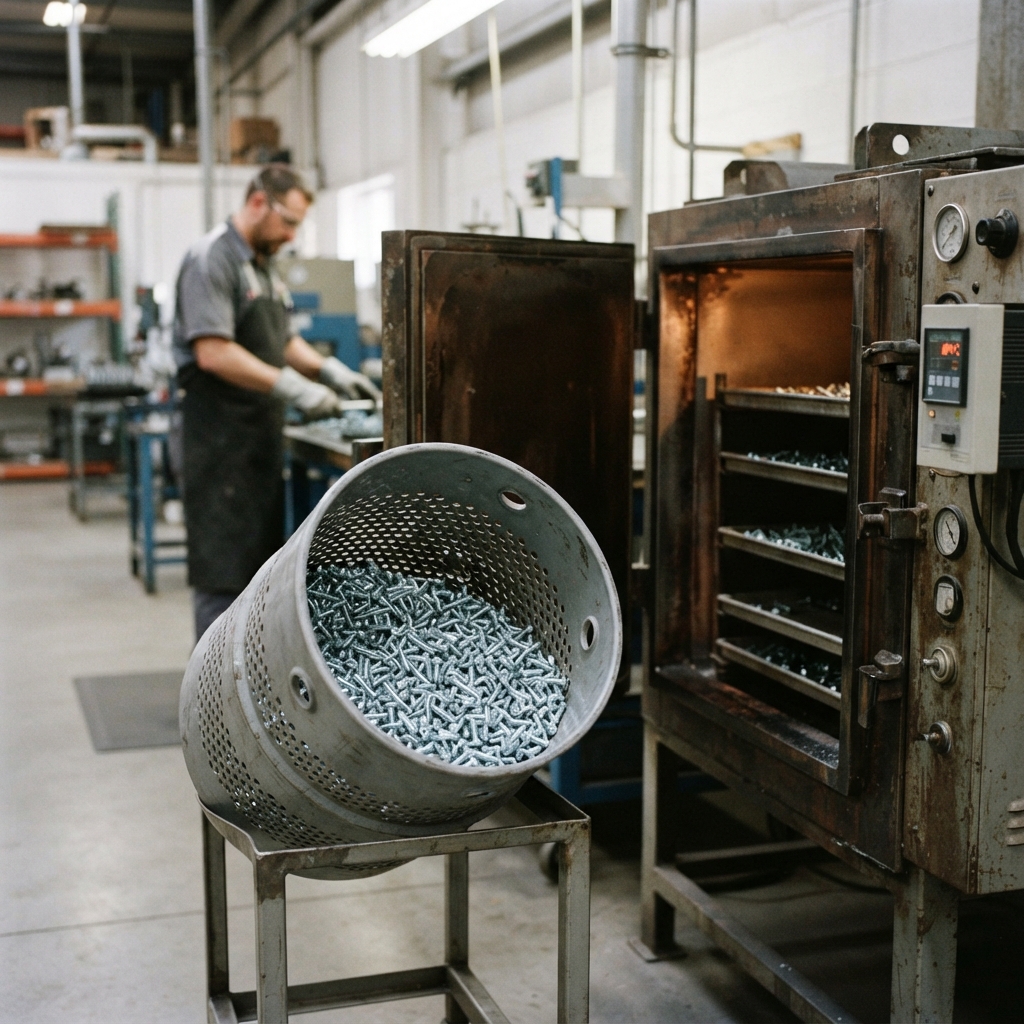
- Delay before baking. Hydrogen continues to redistribute after plating, so baking after zinc plating has to happen inside a defined window rather than whenever the oven is next free. A part that sits for days before entering the oven may not be recoverable at all, because the hydrogen has already reached trapping sites.
- Rework and double plating. Stripping in acid and re-plating adds a second dose on top of the first.
The important consequence for a buyer is that the controlling variables are time and sequence, not just chemistry. A supplier can buy the correct zinc bath and still fail the requirement by stacking plated work in a corner until the next oven load.
What the standards cover, and what to ask for
No single document covers the whole requirement, which is why supplier packs are often incomplete. Each standard answers a different question, and a hydrogen embrittlement test for fasteners answers only one of them.
| Document | What it addresses | What a buyer should ask for |
|---|---|---|
| ISO 4042 | Electroplated zinc and zinc-alloy coating systems: thickness, appearance, adhesion and the requirement to reduce embrittlement risk on high-strength parts | Coating designation, thickness range and the specified post-coating treatment, quoted against the current edition |
| ASTM B850 | Post-coating heat treatment of steel to reduce hydrogen embrittlement risk, with guidance that varies by strength and hardness | The actual oven cycle used: temperature, time, and the maximum delay between plating and baking |
| ISO 15330 | A preloading (sustained-load) test that detects hydrogen embrittlement in fasteners at room temperature | A test report per production lot, with sample size, load, duration and the pass criterion stated |
| ASTM F1940 | Process-control verification intended to prevent hydrogen embrittlement in plated parts | Evidence that the plating line itself was qualified, not only that one lot passed a test |
| ISO 898-1 | Mechanical properties by property class for carbon and alloy steel screws and bolts | Class and standard edition written into the drawing, so the strength level driving the risk is unambiguous |
A 3.1 material certificate does not address this. It reports the steel chemistry and mechanical results of the heat, and says nothing about what the plating line did to the part afterwards. Buyers who accept a 3.1 certificate as evidence of embrittlement control are checking the wrong document, a distinction covered in our guide to screw manufacturer certification documents.
How to write the requirement into the drawing and PO
The requirement has to survive contact with a quoting desk, a plating subcontractor and a shipping clerk. That means plain, checkable lines rather than a reference to a standard with no values.
- State the class and the standard edition — for example "property class 10.9 to ISO 898-1:2013" — so the hardness band that triggers the requirement is fixed.
- Name the coating system and thickness range against ISO 4042, not just the colour or the words "zinc plated".
- Require de-embrittlement baking after plating, with temperature and time stated, and cap the delay between plating and baking. Common industry cycles sit in the region of 190–220 °C for four hours or longer, with longer cycles for higher-strength parts; confirm the exact values from ASTM B850 and from the finisher's qualified process rather than copying a number from a blog.
- Prohibit re-plating and stripping without written approval, and require any rework to be declared before shipment.
- Specify the verification test and the record — ISO 15330 preloading test, sample size per lot, load and duration, pass criterion, and who holds the report.
- Require the oven record to be traceable to the lot, with date, cycle number and the time plating finished.
- State disposition for a failed lot: no shipment, sort and replace at supplier cost, with the failure reported.
A clause that reads "parts shall be baked after plating to prevent hydrogen embrittlement" cannot be audited. Nobody can say whether it passed. A clause that names a temperature, a time, a maximum delay and a test method can be checked by a clerk with a folder, which is exactly what you want.
Three levels of verification
Verification works best as a ladder, cheapest evidence first. On high strength fasteners 10.9 and 12.9, climb all three levels on the first order rather than after a failure.
| Level | What you check | What it proves | What it misses |
|---|---|---|---|
| 1. Records | Oven log tied to lot, plating date, baking start and finish, temperature chart | The process was run as written for that batch | A genuine log attached to the wrong carton |
| 2. Lot test | ISO 15330 preloading test on a sample from the lot, with the report stating load and duration | The sampled parts survived a sustained load without delayed fracture | A small sample can miss a marginal process |
| 3. Process audit | ASTM F1940-style process qualification, plus a walk through the plating and baking sequence | The line is capable of controlling the risk across lots | Nothing, if the audit is current and the line has not changed |
For a first order or a new part, ask for all three. For repeat business, records plus a periodic lot test is a practical rhythm, with a process audit after any change of plating subcontractor, oven, chemistry or coating thickness. If your inspection plan already samples per AQL inspection levels, note that embrittlement testing is not an AQL attribute check; it is a separate destructive test with its own sample and duration.
Coating routes that change the risk
| Route | Hydrogen risk | Practical notes for buyers |
|---|---|---|
| Zinc electroplating (barrel or rack) | High on 10.9 and above | Requires a controlled bake and a capped plating-to-baking delay; the default route that causes most problems |
| Zinc flake coating (ISO 10683) | Lower, but not automatically zero | Applied by dip-spin or spray rather than electrodeposition, which removes the plating current; acid cleaning before coating can still introduce hydrogen, so ask about the full pre-treatment |
| Mechanical zinc plating (ASTM B695) | Low | A cold mechanical deposition process with no electrolytic hydrogen generation; coverage in blind recesses and thread flanks needs checking |
| Phosphate plus oil or sealer | Low to moderate | Common on internal and machine parts; corrosion performance is lower than zinc systems, so match it to the environment |
| Zinc-nickel electroplating | High | Better corrosion performance, same embrittlement discipline as zinc; do not treat the alloy coating as a free pass |
| Austenitic stainless (A2 / A4) | Not the same mechanism | Removes the plating step entirely; verify grade, passivation and thread galling instead, as covered in our corrosion-resistant screw guide |
Changing the coating is a legitimate way to reduce risk, but it changes corrosion performance, cost and often lead time at the same time. On very high classes, switching route is sometimes the cleanest answer to hydrogen embrittlement in fasteners, because it removes the electrolytic step instead of trying to control it. The usual mistake is switching from electroplated zinc to zinc flake without re-checking salt spray expectations, appearance and thread fit.
Six mistakes buyers make
Most hydrogen embrittlement in fasteners problems trace back to a purchasing decision rather than a plating failure: something in the requirement was left open, and the cheapest interpretation filled the gap.
- Specifying "zinc plated" with no class. The supplier cannot know whether de-embrittlement applies, so the cheapest route is quoted.
- Accepting a material certificate as process evidence. A 3.1 certificate describes the steel, not the plating line.
- Baking without a time cap. A bake that happens three days after plating may be too late, and nothing in the record shows the gap.
- Testing only at first article. Embrittlement control is a process control; one passing lot does not qualify the next one.
- Treating rework as invisible. Stripping and re-plating doubles the hydrogen dose and rarely appears on a shipping document.
- Approving a coating change for cost. A cheaper coating route can move a 10.9 part from "controlled" to "uncontrolled" without any drawing revision.
Ten questions before you approve the part
- What property class and standard edition is this part made to, and what hardness band does that imply?
- Which plating process is used, in-house or subcontracted, and to which ISO 4042 designation?
- Is there a de-embrittlement bake, at what temperature and for how long?
- What is the maximum time between end of plating and start of baking, and how is it recorded?
- Can you show an oven chart for the lot, tied to the lot code on the carton?
- Do you run a sustained-load test to ISO 15330, at what sample size and load, and who signs the report?
- Has the plating line been process-qualified, and when was it last reviewed?
- What happens to parts that fail — are they re-plated, scrapped or shipped?
- If the coating is changed later, who approves it and how is the change recorded?
- Which documents ship with the lot, and can I see the format before I order?
Answers that stay general — "we always bake", "our plater is certified" — are the ones to press. A supplier who can produce a cycle record, a lot test and a named standard usually answers in specifics without being pushed.
How JHFIX handles plated high-strength parts
JHFIX has manufactured fasteners and furniture hardware in Jiangmen, Guangdong since 2004, exporting to more than 40 countries through its authorised export partner, Jiangmen Shenxin Trading Co., Ltd. Production runs through cold heading, tapping, punching, injection moulding, assembly and packing, with an inspection room and finished-goods warehouse on site.
Most of the range is zinc-plated or coated carbon steel and 304 stainless, in the 4.8 to 8.8 range, where embrittlement risk is lower but still governed by the coating specification. Finish options such as zinc plating, Ruspert coating, spray painting, electrophoretic coating and blackening are reviewed against the drawing, and published MOQ is 10,000 pieces per confirmed specification.
Two current examples show where the conversation usually starts. The black hex-socket wide-head machine screw is offered in M6 and M8 from 12 mm to 150 mm, with finishes reviewed per order. The 304 stainless metric socket screw, nut and washer kit removes the plating step altogether by using an austenitic grade.
If your part is 10.9 or above, say so in the enquiry and put the coating standard, the bake requirement and the test document on separate lines. Those items are then quoted and reviewed as requirements rather than assumed from a photograph, which is the only way the answer stays checkable after the order is placed.
Conclusion
Hydrogen embrittlement in fasteners is a plating and baking problem that surfaces as a service failure, so it has to be controlled before the parts are packed. The working sequence is short: know the property class, choose a coating route that suits it, require a bake inside a defined window with a capped delay, and verify with a sustained-load test plus a process record that ties back to the lot. Buyers who skip the class in the drawing lose control of everything downstream.
Send the drawing, the property class, the coating callout and your evidence requirements to the JHFIX team and they will be reviewed as line items in the quotation, or start from the fastener product range to see the current configurations.
Frequently asked questions
What is the primary cause of hydrogen embrittlement in electroplated fasteners?
Hydrogen generated at the steel surface during acid pickling, electro-cleaning and electroplating diffuses into the part and becomes trapped at stress concentrations. If the part is not baked promptly and correctly, that trapped hydrogen causes delayed brittle fracture under sustained load. High hardness, thick coatings and long delays before baking all raise the risk.
Which property classes need de-embrittlement baking?
Hydrogen embrittlement in fasteners becomes a practical concern above roughly 1,000 MPa tensile strength, which covers classes 10.9 and 12.9, and around 320 HV and above. Class 8.8 is a moderate-risk middle ground that depends on hardness, coating thickness and process control. The class alone does not decide it: the coating process and the baking discipline do.
How long after plating must a part be baked?
The delay is part of the qualified process and is usually capped in hours, not days. Hydrogen continues to move through the steel while the part waits, and a late bake may not recover it. Ask the finisher for the maximum delay in their qualified cycle and require the oven record to show the plating end time and the bake start time.
Does a 3.1 material certificate prove the parts are not embrittled?
No. An EN 10204 3.1 certificate reports the chemistry and mechanical results of the steel heat. It says nothing about pickling, plating current, coating thickness or baking. Embrittlement control is evidenced by process records and a sustained-load test on the lot, not by a steel certificate.
Is zinc flake coating free of hydrogen embrittlement risk?
It is lower risk than zinc electroplating because the coating is not deposited by electrolysis, but it is not automatically risk-free. Acid cleaning before coating can still introduce hydrogen. Ask what pre-treatment is used, and keep the de-embrittlement question in the specification for 10.9 and 12.9 parts.
Can hydrogen embrittlement be detected at goods-in?
Not visually, and not by dimensional or coating-thickness checks. Detection of hydrogen embrittlement in fasteners needs a sustained-load test such as ISO 15330 on a sample from the lot, or a process audit of the plating and baking line. A part that fails usually shows no external sign until it fractures.
Do stainless steel screws suffer from hydrogen embrittlement?
Austenitic grades in the 304 and 316 families are not susceptible in the same way, which is one reason they are chosen for high-strength or safety-related joints. Martensitic and precipitation-hardening stainless grades are a different case and should be assessed on their own. Specify the grade and the ISO 3506-1 designation rather than assuming stainless means immune.
What does a hydrogen embrittlement test report contain?
A usable report names the standard and edition, the lot or heat it covers, the sample size, the applied load and duration, the test temperature, the pass criterion and the result, with the equipment and the person who signed it. A line saying "passed" with no load or duration is not evidence.
References
- ISO 15330:1999 — Fasteners: preloading test for the detection of hydrogen embrittlement, listed by ANSI Webstore
- ASTM B850 — Standard guide for post-coating treatments of steel for reducing the risk of hydrogen embrittlement
- ASTM F1940 — Standard test method for process control verification to prevent hydrogen embrittlement in plated or coated fasteners
- ISO 4042 — Fasteners: electroplated coating systems