
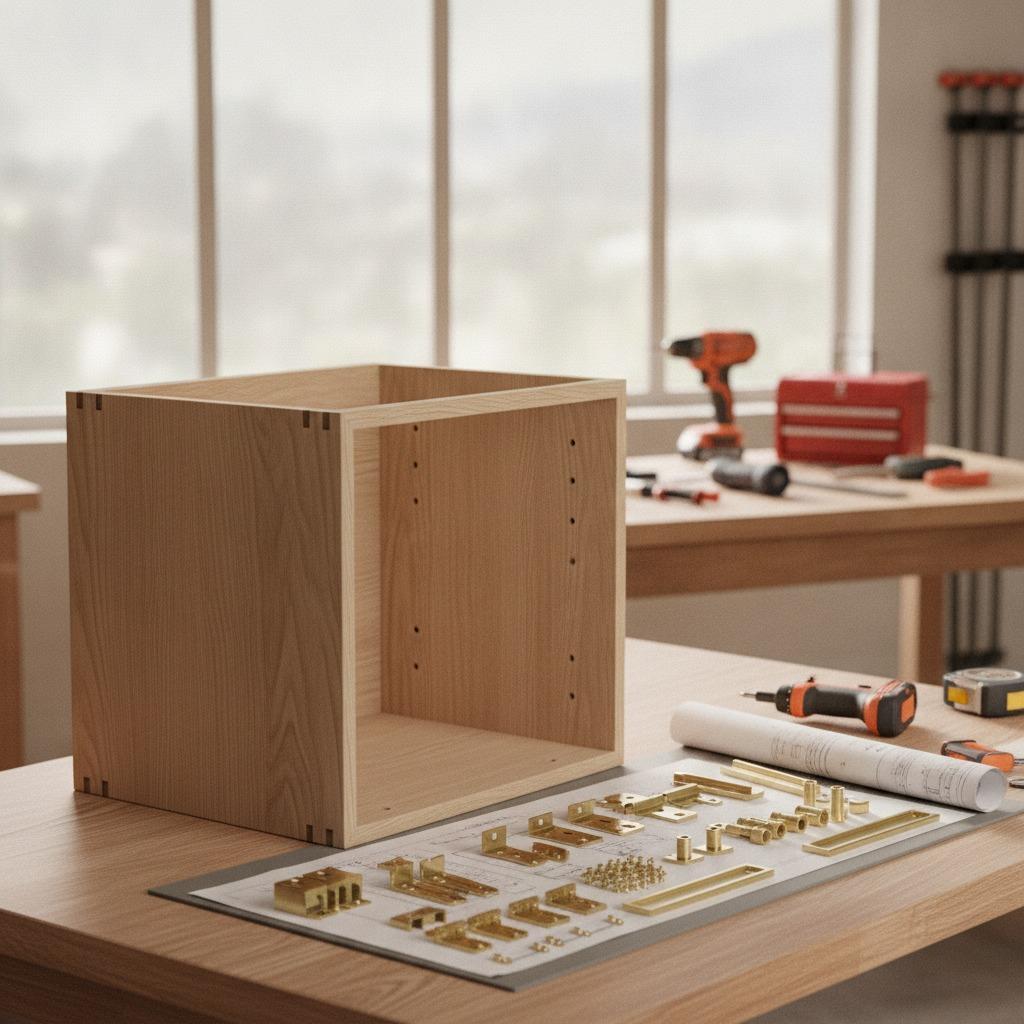
Why Metal Furniture Connectors Matter Beyond the Assembly Bench
A cabinet can look perfect in a drawing and still feel wrong the moment someone assembles it.
The panels may be cut accurately. The finish may be clean. Every hole may appear to be in the correct place. Yet the carcass twists slightly when lifted, or one corner refuses to close without extra pressure.
In many cases, the board is not the real problem. The joint is.
Metal furniture connectors determine how panels pull together, how accurately the finished unit holds its shape, and whether workers can repeat the same assembly hundreds of times without stopping to make adjustments. They also influence what happens after production: packing, transport, installation, repair, and possible disassembly.
For engineers and sourcing managers, connector selection is therefore not a finishing detail. It is part of the structural and manufacturing design.
 A connector has to work with the furniture around it
No connector performs alone.
It depends on the panel material, drilled-hole position, edge quality, tightening method, and the direction in which the joint carries load. A fitting that works well in one cabinet may perform poorly in another, even when the two products look similar.
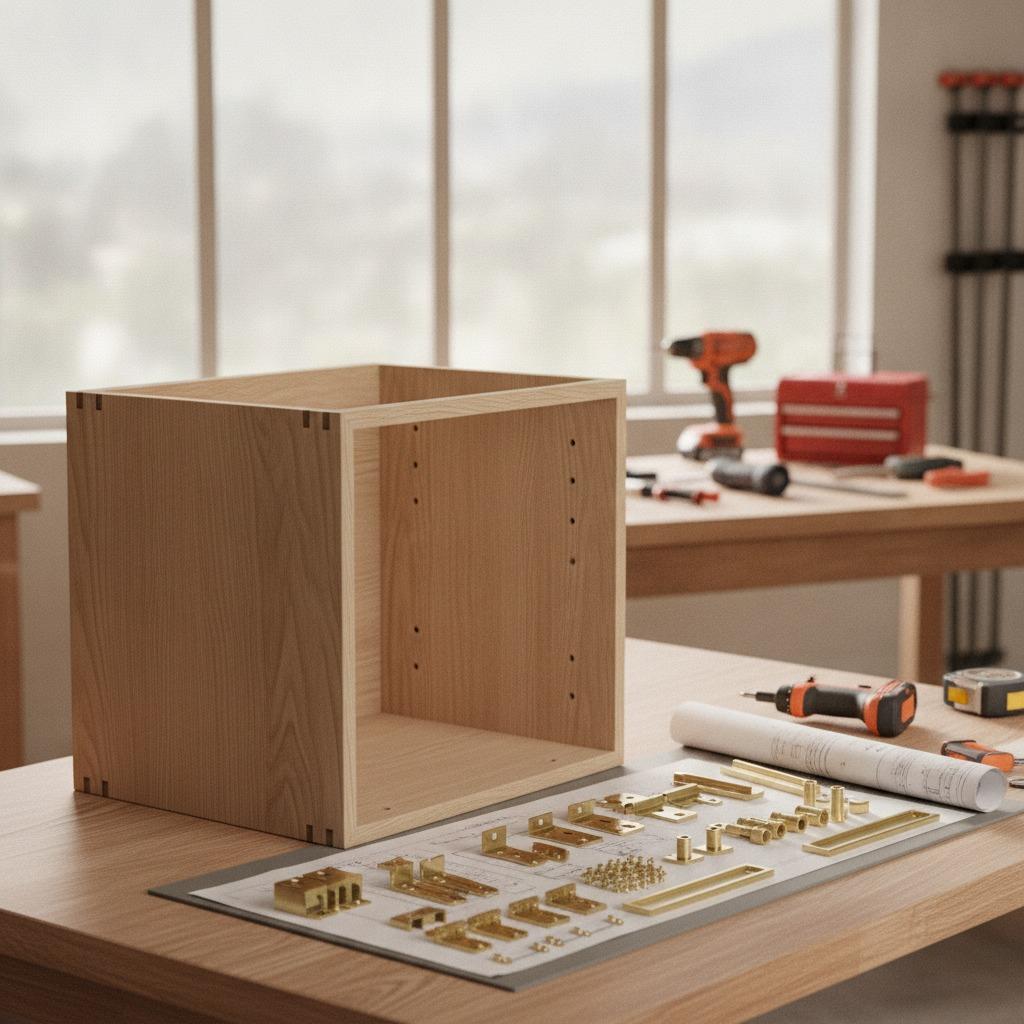
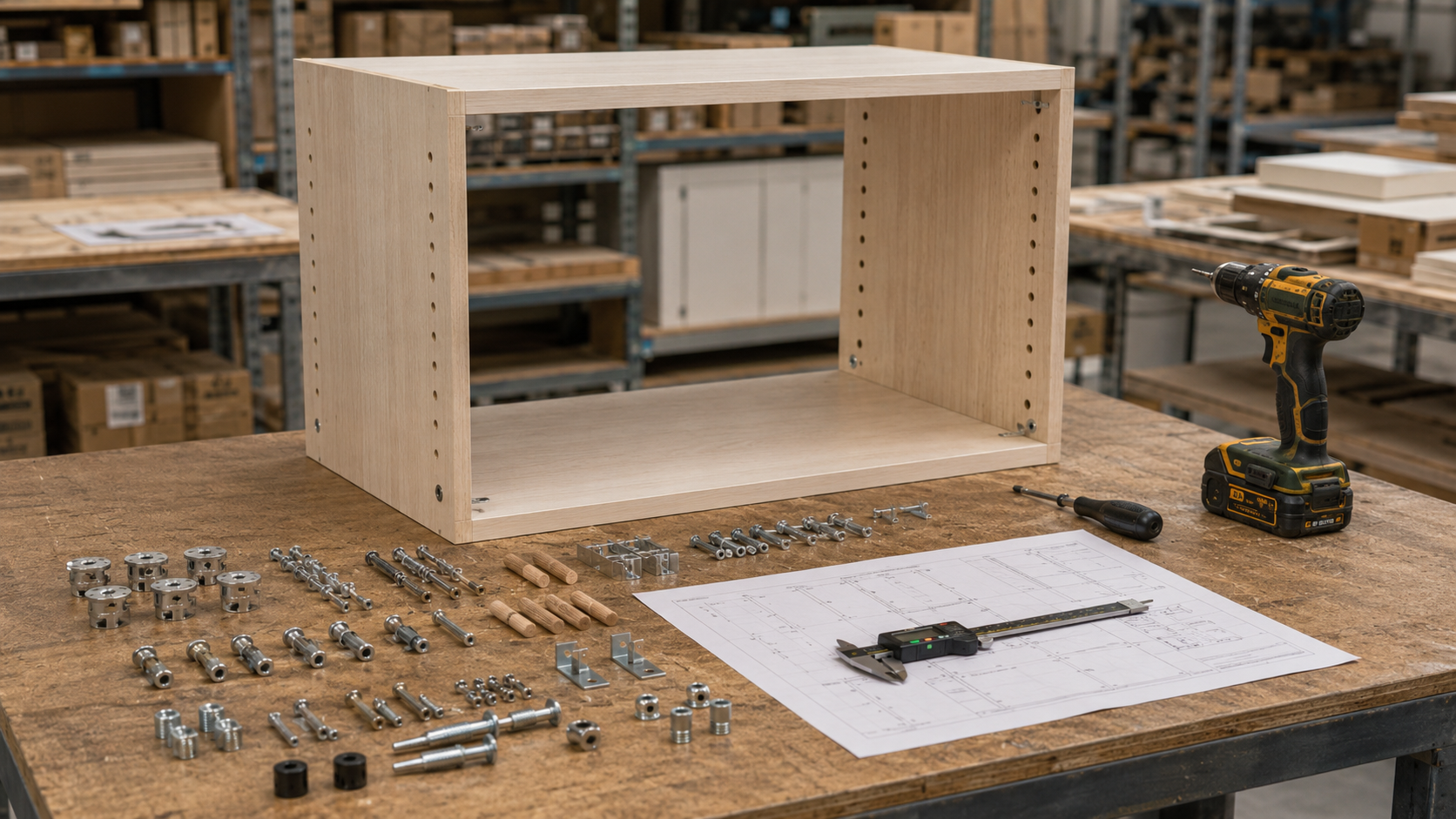
Take a simple open-front cabinet carcass as an example. It may consist of two side panels, a top, and a base, with evenly spaced holes drilled along the inner faces. Those rows might later hold adjustable shelves, mounting hardware, or internal fittings.
At this stage, the cabinet looks uncomplicated. In practice, several variables are already interacting:
- Panel thickness
- Hole diameter and depth
- Distance from the panel edge
- Connector length
- Installation torque
- Board density
- Assembly order
A connector that is slightly too long may interfere with another fitting. One that needs high tightening force may damage a low-density particleboard panel. A poorly matched cam-and-bolt set may leave a visible gap even though both individual parts meet their drawings.
This is why connector selection should begin with the joint and the panel—not with a catalog photograph.
What a prototype carcass can tell the engineering team
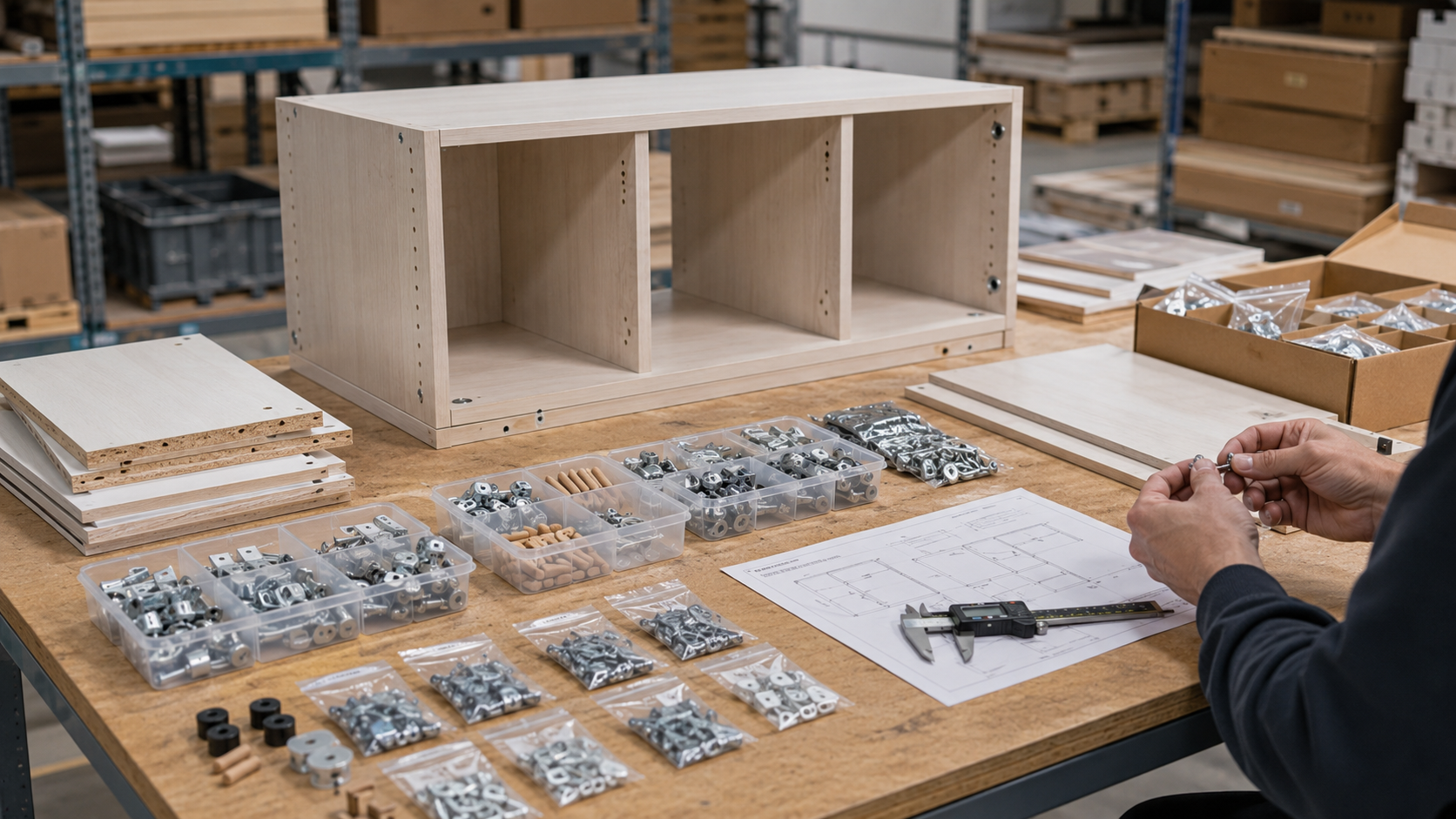 A prototype should expose weaknesses. It should not simply prove that one careful technician can assemble the product once.
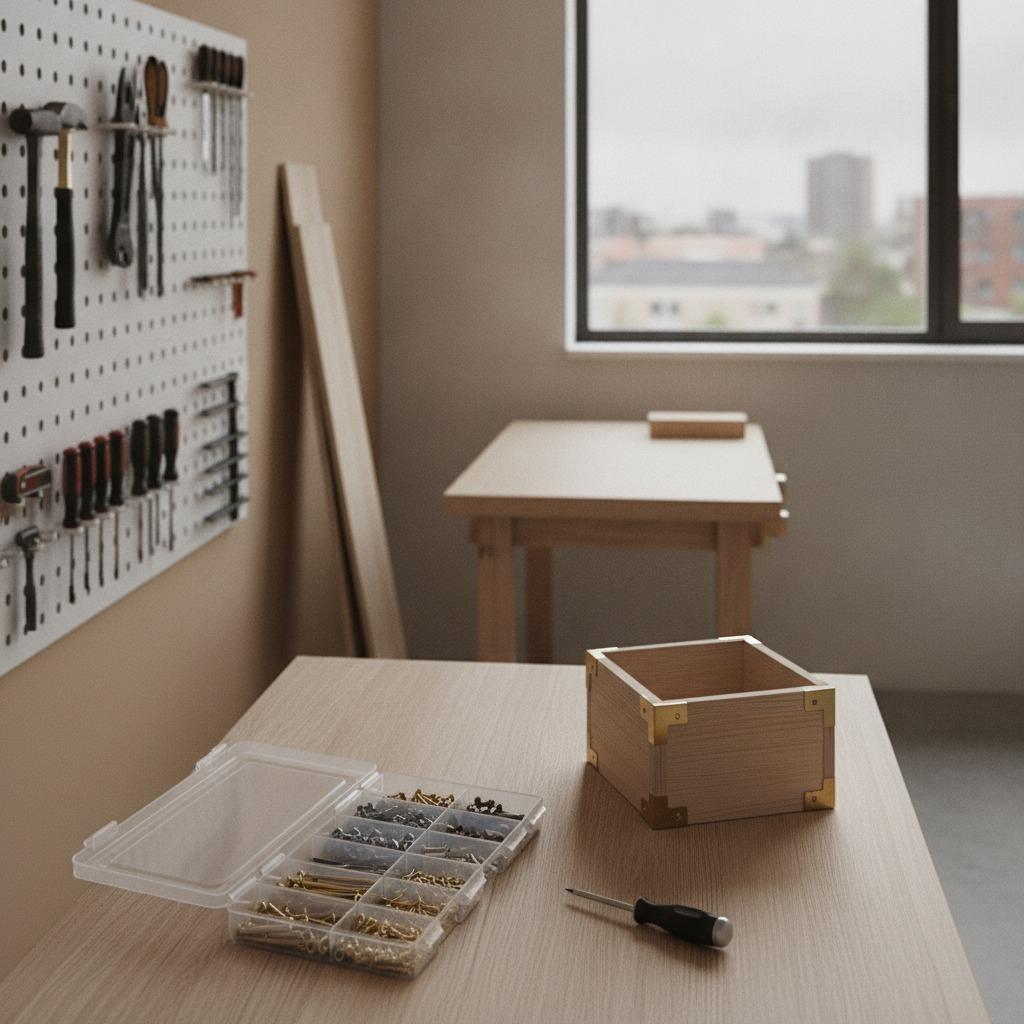
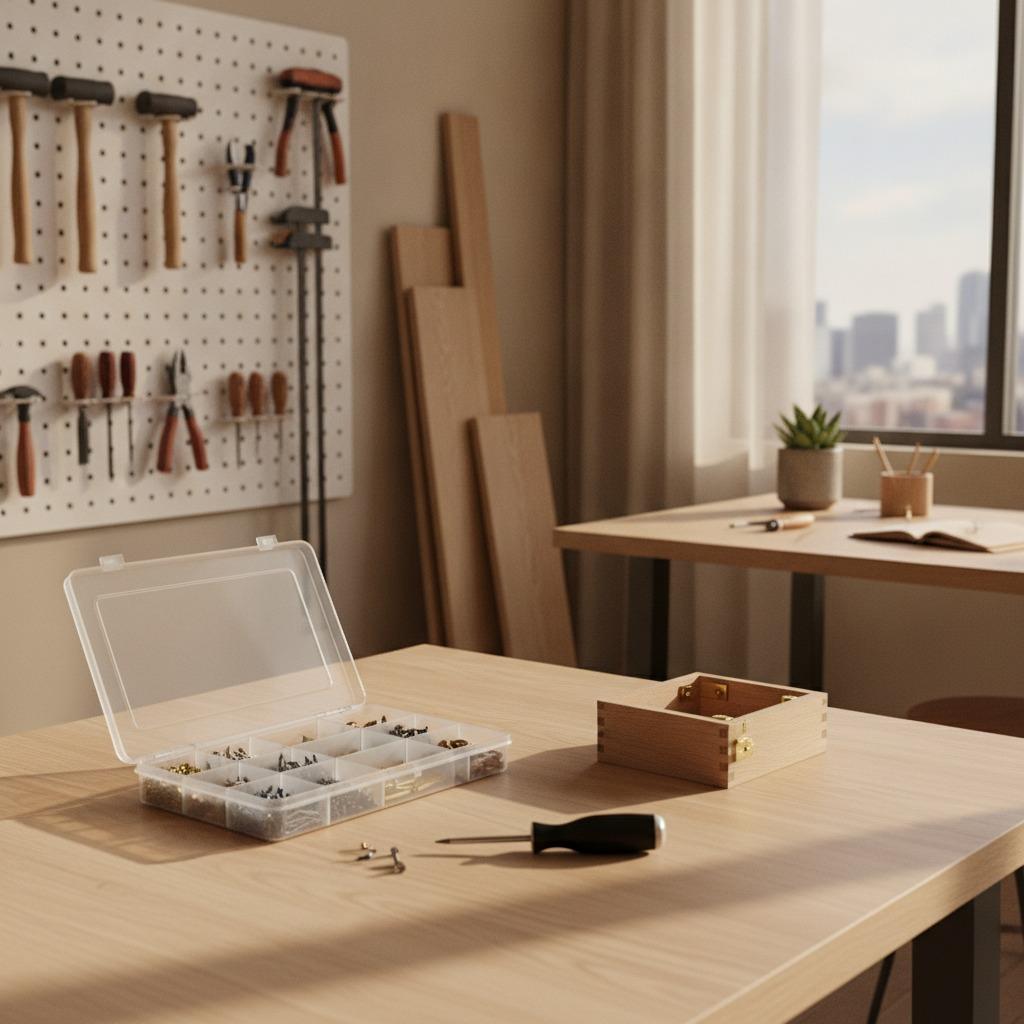
When a trial cabinet is placed on a workshop bench, the team should look beyond whether the box stays together. Check how naturally the panels locate themselves. Notice whether the fitting starts smoothly or needs to be forced. Watch the panel edge while the joint is tightened.
If the connector is doing its job properly, the panels should close in a controlled way.
If workers need to push one side into position while tightening the other, the assembly may be relying too heavily on manual correction. That may be manageable during prototyping, where everyone has time to inspect each joint. It becomes a different problem when the same operation reaches a busy production line.
A useful trial should answer practical questions:
Does the connector tolerate normal variation in the drilled holes?
Can the operator reach it with the planned tool?
Does the panel surface remain undamaged after tightening?
Can the joint be opened and closed again?
Does the cabinet remain square when moved?
These observations often reveal more than a dimensional report.
Metal furniture connectors versus other joining methods
Furniture manufacturers rarely choose between a “good” and a “bad” connector. More often, they choose between several workable systems, each with different consequences.
Knock-down connectors for furniture shipped flat
Knock down furniture connectors are widely used in wardrobes, cabinets, shelving systems, and other products that need to travel in compact cartons.
Their main advantage is obvious: panels can be packed separately and assembled later. This reduces shipping volume and may simplify storage.
Cam locks and matching bolts are among the most familiar options. When the holes are accurate, they create a clean joint with little visible hardware. They are also understandable to many end users.
The system becomes less forgiving when the drilling varies.
If the cam sits too deep, it may not engage the bolt correctly. If the bolt projects too far, the panel may not close. If the fitting requires more force than expected, a customer may assume the product is defective—or damage the panel while trying to finish the assembly.
For flat-pack products, ease of use is part of connector performance.
Dowel connectors for alignment
Dowel connectors for furniture are still widely used because they provide a simple way to locate two panels.
A dowel does not always carry the main structural load. Often, its most important job is alignment. It helps prevent the panels from sliding while a screw, bolt, or cam fitting supplies the clamping force.
This combination can work very well with CNC-drilled boards.
The tolerances still matter. A dowel that is too loose contributes little to positioning. One that is too tight may chip the panel edge or make assembly unnecessarily difficult. Moisture and material variation can also affect wooden dowels.
Dowel systems are reliable when drilling is controlled. They are less forgiving when hole positions drift.
Brackets, plates, and exposed fittings
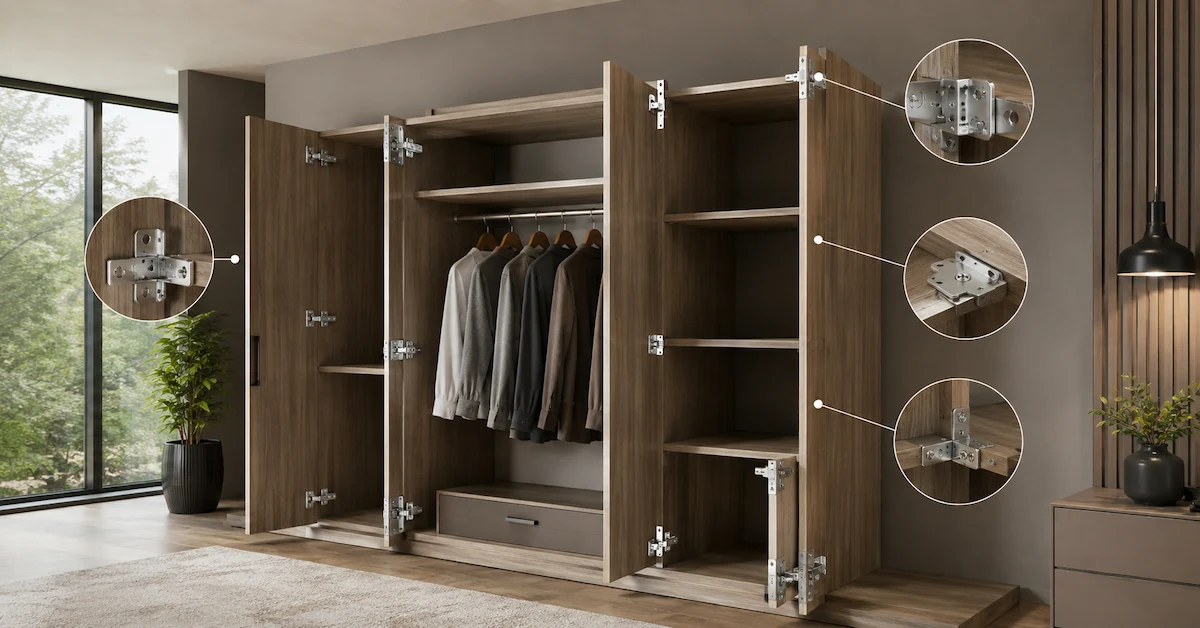
Brackets and reinforcement plates are practical when the furniture needs additional support or when there is not enough room for a concealed connector.
They are commonly used inside cabinet corners, beneath shelves, around mounting points, and in workshop or utility furniture where appearance is not the only concern.
These parts may look simple, but production consistency still matters. A small variation in the bend angle can prevent the bracket from sitting flat. Incorrect hole spacing may force the operator to enlarge a hole or pull the cabinet out of square.
Where the bracket remains visible, the finish also becomes part of the product.
Threaded inserts for joints that may be reopened
Threaded inserts create a durable metal thread inside a wood-based panel. They are useful when the furniture may be assembled more than once or when the joint needs to accept repeated bolt installation.
The insert itself must remain secure.
If it turns inside the board, sits at the wrong depth, or pulls out under load, the joint becomes difficult to repair. The outer thread design, panel density, pilot-hole size, and installation method all affect performance.
Threaded inserts can improve serviceability, but only when the surrounding panel can support them.
Why metal parts are attractive in production
Metal fittings provide several practical advantages.
They can deliver more predictable clamping force than joints relying only on wood. Their dimensions are easier to standardize across product models, and many designs support disassembly without destroying the panel.
Metal parts can also simplify quality control. Length, thread, head size, coating, and mating fit can all be measured against an approved specification.
None of this means that metal hardware automatically creates a strong joint.
The load still has to transfer into the panel. If the board edge is weak, the drilling is inaccurate, or the connector is installed incorrectly, a high-quality fitting will simply expose the weakness more clearly.
Good hardware cannot correct poor panel machining.
Panel material changes the connector decision
Furniture panels do not respond to fasteners in the same way.
Plywood has layered construction and can provide good holding strength, although performance depends on veneer quality and drilling direction. MDF offers a smooth, consistent surface but may be vulnerable near edges if the connector creates concentrated stress.
Particleboard is widely used in cabinet and flat-pack furniture because it is economical and easy to process. Its lower-density core, however, requires careful control of hole size and tightening force.
Solid wood introduces another set of variables. Grain direction, moisture content, and seasonal movement may affect the joint over time.
Before selecting cabinet connector hardware, the engineering team should test the fitting in the exact board intended for production. A sample made from a different material may create false confidence.
Assembly method matters as much as connector strength
A connector can be strong and still be unsuitable for the line.
Consider the number of actions required to install it. Does the operator need to turn the panel over? Is a special bit required? Can the fitting be inserted automatically, or must it be positioned by hand? Is the connector accessible after another panel has been added?
Small complications accumulate quickly.
A fitting that takes only ten extra seconds may not seem important during prototyping. Across 2,000 units, those seconds become hours of labor.
There is also the question of consistency. A connector that depends on the installer “feeling” the correct tightness may create more variation than one installed to a controlled depth or torque.
The best connector is not always the strongest available option. It is the one that provides sufficient strength while fitting naturally into the production process.
Serviceability should be considered before the product ships
Furniture does not always remain untouched after installation.
Doors need adjusting. Panels may be replaced. Built-in cabinets may be removed during renovation. Modular products can be rearranged, expanded, or moved to another location.
A completely hidden connector may produce the cleanest appearance, but it can create difficulty later if technicians cannot reach it.
This is where design teams sometimes make a trade-off without realizing it. They optimize the joint for the first assembly and overlook every assembly that may come afterward.
For products expected to be serviced, moved, or reconfigured, access matters.
A slightly more visible connector may be the better engineering choice if it allows the joint to be tightened or replaced without damaging the furniture.
How custom furniture fasteners fit into the system
Many furniture connector systems depend on supporting hardware that receives less attention than the main fitting.
A cam connector needs a matching bolt. A metal bracket requires screws suited to the panel. A threaded insert depends on a bolt with the correct length and thread. Even a dowel-based joint may include additional screws or reinforcement hardware.
Jiangmen Jinhe Hardware Co., Ltd. manufactures machine screws, self-tapping screws, micro screws, precision screws, and customized non-standard fasteners. For furniture manufacturers, this can be relevant when the standard screw supplied with a connector does not suit the panel thickness, available space, finish, or installation method.
A custom fastener should solve a defined problem.
It may reduce the risk of a screw breaking through the opposite panel face. It may provide a head shape that fits a restricted area. It may combine the required thread with a specific drive style used on the production line.
Customization should not be added simply to make a product appear more specialized. It introduces drawings, tooling, minimum quantities, and replacement considerations. Where a standard fastener works reliably, it is often easier to maintain over the life of the product.
What sourcing teams should verify before ordering
Price is only one part of a connector quotation.
Buyers should also confirm whether the manufacturer understands the mating components and the furniture application. Ask which dimensions affect fit. Request information about the material, coating, production tolerances, inspection method, and packaging.
For a connector system, the relationship between parts is often more important than any individual measurement.
A bolt may meet its own drawing and still fail to engage properly with the matching fitting. A screw may have the correct thread but be unsuitable for the actual board. A bracket may be dimensionally acceptable but arrive mixed with another version.
A useful sample review should include the complete joint wherever possible.
Packaging is part of production reliability
Connector quality does not end after manufacturing.
Small hardware must arrive in the correct quantity, clearly separated, and protected from damage or mixing. A flat-pack cabinet with one missing bolt is not 99% complete from the customer’s point of view. It cannot be assembled.
Similar-looking screws deserve particular attention. A difference of only a few millimeters may be hard to notice in a mixed bag, yet the longer screw could damage a finished panel.
Buyers should define:
- Quantity per bag or kit
- Components allowed in the same package
- Label information
- Spare-part quantity
- Verification method
- Carton arrangement
- Protection against moisture and abrasion
For factory assembly, bulk packing may be efficient. For retail furniture, counted kits are usually more appropriate.
The packaging method should support the next stage rather than create additional sorting work.
Common mistakes that create avoidable rework
One mistake is selecting a connector before the panel design is stable.
If the board thickness or hole position changes later, the fitting may no longer be suitable. Hardware, drilling, and assembly sequence should be reviewed together.
Another is assuming that a heavy-duty fitting is automatically better.
Oversized hardware can increase cost, require more machining, and make assembly slower without improving the product in a meaningful way. The connector needs to match the actual load.
Teams also underestimate repeated assembly.
A joint that works once may not survive being opened and closed several times. This matters for showroom furniture, rental products, office systems, and flat-pack items that may be moved.
The final mistake is approving a connector based on appearance. A clean finish is welcome, but the real test is how consistently the part fits, tightens, and holds.
A practical selection process for metal furniture connectors
Before approving metal furniture connectors for production, begin with the furniture itself.
Confirm the panel material and thickness. Review the hole pattern and edge distance. Decide whether the product will be factory-built or assembled later. Identify the expected load and whether the joint may need to be reopened.
Then test the complete connection.
Use production-intent panels, normal drilling conditions, and the tools planned for the line. Assemble several joints rather than one. Check alignment, tightening effort, panel damage, rigidity, and repeatability.
A short pilot run can be more informative than another week of discussing drawings.
It reveals how the connector, operator, panel, packaging, and inspection process work together.
Frequently Asked Questions
Are metal furniture connectors always stronger than wood-only joints?
Not always. Metal fittings can provide controlled clamping and repeatable dimensions, but the final joint strength also depends on the panel, hole quality, load direction, and installation method.
When should manufacturers use knock down furniture connectors?
They are useful when furniture needs to ship flat, be assembled with basic tools, or come apart again later. They are common in cabinets, wardrobes, storage units, and modular furniture.
Do dowels still matter when metal connectors are used?
Yes. Dowels often improve panel alignment while a metal fitting supplies the main clamping force. The two methods can complement each other.
Should the connector be tested in the actual board material?
Yes. Different wood-based panels have different density, edge strength, and screw-holding performance. Testing in another material may not reflect production conditions.
When is a custom fastener justified?
Customization makes sense when a standard screw cannot meet the required length, thread, drive, head shape, finish, or installation conditions. It should address a specific manufacturing or performance issue.
What should be included in a connector sample request?
Include the part drawing, panel material, board thickness, drilled-hole information, matching components, expected quantity, surface finish, assembly method, and packaging requirement.
Small hardware makes large differences visible
Furniture connectors are easy to overlook because they disappear inside the finished product.
Their effect does not disappear.
They influence whether panels close cleanly, whether cabinets remain square, whether workers can maintain production speed, and whether customers can complete an installation without damaging the furniture.
The right connector system does not need to be unusually complex. It needs to suit the panel, the load, the assembly sequence, and the expected life of the product.
When engineers and sourcing teams evaluate metal furniture connectors, they should begin with the actual joint and production conditions. Drawings and catalog specifications are useful, but workshop trials show whether the parts truly belong together.
For projects requiring standard or custom furniture fasteners, Jiangmen Jinhe Hardware Co., Ltd. can review connector drawings, matching hardware, panel requirements, quantities, finishes, and packaging needs before production.
The connector may be one of the smallest parts in the cabinet.