
What Metal Furniture Connectors Reveal Before a Cabinet Enters Production
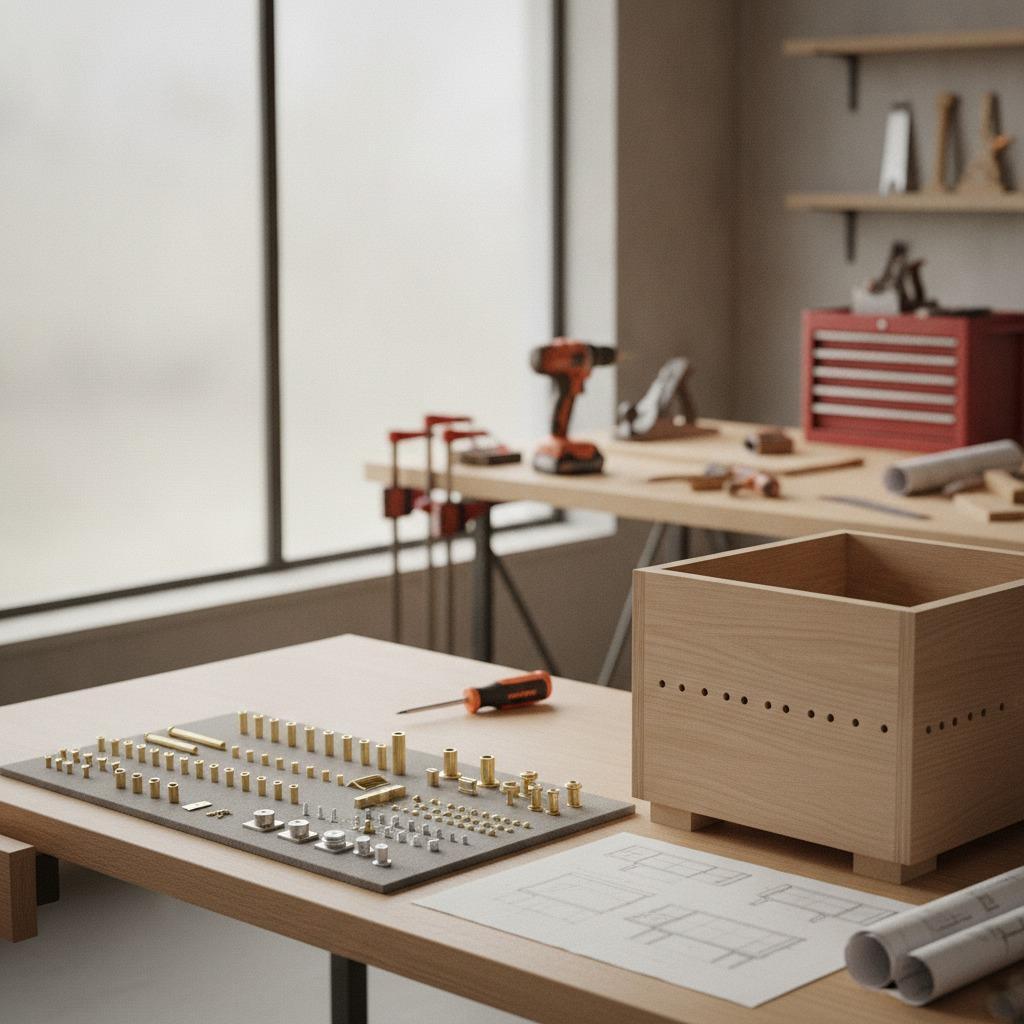
A cabinet prototype can look square in a drawing and still behave badly on a workbench.
The panels may be cut to size. The drilled holes may appear neat. The surface finish may be exactly what the designer requested. Then someone begins assembling the carcass, and the trouble becomes visible.
One side closes cleanly while the other needs pressure. A connector turns without pulling the panels together. The cabinet stands upright, but a slight push makes it rack. Nothing has failed completely, yet the product does not feel ready for production.
This is where metal furniture connectors become more than small hardware items.
They influence how easily a cabinet is assembled, how well it keeps its shape, whether the joint can be opened again, and how much variation the production process can tolerate. For engineering and sourcing teams, connector selection affects labor, packaging, service, customer experience, and warranty risk.
The decision should therefore be made before the cabinet reaches full production—not after assembly problems begin appearing on the line.
 Start with the cabinet joint, not the hardware catalog
Furniture hardware is often selected by comparing dimensions, finishes, and unit prices. Those details matter, but they do not describe the complete joint.
A connector only works when several conditions come together:
- The panel material can support it.
- The holes are drilled in the correct position.
- The mating parts align.
- The installer can reach the fitting.
- The joint closes without damaging the board.
- The connection remains stable after handling and transport.
A product page cannot answer all of those questions.
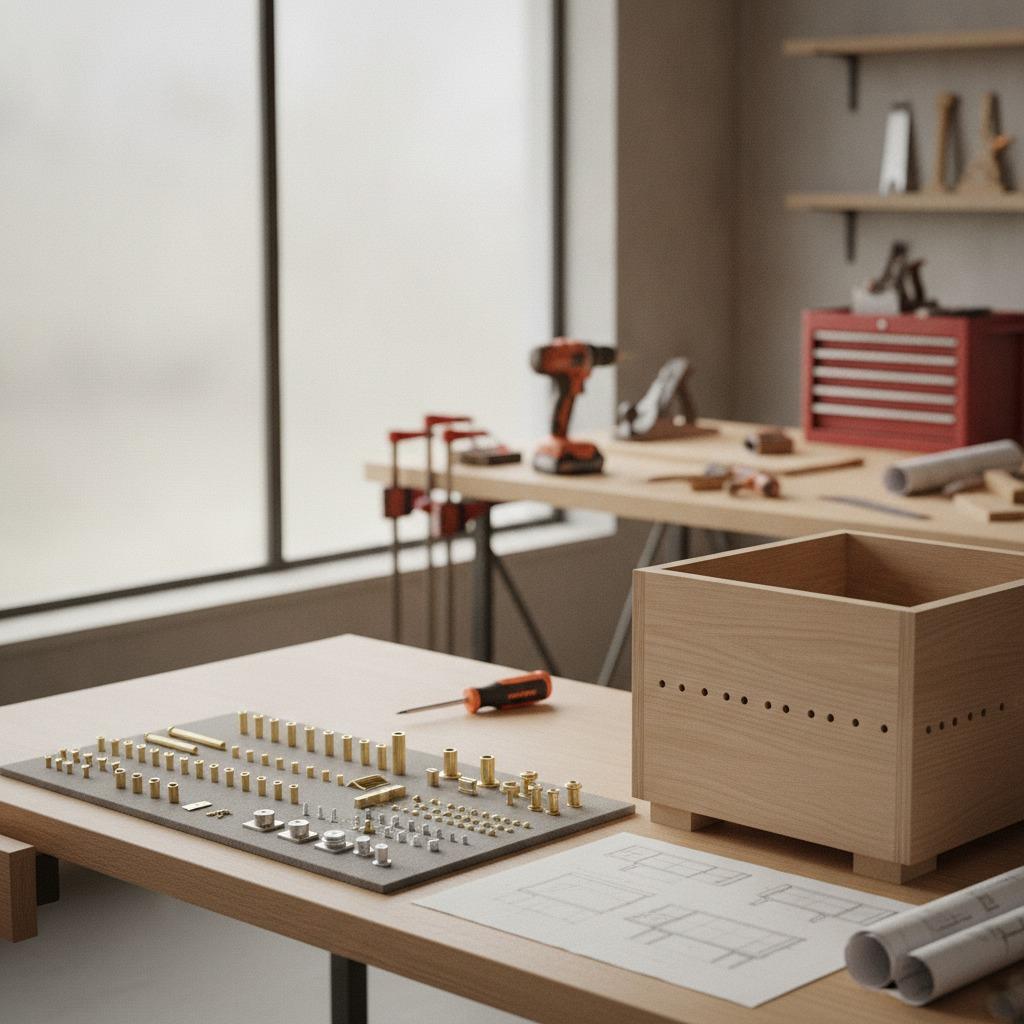
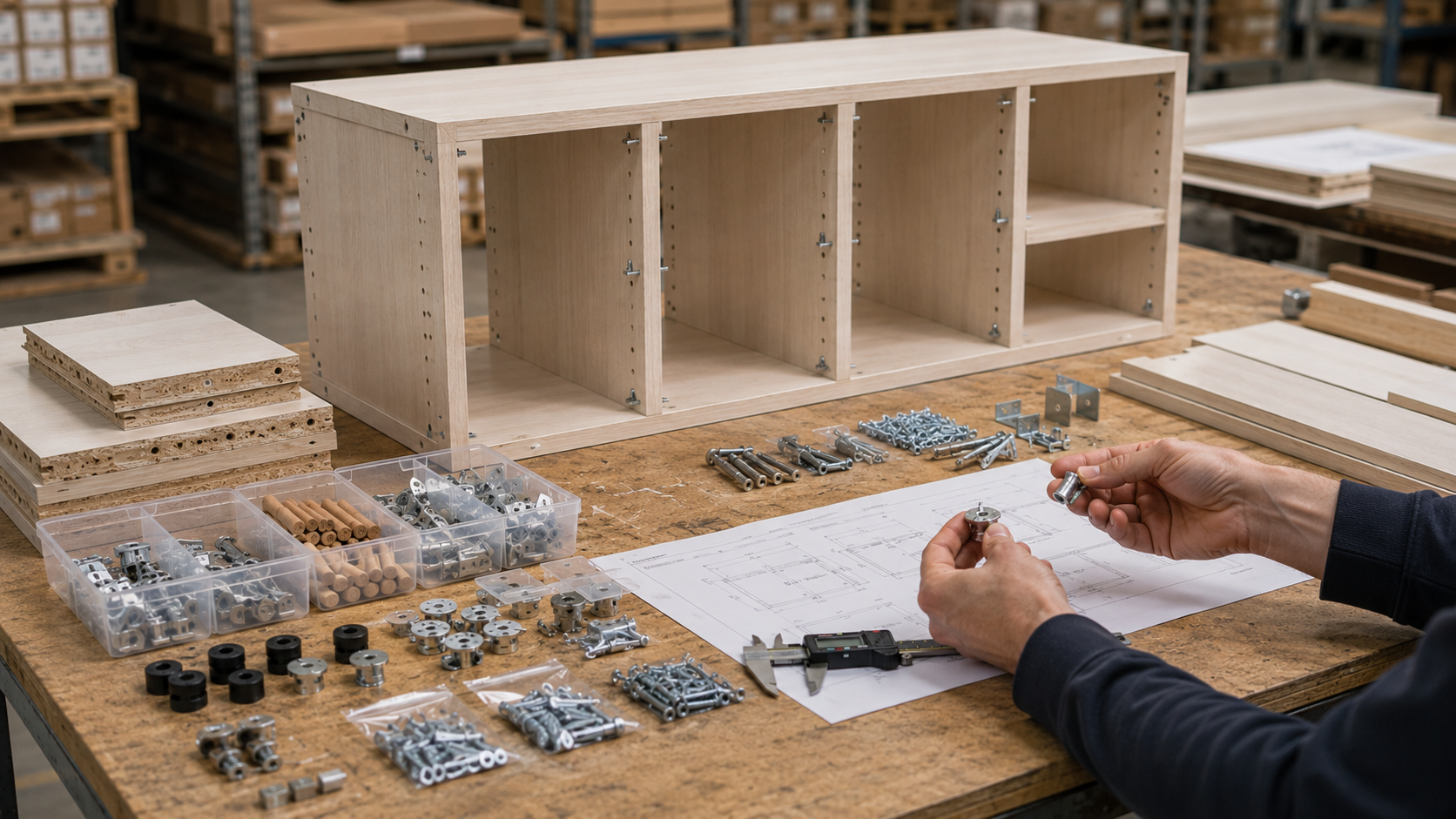
Consider an open-front cabinet carcass made from pre-drilled wood-based panels. Rows of holes may run along the inner faces for shelves or fittings. The top, bottom, and side panels form a simple rectangular structure.
It looks straightforward. In reality, small variations can quickly become visible.
If one connector pulls harder than another, the cabinet may twist. If the hole depth is wrong, the fitting may sit proud or fail to engage. If the board edge is too weak for the selected fastener, tightening may crush the material rather than strengthen the joint.
This is why experienced teams begin with the panel construction and assembly sequence. The connector comes afterward.
A prototype should expose problems, not hide them
Prototype assembly is not only a demonstration that the furniture can be built.
It is a test of whether the product can be built repeatedly by ordinary operators under normal working conditions.
A skilled technician can often compensate for a difficult joint. They may push one panel into place, adjust the angle of a screw, or tighten two fittings in a particular order. The finished prototype looks acceptable, but the assembly method depends on personal experience.
That is difficult to scale.
During a trial build, it is worth watching the process rather than only inspecting the final cabinet.
Does the connector enter smoothly?
Do workers need to hold the panels in an awkward position?
Does tightening one corner open a gap somewhere else?
Can the fitting be installed with the tools already used on the line?
Does the board show compression, chipping, or surface damage afterward?
A prototype that reveals these weaknesses is useful. It gives the team time to change the connector, drilling layout, or assembly order before larger quantities are involved.
 Why metal connectors are widely used in cabinet production
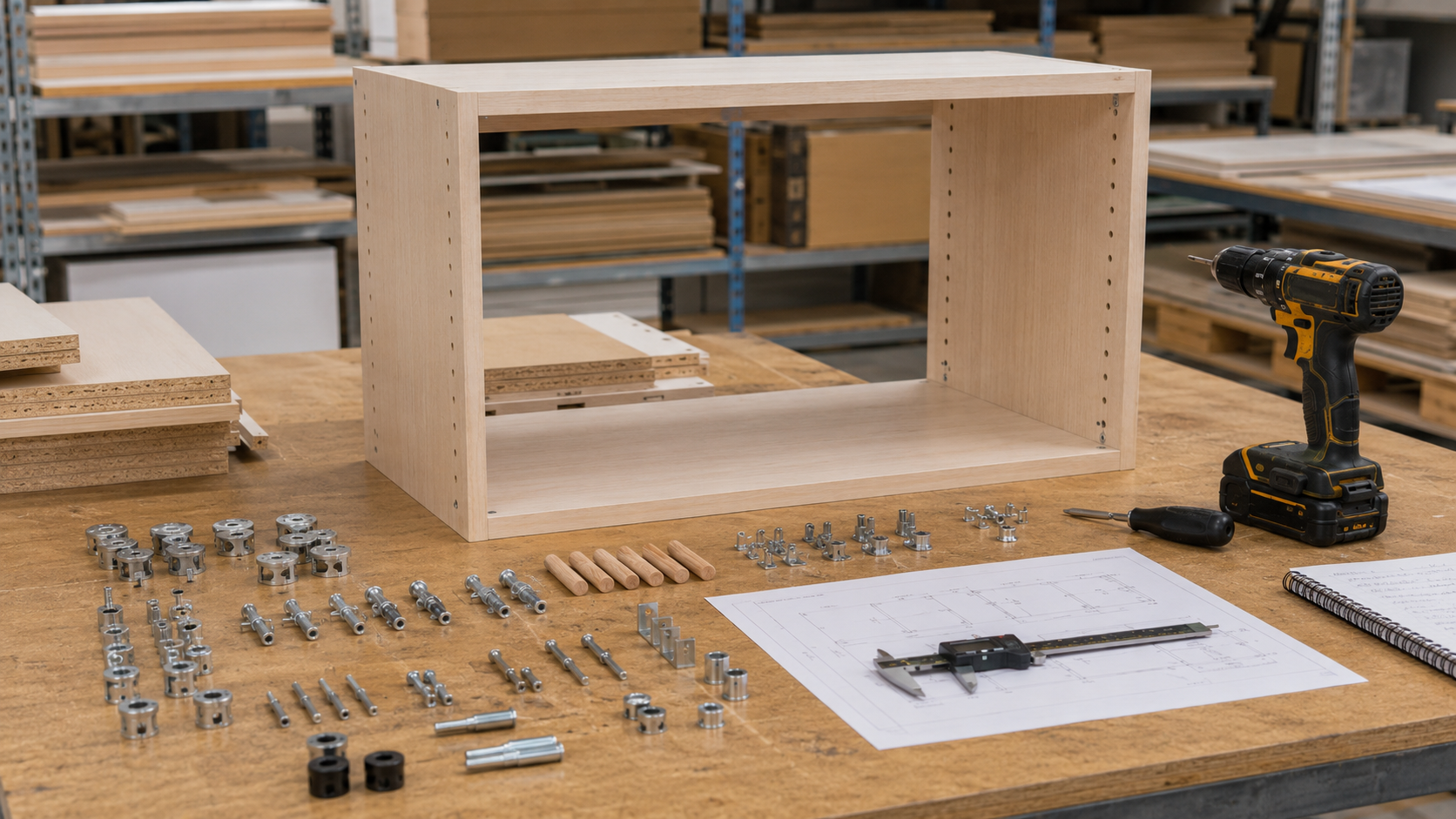
Metal furniture connectors offer a level of dimensional control that is difficult to achieve with wood-only joints.
They can provide predictable clamping force, repeatable geometry, and a connection that may be opened without destroying the panel. Standardized metal parts can also be used across several furniture models, which simplifies purchasing and replacement.
These advantages are especially useful in modular and flat-pack furniture.
However, metal hardware does not automatically create a reliable cabinet.
The force from the connector still has to pass into the panel. When the board is too soft, the edge distance is too small, or the pilot hole is poorly controlled, the metal fitting may simply expose the weakness of the surrounding material.
The connector and the panel need to be developed as a system.
Comparing the main furniture joint options
There is no single connector style that suits every cabinet. The right choice depends on the product, the manufacturing method, and what happens after the furniture leaves the factory.
Knock-down connectors
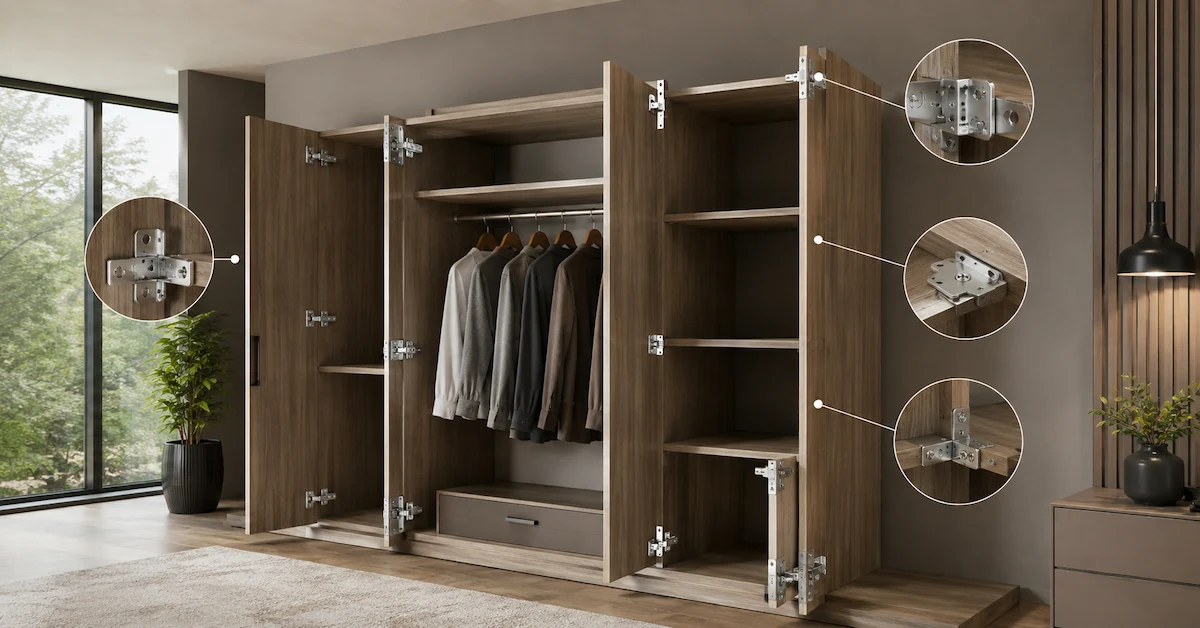
Knock down furniture connectors are commonly used in cabinets, shelving, wardrobes, and storage products that ship as separate panels.
They reduce shipping volume and make warehouse handling easier. The finished furniture can often be assembled with basic tools, which is useful for retail and cross-border e-commerce products.
Cam locks and matching bolts are familiar examples. They can produce a clean exterior because most of the hardware remains concealed.
The system depends heavily on drilling accuracy.
A small change in cam depth or bolt position may prevent the joint from closing. When the furniture is assembled by a customer rather than a trained worker, the connector also needs to be intuitive and forgiving.
Hardware that saves freight but creates installation complaints is not a complete solution.
Dowel-based joints
Dowel connectors for furniture are frequently used to position panels before another fitting supplies the main clamping force.
Their role is often alignment rather than final strength.
A properly fitted dowel helps stop the panels from sliding while screws, bolts, or cams are tightened. This can make the assembly process more stable and improve the appearance of the finished joint.
The drilling still has to be accurate.
A loose dowel does little to control movement. A tight one can chip the edge or make the cabinet difficult to assemble. Wooden dowels may also react to changes in moisture, which should be considered when products move between different environments.
Brackets and metal plates
Brackets and reinforcement plates are useful in utility cabinets, workshop storage, shelving, and areas where the structure needs additional support.
They may also be chosen when there is not enough space for a concealed connector.
Although these parts look uncomplicated, their formed angles and hole positions matter. A bracket that is not square may force the panels apart. A poorly placed hole can make installation slow or pull the cabinet out of alignment.
Visible brackets also need a finish that matches the intended appearance and environment.
Threaded inserts
Threaded inserts create a reusable metal thread inside a wood-based panel.
They can be valuable when the furniture will be assembled more than once, serviced in the field, or connected with bolts that require controlled tightening.
Their performance depends on the pilot hole, installation depth, outer thread design, and density of the panel.
If the insert rotates during tightening, the joint becomes difficult to repair. If it sits too close to an edge, the surrounding board may split or break away.
Threaded inserts improve serviceability when the complete installation process is controlled.
Panel material changes how the connector behaves
A connector that performs well in plywood may not produce the same result in MDF or particleboard.
Plywood contains multiple layers and generally offers useful holding strength, although the quality and direction of the veneers still matter.
MDF has a smooth, uniform surface and machines cleanly, but its edges can be vulnerable when fasteners create concentrated stress.
Particleboard is economical and widely used in flat-pack furniture. Its internal density may vary, so hole size and tightening force require careful control.
Solid wood brings grain direction, moisture movement, and natural variation into the joint.
This is why sample testing should use the exact panel intended for production.
Testing metal furniture connectors in a different board may confirm the dimensions of the hardware, but it does not confirm the behavior of the finished joint.
Assembly labor can cost more than stronger hardware saves
Sourcing teams sometimes compare connectors mainly by strength and price.
The installation process deserves equal attention.
A heavy-duty fitting may carry more load than the cabinet will ever experience, yet require several extra actions during assembly. The operator may need to turn the panel, change tools, or work in a restricted space.
Those actions create labor cost.
A connector that adds ten seconds to one cabinet may appear insignificant. Across a large order, those seconds become working hours.
There is also the issue of consistency. A fitting that requires the operator to judge tightness by feel may create more variation than one installed to a controlled position or torque.
The most suitable connector is not necessarily the strongest part available. It is the fitting that provides enough strength while fitting naturally into the production process.
Repeated assembly changes the design requirement
Not all furniture is assembled once and left untouched.
Showroom cabinets may be moved between displays. Office furniture can be reconfigured. Rental products are assembled and disassembled repeatedly. Flat-pack items may be taken apart when the customer moves.
A joint that performs well during the first assembly may loosen or damage the panel during later cycles.
For products expected to be reopened, engineers should test more than the initial fit.
Assemble the joint, take it apart, and repeat the process. Check whether the connector still engages correctly and whether the surrounding board begins to wear.
The results may change the decision between dowels, screws, inserts, and knock-down hardware.
The supporting fasteners matter too
A furniture connector is rarely a single independent component.
A cam fitting needs a matching bolt. A bracket needs screws suited to the panel. An insert relies on a bolt with the correct thread and length. Several ordinary fasteners may sit behind one visible connector system.
This makes compatibility important.
Jiangmen Jinhe Hardware Co., Ltd. supplies machine screws, self-tapping screws, micro screws, precision screws, and non-standard customized fasteners. For furniture manufacturers, this type of capability may be useful when a standard screw does not match the panel thickness, available installation space, or required head design.
Custom furniture fasteners should solve a clear problem.
A customized screw may prevent the tip from reaching a visible panel face. It may allow installation in a narrow location or match a connector with an unusual thread.
Customization also introduces drawings, tooling, minimum quantities, and replacement planning. A standard part remains the better option when it can perform the same job reliably.
Production consistency matters more than one perfect sample
A good sample proves that the part can be manufactured.
It does not prove that every production batch will behave the same way.
For metal furniture connectors, relatively small dimensional changes may affect installation. These may involve:
- Thread diameter
- Connector length
- Head height
- Cam position
- Insert diameter
- Recess depth
- Bracket angle
- Hole spacing
The buyer and supplier should identify which features directly affect the joint.
Those dimensions deserve closer inspection during production. It is also useful to understand how tool wear is monitored and how frequently parts are measured.
A long inspection report is not automatically better than a short one. The document is valuable when it focuses on the characteristics that control fit and function.
Packaging belongs in the connector specification
Correctly manufactured hardware can still create a failed customer experience when it is packed incorrectly.
A flat-pack cabinet that requires eight bolts cannot be assembled when the bag contains seven. A longer screw mixed into the wrong kit may break through a finished panel.
From the factory’s perspective, the hardware may meet every dimensional requirement. From the customer’s perspective, the furniture is defective.
Packaging instructions should define:
- Quantity per bag
- Parts that may be packed together
- Label or barcode information
- Spare-part requirements
- Bag and carton strength
- Counting or weight-verification method
Bulk packing may be efficient for factory assembly. Retail furniture usually needs clearly separated, counted kits.
A suitable cabinet hardware supplier should understand that packaging is part of production reliability, not an afterthought.
Questions worth asking before the first order
Before approving a connector system, purchasing and engineering teams should review the same information.
Confirm the panel material, thickness, hole diameter, drilling depth, edge distance, mating component, expected load, finish, installation tool, and packaging format.
Ask the supplier how the sample will be produced.
Will it come from normal production tooling? Is it selected from existing stock? Has it been adjusted by hand?
That distinction matters because a carefully modified sample may not represent the later manufacturing process.
It is also worth building a small pilot batch before releasing a large order.
A pilot run tests more than the part. It tests drawing control, production consistency, inspection, packaging, delivery, and actual assembly.
Common mistakes that create avoidable problems
One common mistake is choosing the connector before the panel design is stable.
When board thickness or hole position changes later, the approved hardware may no longer fit. Panel design, drilling, and connector selection should move forward together.
Another mistake is treating all similar-looking connectors as interchangeable.
Small changes in thread, length, head dimensions, or mating geometry may affect the finished joint even when the parts appear nearly identical.
Over-specification creates a different problem.
A stronger, larger, or more complicated fitting may increase cost and assembly time without improving the product. Hardware should be matched to the actual load rather than selected for the highest possible rating.
Finally, buyers sometimes approve a connector based on appearance.
A clean finish is useful. Reliable installation, batch consistency, and panel compatibility matter more.
Frequently Asked Questions
Are metal furniture connectors better than wooden dowels?
Neither option is always better. Metal connectors often provide stronger mechanical locking and better repeat assembly. Dowels can offer simple, concealed alignment when drilling is accurate. Many cabinet joints use both.
Do pre-drilled panels guarantee that the connector will fit?
No. Hole diameter, depth, spacing, edge distance, and connector geometry all need to match. A neat drilling pattern does not confirm complete compatibility.
When should knock-down furniture connectors be used?
They are useful for products that ship flat, require simple installation, or may need to be disassembled later. Common applications include wardrobes, cabinets, shelving, and modular storage systems.
Should the sample be tested in the final panel material?
Yes. Different panel materials respond differently to tightening force, pull-out load, and repeated assembly. Testing in the intended board gives a more realistic result.
When is a custom fastener necessary?
A custom part may be justified when standard hardware cannot meet the required length, thread, drive, head shape, finish, or installation space. It should address a specific production or performance issue.
What should buyers inspect on a cabinet prototype?
Check panel squareness, hole consistency, connector engagement, tightening effort, surface damage, joint rigidity, and whether the assembly steps are realistic for workers or end users.
The connector decision is visible in the finished cabinet
Metal furniture connectors usually disappear inside the completed product.
Their effect remains visible.
They determine whether panel edges meet evenly, whether the cabinet stays square during transport, whether installation feels straightforward, and whether the joint remains stable over time.
A reliable connector system does not need to be unusually complex. It needs to match the panel, drilling process, expected load, assembly sequence, and service requirements.
For furniture brands, engineers, and purchasing teams, the best time to evaluate these details is before mass production begins.
Jiangmen Jinhe Hardware Co., Ltd. can review standard or customized fastener requirements, connector drawings, panel details, surface finishes, quantities, and packaging needs for furniture projects.
Start with the joint and the way the cabinet will be built.
The correct hardware choice becomes much easier once those conditions are clear.