
What a nut supplier really needs to get right
A Nut Manufacturer is often judged as if the job were simple: cut threads, keep dimensions steady, ship on time. In practice, buyers know it is closer to a discipline than a commodity. A nut that looks ordinary on a drawing can become a nuisance in assembly if the thread form is inconsistent, the surface finish fights insertion, or the lot-to-lot variation forces operators to rework parts at the line.
That is why sourcing decisions around nuts and other precision fasteners usually come down to more than unit price. Engineers want fit and function. Sourcing teams want reliable supply and documentation. Product teams want parts that disappear into the assembly without slowing production. A good supplier has to serve all three.
Why industrial buyers care about process, not just part shape
The visible product range from Jiangmen Jinhe Hardware Co., Ltd. points to that broader reality. The company produces machine screws, self-tapping screws, micro screws, and precision screws in stainless steel, iron, and aluminum, with work aligned to GB, DIN, ANSI, BS, JIS, and ISO standards. It also handles non-standard customization, which matters because OEM programs rarely stay perfectly standard for long.
For buyers, the real question is not simply whether a nut or fastener exists. It is whether the supplier can hold the thread geometry, manage surface condition, and keep the part consistent across repeat orders. In electronics, medical devices, automation equipment, and appliance assemblies, even a small mismatch can create a chain of assembly issues that is expensive to chase later.
What the factory line says about fastener manufacturing
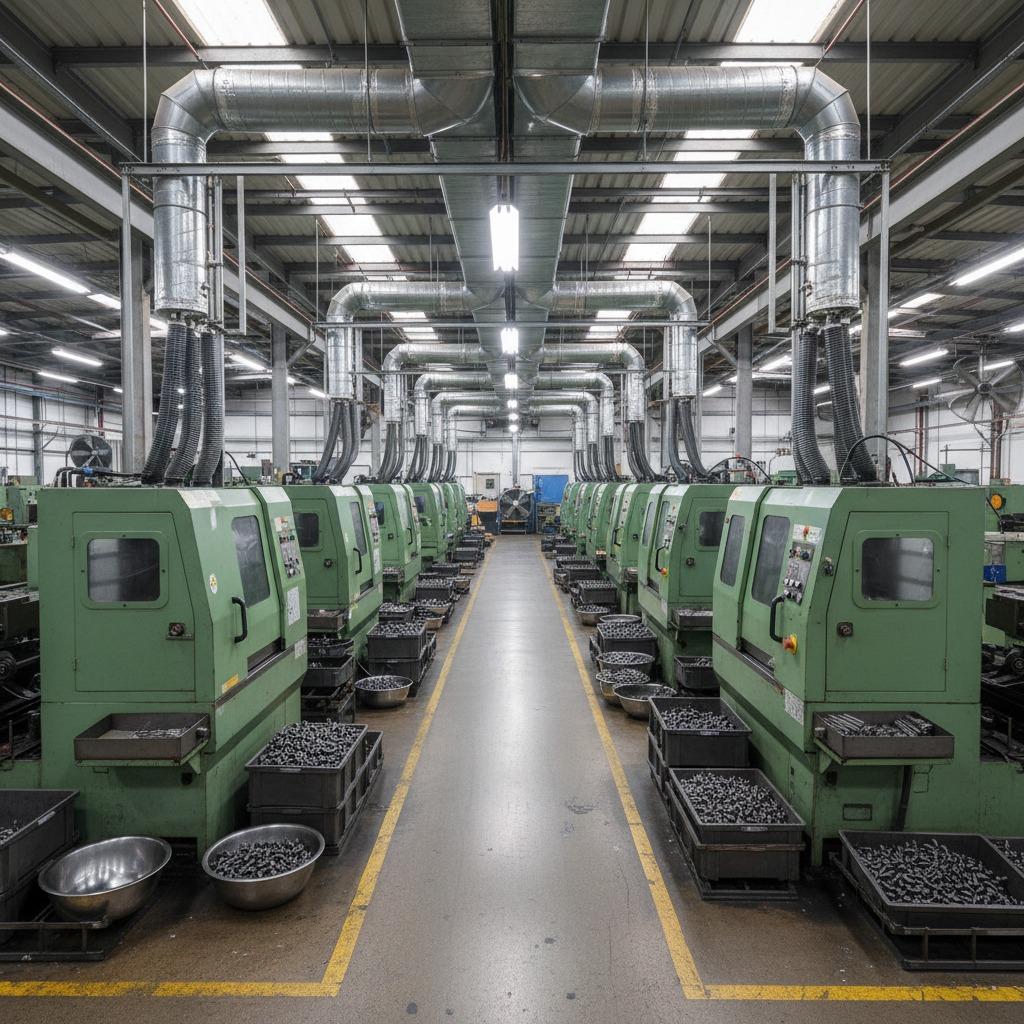
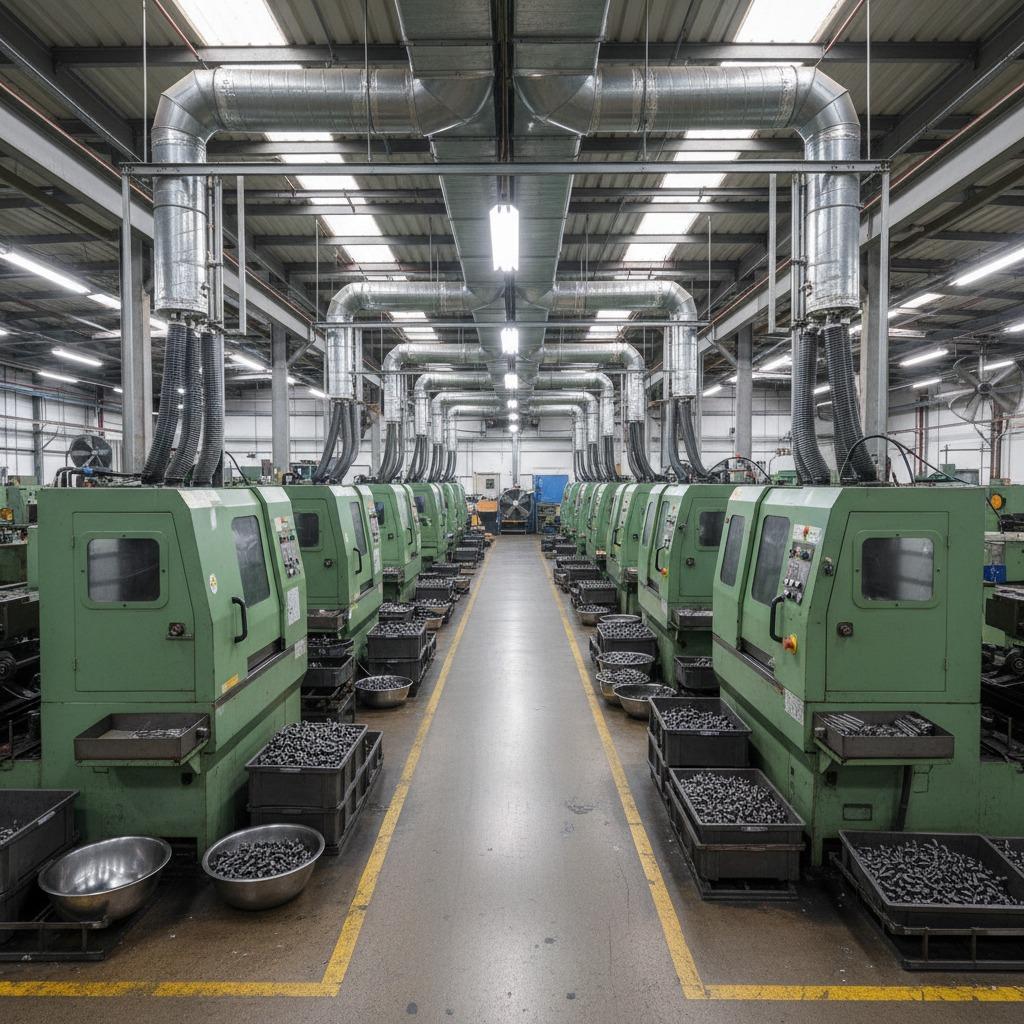
The production image shows a row of enclosed, green metal machines with overhead ducting and collection bins below. That layout suggests a continuous metalworking workflow built around containment, extraction, and batch output. The exact machine type is not identified, and it would be a mistake to claim otherwise, but the setup is consistent with high-volume fastener forming or related finishing operations.
That matters because fastener buyers increasingly look for more than a machine shop with a few lathes. A real industrial line should support stable throughput, controlled scrap handling, and a degree of process discipline. Enclosures can help contain chips, dust, or noise. Extraction systems matter when a shop wants cleaner conditions and a more stable process environment. In fastener production, those details often show up later in quality consistency.
Quick buyer takeaway
If you are selecting a Nut Manufacturer or a broader Custom Fasteners Manufacturer, ask first how the parts are made, inspected, and handled after forming. The visible machinery, inspection discipline, and packaging workflow usually tell you more than a glossy brochure does.
Selection criteria that actually affect assembly
One common mistake is to treat all nuts and small turned components as interchangeable if the nominal thread size matches. That approach can be costly. Fit depends on more than the thread callout. Surface finish, burr control, concentricity, and the condition of the lead-in all affect how a part behaves during automated or semi-automated assembly.
A practical buyer should look for these signals:
The supplier understands the application, not just the print.
The factory can support standard parts and non-standard customization.
Inspection is built into the process, not added as an afterthought.
The company can handle documentation and export logistics if needed.
Jiangmen Jinhe Hardware Co., Ltd. says its products undergo strict inspection before delivery and are accompanied by necessary documentation. It also notes customer support response within 30–60 minutes and solution handling within 2 hours. Those are useful service cues, especially for buyers who manage production schedules and cannot wait days for a simple clarification.
Where cost reduction really comes from
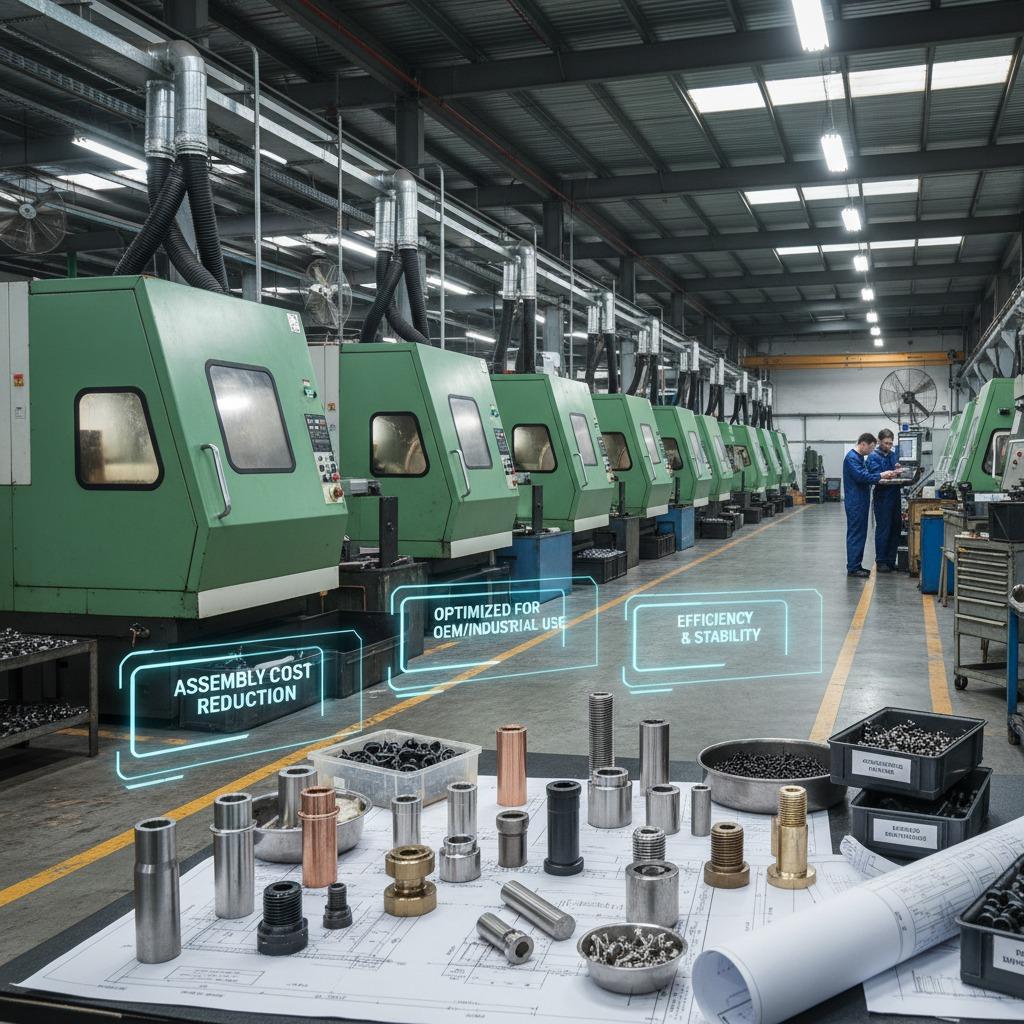
The phrase “assembly cost reduction” is easy to print on a product sheet, but it only means something if the component is designed and supplied to simplify the line. For fasteners and turned parts, that usually means fewer secondary operations, fewer rejected parts, and less time spent sorting mixed lots.
OEM buyers often gain the most from suppliers who can keep variants organized. If a part family includes multiple SKUs, or if one base design is adapted across products, the supplier needs a clean system for material control and identification. Otherwise, assembly stability suffers. That is where small errors become large costs.
Common mistakes when sourcing fasteners
The most frequent error is over-specifying one feature while ignoring the rest. A buyer may focus on thread size and forget about finish. Another may ask for a custom part without clarifying whether the application needs corrosion resistance, electrical behavior, or simple mechanical retention. A third mistake is assuming every supplier can scale from sample to volume without rework.
There is also a quiet risk in buying too broadly. If one vendor handles standard parts, special turned components, and full custom runs, the buyer should still confirm how the shop separates jobs and controls revision changes. That is not glamorous, but it is where a lot of the real risk sits.
FAQ for sourcing managers and engineers
Are standard parts better than custom fasteners?
Not always. Standard parts are easier to source, but custom fasteners can reduce assembly steps or solve a fit problem that standard catalog items cannot.
What should I verify first with a supplier?
Start with material options, inspection practice, documentation, and whether the supplier can keep the same result across repeat batches.
Does a larger factory automatically mean better quality?
No. Capacity helps, but process control and inspection discipline matter more than floor size alone.
A practical next step
If you are sourcing nuts, screws, or other precision metal components for OEM or industrial assembly, ask for a part review that covers function, finish, and production route together. Jiangmen Jinhe Hardware Co., Ltd. positions itself around standard fasteners, non-standard customization, and export support, which makes it a relevant contact point for buyers who need more than off-the-shelf stock.
For engineering teams, the best first conversation is rarely about price. It is about whether the supplier can make the part behave the way the assembly needs it to behave. Everything else follows from that.