
Why outdoor screws fail faster than people expect
Choosing outdoor screws is rarely as simple as picking a “rust-resistant” fastener off the shelf. In the field, the wrong screw can stain timber, loosen under seasonal movement, or corrode long before the rest of the assembly is ready for replacement. That matters whether you are building a fence, attaching cladding, fastening trim, or sourcing fixings for a larger assembly line.

The first question is not just “Will it hold today?” but “Will it still hold after wet seasons, UV exposure, temperature swings, and repeated load changes?” For buyers and engineers, that turns a commodity item into a specification decision. And if the job involves masonry or mixed-material construction, the conversation shifts again, because the fastener must suit the substrate as much as the environment.
What matters most in outdoor fastening
For exterior work, the practical shortlist is usually corrosion resistance, thread design, head style, and the material being joined. Stainless steel screws outdoor applications are often chosen when moisture, coastal air, or staining risk is part of the picture. But stainless is not a universal answer. In some assemblies, coating performance, driveability, or compatibility with the base material matters just as much.
Company data from Jiangmen Jinhe Hardware Co., Ltd. shows a broader fastener capability than a single outdoor category: machine screws, self-tapping screws, micro screws, and precision screws, made in materials including stainless steel, iron, and aluminum. The company also notes compliance with GB, DIN, ANSI, BS, JIS, and ISO standards, which is useful context for buyers who need standardized sourcing rather than improvised substitutions.
Wood, masonry, and metal each ask for a different screw
Screws for redwood outdoor
Redwood is a good example of why exterior fastening is not one-size-fits-all. Screws for redwood outdoor use should minimize staining and resist corrosion, especially where the wood contains natural extractives and the assembly will stay wet for long periods. A clean-looking deck board today can develop black streaking around the heads later if the metal and finish are poorly matched to the species.
Screws for cedar outdoor
Cedar behaves similarly, though installers often describe it as forgiving. Screws for cedar outdoor projects still need a careful choice of material and finish because the wood is used in fencing, siding, pergolas, and trim where appearance matters. A practical caution: the screw that drives easiest is not always the one that lasts longest. Buyers sometimes overvalue immediate installation speed and underweight long-term appearance.
Masonry and concrete fastening
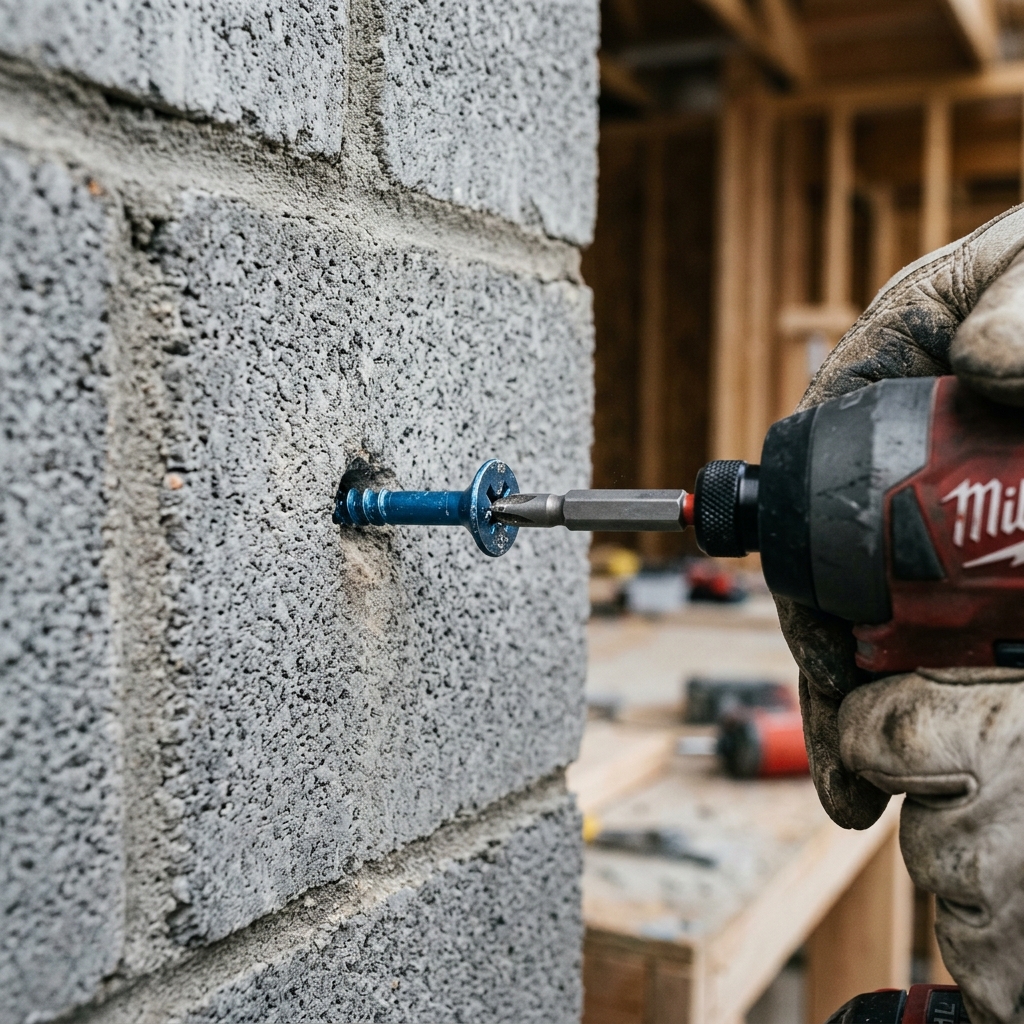
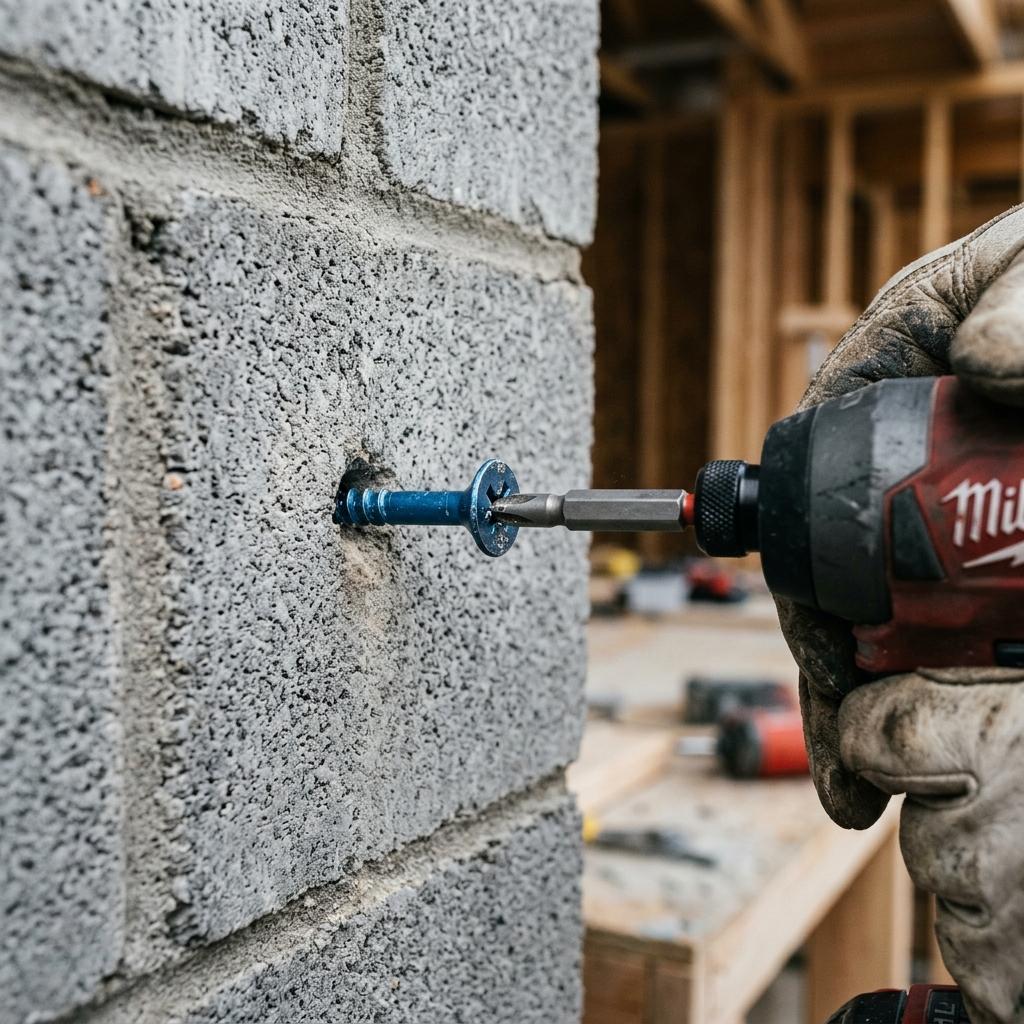
The product image supplied here shows a blue-coated metal fastener being driven into a concrete or masonry block wall with a power driver. That points to a masonry-style fastening application rather than a timber screw. The visible washer or flange head helps spread load across the wall surface, while the coarse threaded shank is designed for engagement in a predrilled hole. The exact fastener type cannot be confirmed from the image alone, but the use case is clear: brackets, conduit clips, fixtures, and light structural attachments on concrete block or similar substrates.
Quick buyer comparison: what to ask before you place an order
If you are sourcing outdoor screws for production or field installation, ask for the substrate, exposure level, drive type, and finish system before you ask for price. That order matters. A lower-cost screw can be perfectly acceptable in a dry, sheltered setting and completely wrong for an exposed deck edge or coastal installation.
For suppliers such as Jiangmen Jinhe Hardware Co., Ltd., a useful sourcing discussion would cover material grade, standard reference, inspection documentation, and whether the fastener is intended for OEM, non-standard customization, or standard parts supply. The company states it supports foreign trade services, logistics, warehousing, and supply chain handling, which is relevant for buyers trying to reduce handoffs between factory, freight forwarder, and warehouse.
Common mistakes buyers still make
The most common error is treating “outdoor” as a finish instead of a service condition. Another is mixing fasteners across materials without checking galvanic compatibility. A stainless screw in one assembly may be ideal; in another, it may be unnecessary overkill or the wrong choice if the joint design relies on different mechanical behavior.
One more caution: in masonry applications, installers sometimes blame the screw when the issue is the hole preparation. Pre-drilled diameter, hole cleanliness, and substrate condition can decide whether the connection performs as intended. That is especially true in renovation work, where old block walls are rarely uniform.
Why supplier capability matters as much as the screw itself
Jiangmen Jinhe Hardware Co., Ltd., founded in 2016 in Jiangmen, Guangdong, spans 4,000 square meters and serves sectors including electronics, medical devices, automation, home appliances, furniture, building materials, and hardware wholesale. That mix suggests an operation used to balancing standard production with custom requirements, which is often what exterior fastener buyers need when the job sits between catalog items.
The company also says it performs strict inspection before delivery and provides required documentation. For procurement teams, that is not a side note. It is often the difference between a fast-moving project and a costly line stop caused by inconsistent hardware.
Practical next step for sourcing teams
If you are specifying outdoor screws for a new product, a retrofit, or an export order, start with the environment: timber, masonry, or mixed assembly; wet, dry, or coastal exposure; visible or hidden fixing. Then ask the supplier for the material, finish, standard, and inspection approach. If the application includes redwood, cedar, or concrete block, say so plainly. That gives the factory a usable brief instead of a vague “weatherproof screw” request, which is usually where trouble begins.
For technical sourcing, a short sample evaluation and a clear substrate description will save more time than a long debate over catalog photos. And that is usually where a good fastener supplier proves its value.