
What Buyers Miss When Ordering Wholesale Furniture Hardware Kits
A furniture hardware kit usually occupies very little space inside a carton. It may also represent only a small percentage of the total product cost.
That makes it easy to treat the kit as a routine purchasing item.
The problems appear later.
A cabinet reaches the assembly station, but one connector does not engage fully. Two screw lengths have been mixed in the same bag. A threaded insert turns inside the panel instead of staying fixed. The component count is technically correct, yet the parts belong to another furniture model.
At that point, the cost of the hardware is no longer the important number. Workers stop, cartons are opened, parts are sorted, and someone has to decide whether production can continue.
This is why wholesale furniture hardware kits should be evaluated as part of the furniture system rather than as a collection of inexpensive fasteners.
For wholesalers, OEM buyers, furniture manufacturers, and sourcing teams, the real question is not simply whether every item is present. It is whether those items fit the panels, follow the intended assembly sequence, and remain consistent from one production batch to the next.
 The kit begins with the cabinet, not the bag
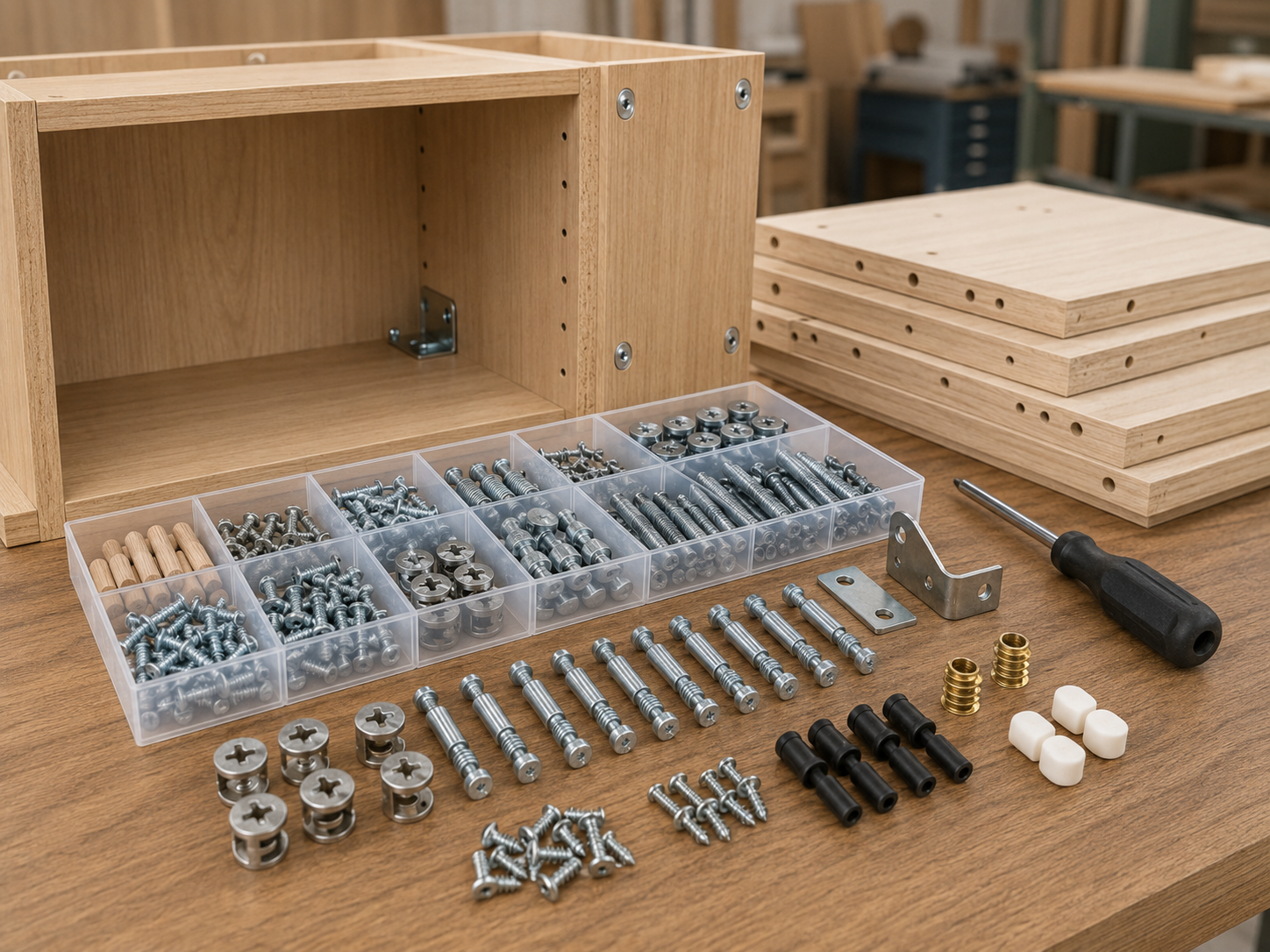
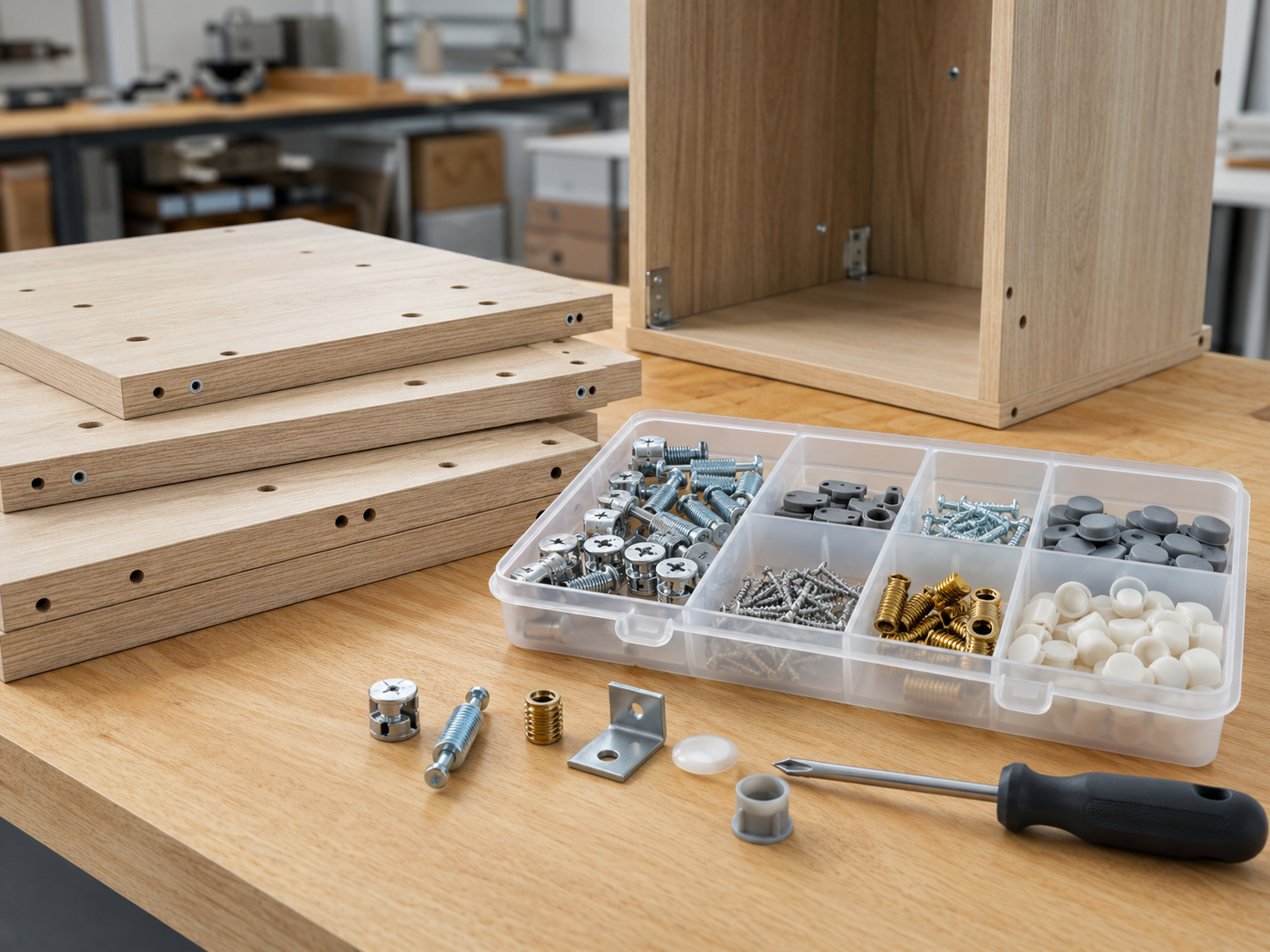
A supplier may receive a photograph showing several screws, cam fittings, brackets, inserts, plastic caps, and a small tool. From that image, it is possible to prepare a rough quotation.
It is not possible to confirm the complete application.
The same connector can behave differently depending on panel thickness, board density, hole depth, edge distance, and installation direction. Even a familiar screw may be unsuitable if it is a few millimeters too long for the board.
That is why the furniture design should come first.
Before finalizing the kit, buyers should confirm how the cabinet is built. Is it factory assembled or packed flat? Will the end customer install it? Does the joint need to be reopened later? Are the fasteners hidden, partly visible, or exposed inside the finished unit?
Those answers change the hardware requirement.
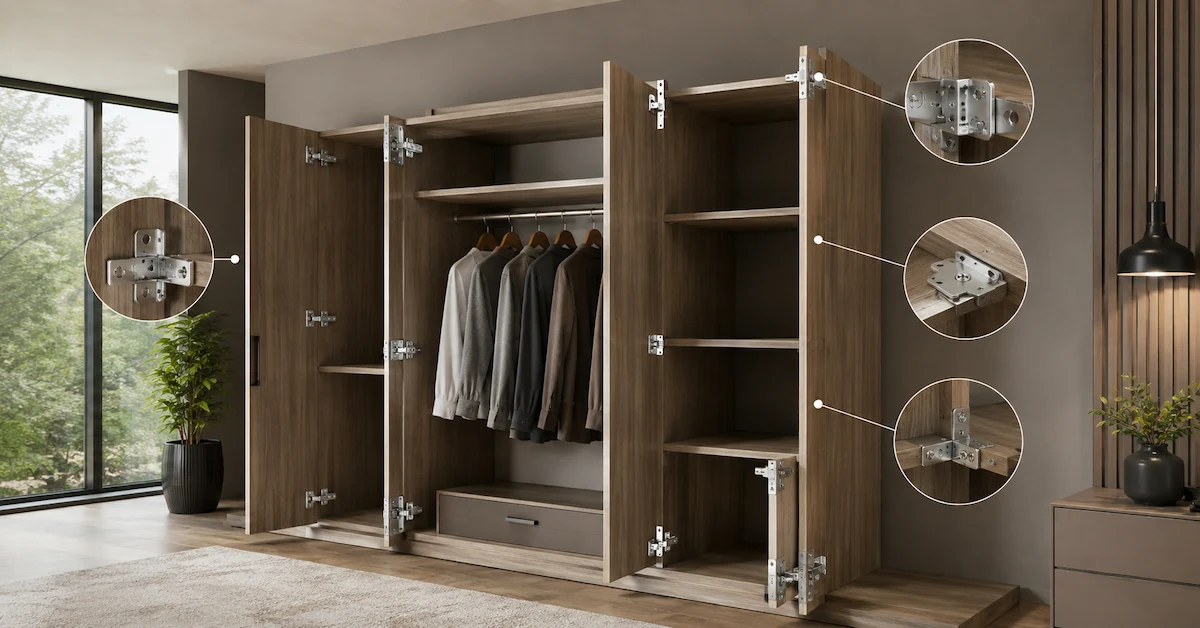
A kit for a factory-built bathroom cabinet may prioritize corrosion resistance and quick line installation. A flat-pack wardrobe needs hardware that a non-professional user can understand. A modular shelving system may require connectors that tolerate more than one assembly cycle.
The parts may look similar on a table. Their jobs are not the same.
What a typical furniture hardware kit may contain
The exact component mix depends on the product, but a cabinet or wardrobe set often combines several fastening methods.
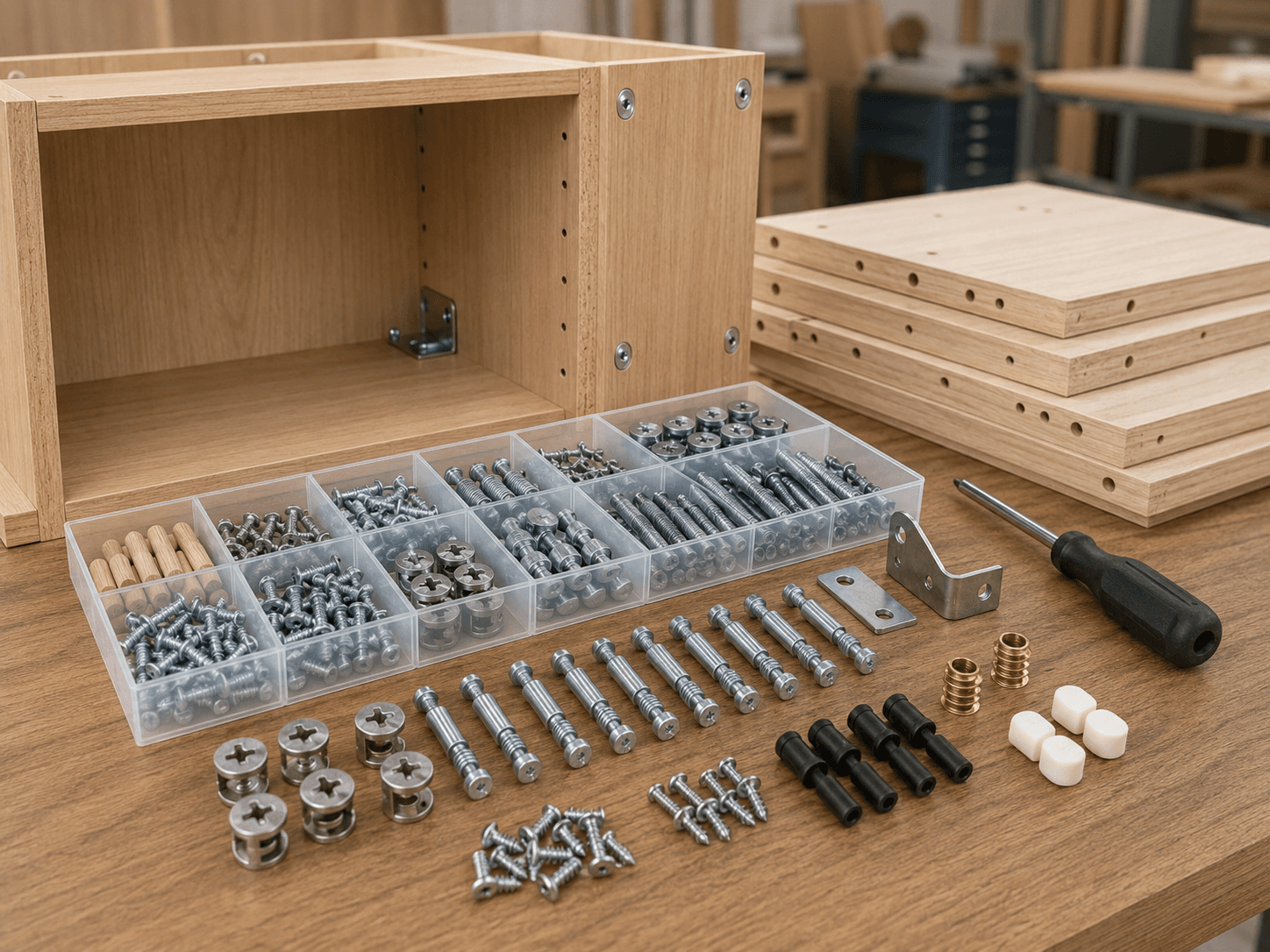
Common parts include cam fittings, connector bolts, wood screws, machine screws, threaded inserts, wooden dowels, corner brackets, plastic sleeves, cover caps, and simple tightening tools.
Each component has a separate purpose.
A dowel may locate the panels before the main connector is tightened. A cam fitting draws the joint closed. A bracket reinforces a corner. A threaded insert creates a reusable metal thread inside a wood-based panel. A cover cap hides an access hole after installation.
This is why a well-designed kit is more than an assortment.
The connector bolt must match the cam. The insert must accept the correct screw or bolt. The bracket holes must correspond with the panel drilling. The included tool must fit the drive recess and reach the installation point.
One wrong relationship can make several otherwise acceptable parts unusable.
A capable cabinet hardware kit manufacturer should therefore review how the components interact, not only whether each part meets its individual drawing.
More pieces do not make a better kit
Large assortments are visually impressive. They can also create confusion.
For production furniture, a kit should contain what the product actually needs. Unused components add weight, complicate counting, and make shortages harder to detect.
A smaller, model-specific kit is often more valuable than a large general assortment.
Consider two options.
The first contains 80 mixed fasteners intended for broad use. The second contains 24 carefully selected parts for one cabinet model. Every component in the second kit has a known location and quantity.
For an OEM production line, the second option is usually easier to manage.
Workers do not have to identify which pieces belong to the product. Incoming inspection is more straightforward. Replacement parts can be recorded against a controlled part number. Packaging staff know exactly what should remain in the bag after each kit is assembled.
The goal is not to maximize piece count. It is to remove uncertainty.
Panel material changes the fastening result
Furniture panels are not interchangeable from a fastening perspective.
Particleboard is widely used in flat-pack furniture, but its internal density may vary. MDF offers a smooth and consistent surface, although its edges can be vulnerable when a connector creates concentrated pressure. Plywood often provides better holding strength, but the veneer structure and drilling direction still affect performance.
A screw approved in plywood may not behave the same way in particleboard.
Threaded inserts are another example. An insert may hold securely in a dense panel and rotate inside a softer board. Changing the pilot-hole diameter by a small amount can alter the result again.
Buyers should provide the supplier with more than nominal panel thickness.
Useful information includes:
- Board material and density where available
- Panel thickness
- Hole diameter and depth
- Distance from the panel edge
- Installation direction
- Mating connector
- Expected tightening method
- Whether the joint will be assembled again
The closer the sample conditions are to actual production, the more useful the test becomes.
A sample kit needs to be installed
Counting a sample kit is necessary. Measuring the components is useful. Checking the finish under good lighting may reveal scratches or coating differences.
None of those steps confirms that the furniture will assemble correctly.
The kit needs to meet the panels.
Use the planned board material, drilling layout, and installation tool. Assemble several joints, not just one. Where possible, let regular production workers perform the test rather than relying only on engineers or prototype technicians.
Watch how the process feels.
Does the screw enter cleanly? Does the cam engage without forcing it? Do the panels pull together evenly? Can the included tool reach the fitting? Are similar components easy to distinguish?
Operators often notice problems that are difficult to express on a dimensional report. A fitting may be technically within tolerance but still feel inconsistent from one piece to the next. A tool may fit the connector but be awkward to turn inside a narrow cabinet.
Those observations matter because production is built around repetition.
One successful assembly shows that the kit can work. Ten similar assemblies begin to show whether it can work reliably.
Flat-pack furniture leaves less room for correction
Factory workers can sometimes compensate for imperfect hardware.
They may adjust the panel, replace a screw from a nearby bin, use another tool, or change the order of tightening. That should not be necessary, but the factory has people and equipment available to solve the problem.
The customer assembling flat-pack furniture at home does not.
The person opening the carton may have only the included tool and a printed instruction sheet. When the connector does not fit, the customer cannot easily tell whether the problem comes from the panel, the hardware, or the assembly method.
The entire product feels defective.
For OEM furniture hardware kits used in retail products, the hardware should be clear and forgiving. Similar screws may need separate bags. Parts can be marked by assembly step. The supplied tool should be strong enough to complete the installation without bending or stripping the connector.
Small design decisions at the kit stage can prevent a large number of support requests later.
Finish should be specified, not guessed
Silver-colored hardware may be zinc plated, nickel plated, or treated with another coating. A brass-colored insert may be solid brass, zinc alloy, plated steel, or another material.
A photograph cannot confirm the specification.
Buyers should request the base material and surface treatment in writing, particularly when the furniture will be stored or used in demanding conditions.
A wardrobe intended for a dry bedroom may have different requirements from a bathroom cabinet. Products shipped across humid regions or stored for long periods may also need additional corrosion protection.
Finish discussions may include:
- Base metal
- Coating type
- Coating thickness
- Corrosion test requirement
- Color consistency
- Environmental compliance
- Appearance requirements for visible components
Not every part in a kit has to use the same finish. Different materials may be chosen for functional reasons.
The important point is that the differences are approved rather than assumed.
Packaging can undo good manufacturing
A kit can contain excellent components and still fail because of packaging.
The most obvious problem is a missing part. One absent connector can prevent the entire cabinet from being completed.
Mixed parts are more difficult to spot.
Suppose a furniture model uses two screw lengths that look almost identical. The longer screw is placed in the wrong bag. During assembly, it reaches through the panel and damages the finished surface.
The quantity in the kit may still be correct. The product is not.
Packaging requirements should therefore be treated as part of the technical specification.
Buyers need to decide:
- Which components may share one bag
- Which similar parts must be separated
- Quantity of each part
- Spare quantity
- Bag thickness and seal method
- Model and part identification
- Barcode or QR code requirements
- Assembly-step labels
- Master-carton quantity
- Verification method
A wardrobe hardware kit supplier packing several models should also have a process for clearing the work area between production runs. Otherwise, one small leftover component can enter the next SKU.
That is how seemingly random packing errors begin.
Counting methods should match the kit risk
Manual counting can work for low-volume sets with a small number of clearly different components.
It becomes less dependable as volume and complexity increase.
Suppliers may use automatic counting machines, divided trays, weight checks, visual inspection, or several methods together.
Weight verification is useful but not perfect.
A missing lightweight washer may be offset by one additional screw. Two small parts with similar weights may produce a total that looks acceptable even when the mix is wrong.
The inspection process should reflect the consequences of an error.
A simple repair assortment may tolerate a basic count check. A model-specific flat-pack kit containing several similar fasteners deserves tighter control.
Buyers should ask how the supplier verifies both total quantity and component identity.
Standard parts and customized components can work together
Custom furniture hardware kits do not require every item to be specially manufactured.
Many reliable kits combine standard screws, established connector types, and only a few customized pieces.
This can shorten lead times and make replacement easier.
Customization becomes useful when a standard part cannot meet the application. A screw may need a shorter length to protect the opposite panel face. A bracket may require different hole spacing. The furniture brand may need model-specific labels, branded instructions, or a particular packing sequence.
These are practical changes.
Non-standard components also bring additional responsibilities. They require controlled drawings, sample approval, minimum quantities, and revision management.
Before requesting a custom part, buyers should ask what problem it solves.
When an existing component performs the same function reliably, the standard option may be easier to source for years. When the panel design creates a genuine dimensional or installation constraint, customization may be the correct decision.
How to evaluate the supplier behind the kit
A fastener manufacturer and a hardware-kit supplier may share some capabilities, but the jobs are not identical.
Producing screws in bulk is one process. Coordinating several metal and plastic components into a model-specific kit is another.
The supplier needs to manage multiple drawings, finishes, quantities, labels, and packaging instructions without mixing products.
Before selecting a cabinet hardware kit manufacturer or wardrobe hardware kit supplier, buyers should review how the company handles:
- Bill-of-material control
- Drawing revisions
- Dimensional inspection
- Surface-finish verification
- Component counting
- Kit assembly
- SKU separation
- Label approval
- Lot traceability
- Repeat-order consistency
- Incorrect or missing parts
Jiangmen Jinhe Hardware Co., Ltd. works with machine screws, self-tapping screws, precision screws, standard fasteners, and non-standard customization. That background may be useful for furniture programs that combine established fasteners with application-specific components.
The supplier still needs to prove that it can control the complete kit.
A polished sample demonstrates attention. A repeatable production process demonstrates capability.
Where bundled kits create the most value
Bundled hardware kits are especially useful when the same assembly needs to be repeated many times.
Typical applications include flat-pack cabinets, wardrobes, modular shelving, office furniture, kitchen units, bathroom storage, repair programs, and cross-border e-commerce products.
The advantage is not limited to purchasing convenience.
A controlled kit can reduce the number of line-side bins. It makes staff training easier. Inventory becomes easier to trace by furniture model. Replacement parts can be identified more quickly.
For wholesalers, fewer separate line items may also simplify receiving and distribution.
That simplicity only exists when the kit itself is stable. If quantities, finishes, or component types change between orders, the bundled format becomes another source of uncertainty.
Common sourcing mistakes
A frequent mistake is requesting a quotation from a photograph alone.
The supplier can see the general component types. It cannot reliably determine thread pitch, exact length, material grade, panel compatibility, or the function of every piece.
Another mistake is testing the components separately.
The bolt passes inspection. The cam passes inspection. The insert passes inspection. Yet the assembled joint still fails because the parts were never tested together.
Packaging samples can also be misleading.
A few sample kits may be packed carefully by hand. Regular production introduces faster counting, repeated SKU changes, and more handling. A bag that looks strong on the sample table may tear after sharp brackets move inside the carton.
The last mistake is moving directly from sample approval to a large order.
A small pilot batch tests far more than component fit. It tests production consistency, counting, labels, carton packing, shipping, and real assembly.
What to confirm before the bulk purchase order
Before releasing the order, both sides should approve the same version of the kit.
Confirm the final bill of materials, drawings, materials, finishes, quantities, panel compatibility, included tools, packaging arrangement, labels, barcodes, inspection requirements, and delivery schedule.
Keep a sealed approval kit where possible.
That reference gives the buyer and supplier something physical to compare against future production.
For repeat orders, confirm that no component has been substituted without approval. A replacement may appear similar while using another thread, finish, material, or dimension.
Consistency is what turns a useful sample into a dependable supply program.
Frequently Asked Questions
What is usually included in wholesale furniture hardware kits?
Common components include cam fittings, connector bolts, screws, threaded inserts, wooden dowels, brackets, plastic sleeves, cover caps, washers, and assembly tools. The contents should match a specific furniture model or product family.
Can furniture hardware kits be customized for OEM projects?
Yes. Suppliers may customize component dimensions, finishes, quantities, labels, instructions, tools, packaging, and barcodes. Buyers should provide drawings and a controlled bill of materials.
Is a product photograph enough for an accurate quotation?
Usually not. The supplier also needs dimensions, thread information, panel details, finishes, quantities, and packaging requirements.
How can buyers reduce missing-part complaints?
Use controlled BOMs, suitable counting equipment, clear separation of similar parts, model-specific labels, final verification, and an approved spare-part policy.
Should the complete kit be tested before production?
Yes. Install the full kit using the actual panels, drilling layout, tools, and assembly sequence. A pilot batch is advisable before a large wholesale order.
Are customized parts always necessary?
No. Standard components may offer quicker replenishment and lower long-term risk. Custom parts are most useful when they solve a specific dimensional, structural, appearance, or installation problem.
A good kit should disappear into the assembly process
The best hardware kit does not demand much attention.
Workers open the package and recognize the parts. The connector matches the drilled hole. The supplied tool fits. The panels close without being forced, and there are no leftover components that nobody can explain.
For the end customer, the same principle applies. The hardware should make the furniture easier to assemble, not turn a simple cabinet into a puzzle.
That quiet reliability comes from matching the kit to the furniture, controlling the component mix, and treating packaging as part of the engineering work.
When comparing wholesale furniture hardware kits, buyers should look beyond piece count and unit price. Fit, repeatability, finish, labeling, counting accuracy, and supplier control have a greater effect on the finished product.
Jiangmen Jinhe Hardware Co., Ltd. can discuss standard fasteners, customized components, cabinet and wardrobe hardware combinations, OEM packaging, and repeat-order requirements.
Begin with the panel drawings, hardware BOM, assembly sequence, and expected order volume.
A suitable kit is much easier to define when the furniture—not the assortment—is the starting point.