
Wholesale Furniture Hardware Kits: What Makes a Kit Ready for OEM Production?
A hardware bag can look perfectly organized and still bring a furniture line to a stop.
The screws are counted. The cam fittings are bright and clean. Inserts, brackets, caps, and tools are all present. Nothing appears missing when the kit is checked on a table.
Then the first cabinet is assembled.
One connector does not pull the panels together completely. A screw is long enough to mark the opposite surface. The included tool cannot reach a recessed fitting. Another bag contains the correct number of parts, but two similar bolts have been mixed.
This is the part of wholesale furniture hardware kits that buyers cannot judge from a product photo.
The value of a kit does not come from how many components are inside it. It comes from whether those components match the panel design, arrive in the right quantities, and guide the assembler through a repeatable process.
For flat-pack brands, cabinet manufacturers, OEM programs, and cross-border sellers, the kit is part of the product—not an accessory added at the packing stage.
 A furniture hardware kit is really an assembly system
It is tempting to describe a kit by listing its contents.
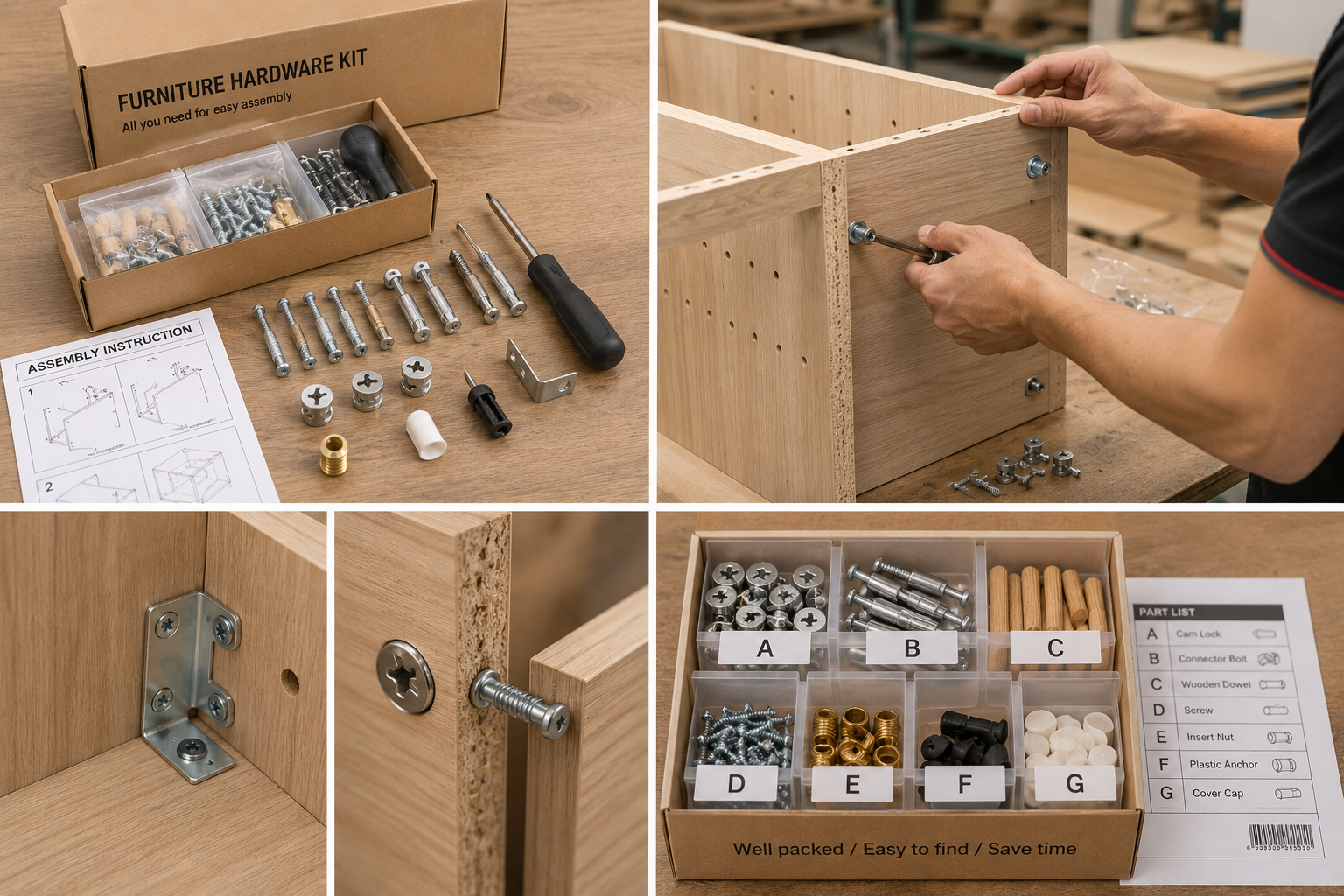
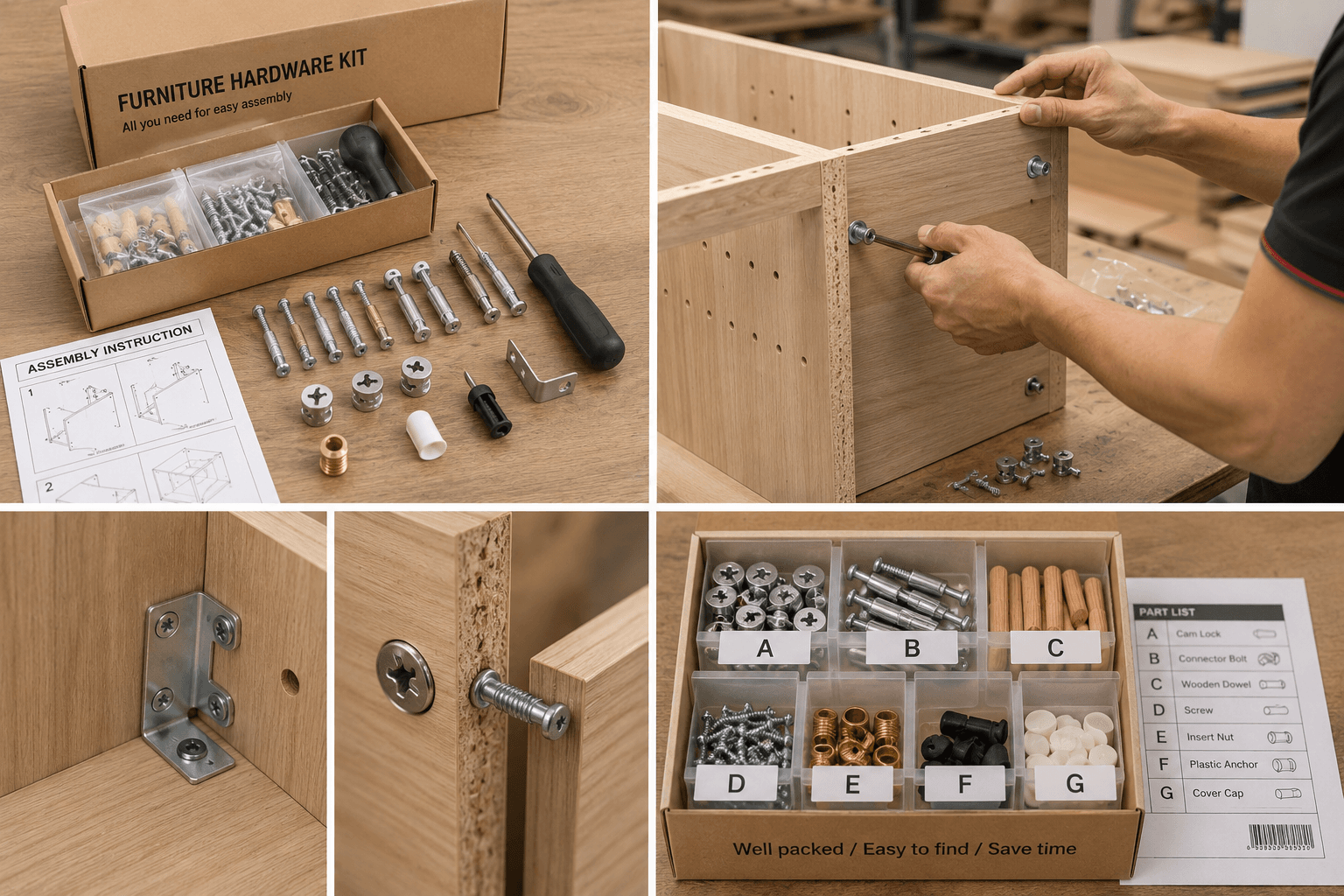
A typical set may include cam locks, connector bolts, wood screws, machine screws, threaded inserts, dowels, brackets, plastic sleeves, cover caps, and a simple hand tool.
That description is accurate, but incomplete.
Each part has to support a particular moment in the assembly:
- A dowel helps position two panels.
- A connector bolt engages with a cam fitting.
- A threaded insert creates a reusable metal thread.
- A bracket reinforces a corner or mounting point.
- A cap hides an exposed hole after installation.
- The supplied tool allows the customer or operator to tighten the joint.
If one part does not match the others, the complete kit loses its purpose.
This is why an OEM furniture hardware kit should be designed around the finished furniture and its assembly sequence. Starting with a generic assortment and trying to make the cabinet fit it usually creates unnecessary compromises.
What the visible components tell a buyer
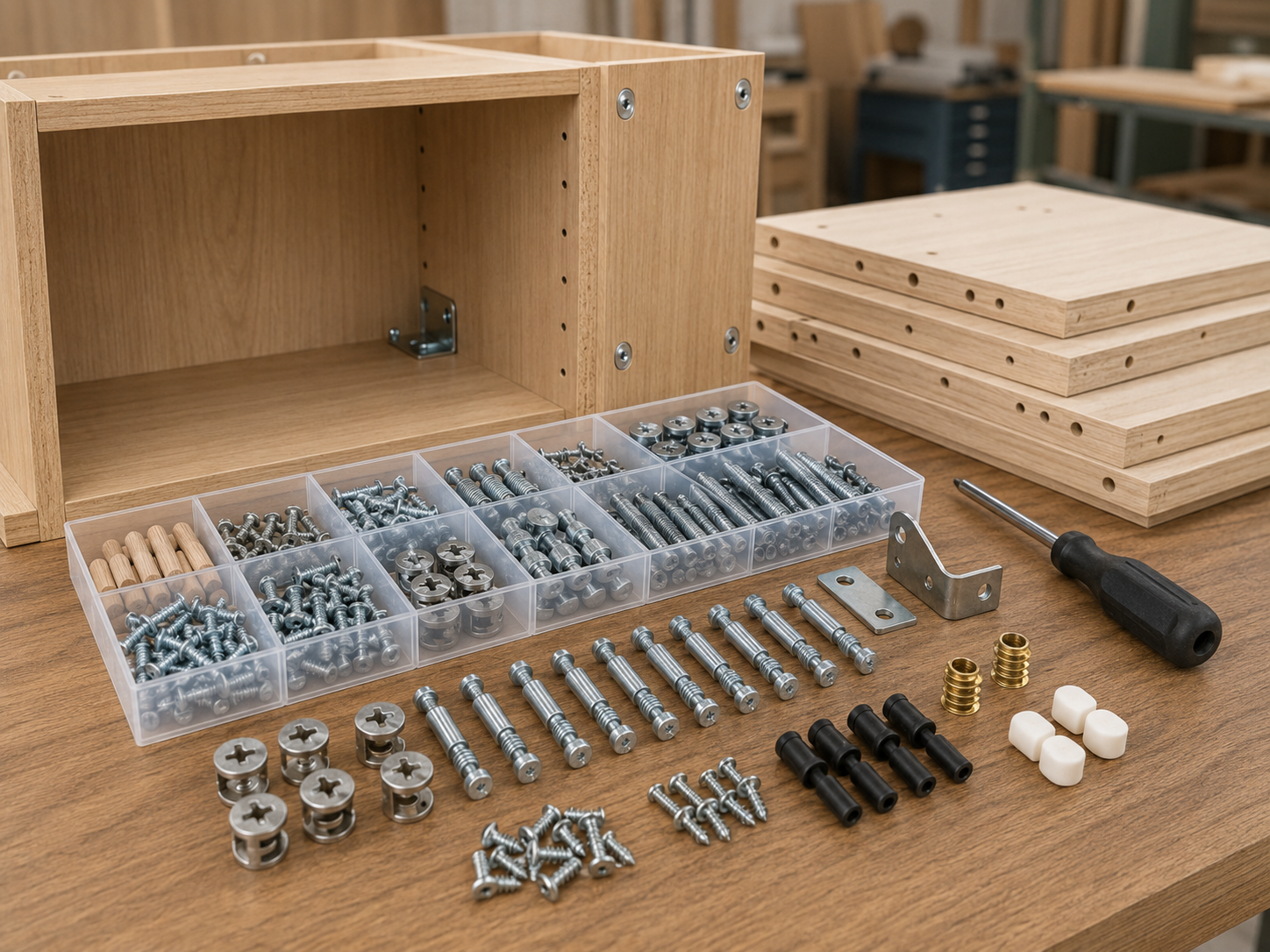
The hardware set described here appears to contain several fastening methods rather than one universal connector.
There are silver-colored screws and connector bolts, a cam-style cylindrical fitting, a brass-colored threaded insert, an L-shaped bracket, black plastic components, and a white nylon or plastic sleeve. The associated panels appear to be laminated or veneered engineered wood with pre-drilled holes.
That combination is common in cabinet and flat-pack assembly.
The metal connectors provide locking or clamping force. Plastic parts may guide, cover, isolate, or protect the joint. Brackets handle areas that need reinforcement. Inserts create more durable threaded locations inside the board.
It also suggests that the kit was intended for several assembly steps.
This matters during sourcing because every step creates a compatibility requirement. A bolt may fit the cam but be too long for the panel. A bracket may be structurally adequate but not align with the drilling pattern. A plastic cover may hide the hole but use a color that does not match the furniture finish.
A cabinet hardware kit manufacturer should therefore review the complete panel layout, not only the individual component drawings.
Why flat-pack production puts more pressure on the hardware kit
In factory-assembled furniture, experienced workers can sometimes compensate for a difficult connector.
They may adjust the panel, change the order of tightening, or replace a questionable screw from a nearby bin. That is not ideal, but the factory still has tools, spare parts, and skilled labor available.
Flat-pack furniture has less room for correction.
The customer may be assembling the product at home with one small tool and a printed instruction sheet. They may not know whether a connector is fitted incorrectly or manufactured incorrectly. When the panels do not close, the entire furniture product feels defective.
The hardware kit must therefore do several things well:
- Make the correct assembly sequence easy to understand
- Include every required component
- Keep similar parts clearly separated
- Match the pre-drilled panel holes
- Avoid tools or movements that are difficult for non-professional users
- Allow reasonable installation without damaging the board
This is why wholesale furniture hardware kits for retail products often need more control than bulk fasteners supplied to a factory.
The hardware may be inexpensive. The customer experience attached to it is not.
Panel design should be confirmed before the kit is finalized
One of the most common sourcing mistakes is approving the kit while the furniture structure is still changing.
A designer increases the panel thickness. A hole moves to avoid a hinge plate. A cabinet side becomes narrower. A shelf support is replaced with another style.
Any of these revisions can affect the hardware.
The panel material matters too.
Particleboard, MDF, plywood, and solid wood do not hold screws and inserts in the same way. Even two engineered boards with the same nominal thickness may have different internal densities.
A fastener that feels secure in plywood may loosen more easily in particleboard. An insert that performs well in a dense panel may rotate inside a softer core. A screw near an MDF edge may need a different pilot hole from one installed in the face.
Before confirming custom furniture hardware kits, the buyer should provide:
- Panel material
- Panel thickness
- Hole diameter
- Drilling depth
- Distance from the edge
- Connector location
- Assembly direction
- Matching component
- Expected load
- Whether the joint will be opened again
A supplier can quote without this information. It simply means more assumptions are being built into the quotation.
 Compatibility matters more than the number of pieces
A large piece count often looks attractive in a product listing.
For furniture production, it can be misleading.
A 100-piece assortment is not better than a 20-piece kit when most of the components are irrelevant to the product. Extra pieces can increase packing time, confuse assemblers, and make shortages harder to identify.
A production kit should be specific.
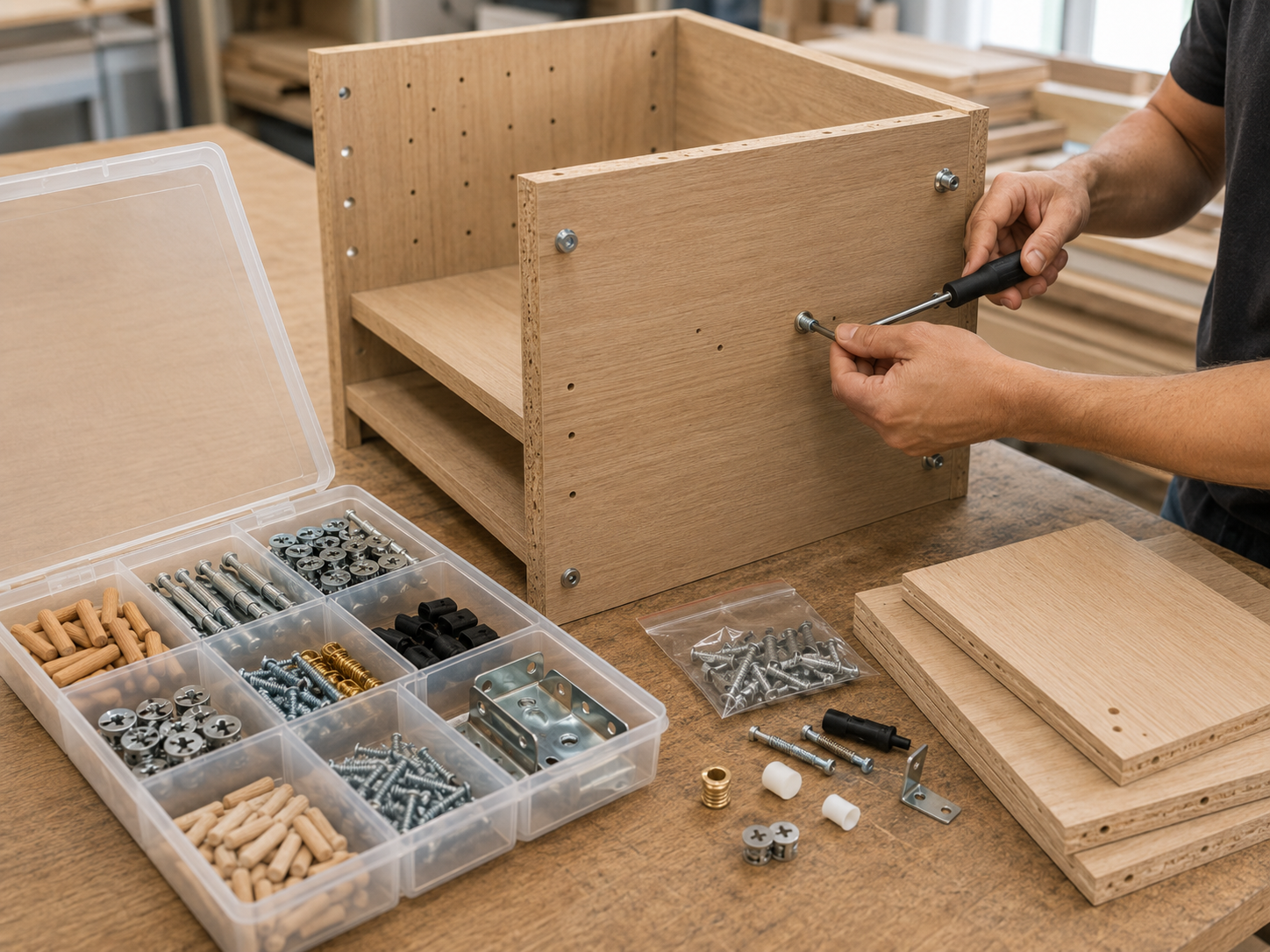
For each furniture model, the buyer should know which component is used, how many are required, and where it appears in the assembly. A controlled bill of materials is far more useful than a general description such as “mixed cabinet hardware.”
A practical BOM may include:
| Component | Quantity per kit | Function | Drawing reference |
|---|---|---|---|
| Cam fitting | 8 | Locks panel joints | Part A |
| Connector bolt | 8 | Mates with cam fitting | Part B |
| Wooden dowel | 12 | Aligns panels | Part C |
| Self-tapping screw | 16 | Secures brackets and fittings | Part D |
| Threaded insert | 4 | Creates reusable thread | Part E |
| Corner bracket | 2 | Reinforces carcass | Part F |
| Cover cap | 8 | Conceals access holes | Part G |
The quantities above are examples, not a universal specification. The important point is that every part should have a defined function and approved reference.
A sample kit should be assembled, not merely inspected
A sample often receives an office inspection.
The parts are spread out, counted, measured, and photographed. The finish is checked under bright light. Everything seems acceptable.
That is only half of the review.
The complete kit should be installed using actual production-intent panels and the planned assembly method.
During the trial, observe what happens rather than focusing only on the finished cabinet.
Does the bolt enter smoothly?
Does the cam rotate without excessive resistance?
Does the joint close evenly?
Can the included tool reach every fitting?
Do workers need to sort parts before use?
Do any screws look confusingly similar?
Does the panel show swelling, cracking, or compression after tightening?
Assemble more than one unit.
One successful cabinet proves that the parts can work. Several assemblies begin to show whether they work consistently.
For OEM production, consistency is the more important result.
Surface finish should never be approved by color alone
Silver-colored hardware is often described casually as zinc plated, nickel plated, or chrome finished. A brass-colored insert may be assumed to be solid brass.
Appearance is not a specification.
The buyer should request written confirmation of the base material and surface treatment. Similar-looking coatings can have different corrosion resistance, thickness, friction, cost, and environmental compliance.
Furniture used in a dry bedroom may have modest corrosion requirements. Kitchen, bathroom, coastal, and commercial applications may need more protection. Export shipments can also spend weeks in changing temperature and humidity conditions before the cartons are opened.
Important finish details may include:
- Base material
- Coating type
- Coating thickness
- Salt-spray requirement
- Color range
- RoHS or other compliance needs
- Whether visible components require a matched finish
Mixed finishes are not always a problem. Some components are hidden, and others use different materials for functional reasons.
The difference should be intentional, not accidental.
Included tools need to survive the real assembly
Many flat-pack kits contain a hex key, small wrench, or simple connector driver.
That looks convenient. Sometimes it is.
A poorly chosen tool can also become the weakest item in the carton.
A thin hex key may twist before the connector is fully tightened. A short driver may be difficult to use inside a narrow cabinet. A plastic handle may crack when the joint needs more force than expected.
The tool should be tested with the same hardware and panel setup used in the finished furniture.
For factory assembly, a disposable hand tool may not be necessary at all. Operators may use controlled electric drivers or pneumatic tools. In that case, the supplier should confirm the drive type and whether the connector is suitable for the planned equipment.
For customer assembly, simplicity matters more.
The end user should not need to guess which end of the tool to use or how much force is safe.
Kitting accuracy often matters more than fastener price
Small component shortages create disproportionately large problems.
A cabinet kit may contain 40 pieces. If one essential bolt is missing, the product is not 97.5% complete. It is impossible to finish.
This is why kitting discipline should be evaluated separately from manufacturing capability.
A supplier may produce excellent screws and still lack a reliable process for assembling multi-component kits.
Before ordering, ask how the parts are counted.
Possible methods include:
- Manual counting
- Automatic counting machines
- Divided trays
- Weight checks
- Vision systems
- Final visual verification
- Combination checks
Weight checking can be useful, but it has limits. If several small parts have similar weights, one missing item may be offset by an extra component of another type.
The verification method should match the risk and complexity of the kit.
A furniture set containing three easily distinguished components may need a simpler process than a bag containing twelve similar screws in four lengths.
Packaging should support the person who opens it
Packaging decisions are sometimes postponed until the hardware is already approved.
That is too late.
The way components are packed affects identification, assembly speed, protection, and customer confidence.
A line-side production kit may need one labeled bag for each cabinet model. A retail furniture set may benefit from several smaller bags marked by assembly step. Replacement hardware may require individual part numbers so customers can identify what they need.
Buyers should confirm:
- Components per bag
- Whether similar screws are separated
- Label language
- Furniture model number
- Part or step identification
- Barcode requirements
- Bag thickness
- Seal strength
- Protection for sharp brackets
- Spare-part policy
- Master-carton quantity
A bag that looks neat in a sample may split during transport when brackets and bolts move against the film.
Packaging trials should include handling, vibration, and realistic carton conditions—not just appearance.
Standard and custom parts can belong in the same kit
A custom kit does not require every component to be custom made.
In many cases, the most reliable solution combines standard screws, established connectors, and only a few project-specific items.
This approach can reduce tooling, shorten lead times, and make future replacement easier.
Customization may still be necessary when:
- A standard screw is too long for the panel
- A restricted space requires another head style
- The connector uses an unusual thread
- A bracket must match a specific cabinet structure
- The finish must coordinate with visible hardware
- The quantity mix is unique to one model
- Packaging and labels are brand-specific
Jiangmen Jinhe Hardware Co., Ltd. works with machine screws, self-tapping screws, micro screws, precision screws, and non-standard fastener customization. For furniture projects, that type of mixed capability may help when the kit contains ordinary catalog parts alongside one or two application-specific components.
The supplier should still explain why a custom part is needed.
Non-standard hardware adds drawings, samples, tooling, minimum quantities, and revision control. It should solve a real production or performance problem.
How to compare a cabinet kit supplier with a general fastener vendor
Not every fastener factory is set up to manage finished furniture kits.
A general fastener vendor may be excellent at producing screws in bulk. A kit supplier must coordinate several additional tasks:
- Manage multiple component drawings
- Source or manufacture plastic and metal parts
- Control finishes across the set
- Follow model-specific BOMs
- Count parts accurately
- Produce labels and barcodes
- Assemble kits without mixing SKUs
- Maintain the same configuration on repeat orders
- Handle packaging revisions
When comparing a cabinet hardware kit manufacturer or wardrobe hardware kit supplier, ask for evidence of the kitting process.
A polished sample is useful. Process control is more useful.
Buyers should understand who approves the BOM, how revisions are communicated, how line clearance is handled between different kits, and how lot traceability is maintained.
These details become particularly important when several furniture models use components that look nearly identical.
Common sourcing mistakes
A familiar mistake is sending a photo and asking for an identical kit.
The supplier can copy what is visible. It cannot reliably infer thread pitch, material grade, hole depth, coating specification, or the function of every part.
Another mistake is approving each component separately.
The screw passes inspection. The insert passes inspection. The bracket passes inspection. Yet the complete cabinet still does not assemble correctly because the components were never tested together.
Buyers also sometimes approve packaging from one handmade sample.
Regular production may behave differently. Parts are counted faster, multiple SKUs run on the same line, and bags are exposed to more handling before reaching the carton.
Finally, some projects move from a few sample kits directly to a large purchase order.
A pilot batch provides a safer bridge. It tests manufacturing, counting, labeling, carton packing, transport, and actual furniture assembly under conditions closer to production.
Where wholesale furniture hardware kits create the most value
Well-designed kits are especially useful for:
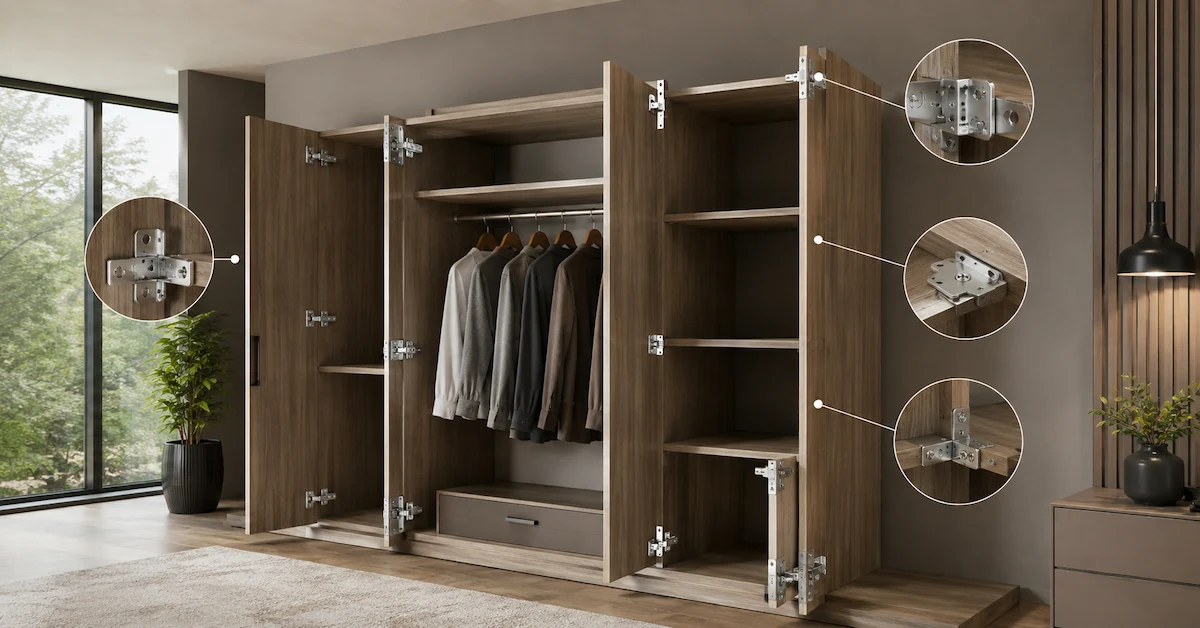
- Flat-pack cabinets and wardrobes
- Modular shelving
- Ready-to-assemble office furniture
- Kitchen and bathroom cabinet systems
- Retail furniture sold through e-commerce
- Spare-parts and repair programs
- Furniture brands managing several factories
- OEM and ODM product lines
- Export products with model-specific hardware
- Assembly operations seeking fewer line-side bins
The value is not limited to speed.
A controlled kit can simplify training, reduce incorrect substitutions, improve inventory visibility, and make replacement parts easier to identify.
For brands selling furniture directly to consumers, it can also reduce support requests caused by missing or confusing hardware.
What to approve before a bulk order
Before releasing a wholesale order, both buyer and supplier should be working from the same approved information.
Confirm:
- Final BOM
- Part drawings
- Drawing revisions
- Materials
- Surface finishes
- Quantity of each component
- Approved panel and hole layout
- Sample test results
- Included tools
- Packaging arrangement
- Label and barcode files
- Counting method
- Inspection criteria
- Production lead time
- Repeat-order controls
- Procedure for shortages or incorrect parts
It is also worth keeping one sealed approval kit.
That physical reference can help settle questions later if a production shipment differs from the confirmed configuration.
Frequently Asked Questions
What is included in wholesale furniture hardware kits?
Common parts include cam fittings, connector bolts, screws, threaded inserts, dowels, brackets, sleeves, washers, cover caps, and assembly tools. The exact contents should match a specific furniture model or product family.
Can a furniture hardware kit be customized for OEM production?
Yes. Components, dimensions, materials, finishes, quantities, labels, barcodes, instructions, tools, and packaging formats can all be customized.
Is a sample photo enough to receive an accurate quotation?
Usually not. Buyers should also provide dimensions, drawings, panel details, quantities, surface-finish requirements, and a kit BOM.
How can buyers reduce missing-part complaints?
Use controlled bills of materials, reliable counting equipment, clear separation of similar parts, final inspection, and model-specific labels. A defined spare-part policy may also help.
Should the full kit be tested before bulk production?
Yes. Test the complete kit with actual panels, drilling, tools, and assembly instructions. A small pilot order is recommended before large-volume production.
Are custom parts always better for OEM furniture?
No. Standard components may offer lower cost, quicker replenishment, and easier replacement. Custom parts are most useful when they solve a specific dimensional, structural, appearance, or assembly problem.
The best hardware kit makes assembly feel ordinary
A good furniture hardware kit does not create a memorable assembly experience.
That is a compliment.
The correct parts are easy to find. Similar components are not mixed. The screws match the inserts. The tool reaches every fitting. The panels close without force, and no one has to search for a missing connector halfway through the build.
This kind of reliability is not achieved by adding more pieces to the bag.
It comes from matching the hardware to the furniture, controlling every component, and packing the set around the real assembly process.
When comparing wholesale furniture hardware kits, buyers should evaluate the complete system: fit, finish, quantity, labeling, packaging, repeatability, and supplier response.
Jiangmen Jinhe Hardware Co., Ltd. can discuss standard fasteners, non-standard components, cabinet and wardrobe hardware combinations, OEM packing, and repeat supply requirements.
Begin with the furniture drawings, panel specifications, BOM, and expected order quantity.
Once the assembly requirements are clear, the right hardware kit becomes much easier to define.