TL;DR: Choosing a reliable corrosion resistant screws supplier means evaluating how screw materials and protective coatings behave under real operating conditions. Zinc plating, zinc-flake coatings, and stainless steel resist corrosion through different mechanisms. Their performance depends on environmental exposure, surface preparation, installation damage, joint design, and quality control. For OEM buyers, the most reliable approach is to specify corrosion requirements, verify representative samples, and control production quality before bulk ordering.
Rust complaints do not always indicate a defective screw. Moisture trapped during shipping, damaged coatings, unsuitable wood treatments, or contact between dissimilar metals can all contribute to corrosion.
For furniture manufacturers, outdoor hardware brands, and industrial equipment suppliers, understanding these mechanisms helps prevent premature product failures and unnecessary replacement costs.
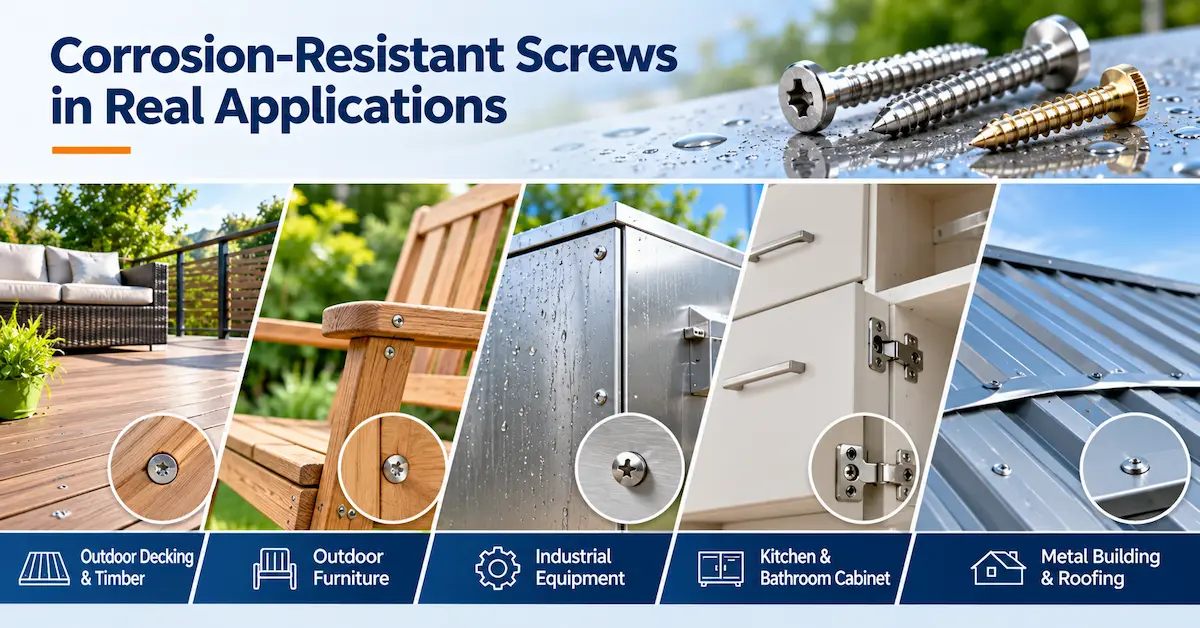
Key Takeaways
-
Corrosion resistance depends on the complete fastening system. Material, coating, installation, substrate, and environmental exposure all influence performance.
-
Different protective systems work differently. Zinc coatings provide sacrificial protection, while stainless steel relies primarily on its chromium-rich passive film.
-
Coating quality is more than thickness. Surface preparation, coverage, adhesion, application conditions, and functional fit also matter.
-
Installation can compromise protection. Drilling, tightening, abrasion, and trapped moisture may create localized corrosion risks.
-
Laboratory testing requires proper interpretation. Salt spray results are useful for defined quality assessments but do not directly predict years of outdoor service.
-
Supplier qualification should include production controls. Approved drawings, material specifications, test criteria, and packaging instructions help maintain batch consistency.
1. What Are Corrosion-Resistant Screws?
Corrosion-resistant screws are fastening components designed to resist chemical or electrochemical deterioration under specified service conditions.
Corrosion protection may come from the screw's base material, a surface coating, or a combination of both.
For example, carbon steel screws may receive zinc electroplating or zinc-flake coatings, while stainless steel screws derive much of their corrosion resistance from the alloy itself.
The correct solution depends on the operating environment and functional requirements.
Protective Coatings vs Corrosion-Resistant Alloys
These two protection approaches should not be confused.
Protective coatings create a corrosion-resistant layer or system on a substrate.
Corrosion-resistant alloys contain alloying elements that influence the material's corrosion behavior.
A zinc-plated steel screw and a stainless steel screw may both resist corrosion, but they rely on different protective mechanisms.
| Protection approach | How it works | Primary consideration |
|---|---|---|
| Zinc electroplating | Zinc coating provides sacrificial protection to steel | Coating thickness, coverage, supplementary treatment |
| Zinc-flake coating | Engineered coating system provides barrier and potentially sacrificial protection | Coating composition, application, curing, thickness |
| Stainless steel | Chromium-rich passive film protects the underlying alloy | Alloy grade, surface condition, environment |
| Specialized coating system | Multiple protective layers may provide application-specific performance | Complete system qualification and compatibility |
The visible appearance of a screw is not sufficient evidence of corrosion performance.
A bright silver finish, colored coating, or dark surface treatment does not establish the product's protective capabilities without a supporting specification.
For customizable products, review JHFIX Specialty & Custom Screws.
Where Does Screw Corrosion Begin?
Corrosion frequently develops where environmental exposure and material conditions allow electrochemical reactions to occur.
Potential initiation points include:
-
Damaged coating around screw heads.
-
Exposed metal at drill points.
-
Thread contact surfaces.
-
Crevices retaining water.
-
Areas contacting dissimilar metals.
-
Surface contamination from manufacturing.
-
Locations exposed to moisture during storage.
Understanding where corrosion begins helps buyers distinguish material problems from installation or environmental problems.
Section Takeaway: Corrosion-resistant screws should be evaluated by their protective mechanism and actual application, not appearance alone.
2. How Do Corrosion-Resistant Screw Coatings Prevent Rust?
Most corrosion mechanisms involve reactions between metals and their surrounding environment.
Moisture, oxygen, dissolved salts, and other substances may contribute to electrochemical corrosion.
Protective materials and coatings reduce corrosion through different mechanisms.
Sacrificial Protection from Zinc
Zinc is more electrochemically active than steel under many exposure conditions.
When a zinc-coated steel component is exposed to a suitable corrosive environment, zinc can corrode preferentially, helping protect the underlying steel.
This is commonly called sacrificial protection.
However, the effectiveness depends on coating condition, exposed area, environmental chemistry, and other factors.
Once sufficient protection is lost, the underlying steel may begin to develop red rust.
Barrier Protection from Coating Systems
Some protective systems reduce the contact between the steel substrate and the surrounding environment.
Zinc-flake coatings, particularly when combined with suitable topcoats, may provide both barrier effects and corrosion protection associated with their metallic constituents.
For these systems, coating composition and application quality matter.
Uneven coverage, inadequate processing, or damage during installation can reduce the intended protection.
Passive Film Protection in Stainless Steel
Stainless steel forms a thin chromium-rich passive film on its surface.
This film contributes to the alloy's corrosion resistance.
Surface contamination, chloride exposure, unfavorable crevice conditions, and other factors may still cause localized corrosion.
For stainless components requiring chemical passivation, ASTM A967/A967M-25 describes applicable treatments and verification methods.
Chemical passivation is not the same as applying zinc plating. The processes have different purposes and requirements.
Why Installation Geometry Matters
The protective material alone does not determine corrosion performance.
For instance, moisture trapped beneath a screw head can create conditions different from those on an exposed surface.
Likewise, contact between dissimilar metals may introduce galvanic corrosion risks when a suitable electrolyte is present.
Section Takeaways
-
Zinc and stainless steel protect through different mechanisms.
-
Surface condition and exposure strongly influence corrosion behavior.
-
Joint design, installation, and material compatibility can be as important as coating selection.
3. How Does a Controlled Coating Workflow Maintain Screw Quality?
A corrosion-resistant coating must be applied to a screw that meets its required geometry and manufacturing specifications.
Coating cannot compensate for an incorrect thread, damaged point, or unsuitable head design.
The workflow varies depending on the material and protective system, but a practical OEM quality plan includes six stages.
Stage 1: Confirm Base Material and Screw Geometry
Before coating, verify the specified base material and the screw's critical features.
These may include diameter, length, thread geometry, head dimensions, drive recess, and drill point.
For self-drilling screws, the point must remain suitable for the intended substrate after finishing.
Stage 2: Prepare the Surface
Suitable cleaning and preparation are important for many protective coating processes.
Manufacturing oils, contamination, and unsuitable surface conditions may interfere with coating quality.
The required preparation depends on the specific process.
Stage 3: Apply the Specified Protective System
The coating process must follow the agreed material and finish requirements.
Electroplating, zinc-flake coating, and other finishing methods involve different equipment, process controls, and potential limitations.
For susceptible hardened or high-strength steel fasteners, hydrogen-embrittlement risk must also be considered where relevant.
Stage 4: Complete Required Post-Treatment
Depending on the coating, this may involve rinsing, supplementary treatment, curing, drying, or other specified processing.
These steps should follow the relevant coating procedure.
Stage 5: Inspect Finished Screws
Inspection should check critical dimensions, surface condition, coating requirements, and any applicable functional properties.
Coating buildup must not create unacceptable thread interference or other assembly problems.
Stage 6: Verify Packaging and Shipment Protection
Finished components should be packed according to the agreed requirements.
Packaging should help prevent mixing, avoidable abrasion, and inappropriate moisture exposure.
For international orders, packaging decisions should consider the expected storage and transport conditions.
Coating Workflow and Inspection Table
| Production stage | Main risk | Verification |
|---|---|---|
| Material selection | Incorrect steel grade | Approved material specification |
| Screw forming | Dimensional variation | Drawing-based measurement |
| Surface preparation | Contamination and poor coating contact | Process and surface checks |
| Coating application | Inadequate or inconsistent protection | Applicable coating inspection |
| Post-treatment | Incomplete processing | Process records and inspection |
| Final inspection | Thread interference or finish damage | Functional and appearance checks |
| Packaging | Moisture, mixing, abrasion | Packaging and identification audit |
Section Takeaway: A dependable coating workflow protects screw function as well as surface quality. Both must be verified before approving a production batch.
4. Zinc-Plated vs Zinc-Flake vs Stainless Steel Screws: Which Is Better?
The correct corrosion-protection strategy depends on environmental severity, mechanical requirements, fastener geometry, and cost.
Zinc-Plated Screws
Electroplated zinc is commonly used for steel fasteners in applications requiring practical surface protection.
ASTM F1941/F1941M-16(2025) addresses electrodeposited coatings on mechanical fasteners within its scope.
Important purchasing factors include coating specification, thickness, supplementary treatment, and dimensional requirements.
Zinc-Flake Coated Screws
Zinc-flake systems may be evaluated for selected industrial and outdoor applications where engineered corrosion protection is necessary.
ISO 10683:2018 specifies requirements for non-electrolytically applied zinc-flake coating systems on steel fasteners.
Not every screw design or substrate is automatically suitable.
Stainless Steel Screws
Stainless steel may be selected when corrosion resistance from the base alloy is desirable.
Grade 304 is commonly considered for many general environments, while grade 316 can provide improved resistance in certain chloride-containing conditions.
However, stainless steel remains vulnerable to some forms of corrosion, and the mechanical requirements must also be satisfied.
Material and Coating Comparison
| Option | Protection principle | Potential application | Key limitation | Cost consideration |
|---|---|---|---|---|
| Zinc-plated steel | Sacrificial zinc protection | Dry indoor and selected controlled environments | Protection depends on coating and exposure | Often economical |
| Zinc-flake coated steel | Engineered coating system | Selected industrial and exterior applications | Requires system qualification | Depends on coating complexity |
| Stainless steel 304 | Alloy passive film | General corrosion-resistant assemblies | Less suitable for some chloride-rich environments | Typically higher material cost |
| Stainless steel 316 | Alloy passive film with improved resistance in some chloride conditions | Selected coastal or demanding applications | Localized corrosion can still occur | Typically more expensive |
| Custom protective system | Application-specific mechanism | Specialized OEM products | Requires testing and supplier confirmation | Project-dependent |
A common purchasing mistake is to specify the most expensive option without assessing actual exposure.
Another is to choose the lowest-cost coating without considering long-term service conditions.
The correct choice should meet the required performance at an acceptable total procurement cost.
5. Why Do Corrosion-Resistant Screws Sometimes Fail?
Failures may originate before coating, during finishing, after packaging, or during installation.
A structured investigation should identify the cause rather than immediately blame the protective material.
Failure 1: Poor Surface Preparation
Contamination may reduce coating quality or create localized defects.
Manufacturing residues and inappropriate surface conditions should be addressed through the specified preparation process.
Buyer action: Request confirmation of the applicable coating process controls and inspection criteria.
Failure 2: Coating Damage During Installation
Powered screwdriving, drilling friction, or unsuitable tools may damage protective surfaces.
This is especially relevant for self-drilling screws and fasteners installed into hard substrates.
Buyer action: Test screws under representative production conditions, including the intended driver and substrate.
Failure 3: Trapped Moisture During Shipping
Condensation inside packaging or exposure to unsuitable warehouse conditions can contribute to early corrosion.
Buyer action: Review packing conditions, humidity exposure, carton protection, and storage expectations.
Failure 4: Incompatible Treated Timber
Some timber treatments can influence fastener corrosion behavior.
Buyer action: Follow the applicable wood treatment manufacturer's recommendations and select fasteners compatible with the actual treatment and environment.
Failure 5: Galvanic and Crevice Corrosion
Contact between dissimilar metals and trapped moisture may contribute to localized corrosion.
Buyer action: Evaluate mating materials, joint design, drainage, and exposure conditions.
Failure 6: Misinterpreted Corrosion Test Results
A coating may pass a defined laboratory test without being suitable for every real-world environment.
ISO 9227:2022 describes salt spray test methods but does not establish universal test durations or predict field service life.
Buyer action: Define application-specific acceptance requirements and interpret the test results within their actual scope.
Failure Mode Checklist
| Observed problem | Possible contributing factor | Recommended investigation |
|---|---|---|
| White corrosion deposits | Zinc surface exposed to unfavorable moisture | Coating and storage conditions |
| Red rust | Steel exposure or insufficient protection | Coating damage, specification, service environment |
| Rust near screw head | Trapped water, damage, material contact | Joint design and installation |
| Corrosion after shipment | Condensation or unsuitable packaging | Transit and storage conditions |
| Corrosion after installation | Abrasion, substrate chemistry, water exposure | Installed assembly and mating materials |
| Poor screw fit | Coating buildup or dimensional error | Finished-thread and functional inspection |
Section Takeaway: Effective failure analysis considers the entire supply and installation process instead of assuming one coating defect explains every rust complaint.
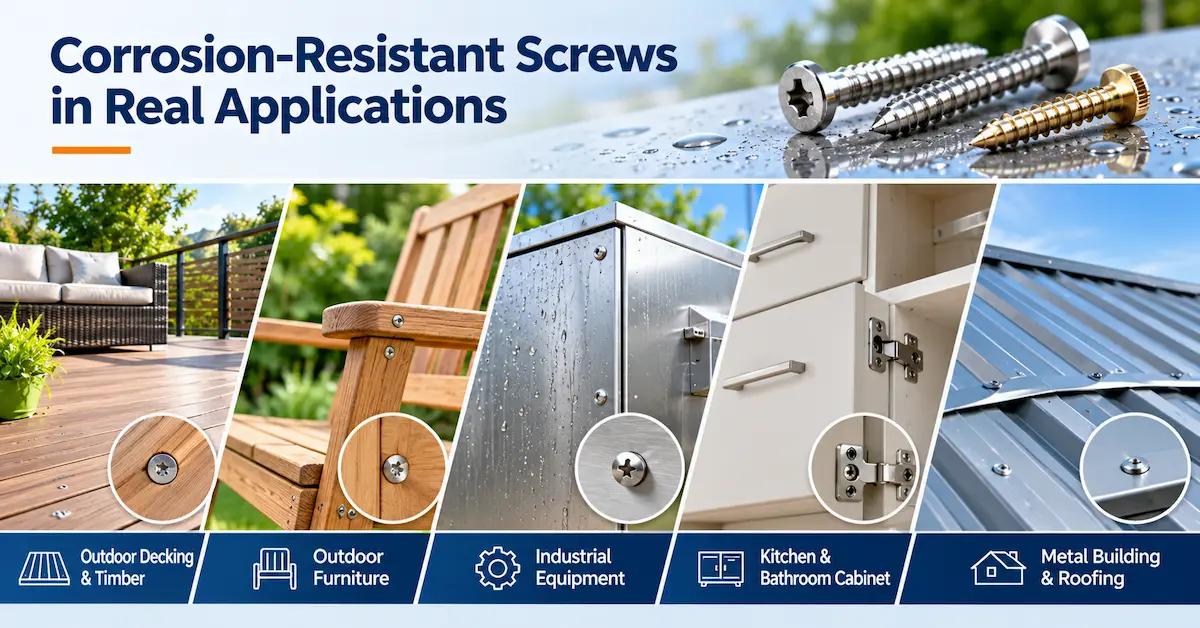
6. How Does This Work in Practice? An Outdoor Timber Screw OEM Scenario
The following is an illustrative procurement scenario, not a documented JHFIX customer project or test result.
Application Scenario
An outdoor furniture manufacturer needs screws for timber panels and metal mounting brackets.
The furniture may experience seasonal humidity, occasional rain, and changes in temperature.
The purchasing team wants to reduce corrosion-related complaints without unnecessarily increasing material costs.
Step 1: Define the Exposure
The buyer identifies whether the application is sheltered or directly exposed to weather.
The specification also identifies the wood treatment, metal bracket material, cleaning conditions, and expected maintenance.
Step 2: Select Candidate Materials
The buyer evaluates suitable protective coating systems and stainless steel options.
Each option must meet the intended screw geometry, mechanical requirements, and environmental conditions.
Step 3: Test Representative Assemblies
Sample screws are installed into the actual timber and bracket materials.
Evaluation may include driving behavior, head seating, thread engagement, visible coating damage, and agreed corrosion-related testing.
Step 4: Confirm Technical Acceptance
The buyer compares results with defined acceptance criteria.
If the design or material does not meet requirements, the specification must be revised before approving production.
Step 5: Control Bulk Packaging
Approved screws are identified by part number, material or coating specification, and required quantity.
Packaging is selected to reduce mixing, handling damage, and inappropriate moisture exposure.
Practical Purchasing Insight
This scenario demonstrates why choosing a screw coating solely from a catalog is insufficient.
The final decision depends on environmental requirements, mechanical compatibility, representative testing, and supply consistency.
For suitable wood fastening designs, review the JHFIX Wood, Timber & Deck Screws.
7. How Should OEM Buyers Evaluate a Corrosion Resistant Screws Supplier?
A professional corrosion resistant screws supplier should be able to discuss technical specifications, suitable protective systems, sample approval, and repeat-order quality requirements.
Supplier evaluation should include more than product photographs or an advertised salt spray duration.
Supplier Evaluation Checklist
| Evaluation area | Questions to ask |
|---|---|
| Product capability | Can the required screw geometry be supplied? |
| Material identification | Can the specified base material be confirmed? |
| Protective system | Can the required coating or material option be evaluated? |
| Engineering communication | Can drawings and installation conditions be reviewed? |
| Quality control | What inspections can be performed and documented? |
| Testing | Can the agreed corrosion and functional tests be performed or arranged? |
| Sample approval | Can representative samples be verified before production? |
| Change control | How are materials, coatings, and drawings controlled between orders? |
| Packaging | Can parts be identified and packed according to the purchasing specification? |
| Commercial terms | Are MOQ, tooling, lead time, and delivery arrangements clear? |
JHFIX Manufacturing and OEM Support
JHFIX supplies industrial screws, furniture hardware, and customized fastening components for international B2B buyers.
Its manufacturing company, Jiangmen Jinhe Hardware Products Co., Ltd., describes production capabilities including cold heading, tapping, stamping, assembly, packaging, and quality inspection.
The company supports OEM/ODM requirements and works with its authorized export and trading partner, Jiangmen Shenxin Trading Co., Ltd., for international purchasing coordination.
Relevant product categories include:
JHFIX product information includes options for evaluating zinc plating, Ruspert coating, and other finishes on suitable custom screw designs.
However, availability, coating suitability, corrosion performance, inspection scope, and manufacturing feasibility must be confirmed for each specific order.
Buyers can review JHFIX manufacturing capabilities before submitting technical requirements.
8. RFQ Checklist: What Should Buyers Send Before Bulk Ordering?
An effective request for quotation should define the screw and its intended operating conditions.
| RFQ item | Required information |
|---|---|
| Screw type | Wood, deck, self-drilling, self-tapping, machine, or custom |
| Technical drawing | Diameter, length, thread, head, drive, and revision |
| Base material | Required steel grade or alternative alloy |
| Protective system | Coating type, stainless grade, or defined performance requirements |
| Environment | Indoor, humid, exterior, coastal, or industrial |
| Installation substrate | Timber, treated wood, metal, or other material |
| Functional requirements | Drill capability, thread fit, installation behavior |
| Corrosion verification | Test method, exposure duration, acceptance criteria |
| Order volume | Initial quantity and repeat demand |
| Packaging | Bulk cartons, labeled bags, buckets, or private-label packs |
| Shipping | Destination and delivery requirements |
A complete RFQ helps suppliers identify technical uncertainties and quote the correct specification.
Need corrosion-resistant screws for outdoor furniture, timber fastening, or industrial assembly?
9. Frequently Asked Questions
1. What is the best corrosion-resistant screw for outdoor applications?
There is no universally best option. The appropriate screw depends on environmental exposure, substrate, mechanical requirements, installation conditions, and applicable standards. Stainless steel and qualified coated steel screws are common options.
2. Are zinc-flake coated screws better than zinc-plated screws?
Zinc-flake systems may offer advantages for particular applications, but performance depends on the complete coating specification. The two should be compared against defined functional and corrosion requirements rather than appearance alone.
3. Why do screws rust even when they have protective coatings?
Possible causes include coating damage, insufficient protection, moisture exposure, surface contamination, unfavorable joint geometry, or incompatible surrounding materials. A reliable investigation examines actual exposure and product condition.
4. What is the difference between white rust and red rust?
White corrosion products are commonly associated with zinc corrosion, while red rust typically indicates corrosion of an iron-containing substrate. The appearance alone does not establish the complete cause or severity of the problem.
5. Can corrosion-resistant screws be used with treated timber?
Yes, when their materials and coatings are compatible with the specified timber treatment and exposure conditions. Buyers should check the wood treatment manufacturer's instructions and applicable project requirements.
6. Does a 1,000-hour salt spray test mean a screw will last for years outdoors?
No. Salt spray exposure is a controlled laboratory assessment. It does not directly translate into a guaranteed service life. The test conditions and acceptance criteria must be interpreted within their defined scope.
7. Can stainless steel screws still corrode?
Yes. Stainless steel can experience pitting, crevice corrosion, staining, or other deterioration under unfavorable environmental conditions. Correct grade selection and joint design remain important.
8. How can buyers prevent corrosion during international shipping?
Suitable packaging, controlled handling, moisture management, and storage procedures can help reduce corrosion-related risks. The exact requirements depend on the fastener finish and transportation conditions.
9. Can JHFIX supply custom corrosion-resistant screws?
JHFIX describes custom screw manufacturing and OEM/ODM support. Buyers can submit drawings, material requirements, and coating specifications for review. Particular coating systems, testing options, MOQ, and lead times require project-specific confirmation.
10. How should buyers verify corrosion-resistant screw quality before bulk production?
Buyers should define material and coating requirements, inspect representative samples, perform appropriate dimensional and functional checks, and establish corrosion testing and acceptance criteria where necessary.
Conclusion
Selecting a reliable corrosion resistant screws supplier requires understanding how materials and protective systems behave throughout manufacturing, transportation, installation, and service.
Zinc-plated steel, zinc-flake coatings, stainless steel, and other engineered solutions rely on different corrosion-protection mechanisms. Their suitability depends on environmental exposure, substrate compatibility, screw geometry, installation conditions, and quality-control procedures.
For outdoor furniture manufacturers, timber fastener buyers, and industrial OEM companies, the most effective approach combines clear technical specifications, representative sample testing, defined inspection criteria, and controlled repeat production.
JHFIX supports international customers with standard and custom screws, furniture hardware, OEM manufacturing coordination, and suitable packaging solutions.
Contact JHFIX to discuss your corrosion-resistant screw requirements, protective coating options, custom designs, and bulk purchasing projects.