

DIY fasteners look simple until they fail
Anyone who has worked through a weekend installation knows that diy projects live or die on the little hardware choices. A screw that bites cleanly, seats flat, and does not split the base material can save an hour of frustration. A poor one can turn a small job into a damaged panel, a stripped head, or a loose fixture that has to be redone later.
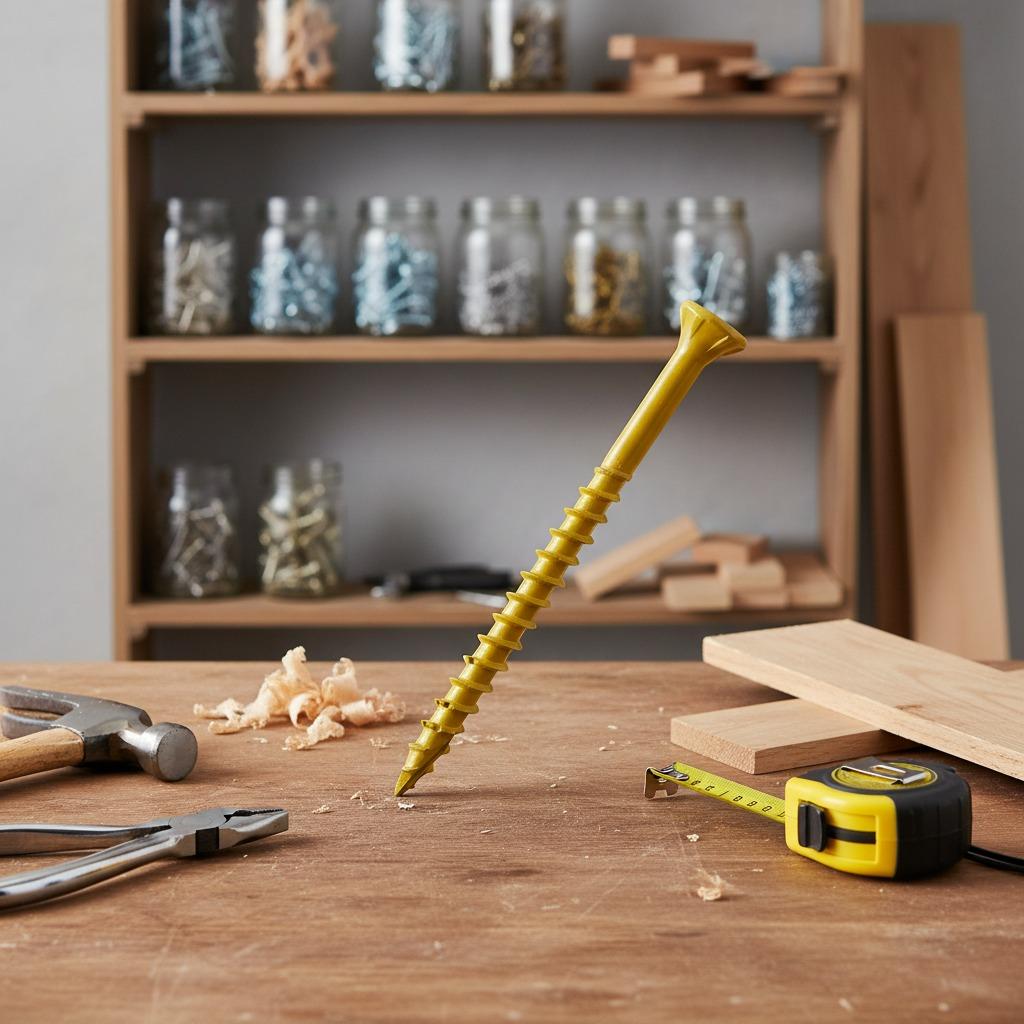
The yellow, deep-thread fastener shown here sits in that practical middle ground between a general-purpose screw and a specialty anchor. The exact base material is not fully confirmed from the visual alone, so it is best treated cautiously: it may be a molded or coated fastening component intended for wood, masonry, drywall, or similar construction substrates. What matters to buyers is the functional promise behind the geometry. Aggressive threads, a pointed tip, a reinforced neck, and a countersunk-style head all suggest a fastener designed for quicker installation and a flush finish.
What this type of fastener is trying to solve
For installers, the problem is rarely fastening in the abstract. The problem is fastening quickly without over-driving, splitting, stripping, or needing extra preparation. That is why marketing claims such as “less drive torque,” “no stripping,” and “no pre-drilling” matter in the field, even if each one still depends on the actual substrate and tool used.
A deep-thread profile usually aims to improve bite and holding behavior. The tapered shank can help the fastener start more easily, while the reinforced neck near the head is there to reduce failure at the point where many fasteners are most vulnerable. In practical terms, that is the section most likely to complain when a technician leans on the drill a little too hard.
Quick buyer takeaways
If you are comparing this style of fastener against a plain screw, the main advantages are likely installation speed and a cleaner seated finish. If you are comparing it against a true anchor, the question becomes whether the base material needs expansion, threading, or some other holding mechanism. Because the image does not confirm the exact product type, buyers should not assume identical performance across all wall or board materials.
That is the small caveat worth keeping in mind: a fastener that works beautifully in one substrate can be a nuisance in another. The visible design suggests convenience, not universal compatibility.
Where the design details matter
Clean, smooth finish
A glossy, uniform yellow finish can help in two ways. It improves visual consistency for consumer-facing installations, and it may indicate a coating or molded surface that is easier to inspect in production. For builders who care about appearance, a neat head and smooth finish are not decorative extras; they reduce the odds that a bracket or panel looks rough after installation.
Reinforced neck and countersunk head
The neck area is where torque loads concentrate. A reinforced transition below the head can reduce deformation during driving, especially when users are working with hand tools or higher-speed drivers. The countersunk-style top also matters because it helps the head sit flush or near-flush, which is often the difference between a clean install and one that snags fingers, trim, or adjacent hardware.
Deep threads and pointed tip
Deep threads generally support faster engagement and better grip in softer or more forgiving materials. The pointed tip is there for self-starting behavior, which is why such products are often marketed to users who want to skip pre-drilling. Still, skipping pre-drilling is not a universal rule. Dense base material, brittle board, or misalignment can quickly change the situation.
How buyers should evaluate it
For sourcing managers and product teams, the real checklist is not the color or the visual style alone. Ask whether the fastener is meant for wood, masonry, drywall, or a hybrid application. Ask for material confirmation, coating details, and relevant standards if the product will be specified into a repeatable assembly. Jiangmen Jinhe Hardware Co., Ltd. notes that it produces fasteners and precision screws in stainless steel, iron, and aluminum, and works across GB, DIN, ANSI, BS, JIS, and ISO standards. That broad manufacturing base is useful, but the specific product still needs its own technical confirmation.
It is also sensible to ask for inspection documentation before committing to a large order. The company states that products undergo strict inspection before delivery and that support responses are handled quickly. For business buyers, that matters more than any glossy product render.
Common mistakes with this kind of fastener
The first mistake is assuming the fastener’s shape guarantees performance in every substrate. It does not. The second is mixing up a coated screw, a plastic anchor, and a hybrid fastening component as if they were interchangeable. They are not. The third is over-driving the head because the installer expects “no stripping” to mean “no limits.” Every fastener has limits, even a well-designed one.
Another practical issue is finish matching. A bright yellow component may be useful for identification or branding, but it can also stand out visually in some installations. That is fine in a workshop or utility setting; less so on a visible interior surface.
FAQ
Is this fastener suitable for DIY use?
Yes, the design is clearly aimed at quick, user-friendly installation, but the exact substrate should be confirmed before use.
Does “no pre-drilling” apply everywhere?
No. That claim depends on the material being fastened into, the tool, and the load demand.
Is it better than a standard screw?
Not always. It may be better for faster installation and a cleaner seat, but standard screws can still be the right choice for some assemblies.
What should buyers request before ordering?
Ask for the confirmed material, size, substrate compatibility, coating or finish specification, and any inspection or compliance documents that apply to the order.
Next step
If you are evaluating fasteners for retail, hardware distribution, or a product assembly line, start with the substrate and installation method, not the marketing copy. Then match the head style, thread form, and material to the job. If you need a supplier that can support both standard parts and non-standard customization, Jiangmen Jinhe Hardware Co., Ltd. is set up for that kind of conversation.
For technical questions or sourcing support, the company lists Tel/WeChat +86 13729150102, WhatsApp +8613322893939, and E-mail sharon@hkhomeideas.com.