

Locknuts and other fasteners: their applicable and inapplicable scenarios
Lock nuts are small pieces of hardware that can save maintenance teams a lot of trouble, but they can also cause problems if used incorrectly. For engineers and purchasing managers, the real issue isn't whether the nut can be tightened, but whether the connection remains secure under vibration, whether it's easy to maintain in the future, and whether it can still be assembled tightly. This is why lock nuts are compared to standard lock nuts, flange nuts, and standard hex nuts.
In practice, a lock nut is a thinner nut that mates with another nut on the same threaded fastener to prevent loosening. While a simple design, it effectively addresses the fastening needs of equipment assemblies, brackets, frames, and other connections that frequently experience repetitive movement or slight vibration. Purchasing personnel typically compare it to other industrial fasteners such as lock nuts and washers, as the final choice usually depends on space, ease of maintenance, and the actual clamping strength required at the connection.
Why do buyers compare lock nuts with anti-loosening nuts and flange nuts?
First, consider the function of the connector. A standard hex nut is the simplest choice. It is easy to source, convenient to install, and works well when the component is stationary or can be inspected periodically. However, if the connection is prone to loosening, the buyer must decide whether to use a lock nut, a preloaded torque lock nut, or a flange nut with a wider bearing surface.
Standard hexagonal nuts
Hex nuts are the preferred choice for general-purpose fasteners. They are common, readily available, and compatible with bolts, washers, and threaded rods. In many maintenance environments, they are the preferred option due to their ease of replacement. However, their limitations are also well-known: if the connection is exposed to vibration, ordinary hex nuts may require additional tightening measures.
Jam and Nuts
Lock nuts are thinner than full-height nuts, making them particularly useful when thread engagement space is limited or when two nuts need to be locked together. They are especially suitable for adjusting points, mechanical linkages, and installations where maintenance technicians may need to reposition the assembly without replacing the entire component. However, it's important to note that lock nuts are not a panacea. If the installer uses insufficient thread length or the connection is not tightened correctly, the locking effect may not be as expected.
Locking nut
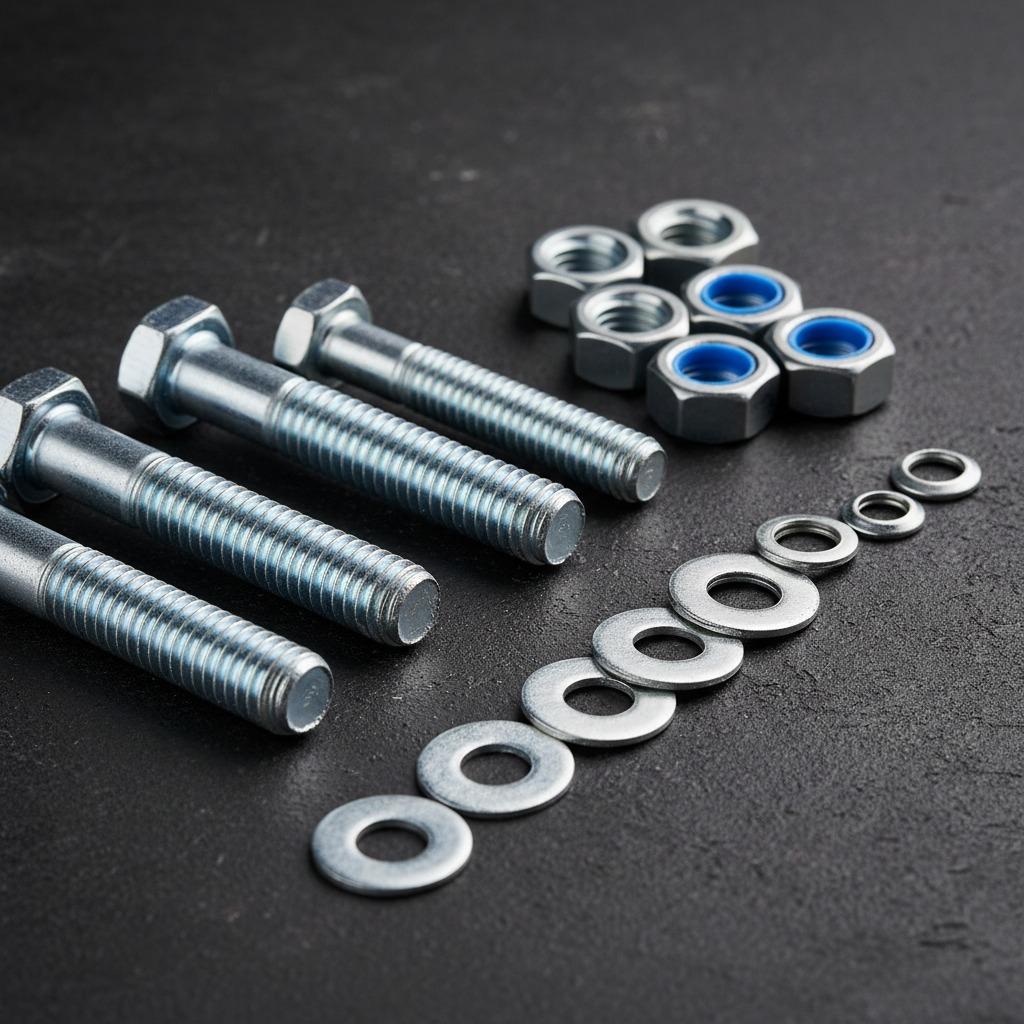
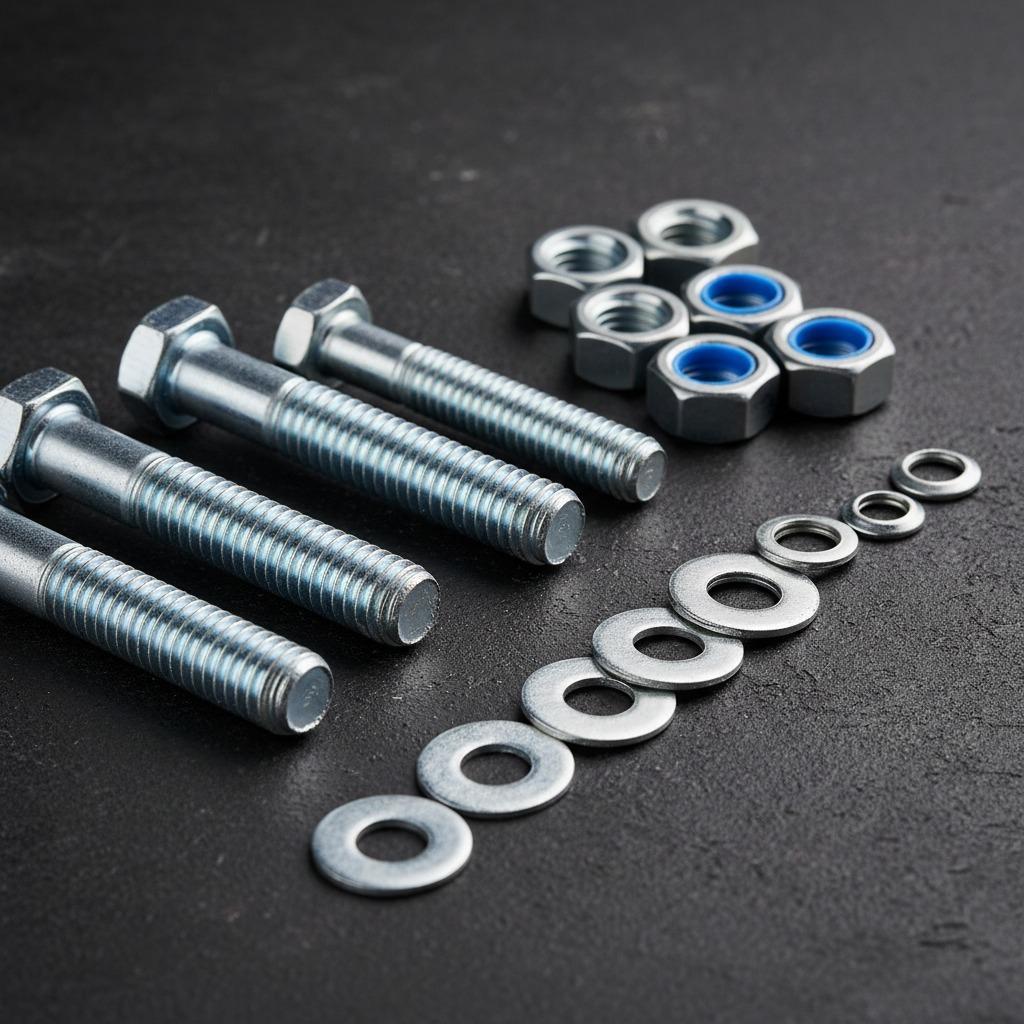
Locking nuts are typically chosen when it's necessary to prevent loosening without using a second nut. These include some nylon insert and preloaded torque locking nuts. They are very convenient, especially in production environments where assembly time is critical. However, a drawback is that they may not be suitable for all high-temperature environments or all repetitive use scenarios. The fact that the product information provided shows that some parts have nuts with colored rings suggests that locking nuts may be included in a wider range of hardware, but the exact type should be confirmed before specifying for a particular project.
Flange nuts
Flange nuts distribute loads over a larger area, thus reducing the need for individual washers in some assemblies. They are highly efficient to manufacture and have a compact design. However, they are not the same as lock nuts. Flange nuts address the problem of load distribution; lock nuts, on the other hand, address loosening by tightening the nuts together or by increasing resistance.
Recommendations for the practical application of fastener kits
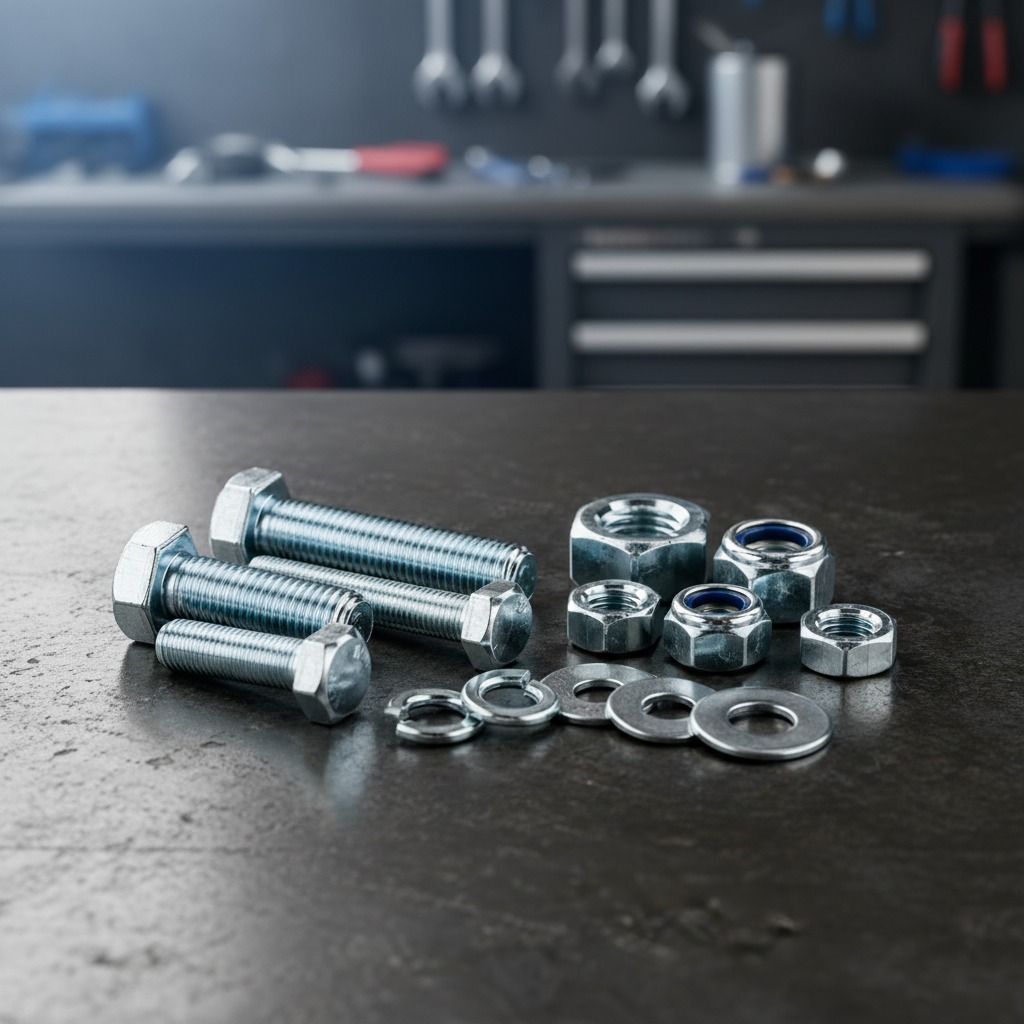
The product category showcases a mixed set of hardware: galvanized or similarly galvanized steel bolts, hexagonal nuts, flat washers, and spring washers. This combination is common in assembly, repair, and manufacturing work because it offers flexibility to the buyer. Flat washers distribute the load under the nut head, while spring washers are used in some applications to prevent the nut from loosening. The bolts appear to be fully threaded, which is useful for general clamping as well as assemblies requiring an adjustable range.
This type of accessory combination is suitable for equipment maintenance, automotive repair, and structural component assembly. The purchasing team also needs to stock this type of accessory when specific site conditions are unclear. However, purchasing personnel should not assume that all washer and nut combinations are interchangeable. The correct combination depends on the thread size, material, torque specification, and load path at the connection.
How to choose from these options?
A good purchasing decision begins with three questions.
First, does this connector require frequent maintenance? If so, then a lock nut type connector might be attractive because of its simple structure and the fact that the maintenance team is familiar with it.
Secondly, is the component subject to vibration or repeated cycles? If so, using a lock nut may be better than relying solely on the friction of a standard hex nut.
Third, is there enough space to accommodate taller stacks of fasteners? If not, a compact solution is more important than convenience, and locknuts may be one such solution.
When procuring, it's also necessary to confirm whether the application requires ordinary steel, stainless steel, or other materials. Jiangmen Jinhe Hardware Co., Ltd. points out that its production covers stainless steel, iron, and aluminum fasteners across standard fastener categories, with a wide range of services conforming to standards such as GB, DIN, ANSI, BS, JIS, and ISO. This is crucial because compatibility and documentation are just as important as the shape of the fastener itself.
Common mistakes buyers make
A common mistake is assuming all locking methods are the same. This is not the case. Lock nuts, open-end lock washers, and preloaded torque lock nuts all perform differently, especially after repeated disassembly and reassembly.
Another common problem is sourcing the same type of nut for every job. In reality, maintenance teams often need a variety of nuts: standard hex nuts for general maintenance, lock nuts for adjustments, and anti-loosening nuts for situations where loosening might occur. A mixed inventory can reduce downtime if the team manages nut sizes and specifications properly.
Practical Procurement Suggestions
When inspecting industrial fasteners, always inquire about the exact thread size, material grade, coating, and any applicable test or inspection documentation. While a product may appear to have a corrosion-resistant coating, the coating specifications should be confirmed; do not assume otherwise. If the connection is critical, also inquire about the type of matching washer; flat washers cannot replace lock washers, and neither can replace a properly selected nut.
For suppliers, responsiveness and documentation are equally important. Jiangmen Jinhe Hardware states that they conduct inspections before shipment and respond to support requests within 30-60 minutes, providing solutions within 2 hours. Buyers can use this as a benchmark for service, especially when sourcing equipment assembly or cross-border supply chains, as delays can incur significant costs.
Frequently Asked Questions: Quick Answers for Standardizers
If repeated adjustments are required, a lock nut may be more suitable than a single lock nut.
If you need simple, wide-load support, flange nuts may be more useful.
If you need a universal fastener that is easy to replace, hex nuts are still the basic choice.
If your components include bolts, flat washers, and open washers, confirm the complete hardware assembly before approving production.
Buyer's next steps
Before placing an order, determine the vibration level, frequency of use, and available thread length for the connector. Then, compare lock nuts, flange nuts, and standard hex nuts based on actual usage conditions, not just catalog descriptions. For teams sourcing mixed fastener kits or custom hardware, suppliers who can provide inspection support and clear documentation are often more valuable than slightly cheaper parts kits.