
Wholesale Furniture Hardware Kits: Small Parts That Control the Whole Assembly
A cabinet can be beautifully finished and accurately cut, yet still feel poorly made when the hardware does not behave as expected.
One connector refuses to tighten. Two panels meet with a narrow gap. A screw supplied in the kit is slightly too long for the board. The assembly worker stops, searches for another part, and begins adjusting something that should have fitted correctly the first time.
This is why wholesale furniture hardware kits deserve more attention than their size or unit price might suggest.
For furniture manufacturers, wholesalers, OEM buyers, and cross-border sellers, the hardware kit affects much more than the final fastening step. It influences how quickly the product moves through assembly, whether the panels stay aligned during transport, how easily the customer can build the furniture, and how many replacement requests appear afterward.
A useful kit does not merely contain enough parts. It removes uncertainty from the assembly process.
 The hardware kit should follow the furniture design
Some projects begin with a supplier’s standard assortment.
The buyer sees cam fittings, screws, brackets, inserts, caps, and a small installation tool packed into a neat box. The set appears close to what the cabinet requires, so the furniture design is adjusted around the available hardware.
That approach can work for simple repair kits. It is less reliable for production furniture.
The better sequence begins with the furniture.
The buyer should first confirm the panel material, thickness, drilling layout, joint position, assembly method, and expected load. Once those details are clear, the appropriate connector system can be selected.
This matters because parts that look similar may behave very differently inside the panel.
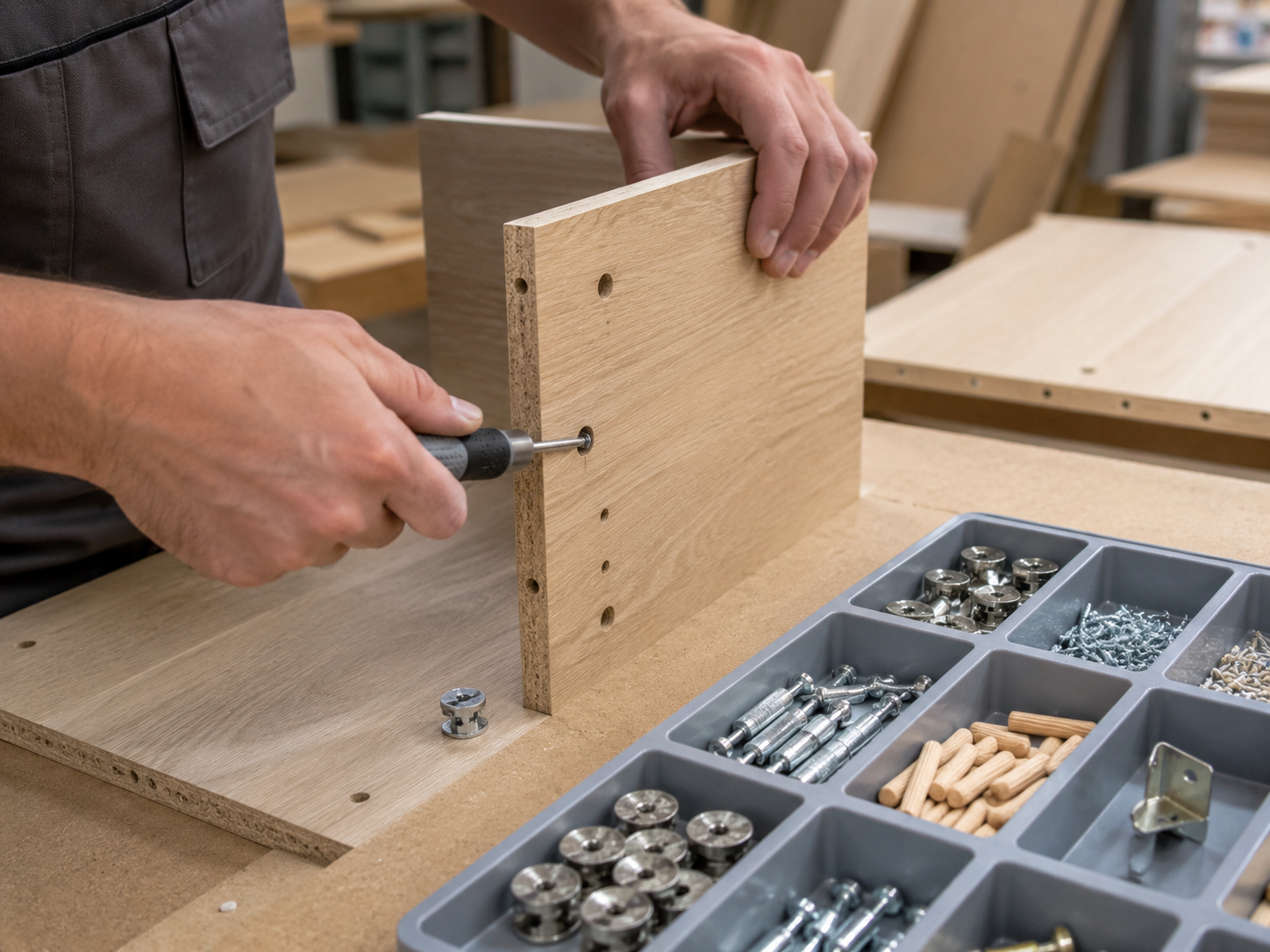
A screw that works in plywood may not hold as well in low-density particleboard. A threaded insert may fit the specified hole but still rotate during tightening. A cam bolt that is only a few millimeters too long can prevent two panels from closing properly.
The kit has to match the cabinet, wardrobe, or shelving structure. The furniture should not be forced to accommodate a generic assortment.
What usually belongs in a furniture hardware kit
The exact contents vary from one furniture model to another, although several components appear frequently in panel furniture.
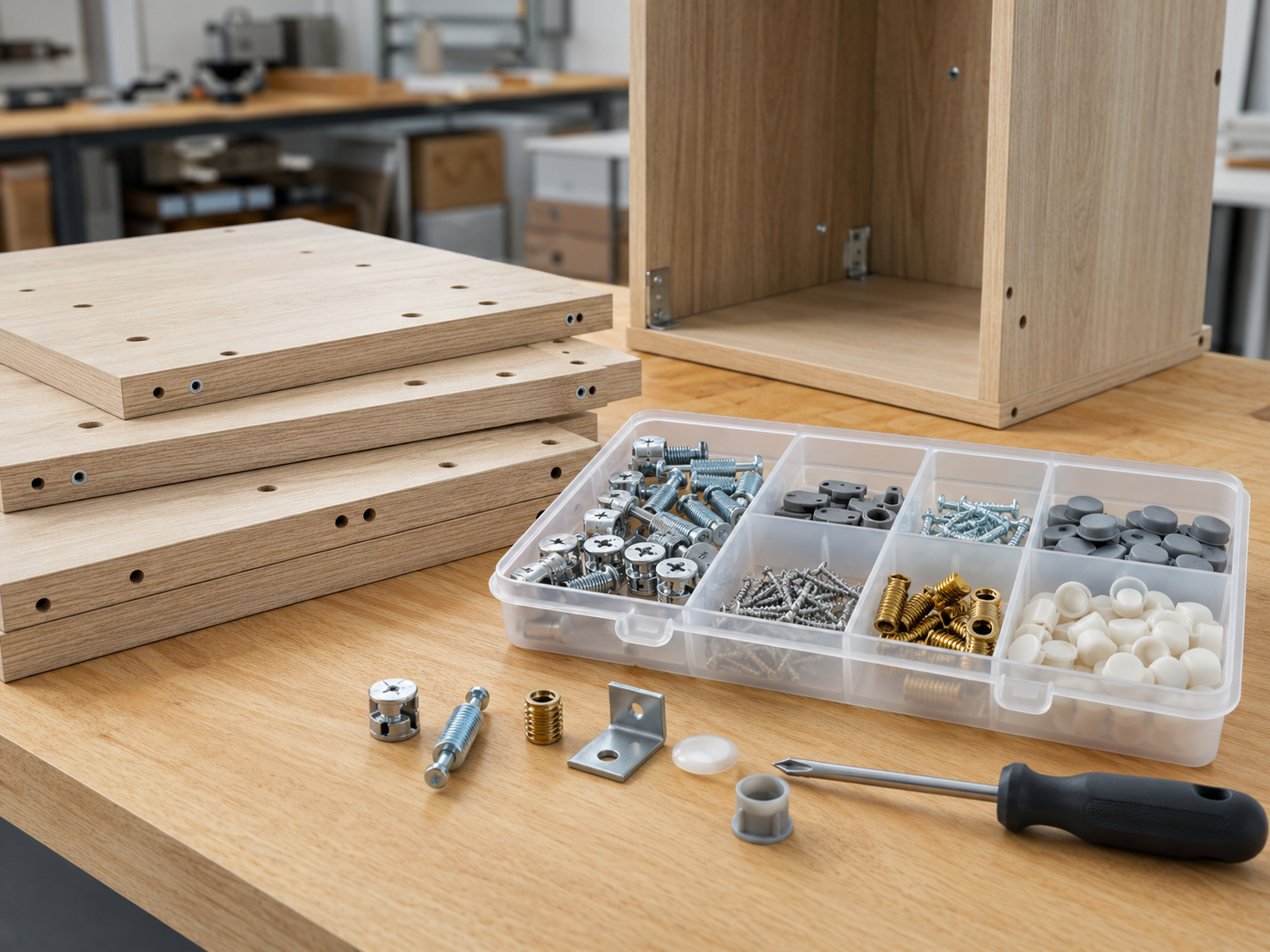
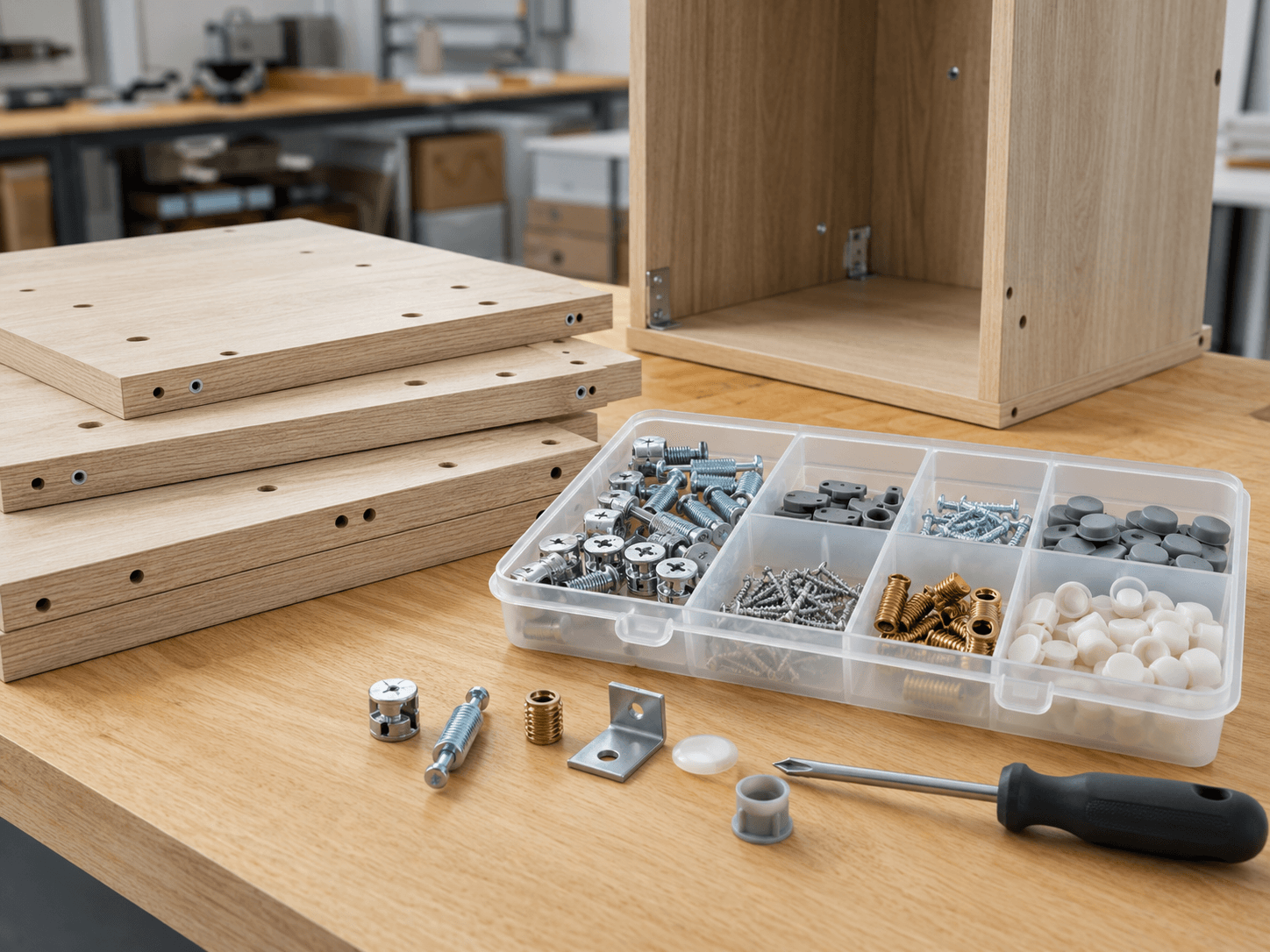
A typical kit may contain:
- Cam fittings and connector bolts
- Machine screws and self-tapping screws
- Threaded inserts
- Wooden dowels
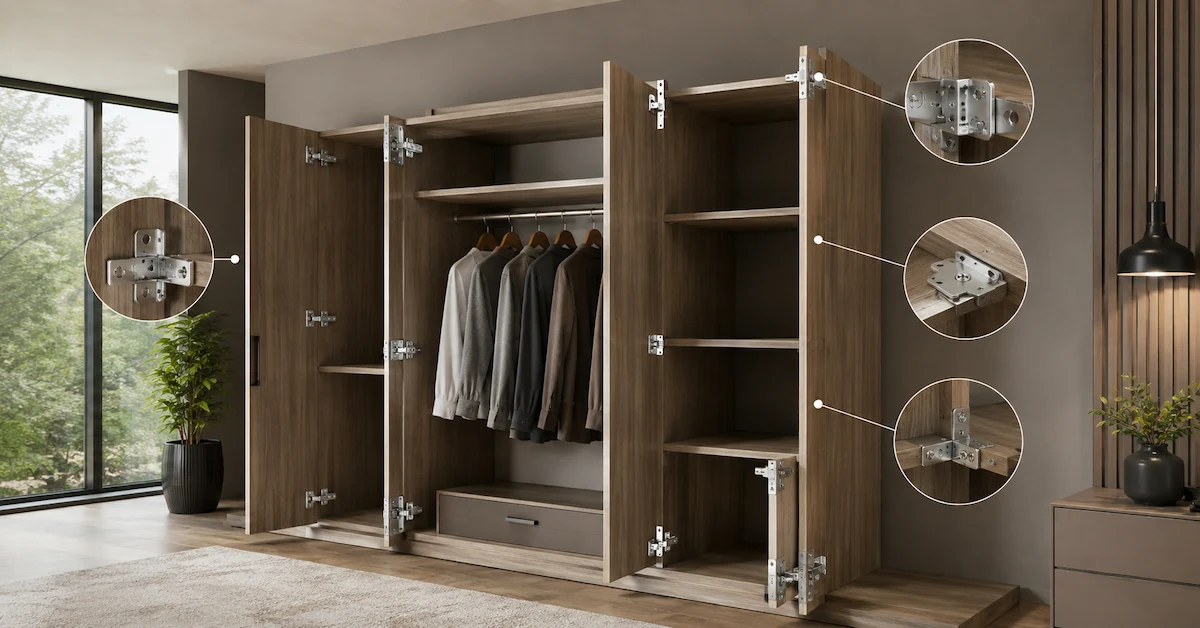
- Metal corner brackets
- Plastic sleeves or anchors
- Washers and spacer components
- Cover caps
- A hex key or simple connector driver
Each part supports a different stage of assembly.
Dowels help position the panels. Cam fittings pull the joint closed. Threaded inserts create a reusable metal thread inside a wood-based board. Brackets reinforce corners or mounting points. Plastic caps cover visible access holes after installation.
The individual components may be inexpensive, but their relationship is critical.
A connector bolt must engage properly with its matching cam. A bracket must align with the pre-drilled holes. A cover cap must fit the opening without falling out. The supplied tool must reach the connector and survive the required tightening force.
A cabinet hardware kit manufacturer should therefore evaluate the complete joint, not simply supply a group of parts with similar dimensions.
Why a complete kit is often better than loose fasteners
Buying each component separately may appear flexible.
The purchasing team can negotiate screws with one supplier, brackets with another, plastic parts with a third, and packaging elsewhere. On paper, this may reduce the price of individual items.
The hidden cost is coordination.
Every supplier has its own drawings, lead times, tolerances, packaging rules, and production schedules. When the complete furniture set is assembled, the buyer becomes responsible for making sure all those parts work together.
A bundled kit can simplify that process.
The supplier follows one approved bill of materials, packs the correct quantities together, and delivers a hardware set linked to a specific furniture model. Incoming inspection becomes easier, warehouse staff handle fewer individual SKUs, and the assembly line receives parts in a more usable format.
This does not mean every bundled kit is automatically better.
The value appears only when the supplier controls the component mix accurately and maintains the same configuration on repeat orders.
Panel material changes how the hardware performs
Wood-based panels may look similar from the outside, but they respond differently to fasteners.
Particleboard is common in flat-pack furniture because it is economical and easy to process. Its internal density can vary, however, which affects screw holding and insert stability.
MDF has a smooth surface and machines cleanly. Near panel edges, concentrated fastening force may still cause cracking or compression.
Plywood generally offers better holding strength, but veneer quality and drilling direction remain important. Solid wood introduces grain direction, moisture movement, and natural variation.
For this reason, buyers should avoid approving hardware only from a metal sample.
The complete connector system needs to be tested in the intended panel.
Useful information to provide the supplier includes:
- Panel type
- Panel thickness
- Hole diameter
- Hole depth
- Edge distance
- Installation direction
- Mating components
- Tightening method
- Expected assembly cycles
This information helps the supplier select or manufacture parts that suit the actual application.
Without it, the quotation may still look precise, but several important details are being guessed.
Custom kits are useful when the product is genuinely different
Custom furniture hardware kits are often necessary in OEM and ODM production.
A furniture brand may use an unusual panel thickness. The available installation space may be restricted. A standard screw may be too long, while a common bracket may place the holes in the wrong position.
Customization can address those problems.
It may involve:
- Changing screw length or thread
- Modifying a connector head
- Producing a project-specific bracket
- Matching a particular surface finish
- Adjusting the quantity mix
- Printing model-specific labels
- Dividing hardware by assembly stage
- Adding branded instructions or tools
The important question is whether the custom feature solves a real production issue.
Non-standard parts create additional work. They require drawings, sample approval, tooling, minimum-order quantities, inventory control, and future replacement planning.
When a standard component performs reliably, it may be the safer long-term choice. Customization makes sense when it reduces assembly problems, improves structural performance, or fits a design that standard hardware cannot support.
A sample kit should be assembled, not admired
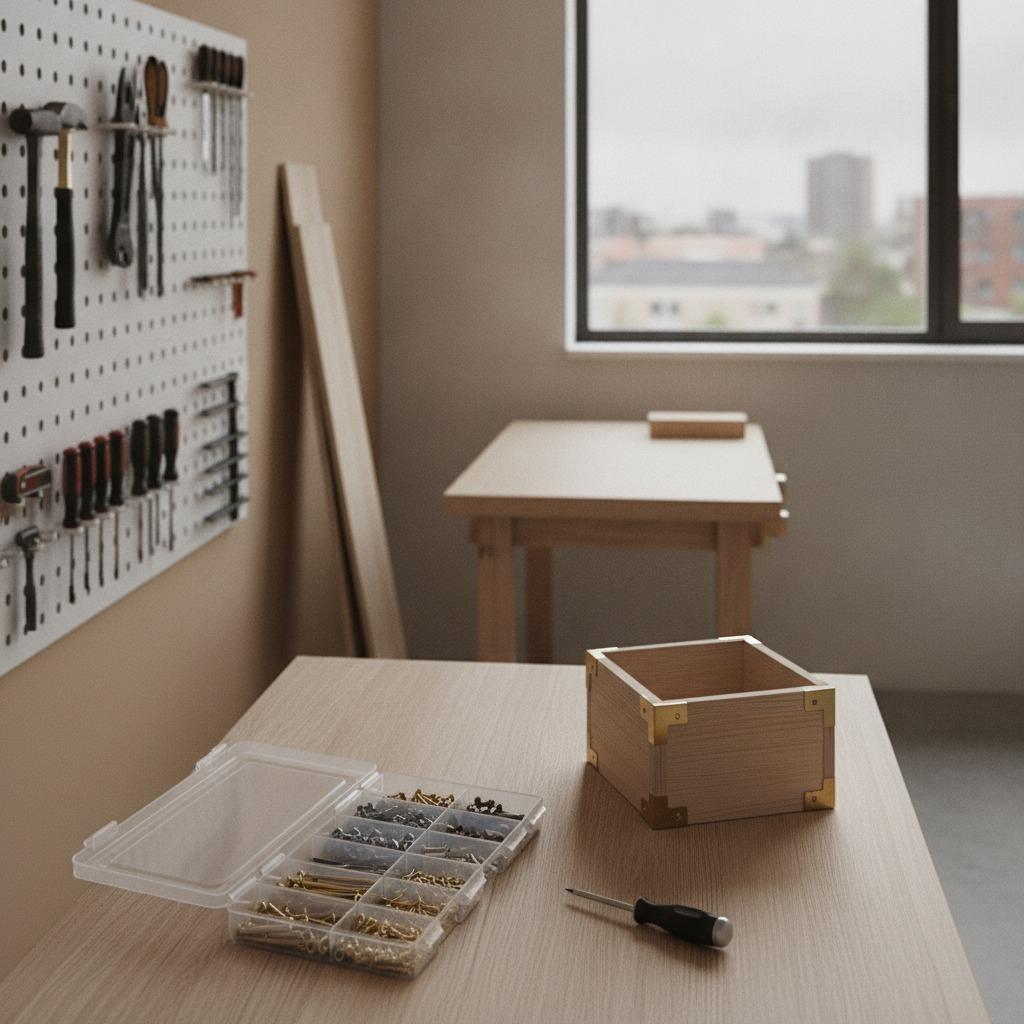
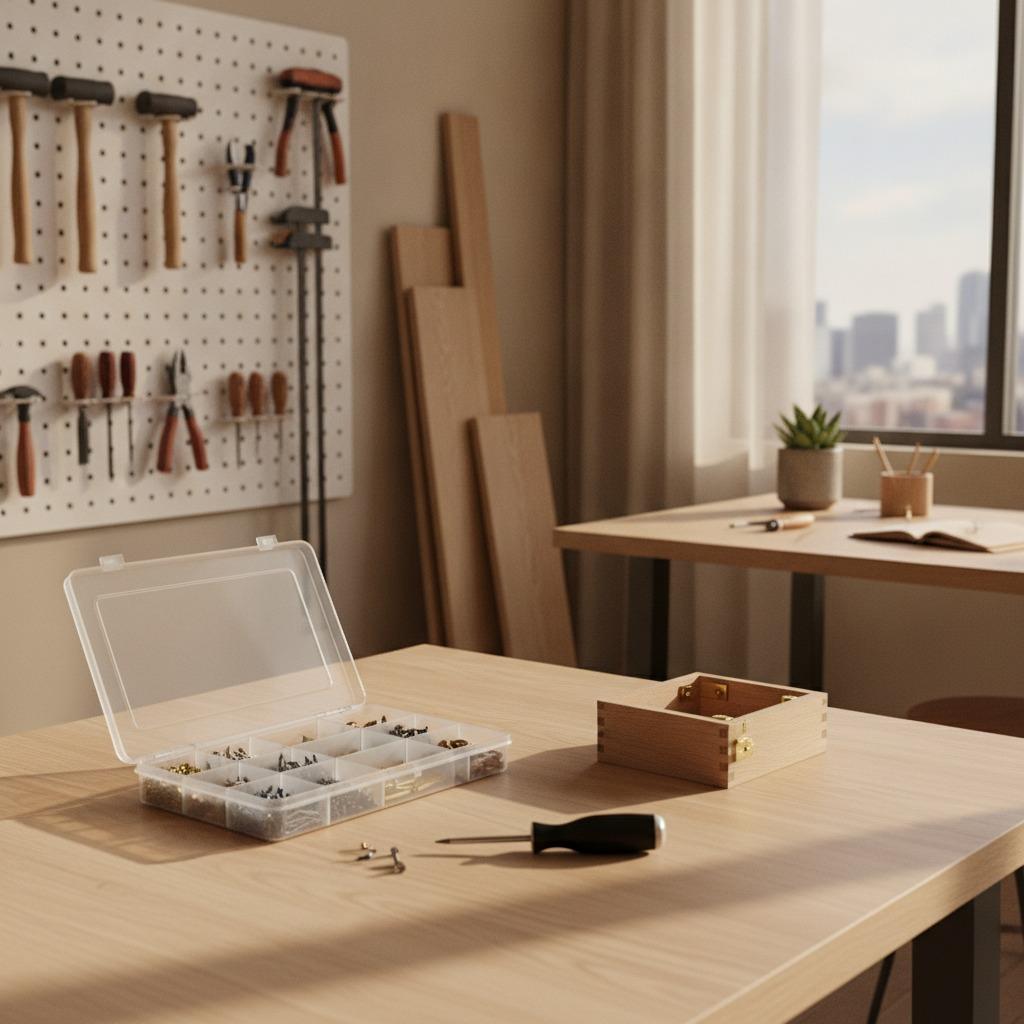
A sample set may look convincing when the parts are arranged neatly on a desk.
The finish is clean. The bags are labeled. The component count is correct. Nothing appears obviously wrong.
That inspection is useful, but incomplete.
The real test begins when the hardware meets the furniture panel.
Use the intended board material, drilling pattern, and installation tools. Assemble several units or joints. Ask regular production workers to perform at least part of the trial.
During the test, observe whether:
- The fasteners enter smoothly
- Tightening force remains consistent
- The panels close without being pushed into place
- The fittings sit at the intended depth
- The tool reaches every connector
- Similar screws are easy to distinguish
- The board remains undamaged
- The joint can be reopened if necessary
One successful assembly does not confirm stable performance.
A technician may unknowingly compensate for a difficult part. Repeating the process several times reveals whether the kit supports normal production or depends on special handling.
For wholesale furniture hardware kits intended for flat-pack products, the trial should also include someone unfamiliar with the design. That person is closer to the real end customer.
The supplied tool can become the weakest part
Flat-pack kits frequently contain a small hex key, screwdriver, or connector handle.
Including a tool makes sense when the customer is expected to assemble the product without additional equipment. However, the tool needs to be treated as a functional component rather than a promotional extra.
A thin hex key may twist. A short screwdriver may not reach a recessed fitting. A plastic handle may crack before the connector is properly tightened.
The tool should be tested with the final joint.
It needs to fit the drive recess accurately, provide enough leverage, and remain usable throughout the complete assembly. When the furniture contains many repeated joints, comfort also matters more than it seems.
For factory assembly, the situation is different. The production line may use electric drivers or controlled torque tools, making a small hand tool unnecessary.
The kit should match the user who will actually open it.
Surface finish must be written into the specification
Furniture fittings often appear silver, black, brass-colored, or chrome-like.
Visual appearance alone does not confirm the material or coating.
A silver component may be zinc plated, nickel plated, or treated with another finish. A brass-colored insert may be made from solid brass, zinc alloy, or coated solid brass, zinc alloy, or steel.
The supplier should confirm the base material and surface treatment in writing.
This becomes particularly important for products used in kitchens, bathrooms, coastal areas, warehouses, or long export routes. Moisture and temperature changes may affect corrosion performance before the furniture even reaches the customer.
Buyers may need to specify:
- Base metal
- Plating or coating type
- Coating thickness
- Corrosion-test requirement
- Color tolerance
- Environmental compliance
- Appearance requirements for visible parts
Not every component needs the same finish. Hidden parts may prioritize function, while visible fittings require better color consistency.
The differences should be controlled rather than accidental.
Kitting accuracy can matter more than component cost
A missing part may cost only a few cents.
The complaint it creates can cost far more.
If one essential connector is absent, the customer cannot finish the furniture. The manufacturer may have to send replacement hardware, answer support messages, or process a return for an otherwise acceptable product.
Incorrect parts create another type of failure.
Two screws may look almost identical but differ in length. When mixed, the longer screw may break through the panel face. The number of screws in the bag is correct, yet the product is damaged during assembly.
This is why buyers should ask how the supplier controls the kit.
Common verification methods include:
- Manual counting
- Automatic counting equipment
- Divided packing trays
- Weight checks
- Camera or vision inspection
- Final visual review
- Combined inspection methods
Weight checking can be useful, but it is not suitable for every kit. One missing lightweight component may be offset by an extra heavier part.
The inspection method should reflect the complexity of the hardware set and the risk of an error.
Packaging should help the next person in the process
The best packaging format depends on where the kit will be used.
A factory assembly line may need one bag for each cabinet model. A retail flat-pack product may use smaller bags identified as Step 1, Step 2, and Step 3. Replacement parts may require individual item numbers and clear photographs.
A wardrobe hardware kit supplier may also need to look similar.
Buyers should confirm:
- Quantity per bag
- Which parts may be mixed
- Which parts must be separated
- Bag thickness
- Sealing method
- Label language
- Furniture model number
- Barcode or QR code
- Assembly-step marking
- Spare-part quantity
- Carton packing arrangement
Sharp brackets and heavy connector bolts may puncture thin plastic during transport. Labels may peel off in humid storage. Small parts may move between compartments if the internal packaging is poorly designed.
Packaging should therefore be tested under realistic handling conditions, not only reviewed as a clean sample on a desk.
How to judge a cabinet hardware kit manufacturer
A supplier that produces excellent screws is not automatically prepared to manage complex furniture kits.
Kitting introduces another layer of control.
The supplier must coordinate several component types, maintain the correct quantities, separate furniture models, follow packaging instructions, and reproduce the same configuration on future orders.
When reviewing a cabinet hardware kit manufacturer or wardrobe hardware kit supplier, ask how it controls:
- Bills of materials
- Drawing revisions
- Material records
- Dimensional inspection
- Surface finishes
- Component sourcing
- Counting and packing
- SKU separation
- Label approval
- Lot traceability
- Repeat orders
- Shortage and replacement handling
Jiangmen Jinhe Hardware Co., Ltd. manufactures machine screws, self-tapping screws, precision screws, standard fasteners, and customized non-standard components. This type of manufacturing background may be useful for furniture programs that combine ordinary fasteners with project-specific hardware.
The buyer should still review the company’s ability to control the complete furniture kit.
Making individual parts and delivering a finished, model-specific kit are related capabilities, but they are not the same process.
Common mistakes buyers can avoid
One familiar mistake is requesting a quotation from a photograph alone.
The photograph may show the component types, but it does not confirm thread pitch, material, coating, dimensions, quantity, or application.
Another mistake is approving each part separately.
A screw may meet its drawing. A connector may pass inspection. A bracket may have the correct angle. Yet the complete cabinet can still fail because the components were never tested together.
Buyers may also underestimate repeat-order risk.
The first sample kit may be packed carefully by hand. Six months later, the production order may use another label, a substitute screw, or a slightly different finish unless the approved configuration is controlled properly.
A sealed reference kit can help.
It gives both buyer and supplier a physical standard for future orders and makes it easier to identify unauthorized substitutions.
Where wholesale furniture hardware kits create the most value
Model-specific kits are especially useful for:
- Flat-pack cabinets
- Wardrobes
- Modular shelving
- Office furniture
- Kitchen and bathroom storage
- DIY furniture
- OEM and ODM programs
- E-commerce furniture
- Spare-parts services
- Export furniture projects
Their value goes beyond quicker purchasing.
A controlled kit reduces line-side sorting, simplifies staff training, improves inventory management, and makes replacement hardware easier to identify.
For end customers, the benefits are equally practical. The correct parts arrive together, the instructions are easier to follow, and assembly is less likely to stop halfway through.
What to approve before placing the bulk order
Before releasing a purchase order, confirm that both parties are using the same approved information.
The final package should include:
- Hardware bill of materials
- Component drawings
- Drawing revisions
- Materials
- Surface finishes
- Quantity of each item
- Approved panel specifications
- Sample test results
- Tool requirements
- Packing arrangement
- Label files
- Barcode information
- Inspection criteria
- Production lead time
- Replacement procedure
A pilot batch is advisable before high-volume production.
It tests more than the connectors. It also tests counting, packing, labels, carton handling, delivery, and the actual assembly process.
That small production trial often exposes issues that never appear in a sample quotation.
Frequently Asked Questions
What is normally included in a furniture hardware kit?
Typical components include cam fittings, connector bolts, screws, threaded inserts, dowels, brackets, plastic sleeves, cover caps, washers, and basic assembly tools. The exact mix should match the furniture model.
Can wholesale furniture hardware kits be customized?
Yes. Components, dimensions, finishes, quantities, labels, instructions, tools, and packaging can all be adjusted for OEM or ODM projects.
Is a product photograph enough for quotation?
A photograph is helpful, but buyers should also provide dimensions, drawings, panel details, required quantities, finishes, and packaging instructions.
How can missing-part complaints be reduced?
Use an approved BOM, suitable counting equipment, separation of similar parts, model-specific labels, final verification, and a defined spare-part policy.
Should the complete kit be tested with the furniture?
Yes. The hardware should be tested using the actual panels, drilled holes, tools, and assembly order. Several joints or units should be assembled before approval.
Are custom components always necessary?
No. Standard parts often provide easier replenishment and lower long-term risk. Custom components are most useful when they solve a specific dimensional, structural, appearance, or installation problem.
A successful hardware kit makes assembly uneventful
Good furniture hardware rarely becomes the most memorable part of the product.
The assembler opens the package, identifies the components, and installs them without stopping. The screws match the inserts. The connectors fit the drilled holes. The panels pull together without being forced.
There are no unexplained leftover pieces and no missing part halfway through the build.
That ordinary, uneventful result is what wholesale furniture hardware kits should deliver.
It requires careful part selection, realistic panel testing, accurate counting, controlled finishes, clear packaging, and a supplier capable of repeating the same configuration order after order.
Jiangmen Jinhe Hardware Co., Ltd. can discuss standard fasteners, non-standard components, cabinet and wardrobe hardware combinations, OEM packaging, and repeat production requirements.
Begin with the furniture drawings, panel information, assembly sequence, bill of materials, and expected volume.