
Why Brass Insert Nut Sourcing Is More Than a Price Comparison
A small threaded insert can determine whether a product assembles smoothly, survives repeated maintenance, or develops an expensive fastening problem after delivery.
Consider a plastic equipment housing secured with machine screws. During initial assembly, the inserts appear to fit correctly. The screws tighten, the housing closes, and the finished unit passes visual inspection.
Several weeks later, technicians discover that some inserts rotate inside their plastic bosses when the covers are removed for servicing. Other inserts pull out when screws are tightened. The problem is no longer limited to inexpensive metal components. It affects finished products, assembly labor, replacement parts, and customer confidence.
This is why choosing a brass insert nut supplier requires a complete understanding of the fastening system.
For OEM buyers, purchasing managers, and product engineers, the important questions are not simply:
-
What is the price per 1,000 pieces?
-
Is the insert available in M3, M4, or M6?
-
Can the supplier produce a brass-colored component?
The more valuable questions concern the actual application.
What brass alloy is specified? How will the insert be installed? What plastic, wood, or other host material surrounds it? How much torque must the joint resist? What happens when the machine screw is repeatedly removed? Can the approved product be supplied consistently across future production orders?
A supplier that understands these requirements can contribute more value than one offering only a low quotation.
This guide explains how to select brass threaded inserts, compare installation methods, evaluate material and dimensional requirements, establish meaningful quality tests, and prepare a complete OEM purchasing specification.
It also explains where a brass insert is not the correct solution.
For buyers who need custom insert geometry or related fasteners, JHFIX offers a broader nut and threaded insert product range, with drawing-based and sample-based evaluation of suitable materials, mating components, installation conditions, and packaging requirements.
Specific brass alloy options, manufacturing feasibility, and commercial terms should be confirmed for each project.
Quick Answer: What Makes a Reliable Brass Insert Nut Supplier?
A reliable supplier should be able to provide or coordinate a threaded insert that meets the buyer's approved drawing, material requirements, installation process, functional performance, and commercial specifications.
The main evaluation criteria are:
-
Material traceability: The brass alloy must be clearly identified rather than inferred from its color.
-
Thread accuracy: Internal threads must match the specified bolt diameter, pitch, tolerance, and engagement.
-
External geometry: Knurls, grooves, shoulders, and flanges must suit the selected installation process.
-
Application compatibility: The insert should be evaluated with the intended plastic, wood, or other host material.
-
Installation repeatability: The approved process should produce consistent seating without damaging the surrounding material.
-
Mechanical validation: Pull-out, torque-out, and other required tests should use agreed methods and acceptance criteria.
-
OEM capability: Drawings, samples, tolerances, and special features should be reviewed before production.
-
Quality documentation: Inspection requirements and material records should match the actual purchase specification.
-
Packaging control: Thread sizes, lengths, and similar-looking variants must remain correctly identified.
-
Commercial reliability: MOQ, tooling, sampling, production lead time, and repeat-order conditions should be confirmed in writing.
The best purchasing decision is based on the approved assembly, not simply on the appearance or unit cost of the insert.
What Is a Brass Insert Nut?
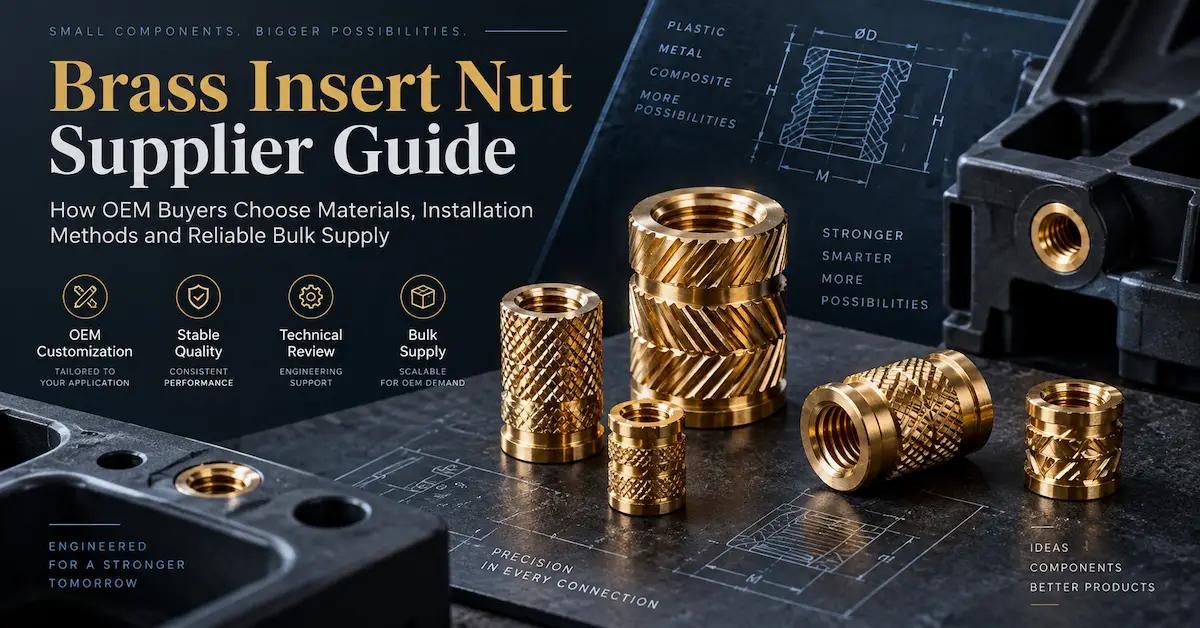
A brass insert nut, also called a brass threaded insert, is a metal component designed to provide an internal machine thread within a compatible host material.
Most designs consist of a cylindrical or specially shaped brass body with an internal thread.
The outside of the component may include:
-
Straight knurls
-
Diamond knurls
-
Helical knurls
-
Grooves
-
Undercuts
-
External threads
-
Barbs
-
Flanges
-
Shoulders
-
Installation pilots
These external features help the insert engage the surrounding material.
After installation, a machine screw or bolt can be threaded into the insert to secure another component.
The result is a fastening arrangement with two distinct interfaces.
Internal interface: The machine screw engages the brass thread.
External interface: The brass insert is retained by the surrounding plastic, wood, or another suitable material.
Both interfaces must function correctly.
An insert with excellent internal thread quality may still fail if it rotates in the host material. Conversely, an insert with strong external retention may be unsuitable if its internal thread does not match the required fastener.
Why Brass Is Used for Threaded Inserts
Brass is widely used because selected brass alloys offer a useful combination of machinability, corrosion resistance, and suitability for precision threaded components.
Brass also conducts heat effectively, which can make it appropriate for some heat-installed insert designs.
However, brass is not a single material grade.
Different brass alloys can have different mechanical properties, compositions, processing characteristics, and regulatory considerations.
Buyers should specify the actual alloy where material selection affects the application.
The final performance depends on the combination of material, geometry, installation, and host material—not brass alone.
Main Types of Brass Threaded Inserts
Brass insert nuts are manufactured in different configurations because the installation method and host material can vary substantially.
A design intended for thermal insertion into molded ABS should not automatically be used as a press-in fitting for hardwood.
The following comparison provides a useful starting point.
| Insert Type | Installation Principle | Typical Host Material | Main Purchasing Concern |
|---|---|---|---|
| Heat-set brass insert | Controlled heat softens compatible thermoplastic around the insert | Thermoplastics | Heat process, hole design, knurl engagement |
| Ultrasonic insert | Ultrasonic energy produces localized heating and plastic flow | Suitable thermoplastics | Installation equipment and process control |
| Press-in brass insert | Mechanical insertion creates retention through interference or exterior features | Compatible plastics or selected substrates | Hole fit, insertion force, retention |
| Molded-in brass insert | Insert is positioned in a mold before material is formed around it | Injection-molded plastics and suitable molding systems | Mold positioning, sealing, orientation |
| Self-tapping brass insert | External thread cuts or forms engagement during installation | Suitable plastic or other specified host | Hole geometry and installation torque |
| Brass insert for wood | External profile engages a prepared wooden or engineered panel | Selected wood and furniture panels | Panel density, hole fit, pull-out and torque |
These are distinct engineering approaches.
They should be compared using the requirements of the finished product.
Heat-Set Brass Inserts for Thermoplastic Components
Heat-set brass threaded inserts are frequently used when plastic components require reusable machine threads.
The installation process uses controlled heating to soften a localized area of thermoplastic around the insert.
The insert is then positioned in the prepared hole.
As the material flows around the insert's external retention features and subsequently cools, it forms a mechanical connection between the metal insert and the plastic.
The strength of this connection depends on the actual geometry, resin, process conditions, and quality of installation.
Where Heat-Set Inserts Are Commonly Considered
Typical applications include:
-
Electronic equipment housings
-
Plastic control enclosures
-
Consumer product assemblies
-
Appliance components
-
Plastic mounting bosses
-
Serviceable covers
-
Selected automotive interior components
-
Thermoplastic furniture accessories
These applications often require a machine-thread connection that can be opened and reassembled during service.
What Buyers Should Check
A professional heat-set insert specification should cover:
-
Plastic resin grade
-
Filler content
-
Boss geometry
-
Pilot-hole diameter
-
Hole depth
-
Insert outside diameter
-
Knurl pattern
-
Insert length
-
Installation equipment
-
Temperature-control method
-
Installation pressure or force
-
Insertion speed
-
Seating depth
-
Cooling procedure
There is no universally correct heating temperature for every brass insert.
The correct process window depends primarily on the host thermoplastic and the complete installation arrangement.
The resin manufacturer and insert design requirements should guide process development.
Heat-Set Installation Risks
Common problems include:
-
Insufficient plastic flow around knurls
-
Excessive flash
-
Deformed bosses
-
Tilted inserts
-
Incomplete seating
-
Reduced rotational retention
-
Poor pull-out performance
-
Damaged internal threads
A trial installation should confirm that softened plastic sufficiently fills the intended retention features without creating unacceptable damage.
Important: Heat-set installation is generally intended for compatible thermoplastics. Conventional thermoset materials do not soften and flow again in the same way.
A buyer working with thermoset materials should evaluate an alternative insertion strategy.
Ultrasonic Brass Inserts: When Is This Method Suitable?
Ultrasonic insertion uses high-frequency mechanical vibration to generate localized heating at the interface between the insert and compatible plastic.
This can allow plastic material to flow around the exterior features of the insert.
After the process, the material solidifies and retains the component.
Ultrasonic insertion may be appropriate for production lines already equipped with suitable ultrasonic assembly systems.
However, it requires careful process control.
Important variables include:
-
Amplitude
-
Applied force
-
Insertion speed
-
Horn alignment
-
Installation time
-
Tool condition
-
Plastic material
-
Insert geometry
-
Hole preparation
Heat-Set vs Ultrasonic Installation
Neither process should be considered universally superior.
Heat installation can be easier to evaluate for some geometries and production conditions.
Ultrasonic insertion may offer advantages in other automated manufacturing environments.
The better process is the one that can repeatedly produce the required installed performance without unacceptable damage or variation.
During approval, buyers should compare both methods using the same insert design, host material, hole condition, and acceptance criteria where technically appropriate.
Press-In Brass Inserts: Fast Installation Requires Correct Hole Design
Press-in inserts rely on mechanical engagement with the host material.
Unlike heat-set designs, they do not necessarily require thermal processing.
Depending on the insert design, external ribs, knurls, or other retention features engage the material during insertion.
This can provide a comparatively straightforward installation method.
However, a simple-looking process can still create significant engineering problems.
What Happens if the Pilot Hole Is Too Small?
An undersized hole may produce excessive insertion force.
Possible consequences include:
-
Boss cracking
-
Plastic deformation
-
Surface stress
-
Insert misalignment
-
Incomplete seating
What Happens if the Pilot Hole Is Too Large?
An oversized hole may reduce retention.
Possible outcomes include:
-
Insert rotation
-
Unstable seating
-
Reduced pull-out resistance
-
Variation between assemblies
When Press-In Inserts May Not Be Appropriate
A press-in design may not be the best choice when the available boss geometry cannot tolerate the required insertion stress or when the joint's functional load exceeds its validated retention.
For an OEM buyer, installation convenience should not replace mechanical verification.
Molded-In Brass Inserts for Injection-Molded Parts
Molded-in inserts are placed into a mold before plastic is introduced.
During molding, the material forms around the insert's exterior geometry.
This method can be useful when an application requires substantial mechanical engagement and the product design can support insert placement during molding.
However, molded-in installation introduces additional production considerations.
Critical Requirements
Buyers should evaluate:
-
Insert positioning
-
Orientation
-
Mold retention
-
Internal thread protection
-
Material flow
-
Flash prevention
-
Dimensional stability
-
Cooling behavior
-
Handling during molding
-
Finished-part inspection
A threaded insert that moves during molding may produce a component that cannot be assembled correctly.
An insert that allows plastic to enter the internal bore can also create thread-quality problems.
Molded-In vs Post-Mold Installation
Molded-in and post-mold installation should be compared using the entire manufacturing process.
Molded-in installation may provide strong mechanical engagement in suitable designs, but it requires the insert to be correctly positioned and retained inside the molding process.
Post-mold installation introduces an additional assembly operation but may offer different manufacturing flexibility.
The correct decision depends on volume, tooling, component design, installation equipment, and required performance.
Brass Inserts for Wood and Furniture Applications
Although brass threaded inserts are strongly associated with plastic components, some designs can also be used in wooden or engineered-panel applications.
The important distinction is the external engagement method.
A heat-set insert intended for thermoplastic should not automatically be specified for MDF or particleboard.
Similarly, an externally threaded furniture insert should not automatically be used in a plastic housing.
Solid Wood Furniture
Brass inserts may be considered for certain removable furniture connections.
Potential applications include:
-
Table-leg mounting
-
Detachable furniture frames
-
Accessory mounting
-
Serviceable wooden assemblies
-
Specialty furniture fittings
The wood species, grain direction, hole preparation, installation process, and required joint performance should be evaluated.
MDF and Particleboard
Engineered furniture panels can behave differently from solid wood.
A supplier should not assume that an insert validated in one panel will perform identically in another.
Relevant conditions include:
-
Panel density
-
Thickness
-
Surface condition
-
Pilot-hole geometry
-
Distance from edges
-
Installation direction
-
Joint load
-
Number of anticipated assembly cycles
Why Insert Geometry Matters
Wood and engineered-board inserts may use an external thread or other engagement profile designed specifically for the substrate.
JHFIX currently displays products including Hex-Drive Threaded Wood Insert Nuts and related furniture threaded inserts.
These pages demonstrate the company's insert-nut product category and drawing-based specification review.
They should not be interpreted as confirmation that the photographed parts are solid brass.
If the project requires a particular brass alloy, that requirement must be reviewed and confirmed separately.
Brass Insert Nuts vs Steel and Stainless Steel Inserts
Material selection is a common buyer decision.
Brass, carbon steel, and stainless steel can all be appropriate for certain threaded insert applications.
However, their properties and manufacturing requirements differ.
| Material | Potential Advantages | Main Considerations |
|---|---|---|
| Brass | Machinability, thermal conductivity, corrosion resistance in suitable environments | Alloy composition, mechanical strength, material cost |
| Carbon steel | Potentially suitable for higher-strength designs | Corrosion protection and manufacturing route |
| Stainless steel | Corrosion resistance with appropriate grade selection | Machinability, processing cost and grade selection |
| Zinc alloy | Suitable for some molded or formed hardware designs | Alloy properties, geometry and application limits |
The comparison should be made using the exact material grade and finished component.
A stronger base metal does not necessarily produce a stronger installed insert if the surrounding plastic or wood is the limiting factor.
When Brass May Be Preferred
Brass may be attractive when:
-
Precision machining is required
-
A thermally installed design is suitable
-
The application benefits from brass's material characteristics
-
Corrosion resistance is important
-
The approved design uses an established brass insert configuration
When Another Material May Be Better
Other materials may deserve consideration when:
-
Mechanical strength is the dominant requirement
-
The service environment creates compatibility concerns
-
Brass is unnecessarily expensive for the application
-
The manufacturing process favors another alloy
-
Regulatory or material-composition requirements cannot be met by the proposed brass grade
Material choice should follow an engineering review rather than a preference for a particular metal color.
Brass Material Grades: What Should OEM Buyers Specify?
One of the most important sourcing mistakes is requesting simply:
"Brass insert nut, M4."
This description does not define a complete material requirement.
Brass alloys differ in composition and processing characteristics.
For example, free-machining brass grades are often considered for precision-turned components.
Lead content and other alloying elements can influence machining behavior and compliance requirements.
Material Information to Include in an RFQ
Specify:
-
Required brass alloy designation
-
Applicable material standard
-
Acceptable chemical composition
-
Required material condition, where relevant
-
Restricted-substance requirements
-
Traceability documentation
-
Any approved alternative alloys
Where the buyer has no predetermined alloy, the supplier may be asked to recommend suitable options for engineering review.
However, substitutions should not be introduced without approval.
Why Brass Color Is Not Enough
A yellow or gold-colored threaded insert is not necessarily made from solid brass.
It could be another metal with a decorative or protective surface treatment.
Similarly, different brass alloys can appear visually similar.
For OEM purchasing, base material and surface finish must be identified separately.
If a purchasing specification requires solid brass, a brass-colored coating is not an equivalent substitute.
Lead Content, RoHS and REACH: Important Compliance Questions
Compliance is particularly important for buyers selling electronic assemblies, consumer products, or products intended for regulated markets.
Some machinable brass alloys contain intentional lead additions.
This creates an important distinction between material suitability and regulatory acceptability.
A buyer should not assume that all brass alloys are lead-free.
RoHS Considerations
For electrical and electronic equipment placed on relevant markets, the applicable RoHS requirements must be evaluated.
Certain exemptions can apply to specified uses of lead in copper alloys, subject to detailed conditions and validity periods.
These exemptions should not be treated as permanent or universally applicable.
Buyers should verify:
-
Product category
-
Destination market
-
Current legal requirements
-
Material composition
-
Applicable exemption, if any
-
Supporting supplier documentation
REACH Considerations
European market requirements may also create obligations relating to substances in articles and supply-chain communication.
The buyer should define the required declarations and supporting information for the actual product and market.
Children's Products and Special Applications
Products intended for children or other restricted applications may have additional requirements.
A component suitable for industrial equipment should not automatically be treated as acceptable for a children's consumer product.
What to Request From a Supplier
Depending on the project:
-
Material composition declaration
-
Alloy certificate
-
Relevant restricted-substance declaration
-
Test report, if required
-
Traceability information
-
Approved material substitution procedure
Avoid accepting a generic statement such as "environmentally friendly brass" in place of specific documentation.
Thread Size, Pitch and Tolerance: Small Differences Matter
A brass insert provides a machine-thread interface.
Therefore, internal thread quality is essential.
Common metric thread designations include:
-
M2
-
M2.5
-
M3
-
M4
-
M5
-
M6
-
M8
These examples describe commonly encountered metric thread sizes in the industry.
They are not a statement that every listed size is available from JHFIX in every material and insert design.
Thread Diameter
The nominal diameter must match the mating fastener.
Thread Pitch
Thread pitch must also match.
Two components with the same nominal diameter but different thread pitches should not be assumed compatible.
Thread Tolerance
The required internal thread tolerance should be defined according to the design and applicable standard.
For ISO general-purpose metric threads, ISO 965-1:2026 establishes principles and basic data for thread tolerances.
The appropriate internal thread class and inspection method should be confirmed on the drawing.
Thread Depth
The insert must provide adequate usable engagement for the mating screw.
An insert with the correct overall length may still have insufficient usable thread depth for a particular assembly.
Blind vs Through-Hole Threads
A blind-ended insert requires attention to available screw engagement and bottoming clearance.
A through-hole insert creates different considerations, including possible screw projection and surrounding clearance.
The joint drawing should clearly identify the required arrangement.
External Knurl Design: Why Geometry Affects Retention
The outside of a brass insert is as important as its internal thread.
Knurls and related retention features influence how the insert interacts with the host material.
Straight Knurls
Straight knurls are commonly associated with resistance to rotation.
Their performance depends on the complete insert and installation design.
Helical Knurls
Helical features can influence both rotational and axial retention.
The orientation and geometry should be evaluated for the actual loading and installation arrangement.
Diamond Knurls
Diamond patterns create intersecting surface features.
They may be useful for certain designs, but they are not automatically the best solution for every installation method.
Grooves and Undercuts
Grooves can provide areas into which compatible plastic material flows during heat or ultrasonic installation.
When the material solidifies, these features contribute to mechanical retention.
Knurl Height and Spacing
Changing knurl dimensions can affect:
-
Installation force
-
Plastic displacement
-
Local stress
-
Rotational resistance
-
Pull-out behavior
Increasing the aggressiveness of a knurl does not guarantee a better joint.
The surrounding material must be able to accommodate the selected geometry.
Pull-Out Strength vs Torque Resistance
Two of the most important functional requirements are pull-out strength and torque resistance.
They describe different failure mechanisms.
Pull-Out Strength
Pull-out testing evaluates resistance to axial extraction under a specified test arrangement.
The result depends on:
-
Insert design
-
Installed depth
-
Host material
-
Hole geometry
-
Installation conditions
-
Loading direction
-
Test method
Torque Resistance
Torque-out testing evaluates resistance to unintended rotation.
An insert may have acceptable pull-out strength yet rotate when a machine screw is tightened.
This is particularly important for products requiring repeated assembly.
Why Both Tests Matter
A plastic housing may experience axial loads during use and rotational loads during maintenance.
If only pull-out resistance is tested, the buyer may overlook rotational failure.
If only torque-out resistance is tested, the buyer may overlook extraction risk.
The correct test plan should reflect the finished product's actual load cases.
Do Not Compare Unrelated Test Results
A supplier might advertise a particular pull-out force for a brass insert.
That value cannot be compared meaningfully with another supplier's result unless the test conditions are equivalent.
A useful report should identify:
-
Insert drawing and material
-
Host resin or substrate
-
Test specimen geometry
-
Hole dimensions
-
Installation process
-
Conditioning
-
Load direction
-
Test equipment
-
Test method
-
Individual results
-
Acceptance criteria
Without those details, a numerical claim provides limited engineering value.
Why Brass Inserts Fail in Plastic Components
Common installation and service failures can be traced to several mechanisms.
1. Insert Rotation
The insert turns inside the plastic boss when the bolt is tightened.
Potential causes include unsuitable knurl engagement, oversized holes, inadequate material flow, or incorrect installation.
2. Insert Pull-Out
The insert is extracted from the surrounding material.
Possible causes include inadequate installed retention, unsuitable geometry, insufficient engagement, or unexpected loading.
3. Boss Cracking
Cracking may occur because of excessive insertion stress, insufficient wall thickness, local molding defects, or installation misalignment.
4. Plastic Flash
Excessive heating or material displacement may create unwanted flash around the insert.
5. Incorrect Seating
An insert that sits too high or too deep can interfere with the mating component.
6. Internal Thread Damage
The machine screw may damage the thread if the pitch, tolerance, alignment, or tightening conditions are incorrect.
7. Jack-Out
Jack-out can occur when the assembly screw bottoms out or the joint geometry directs an undesirable force against the installed insert.
8. Batch-to-Batch Variation
Different resin grades, insert dimensions, hole conditions, or installation settings can create performance variation.
Failure Analysis Table
| Symptom | Possible Cause | Recommended Investigation |
|---|---|---|
| Insert rotates during tightening | Inadequate rotational retention | Inspect knurls, hole size and process |
| Insert pulls out | Poor axial engagement | Review material, geometry and loading |
| Plastic boss cracks | Excessive stress or insufficient wall | Check boss geometry and insertion method |
| Insert tilts | Alignment or tooling issue | Check installation setup |
| Surface flash appears | Excessive plastic displacement | Review heat, force and hole geometry |
| Screw does not start | Thread damage or mismatch | Verify thread and mating bolt |
| Screw bottoms out | Incorrect engagement or hole depth | Review joint stack and blind-hole clearance |
| Different batches perform differently | Process or material variation | Compare controlled samples and records |
A good corrective-action process identifies the actual failure mechanism before changing the insert design.
How to Design Plastic Bosses for Brass Threaded Inserts
A brass insert must be supported by sufficient host material.
A plastic boss is not simply a hole in a molded component.
Its geometry influences the installed joint.
Boss Outside Diameter
The boss needs sufficient surrounding material to support insertion and service loads.
An excessively thin wall may deform or crack.
The appropriate outside diameter depends on the insert, resin, process, and loading.
Pilot-Hole Diameter
The recommended hole size should be obtained from the approved insert geometry and qualified in the actual plastic.
Hole Depth
A blind hole must provide sufficient space for the insert and any displaced material.
The assembly screw should not bottom out in a way that damages the insert or surrounding boss.
Draft and Entry Geometry
Molded holes may contain draft or entry features.
These should be coordinated with the insert's approved installation requirements.
Molding Quality
Local material conditions can affect retention.
Examples include:
-
Weld or knit lines
-
Voids
-
Inconsistent wall thickness
-
Filler distribution
-
Local shrinkage
-
Poor dimensional repeatability
A well-manufactured insert cannot fully compensate for a defective molded boss.
Test the Actual Molding
Prototype blocks can be useful during development, but final approval should reflect the production component and material.
Which Industries Commonly Source Brass Insert Nuts?
Brass threaded inserts are used across several manufacturing sectors.
Their importance often lies in enabling a serviceable threaded connection in a host material that would not otherwise provide the desired machine-thread performance.
Electronics and Electrical Enclosures
Potential applications include:
-
Equipment housings
-
Controller cases
-
Service panels
-
Mounting bosses
-
Communication devices
The insert may need to support repeated maintenance and accurate screw alignment.
Automotive Interior Components
Selected plastic interior components may use threaded inserts.
Purchasing requirements can include material traceability, vibration considerations, assembly repeatability, and defined quality documentation.
Automotive use does not automatically establish qualification to an automotive quality-management standard.
Consumer Appliances
Plastic housings, handles, mounting structures, and serviceable components may require machine-thread connections.
The buyer should evaluate installation repeatability, operating conditions, and disassembly requirements.
Industrial Equipment
Instrument enclosures, control panels, mounting covers, and selected non-metal structural parts may use threaded inserts.
For these applications, the component should be specified according to the actual mechanical and environmental requirements.
Furniture and Cabinet Components
Brass inserts may be appropriate for selected plastic furniture accessories or wooden furniture joints when the insert design is suited to the host material.
For broader furniture applications, JHFIX also offers furniture hardware and connector products.
3D-Printed Components
Heat-set inserts are frequently considered for suitable thermoplastic printed parts.
However, printed components introduce variables such as:
-
Printing orientation
-
Wall count
-
Internal structure
-
Material
-
Print temperature
-
Local density
-
Hole quality
A design validated in an injection-molded plastic part should not automatically be approved for a printed component.
When Brass Insert Nuts Are Not the Best Choice
A credible supplier should be willing to identify applications where another fastening method may be more suitable.
Very Thin Plastic Walls
If there is insufficient material around the hole, the boss may be unable to support the required insert.
Unsupported Thermoset Heat Installation
A conventional heat-set method may be unsuitable for a thermoset host material.
Extremely High Mechanical Loads
The joint may require another insert design, another metal, a through-bolt, or a larger structural connection.
Applications With Unresolved Corrosion Requirements
If the service environment involves chemical exposure or unusual corrosion risks, the selected brass alloy should be evaluated carefully.
Severe Cost Constraints With Limited Service Requirements
Where a product is assembled only once and does not require a reusable thread, another fastening method may be commercially appropriate.
Products With Strict Material Restrictions
Some brass alloys may not meet the buyer's material-composition requirements.
In these situations, evaluate alternative alloys or fastening concepts instead of assuming brass is always suitable.
How Brass Insert Nuts Are Manufactured
The manufacturing route depends on the component design and production requirements.
Precision brass inserts are commonly associated with machining processes, but the complete process may involve several operations.
Material Preparation
The specified brass stock is selected according to the approved material requirement.
Turning and External Profiling
The insert body is formed to the required outside geometry.
Drilling and Internal Threading
The internal bore and machine thread are produced according to the drawing.
Knurling or External Feature Manufacturing
The required retention features are formed using suitable processes.
Deburring
Burr control is important because loose metal particles or sharp edges can interfere with assembly.
Cleaning and Surface Treatment
Components may require cleaning or other specified treatment.
Inspection
Critical dimensions, thread features, and surface condition are evaluated.
Packaging
Finished components are identified and packed according to the order.
Not every design uses the same process sequence.
For OEM quotations, the manufacturing route should be reviewed against the specified brass grade, geometry, tolerance, order quantity, and acceptance requirements.
What Quality Control Should a Brass Insert Nut Supplier Provide?
Quality control should focus on characteristics that influence the installed joint.
Material Inspection
Confirm the required brass grade and material documentation.
Dimensional Inspection
Measure critical features such as:
-
Overall length
-
Body outside diameter
-
Pilot geometry
-
Flange diameter
-
Knurl-band dimensions
-
Groove dimensions
-
Concentricity
-
Thread depth
-
Entry chamfer
Thread Inspection
Verify internal thread geometry and the agreed tolerance.
Use suitable thread gauges or other inspection methods according to the purchase specification.
Knurl Inspection
Check pattern, geometry, damage, and consistency where these features influence retention.
Surface Inspection
Look for:
-
Burrs
-
Damage
-
Contamination
-
Visible defects
-
Unacceptable surface variation
Functional Installation Trial
Use representative host material and installation conditions.
Confirm seating, alignment, thread usability, and required performance.
Packaging Inspection
Check product identification, quantity, finish, protection, and carton labeling.
What Documentation Is Worth Requesting?
Depending on project criticality, a buyer may request:
-
Approved drawing
-
Material record
-
First article inspection report
-
Dimensional inspection results
-
Thread verification
-
Functional test report
-
Surface inspection criteria
-
Packing audit
-
Batch identification
The purpose is to obtain the records needed for the project, not to collect documents that will never be used.
Sample Approval: How to Qualify a New Brass Insert
Before placing a large order, establish a controlled sample approval process.
First: Confirm the Drawing
Freeze the intended geometry, material, internal thread, and surface requirements.
Second: Confirm the Host Material
Identify the production plastic resin, wood, or other substrate.
Third: Confirm the Hole
Agree on hole diameter, depth, and related dimensions.
Fourth: Confirm the Installation Method
Document the equipment and process requirements.
Fifth: Install Representative Samples
Use the actual component or production-equivalent test specimens.
Sixth: Perform Functional Testing
Evaluate the agreed load cases and performance criteria.
Seventh: Inspect the Installed Condition
Where appropriate, cross-sectioned samples can help assess material flow and retention-feature engagement in thermoplastic assemblies.
Eighth: Approve the Golden Sample
Retain a controlled reference for future production.
A golden sample should be associated with:
-
Drawing revision
-
Material specification
-
Insert configuration
-
Test conditions
-
Packaging requirements
-
Approved item code
This prevents repeat orders from depending on incomplete descriptions or old photographs.
How to Compare Brass Insert Nut Suppliers
A supplier comparison should measure the ability to meet the same technical and commercial requirements.
| Evaluation Factor | What to Verify |
|---|---|
| Product specialization | Relevant insert types and application experience |
| Material control | Confirmed brass alloy and traceability |
| Thread capability | Required diameter, pitch, depth and tolerance |
| Customization | Drawing and sample review |
| Manufacturing | Suitable process for the proposed geometry |
| Inspection | Controlled critical dimensions and thread fit |
| Functional testing | Installation, torque-out and pull-out evaluation |
| Compliance | Applicable material and restricted-substance records |
| Sampling | Clear approval and revision process |
| Packaging | Bulk, counted and private-label options |
| Commercial terms | MOQ, tooling, price and lead time |
| Repeat supply | Approved specification and change control |
Avoid allowing a supplier's catalog size range to substitute for confirmation of the actual order.
An M4 heat-set insert and an M4 externally threaded wood insert may have similar internal thread designations but completely different installation requirements.
Brass Insert Nut Pricing: What Influences the Cost?
The unit price of brass inserts depends on several factors.
Brass Alloy
Different material grades can influence raw material and manufacturing costs.
Insert Dimensions
Larger bodies or longer inserts require different material quantities and processing times.
Knurl Complexity
Complex retention geometry may increase production requirements.
Thread Accuracy
Tighter requirements can influence manufacturing and inspection costs.
Production Quantity
Volume affects setup allocation, processing efficiency, and packaging economics.
Secondary Operations
Cleaning, special finishes, additional inspection, or documentation may add cost.
Tooling
Custom designs may require dedicated production tooling.
Packaging
Bulk bags, counted component sets, and branded retail packages have different cost structures.
Delivery Requirements
Freight, destination, shipping terms, and schedule can influence the final purchasing cost.
Compare Total Sourcing Cost
A lower price per insert is not valuable if the component causes assembly failures.
A practical cost comparison should account for:
Component cost + installation cost + inspection cost + packaging cost + expected quality risk + logistics cost.
This provides a better purchasing perspective than unit price alone.
MOQ and Lead Time: What Should Buyers Expect?
MOQ and lead time should be confirmed for the exact insert specification.
They may vary with:
-
Brass grade
-
Thread size
-
Outside geometry
-
Custom tooling
-
Manufacturing route
-
Inspection requirements
-
Finish
-
Packaging
-
Order quantity
JHFIX currently publishes product-specific MOQ information for several threaded insert products within its nut category.
However, those listed products should not be used to infer a confirmed MOQ for a proposed solid-brass heat-set or molded-in insert.
For a brass-specific inquiry, request separate confirmation of:
-
Material and manufacturing feasibility
-
Sample quantity
-
Sample lead time
-
Tooling requirements
-
Production MOQ
-
Production lead time
-
Inspection documentation
-
Packaging terms
Clear commercial boundaries are especially important when a project is moving from prototype quantities to scheduled production.
OEM Brass Insert Nut Customization
Custom insert development begins with a functional requirement.
Buyers may request changes to:
-
Internal thread
-
Insert length
-
Body diameter
-
Knurl design
-
Groove arrangement
-
Flange geometry
-
Entry profile
-
Blind or through-hole configuration
-
Material grade
-
Surface treatment
-
Packaging format
However, customization should not be treated as an unlimited promise.
A proposed design must be reviewed for manufacturing feasibility and assembly compatibility.
What to Send for Technical Evaluation
The most useful documents include:
-
2D or 3D part drawing
-
Existing insert sample
-
Mating fastener
-
Host material specification
-
Hole drawing
-
Installation method
-
Performance requirements
-
Target order quantity
-
Packaging information
JHFIX's existing threaded insert and nut products demonstrate its current insert-nut product scope and approach to made-to-drawing or made-to-sample review.
For a brass-specific project, the required alloy and insert type should be clearly identified so the team can evaluate the proposed configuration rather than assume it matches an existing catalog product.
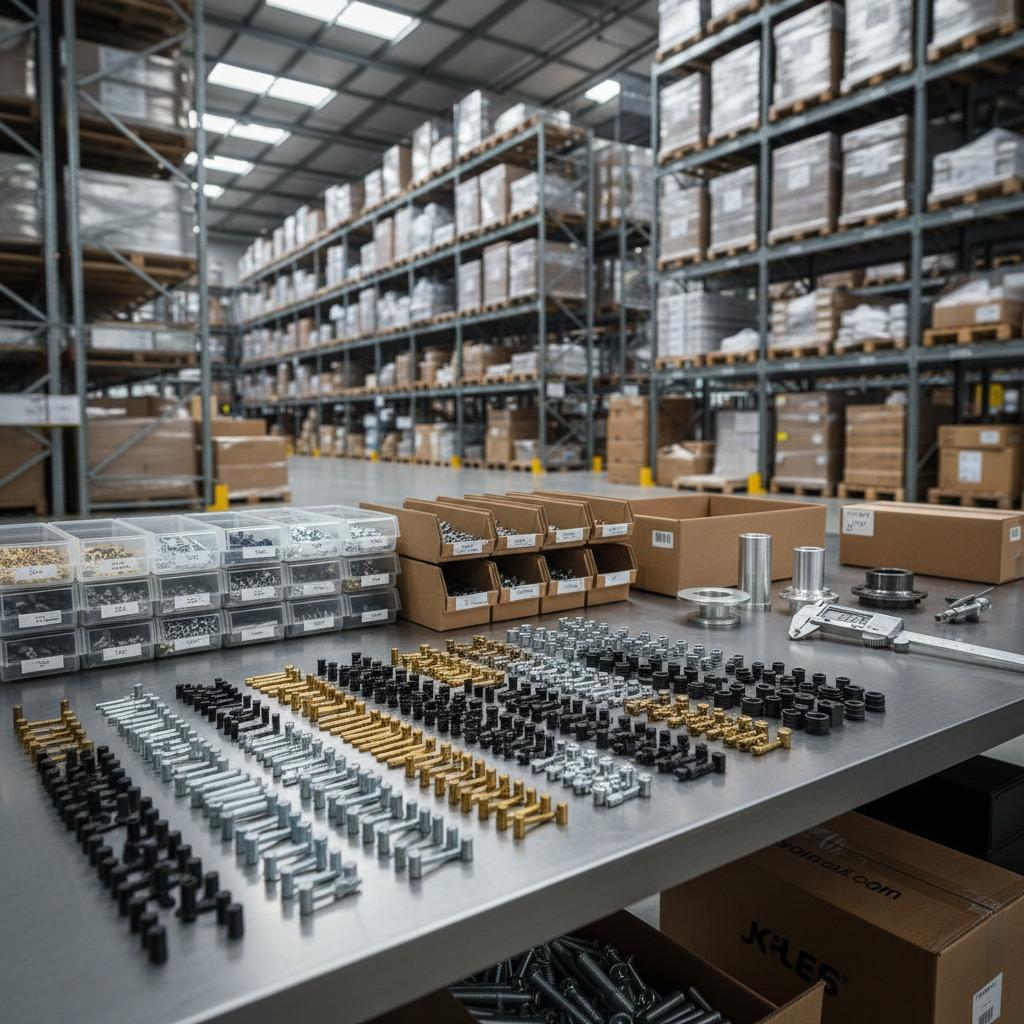
How Hardware Packaging Affects Bulk Brass Insert Supply
Packaging is often overlooked during component qualification.
For a large OEM project, it can affect receiving, storage, assembly, and repeat-order accuracy.
Consider a manufacturer sourcing several insert variants:
-
M3 heat-set inserts
-
M4 heat-set inserts
-
M4 longer-body inserts
-
M5 press-in inserts
-
Custom blind-thread inserts
Some of these components may look very similar.
If bags or cartons are incorrectly labeled, an assembly line can receive a technically correct insert that belongs to another product.
Bulk Packaging
Appropriate where parts are fed into controlled production systems and the buyer has suitable receiving and identification procedures.
Counted Bags
Useful for defined assembly quantities or smaller production kits.
Compartment Packaging
Can help separate variants or combine matched components.
Private-Label Packaging
May be appropriate for distributors, hardware brands, or retail products.
JHFIX offers bag packaging solutions and box packaging options for fastening components and hardware kits.
For brass insert projects, packaging feasibility should be evaluated together with the final component specification.
RFQ Checklist for Brass Insert Nut Buyers
The following table can be used when preparing an OEM inquiry.
| RFQ Field | Information to Include |
|---|---|
| Product | Brass threaded insert type |
| Application | Plastic housing, equipment, furniture or other use |
| Drawing | Controlled 2D/3D drawing or sample |
| Brass grade | Required alloy designation |
| Internal thread | Size, pitch, tolerance and depth |
| External diameter | Body and knurl dimensions |
| Length | Overall and functional length |
| Geometry | Knurls, grooves, flange, pilot and entry |
| Installation method | Heat-set, ultrasonic, press-in, molded-in or other |
| Host material | Resin grade, filler content, wood or other substrate |
| Hole details | Diameter, depth and tolerance |
| Mating screw | Diameter, pitch, engagement and joint stack |
| Performance | Pull-out, torque-out and other acceptance criteria |
| Compliance | Material and restricted-substance documentation |
| Quantity | Sample, initial order and annual forecast |
| Packaging | Bulk, counted bags, kits or private label |
| Destination | Delivery country and logistics requirements |
A complete RFQ helps suppliers quote the same scope and identify uncertainties before tooling or manufacturing begins.
Example: OEM Brass Insert Nut Inquiry
Subject: Custom M4 Brass Heat-Set Inserts for Plastic Equipment Housing
Dear JHFIX Team,
We are developing a plastic equipment housing that requires M4 brass threaded inserts for repeated machine-screw assembly.
Our engineering team can provide the 2D drawing, proposed brass alloy specification, plastic resin information, molded boss geometry, pilot-hole dimensions, mating screw, and functional requirements.
Please review whether this brass insert configuration can be supported through your manufacturing or approved sourcing process.
We would also like to confirm:
-
Material and alloy availability
-
Manufacturing feasibility
-
Sample development requirements
-
Recommended inspection scope
-
Internal thread verification
-
Pull-out and torque-out testing requirements
-
Minimum order quantity
-
Production lead time
-
Bulk packaging options
Our initial request is for technical evaluation, followed by sample approval before any mass-production commitment.
Please let us know which additional documents are needed for an accurate quotation.
Best regards,
OEM Purchasing Department
This inquiry gives the supplier a much stronger basis for evaluating the project than a message asking only for an M4 brass insert price.
Why Consider JHFIX for Threaded Insert and OEM Fastener Projects?
JHFIX is a fastener and furniture hardware supplier associated with Jiangmen Jinhe Hardware Products Co., Ltd., based in Guangdong, China.
According to the company's About Us information, it began operating in 2004 and serves customers in international markets.
Its published manufacturing and support system includes:
-
Cold heading
-
Tapping
-
Stamping
-
Injection molding
-
Assembly
-
Packaging
-
Inspection
The company also provides a range of nuts, threaded inserts, screws, furniture connectors, stamped hardware, and packaging solutions.
Technical Review of Insert Nuts
Current JHFIX product pages describe the importance of:
-
Insert geometry
-
Internal thread
-
External engagement
-
Panel or host material
-
Pilot-hole preparation
-
Mating bolt compatibility
-
Material and finish
-
Installation
-
Quality inspection
-
Packaging
This is a useful starting point for OEM insert-nut discussions.
Drawing-Based Customization
Buyers can submit drawings or existing samples for review of a proposed threaded insert configuration.
Related Fastener Supply
Where the project also needs machine screws, nuts, washers, brackets, or other fastening components, the JHFIX product catalog may help buyers consolidate relevant purchasing requirements.
Packaging Integration
For OEM and private-label buyers, component packaging can be discussed alongside hardware supply.
Brass-Specific Qualification
The presence of threaded insert products in the current catalog should not be treated as proof that every solid-brass insert design is available from stock.
For a heat-set, ultrasonic, press-in, or molded-in brass insert, material grade, geometry, production route, capacity, testing, and commercial conditions require project-specific confirmation.
This creates a practical next step for buyers seeking a qualified supplier rather than relying on assumptions.
Frequently Asked Questions About Brass Insert Nut Suppliers
1. What is a brass insert nut?
A brass insert nut is a component with an internal machine thread designed to be retained within a compatible host material. Depending on its design, it can be installed through heat, ultrasonic energy, pressing, molding, or external threading.
2. What are brass threaded inserts used for?
They are used in plastic housings, electronic enclosures, appliances, industrial assemblies, selected furniture components, and other products requiring machine-thread connections within suitable host materials.
3. What is the difference between a heat-set insert and a press-in insert?
A heat-set insert uses controlled heat to soften compatible thermoplastic around its external features. A press-in insert relies on mechanical engagement during insertion. The correct method depends on the host material and required performance.
4. Are brass inserts suitable for ABS plastic?
Suitable brass inserts can be used in ABS when the geometry, hole design, installation method, and functional requirements have been validated for the specific ABS grade and molded component.
5. Can brass inserts be installed in nylon?
Yes, compatible threaded inserts can be used with suitable nylon materials. However, nylon grades and filler content can affect installation and performance. The process should be qualified for the actual resin.
6. Can brass inserts be used in MDF or wood?
Some brass insert designs are suitable for selected wooden or engineered-panel applications. However, a thermoplastic heat-set insert should not automatically be used as a wood insert. The external geometry must match the intended substrate and installation method.
7. Which is better, brass or stainless steel threaded inserts?
Neither is universally better. Brass may offer advantages in machinability and certain thermal installation applications. Stainless steel may be preferred for particular mechanical or corrosion requirements. The correct choice depends on the actual design and material grade.
8. What thread sizes are available for brass inserts?
Common industry sizes include M2, M2.5, M3, M4, M5, M6, and M8, depending on the insert family. Availability of each size and configuration must be confirmed with the selected supplier.
9. Why do brass inserts spin inside plastic?
Possible causes include an unsuitable hole diameter, poor knurl engagement, insufficient plastic flow, improper installation, or excessive assembly torque. The complete installation should be investigated.
10. How is brass insert pull-out strength measured?
Pull-out performance is evaluated through a defined test arrangement involving the installed insert, host material, loading direction, and test method. Numerical results should only be compared when the test conditions are equivalent.
11. Can brass insert nuts be customized?
Yes, brass threaded inserts can be designed with customized geometry, threads, lengths, flanges, and retention features, subject to manufacturing feasibility. Buyers should provide drawings, material requirements, and installation information.
12. Are all brass threaded inserts RoHS compliant?
No. Compliance depends on the actual alloy composition, product category, destination market, and applicable requirements or exemptions. Buyers should request appropriate material declarations and supporting documents.
13. How do I choose a brass insert nut supplier?
Evaluate material traceability, thread accuracy, external geometry, manufacturing capability, installation knowledge, sample approval, functional testing, packaging, MOQ, and repeat-order control.
14. Can brass inserts be supplied with matching screws?
Depending on the supplier's product range and project requirements, inserts may be supplied alongside matched machine screws or other hardware. Thread compatibility, quantity ratios, and packaging must be confirmed.
15. What is the MOQ for custom brass inserts?
MOQ depends on the brass grade, geometry, manufacturing method, order quantity, and packaging requirements. A specific MOQ should be confirmed during quotation rather than assumed from unrelated insert products.
16. What information should I send before requesting a quote?
Provide the insert drawing, thread, brass material specification, host material, hole design, installation process, mating screw, performance requirements, estimated quantity, and packaging information.
17. Can JHFIX review a custom brass insert project?
JHFIX's published product information supports drawing-based and sample-based review of threaded insert configurations and material requirements. Specific brass alloy availability, manufacturing feasibility, MOQ, testing, and lead time require direct project confirmation.
Conclusion
Choosing a brass insert nut supplier requires more than comparing thread sizes and unit prices. Buyers should evaluate the brass alloy, retention geometry, installation method, host material, thread accuracy, functional testing, and repeat-order consistency before approving bulk supply.
For custom brass inserts, the most useful next step is a complete technical RFQ. If your project also involves matched screws, furniture hardware, OEM components, or customized packaging, explore the JHFIX product range and contact JHFIX with your drawings, material requirements, application details, quantities, and testing criteria to discuss manufacturing feasibility, sample development, and quotation.