
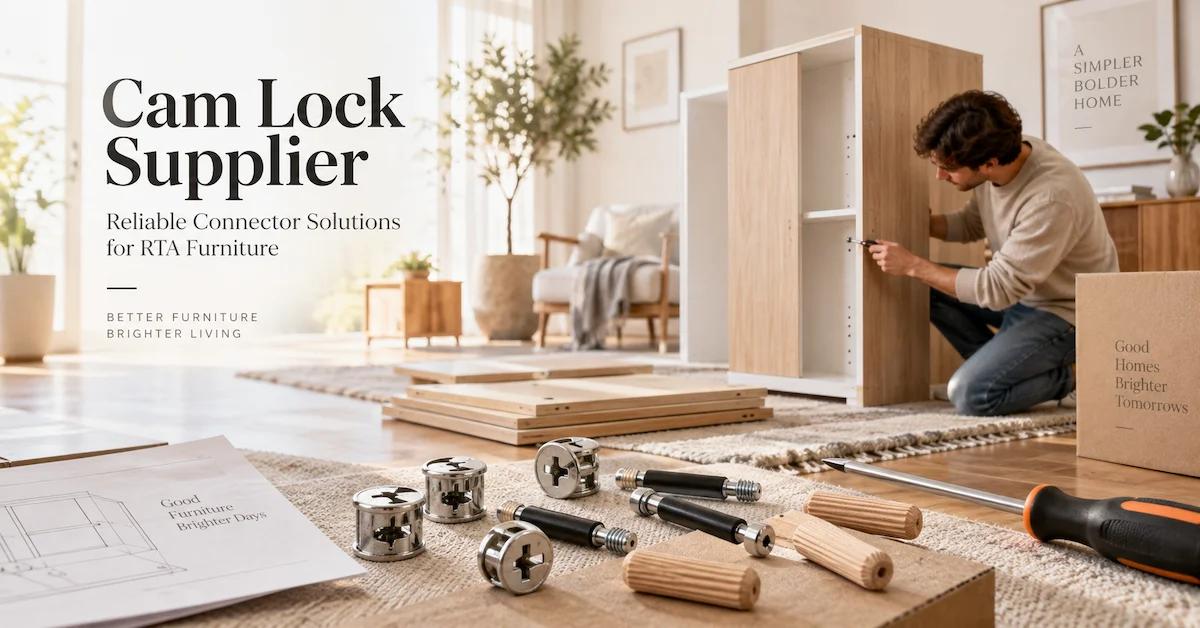
What Should a Cam Lock Supplier Deliver Beyond the Individual Fitting?
A cam lock supplier for furniture production should deliver a controlled connection solution rather than a bag of visually similar metal parts. For cabinet and ready-to-assemble furniture programs, that normally means identifying the correct cam, matching connecting bolt and any related nut, dowel or plastic component; confirming the intended panel and drilling conditions; providing an approval sample; defining the quantity unit; and keeping the approved configuration identifiable when the buyer reorders.
JHFIX currently groups 2-in-1 and 3-in-1 cam locks, eccentric connectors, Minifix fittings and connector sets for cabinets and flat-pack furniture in its Cam Locks & Connector Sets category. Its wider product information also identifies cam-lock systems, connectors and furniture fittings among its core hardware activities. For buyers, the practical implication is that supplier qualification should cover technical compatibility and supply management at the same time.
Who Should Use a Structured Cam Lock Sourcing Process?
This approach is most useful for cabinet factories, wardrobe manufacturers, flat-pack furniture companies, modular-storage brands, furniture importers, distributors and private-label buyers that purchase the same connector repeatedly. These customers are not simply trying to find a part that looks close to an existing cam. They need a connection that corresponds to a defined furniture model and can be supplied consistently across samples, initial production and repeat orders.
A buyer looking for one unidentified household replacement part has a different problem. In that situation, identification comes first. For OEM purchasing, a supplier comparison becomes meaningful only after the buyer can provide the existing hardware or dimensional information, mating components, panel conditions and expected order format. This is consistent with JHFIX’s wider guidance on ready-to-assemble furniture hardware, which treats hardware as a coordinated assembly system rather than unrelated components.
Where Are Cam Locks Commonly Used in Furniture Production?
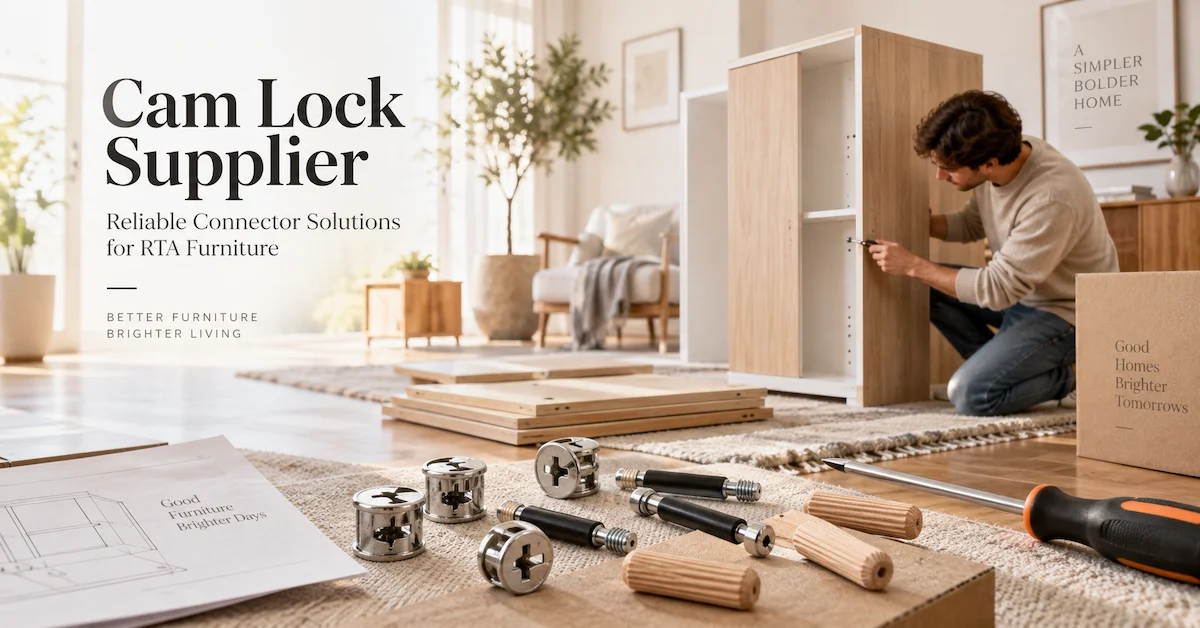
Cam locks are particularly relevant where furniture panels must be assembled efficiently after machining, including kitchen cabinets, wardrobes, shelving, storage furniture, office furniture and other flat-pack or RTA products. A typical connection combines an eccentric cam, a mating connecting bolt and accurately prepared panel holes. During assembly, the cam engages the bolt and pulls the panel connection into position.
The important sourcing issue is that the same general product name can appear across several furniture designs while the actual dimensions and mating conditions differ. A kitchen cabinet and a bedroom wardrobe may both use cam locks, but they do not automatically require the same cam, bolt, drilling position or packing configuration. JHFIX’s cabinet sourcing content therefore recommends specifying panel material, panel thickness, cam dimensions, bolt length and drilling information rather than sending an inquiry that only says “need cabinet cam locks.”
Build the RFQ Around a Matched Connection, Not a Product Name
The strongest RFQ gives the cam lock supplier enough information to understand what the furniture joint must do and how the parts will be delivered. The following table is a procurement framework rather than a universal dimension standard; actual values should come from the buyer’s drawing, approved sample and furniture design.
| Specification Area | What the Buyer Should Define | Why It Matters |
|---|---|---|
| Furniture reference | Furniture model, SKU and drawing revision | Connects the hardware to the correct product |
| Panel information | Material, finished thickness and relevant machining | Establishes the application conditions |
| Cam specification | Type, body dimensions and installation orientation | Defines the cam to be reviewed |
| Cam bore | Diameter, depth and center position | Connects the hardware to panel machining |
| Connecting bolt | Overall length, working geometry, thread or anchoring section | Defines the mating component |
| Installed bolt position | Required projection after installation | Helps confirm cam engagement |
| Related components | Nut, sleeve, dowel, plastic part or other pieces | Prevents incomplete set definitions |
| Material | Material for each individual component | Avoids describing a mixed set with one material |
| Finish | Required surface treatment and appearance | Separates finish from base material |
| Quantity unit | Piece, pair, set or kit | Prevents purchasing-count errors |
| Packaging | Bulk, matched set, bag or furniture-specific kit | Defines the actual supply format |
| Acceptance | Dimensions, appearance, mating fit and agreed checks | Provides an objective inspection basis |
| Approval reference | Drawing revision and accepted sample | Supports repeat-order control |
A phrase such as “M6 cam lock set” may be useful as a starting description, but it is not enough to define every interface. Keep missing values visibly open during quotation instead of allowing an assumption to become a production requirement.
Why Should the Cam and Connecting Bolt Be Approved Together?
The cam and connecting bolt form an interface. Changing one component can affect the joint even when the replacement appears similar. Overall bolt length, installed position, head or neck geometry, anchoring section and cam geometry can influence engagement, while panel drilling determines where those components meet.
JHFIX’s JH-18 furniture connecting bolt product page lists M6 thread size, published lengths of 24, 28, 32 and 34 mm, an 8 mm thread length and pan-head or countersunk options. These values help identify possible configurations, but a buyer should still confirm the mating cam and actual furniture geometry rather than interpreting a length value as proof of compatibility.
The same principle applies when changing suppliers. Sending only the connecting bolt may not reveal enough about the existing connection. Where possible, provide the cam, bolt, panel drawing and relevant drilling dimensions together so the proposed replacement can be reviewed as a complete joint.
How Should Buyers Compare Different Cam Lock Configurations?
A supplier’s catalog can help identify starting points, but different listings should not be treated as interchangeable simply because each one belongs to the cam-lock category. The following comparison uses published JHFIX examples to show what information buyers can extract before sample approval.
| Product Reference | Published Information | Useful Sourcing Role | What Still Needs Confirmation |
|---|---|---|---|
| JH-18 furniture connecting bolt | M6; 24/28/32/34 mm lengths; 8 mm thread length | Selecting a candidate bolt configuration | Mating cam, installed position and panel drilling |
| Φ6.1 × 34 mm mini cam connecting bolt | Φ6.1 × 34 mm; carbon steel + plastic listed; zinc/nickel options | Existing or mini-fix style furniture connection review | Cam geometry, panel preparation and complete joint fit |
| HI-CB0012 three-in-one connector | Bolt + cam + nut; M6.1 and 45 mm listed; carbon steel + zinc alloy + plastic | Buyers seeking a defined multi-component set | Specification of each piece, drilling and final assembly |
| Cam Locks & Connector Sets range | 2-in-1, 3-in-1, eccentric and Minifix product directions | New projects comparing connection concepts | Final dimensions, mating parts, materials and sample approval |
This comparison is not a strength ranking. Its purpose is to show why a professional cam lock supplier discussion should move from catalog identification to application-specific approval.
Define Materials and Finishes Component by Component
Cam-lock sets can contain more than one material. The HI-CB0012 listing, for example, identifies carbon steel, zinc alloy and plastic in a three-part bolt, cam and nut configuration. Recording the entire package simply as “metal furniture hardware” would therefore remove useful purchasing information.
Ask the supplier to identify which material belongs to each component, then record finish separately. A silver appearance does not define a base material or a verified corrosion-performance level. If the furniture will be used in a kitchen, bathroom, humid warehouse or another environment with specific exposure, communicate that condition and agree on the finish and any required test criteria during quotation. Do not assume that a finish name makes one connector suitable for every application.
What Manufacturing Information Should a Cam Lock Supplier Be Able to Explain?
Supplier evaluation should connect manufacturing capability with the ordered component. JHFIX’s About Us and manufacturing overview describes activities including cold heading, tapping, punching, injection molding, assembly, packing and inspection, and identifies cam-lock systems and connectors among its specialized hardware products. A buyer should use this information to ask which processes apply to the exact cam, bolt or accessory being quoted.
Useful questions include how the connecting bolt is formed, how the relevant dimensions are checked, which process produces or finishes the cam, how plastic components are controlled where applicable, and how matched parts remain identifiable during packing. The objective is not to collect the longest equipment list. It is to understand how an accepted sample becomes a repeatable production item.
How Should Samples Be Approved Before a Bulk Order?
Sample approval is stronger when it covers three separate levels. First, check the individual components against the agreed specification. Second, assemble the selected cam and bolt in representative panels using the intended drilling and installation sequence. Third, inspect the actual packed set if the supplier will deliver counted hardware kits.
The individual inspection can verify dimensions, finish, component identity and relevant thread or locking features. The assembly check answers a different question: do the cam, bolt and panel preparation actually work together? The packed-set check then verifies quantities, component combinations and identification.
JHFIX’s product guidance for the HI-CB0012 configuration recommends trial assembly with the actual board and mating parts and also identifies fit, dimensions, appearance, locking function and package count as possible inspection areas depending on the approved specification. That makes component approval → joint approval → pack approval a useful purchasing sequence.
What Should Buyers Do When the Cam Does Not Lock Correctly?
If a sample joint does not close correctly, investigate one variable at a time. Compare the candidate hardware with the approved or existing components, check the cam bore and panel drilling, verify the installed position of the connecting bolt, and confirm that the correct cam and bolt were paired.
If two different hardware sets both fail in the same newly machined panels but work in reference panels, the panel preparation deserves closer investigation. If only the proposed hardware fails across equivalent reference panels, review the connector geometry and mating relationship. These patterns can guide troubleshooting, but they do not prove root cause without measurement.
Avoid solving an unexplained fit issue by simply applying more installation force. JHFIX’s customized connector guidance advises checking drilling accuracy, keeping the working area clear of debris and following the agreed insertion and tightening sequence to avoid damaging the board or hardware.
How Should Quality Control and Documentation Be Defined?
“Strict QC” is not an inspection specification. A professional buyer should identify which characteristics matter for the approved cam-lock configuration and how those characteristics will be checked. Depending on the part, the agreed plan can address cam dimensions, bolt dimensions, thread or anchoring features, finish appearance, mating fit, locking function, quantity and packaging.
Documentation should also be reviewed by scope. A company-level qualification should not be treated as a substitute for the dimensional and assembly acceptance criteria of the ordered connector. If the buyer or destination market requires specific material records, test reports or certifications, request current documents that clearly apply to the relevant product or process. JHFIX’s website provides an FAQ section for general commercial questions, but project-specific acceptance conditions should still be documented in the RFQ and purchase specification.
Bulk Parts or Complete Hardware Kits: Which Supply Format Is Better?
The answer depends on the buyer’s operation.A furniture factory with its own established counting and kitting system may prefer bulk cams and bolts. A flat-pack brand that wants one ready-to-use bag in every furniture carton may benefit more from matched, counted kits.
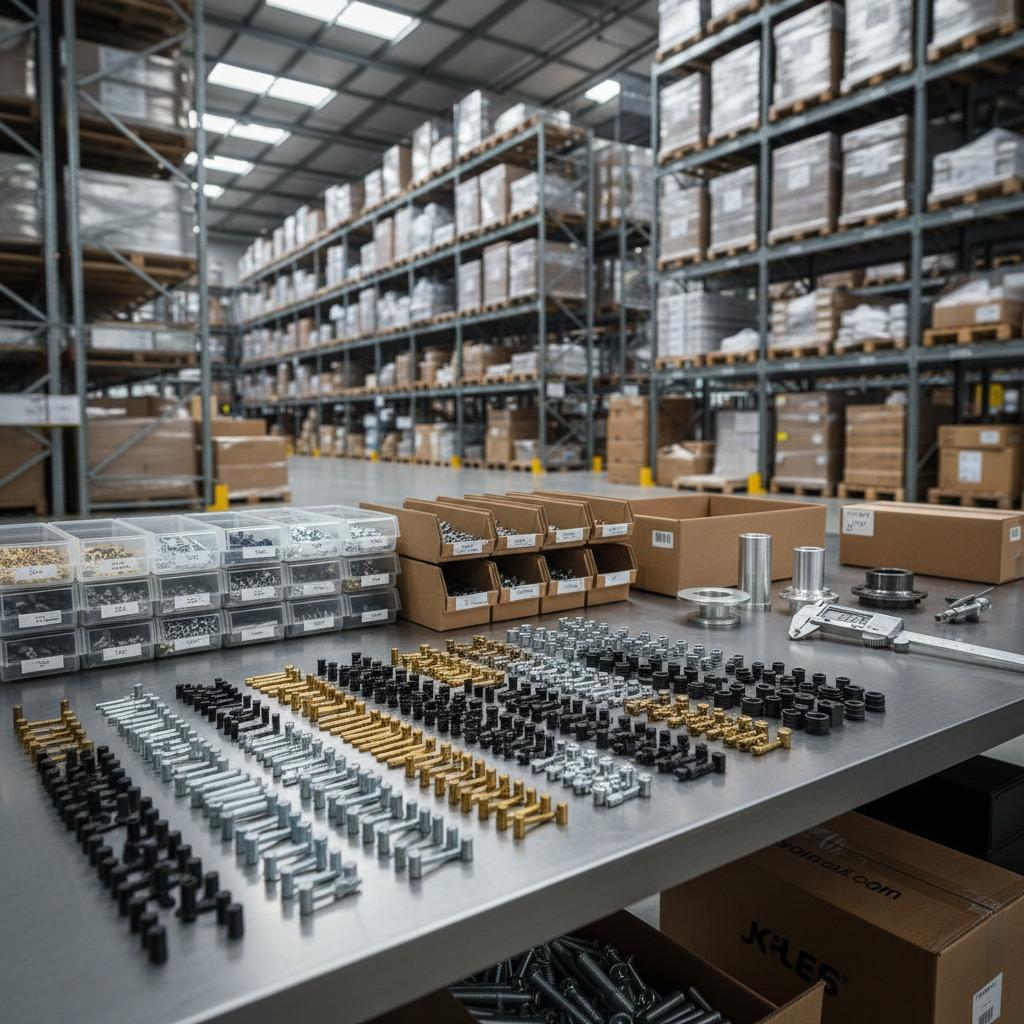
JHFIX’s pre-packed furniture hardware kit guide describes furniture-specific kits containing screws, cam locks, brackets, insert nuts and accessories that can be organized by model or SKU. For a cam-lock program, this means the buyer can define the cam, matching bolt, quantity and other related hardware as one controlled packing configuration rather than receiving all components in unrelated cartons.
The supply format should be specified at quotation stage because bulk parts and finished kits represent different scopes of work. If kitting is required, define whether the supplier is responsible for counting, sub-bagging, labels, barcodes, instructions, spare components and outer-carton identification.
How Should a Cam Lock Supplier Control Packaging Accuracy?
Small furniture connectors are easy to mix, particularly when several bolt lengths or cam configurations look similar. Packaging control should therefore link the physical parts to the furniture model and BOM.
For every pack, define the quantity of cams, the quantity and specification of matching bolts, any dowels or additional pieces, spare quantities where required, the kit identification and packaging revision. If one set includes three individual components, state whether ordering and inspection quantities are measured in sets or pieces.
Approve a physically packed sample rather than approving loose parts and assuming the final pack will be correct. JHFIX also provides dedicated bag packaging solutions for screws, nuts, washers, hardware kits and furniture assembly parts, giving OEM buyers a relevant internal path for discussing model-specific packaging.
How Should MOQ, Capacity, and Lead Time Be Compared?
There is no reliable reason to assume that every cam-lock configuration has one universal MOQ or lead time. A catalog connecting bolt, a customized multi-part set and a furniture-specific packed kit may require different production and preparation steps.
Ask the cam lock supplier to separate sample timing from bulk-production timing and to state what must be approved before the production lead time begins. Relevant stages can include technical review, sample preparation, trial assembly, sample approval, manufacturing, finishing, inspection, kitting and shipment preparation.
Capacity should also be treated as order-specific. A company’s overall factory capability does not automatically represent capacity reserved for one customer or one model. The commercial quotation should therefore identify the confirmed quantity, supply configuration and planned schedule instead of relying on a general factory-capacity statement.
Compare Total Sourcing Cost Instead of Cam Unit Price Alone
When comparing suppliers, make sure the quotations cover the same scope. A price for loose cams cannot be directly compared with a price that includes matched bolts, packing, labeling and inspection.
A useful comparison is the cost per accepted furniture connection or per approved hardware kit. Include the defined components and any recurring work your own factory must perform after receipt, such as counting, sorting, matching and repacking. Keep one-time development or tooling costs separate from recurring product costs so the commercial comparison remains clear.
Specification risk should also be considered. If an inexpensive component causes repeated sorting, panel adjustment or kit replacement, those activities create cost elsewhere in the supply chain. Use your own operational data to quantify those consequences rather than relying on generic claims about savings.
How Should OEM and Custom Cam Lock Projects Be Managed?
Customization should start from the problem the furniture design needs to solve. The buyer may need a different bolt length, connection geometry, finish, accessory combination or packaging method. The supplier should first determine whether an existing platform can meet that requirement or whether a modification is necessary.
JHFIX’s customized HI-CB0012 product information states that dimensions, materials, surface finish, compatible parts, packaging, carton labeling and inspection requirements can be discussed, with samples arranged for evaluation before volume production.
A controlled OEM sequence is straightforward: define the furniture application, review drawings or samples, agree on the proposed configuration, produce samples, test the connection in representative panels, approve the parts and packing, then release bulk production. Repeat orders should reference the same accepted drawings, samples and packaging versions. If one of these elements changes, record the revision before treating the new order as equivalent to the previous one.
What Should You Send a Cam Lock Supplier for a Useful Quotation?
A useful inquiry should include the furniture application, panel material and thickness, existing cam and bolt drawings or samples where available, cam-bore information, required bolt configuration, material and finish, initial quantity, estimated repeat volume, supply format, packaging requirements and any agreed inspection conditions.
If the project is replacing existing hardware, send both mating parts rather than only one component. If the joint is still being developed, indicate which dimensions are fixed and which remain open for supplier review. Buyers can first review the JHFIX Cam Locks & Connector Sets range and then contact JHFIX with drawings, samples, quantities and packaging information for a project-specific quotation.
FAQ
1. What should I look for when choosing a cam lock supplier?
Look beyond catalog variety and unit price. A qualified cam lock supplier should be able to clarify the matching cam and bolt, review the panel application, support sample validation, define packaging quantities and maintain an approved specification for repeat orders.
2. Does a supplier need to provide the cam and connecting bolt together?
Not always, but the mating relationship must be controlled. If you purchase the two components from different sources, give both suppliers the relevant interface information and validate the final combination. Buying both from one supplier may simplify coordination, but it does not remove the need for sample approval.
3. Are all Minifix or furniture cam locks interchangeable?
No interchangeability should be assumed from product names or appearance alone. Cam geometry, connecting-bolt geometry, installed position and drilling conditions need to correspond. Treat a similar catalog item as a candidate until the complete joint has been tested.
4. What information should I provide for a cam lock quotation?
Provide the furniture type, panel material and thickness, cam and bolt dimensions or samples, drilling information where available, material, finish, quantity, packaging and required inspection conditions. More complete input reduces assumptions during quotation.
5. Should I approve a cam lock using my actual furniture panel?
Representative panels are valuable because they test the hardware in the conditions for which it is being purchased. Verify the relevant drilling, cam seating, bolt engagement, panel alignment and installation method before releasing a high-volume order.
6. Can JHFIX supply customized cam lock sets?
JHFIX states that customization discussions can cover dimensions, material, finish, compatible parts, packaging and inspection requirements for relevant connector products. The exact scope, minimum quantity, sample arrangement and commercial terms should be confirmed for the individual project.
7. What materials are used in furniture cam-lock systems?
Materials vary by configuration. For example, JHFIX’s HI-CB0012 listing identifies carbon steel, zinc alloy and plastic within one three-part product. Buyers should identify the material of each component rather than assign one general material description to the entire set.
8. Is it better to buy cam locks in bulk or as pre-packed kits?
Bulk purchasing may suit furniture factories that already have reliable internal sorting and kitting. Pre-packed sets may suit RTA brands that require the correct hardware to accompany each furniture carton. Compare the total handling scope rather than only the price per cam.
9. Is there a standard MOQ and lead time for every cam lock?
A universal MOQ or delivery time should not be assumed. Standard components, customized sets, finishes and packaging options can have different commercial requirements. Confirm the conditions against the final specification and quantity.
10. How do I reduce repeat-order problems with a cam lock supplier?
Link every repeat order to the approved component codes, drawings, mating parts, material and finish, sample reference, kit quantity and packaging revision. Proposed substitutions should be reviewed before implementation so visually similar parts do not silently replace the accepted configuration.
Conclusion
Choosing a cam lock supplier for cabinet and RTA furniture is a supply-control decision as much as a component-purchasing decision. Buyers should define the cam and connecting bolt as a matched interface, verify the joint in representative panels, approve the actual packing format, establish measurable inspection requirements and preserve the accepted specification for future orders. JHFIX provides cam locks, connecting hardware and furniture-kit packaging for OEM furniture applications; review the Cam Locks & Connector Sets range and contact JHFIX with your drawings, samples, quantity and packaging requirements for a project-specific review.