
For OEM manufacturers, furniture producers, and industrial assembly companies, sourcing screws in bulk seems straightforward at first glance. Screws are standardized components, widely available from countless suppliers around the world. However, procurement teams quickly discover that bulk supply introduces its own set of operational challenges.
Common problems include inconsistent batches that affect installation performance, inaccurate counting that causes unexpected shortages, and packaging that fails during transportation or warehouse handling. In high-volume assembly environments, even small disruptions can slow down production lines and increase labor costs.
A professional bulk screws supplier addresses these challenges through stable manufacturing processes, strict batch control, and packaging systems designed for real assembly workflows. At JHFIX, our team focuses on integrating screw manufacturing with controlled packaging solutions, ensuring that bulk orders arrive with consistent quality, accurate quantities, and packaging formats aligned with production needs.
Selecting the right supplier is therefore less about finding the lowest price and more about ensuring supply reliability. The following guide outlines the key criteria buyers should evaluate when choosing a bulk screws supplier.
Why Bulk Screw Procurement Is Different from Standard Orders
Bulk purchasing changes the dynamics of fastener sourcing. Small inconsistencies that might go unnoticed in smaller orders become operational issues at scale.
In high-volume production, screws are installed thousands of times per shift. If driving resistance varies between batches or if packaging causes delays in picking and counting, productivity declines quickly. Assembly operators may spend additional time adjusting tools, sorting fasteners, or waiting for replenishment.
According to manufacturing productivity studies referenced in lean production frameworks, minor inefficiencies repeated at high frequency can reduce effective output by 10–20%. This explains why large-scale manufacturers increasingly prioritize supplier stability rather than simply comparing prices.
The Five Core Criteria for Selecting a Bulk Screws Supplier
Choosing a reliable bulk screws supplier requires evaluating several operational factors. The most effective procurement teams typically assess suppliers based on the following criteria:
1. Manufacturing Consistency
A reliable supplier must maintain stable production processes to ensure that screws perform consistently across batches. Variations in thread geometry or surface treatment can affect installation torque and lead to assembly issues.
2. Quality Control Systems
Look for suppliers with multi-stage inspection processes, including raw material verification, dimensional checks, and batch sampling. These controls reduce the risk of defects reaching the production line.
3. Packaging and Counting Accuracy
Bulk screws should be packaged in formats suitable for storage, transport, and assembly. Accurate counting and durable packaging significantly reduce shortages and material loss.
4. Supply Capacity and Lead Time Stability
A capable bulk screws supplier must maintain predictable lead times, especially for OEM programs requiring regular shipments.
5. OEM and Customization Capability
Even bulk orders may require adjustments such as specific screw lengths, head designs, or packaging formats. Suppliers with customization capabilities provide more flexibility for long-term projects.
Packaging Efficiency: An Overlooked Selection Factor
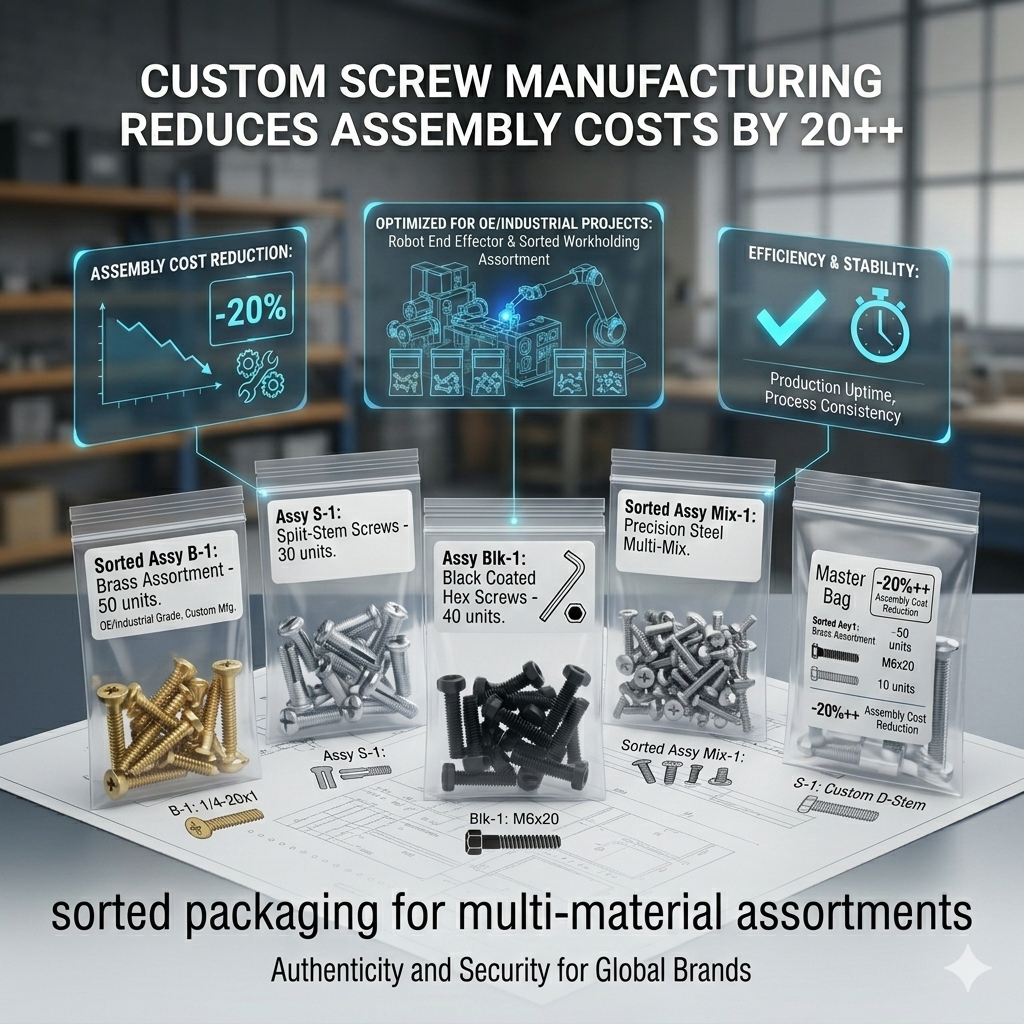
Packaging plays a larger role in bulk screw supply than many buyers expect. Improper packaging leads to counting errors, material loss, and increased handling time.
The table below illustrates the operational differences between common packaging approaches.
| Packaging Type | Loose Bulk Packaging | Standard Industrial Packaging | Custom Packaging |
|---|---|---|---|
| Counting accuracy | ~90% | ~97–98% | 99%+ |
| Material loss rate | 5–7% | 2–3% | <1% |
| Handling efficiency | Baseline | Improved | Highly optimized |
| Assembly preparation time | Standard | -10–15% | -20–30% |
Industry experience shows that improving packaging accuracy alone can reduce operational interruptions significantly. In large-scale assembly environments, these improvements translate directly into cost savings.
The Role of Supplier Integration in Bulk Screw Supply
An integrated bulk screws supplier combines manufacturing, quality control, and packaging within a single system. This approach reduces variability and simplifies logistics.
When screws are produced and packaged under one controlled workflow, several benefits emerge:
-
Reduced risk of mixed fasteners
-
Better traceability between production batches and shipments
-
Faster response to specification adjustments
-
More stable long-term supply agreements
Integrated suppliers also tend to offer better support for OEM projects, where consistency across multiple shipments is critical.
Practical Scenarios Where Supplier Choice Matters Most
The importance of selecting the right bulk screws supplier becomes particularly clear in certain production environments:
-
Furniture manufacturing with high screw usage per unit
-
Industrial equipment assembly lines with torque-controlled installation
-
Export manufacturing requiring durable packaging for international transport
-
OEM projects involving multiple screw specifications across product lines
In these situations, supplier reliability directly affects operational performance.
Frequently Asked Questions
Q1: What is the most important factor when selecting a bulk screws supplier?
Supply consistency is typically the most critical factor, as inconsistent batches can disrupt assembly and increase rework.
Q2: Are custom packaging solutions necessary for bulk screws?
While not always required, custom packaging significantly improves counting accuracy and reduces material loss in high-volume environments.
Q3: How can buyers verify supplier reliability before placing large orders?
Buyers should evaluate production capability, quality control processes, packaging methods, and previous project experience with similar bulk supply requirements.
Building a Reliable Bulk Screw Supply System
Selecting the right bulk screws supplier is a strategic procurement decision that affects production stability, assembly efficiency, and long-term cost control. A supplier capable of maintaining consistent manufacturing quality and accurate packaging can significantly reduce operational risks.
To learn more about how bulk screw manufacturing, quality control, and packaging solutions can support your production environment, you can explore our capabilities on the JHFIX homepage. This overview explains how screws are produced and supplied for industrial and OEM applications.
If you are currently evaluating bulk screw suppliers or planning a large procurement project, a direct discussion can help clarify the most effective approach. Our team works with OEM and industrial buyers to align screw specifications, packaging formats, and supply schedules. You are welcome to reach out through our Contact Us page to discuss your requirements and explore a reliable supply solution.