
Choosing a Cam Lock Fastener Supplier for Cabinet and Furniture Assembly
Cam lock hardware is not the part customers usually notice first.
They see the cabinet surface, the door gap, the shelf position, and whether the finished furniture feels steady. The connector is hidden inside the panel. When it works, nobody talks about it.
When it fails, everyone notices.
A panel does not pull tight. A cam keeps turning without locking. A bolt sits too shallow. A small part is missing from the hardware bag. The assembly worker stops. The installer checks the drawing again. The customer wonders whether the cabinet was made poorly.
This is why choosing a cam lock fastener supplier is more than a price comparison.
For cabinet manufacturers, flat-pack furniture brands, OEM buyers, and wholesalers, the supplier behind the hardware affects assembly speed, panel fit, packaging accuracy, and repeat production quality.
The right supplier helps the furniture go together smoothly. The wrong one may still deliver parts, but the cost shows up later on the line, in the warehouse, or at the customer’s home.
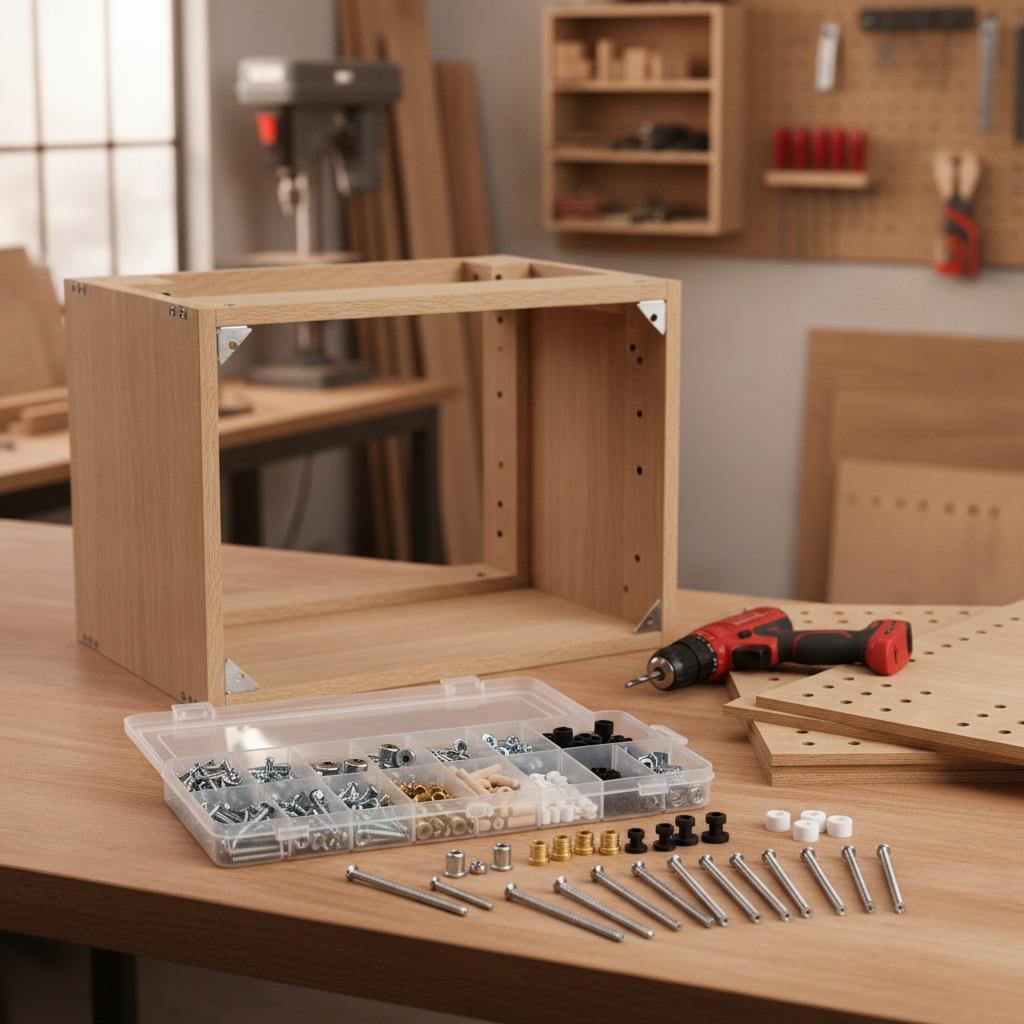 Cam lock hardware is part of a larger assembly system
A cam lock fastener rarely works alone.
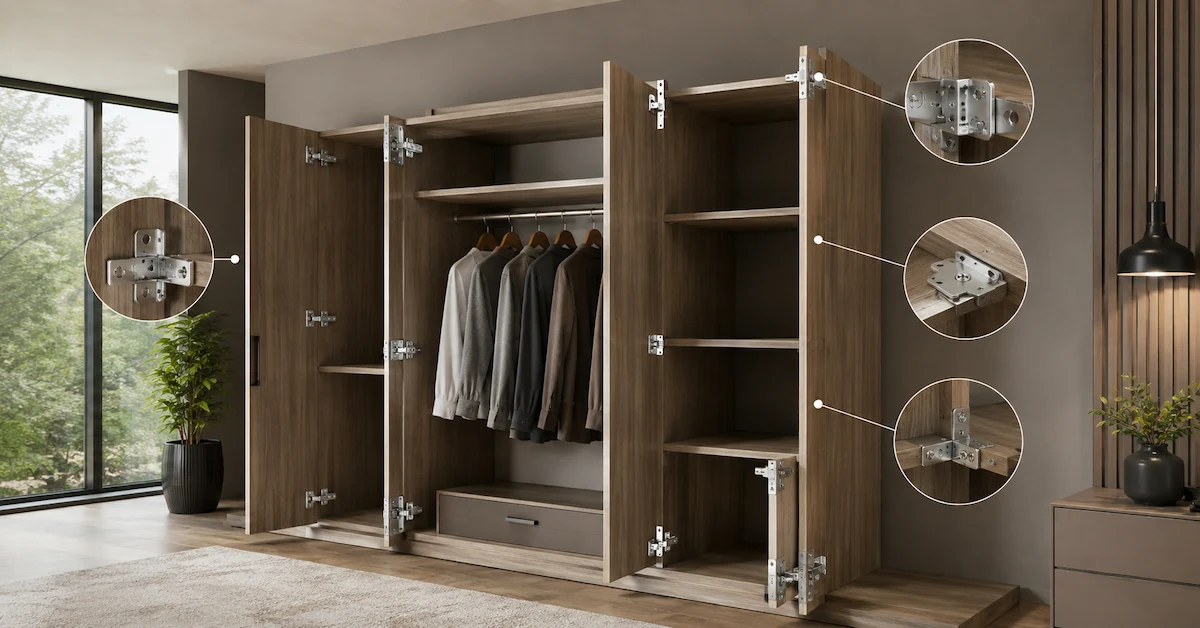
It normally depends on a matching connector bolt, drilled panel holes, dowels, screws, inserts, caps, and sometimes brackets or spacers. Each part has a specific role in the joint.
The cam pulls the panel tight. The bolt gives it something to engage. Dowels help position the panels before tightening. Screws and brackets may reinforce the structure. Plastic caps finish the appearance after assembly.
If one part is wrong, the full connection becomes unreliable.
That is why buyers should not evaluate cam lock hardware only by looking at a sample in a tray. A clean finish and a neat shape are useful, but they do not prove that the connector will work inside the actual cabinet.
The real question is simple:
Can this hardware create the same joint again and again in the panel system we use?
Why cam locks are still common in flat-pack furniture
Cam locks remain widely used because they solve several production problems at once.
They support knock-down assembly. They allow panels to ship flat. They keep the outside surface cleaner than many exposed fasteners. They are also familiar to furniture factories, installers, and many end users.
This makes them suitable for:
- Kitchen cabinets
- Wardrobes
- Storage units
- Modular shelving
- Office furniture
- Workshop cabinets
- Ready-to-assemble furniture
- OEM cabinet hardware kits
The advantage is not only that the cabinet can be assembled quickly.
The greater value is repeatability. Once the drilling pattern, panel thickness, connector size, and hardware mix are stable, the same joint can be reproduced across large production runs.
That repeatability depends on accuracy.
If the hole depth changes, the cam may not catch correctly. If the connector bolt is too long, the panels may not close. If the cam geometry is slightly different from the approved part, the joint may feel loose even though the hardware looks similar.
Small differences become big problems when thousands of units are involved.
The panel design and the hardware should be reviewed together
One common sourcing mistake is treating the hardware kit as separate from the cabinet design.
It is not separate.
The cam lock system depends on the panel material, hole diameter, drilling depth, edge distance, and assembly order. A supplier that does not understand these details may quote quickly, but the buyer carries more risk.
For example, MDF, particleboard, plywood, and solid wood do not respond to fastening force in the same way. A connector that works well in one substrate may loosen, crush, or feel too aggressive in another.
The same applies to drilling.
A CNC-drilled panel with stable hole positions gives cam lock hardware a better chance of working consistently. A loose or drifting hole pattern creates assembly problems no matter how good the connector looks.
Before placing a bulk order, buyers should confirm:
- Panel material
- Panel thickness
- Hole diameter
- Hole depth
- Distance from the panel edge
- Matching bolt or insert
- Assembly direction
- Whether the furniture ships flat-packed or assembled
- Whether the joint may be reopened later
A good cam lock fastener supplier should be comfortable discussing these details.
A cabinet hardware kit needs complete part matching
In many furniture programs, cam locks are supplied as part of a cabinet hardware kit.
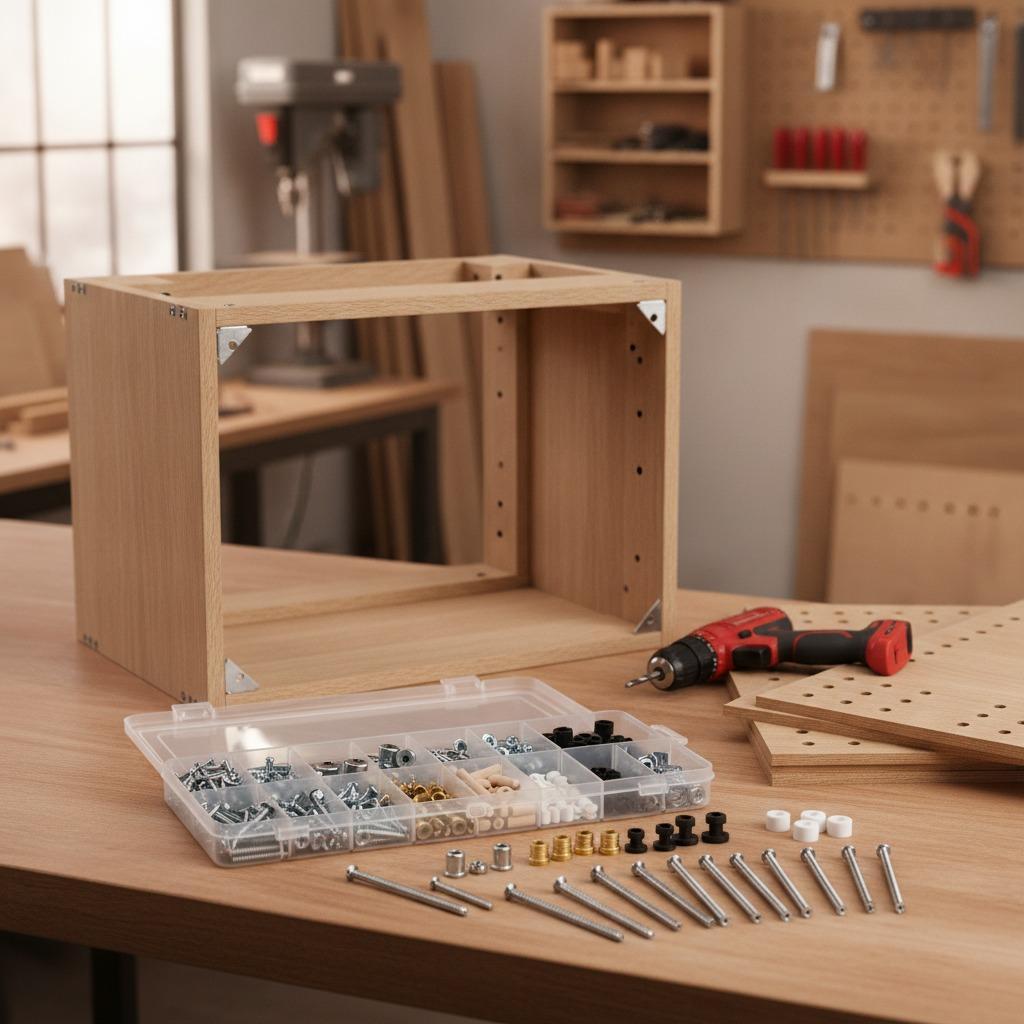
That kit may include cam bodies, connector bolts, dowels, screws, threaded inserts, washers, brackets, plastic caps, and a small installation tool.
This format is useful because it keeps related parts together. It can reduce picking errors and make assembly easier for both factory workers and end users.
It also creates a new responsibility.
The supplier must control the full kit, not only the cam lock itself.
A kit that contains good cam fittings but the wrong bolt length will still fail. A kit with accurate components but poor counting can stop production. A kit with similar screws mixed together can lead to panel damage during assembly.
When comparing suppliers, buyers should ask whether the company can provide:
- Full kit breakdown
- Part drawings
- Matching connector bolts
- Compatible dowels or inserts
- Packaging by furniture model
- Labels or part numbers
- Final kit inspection
- Repeat-order control
A hardware kit should remove confusion from assembly. It should not add another sorting task.
Material and finish should be confirmed clearly
Cam lock hardware often includes zinc-plated steel, nickel-like finishes, brass-colored inserts, and plastic or nylon accessories.
Those finishes are common in cabinet hardware, but they should not be guessed from appearance.
A bright silver part may look clean in a sample tray, yet the buyer still needs to know the actual material and coating. This is especially important for kitchen cabinets, bathroom storage, humid warehouses, export shipments, or products stored for long periods.
Ask the supplier to confirm:
- Base material
- Surface finish
- Coating thickness where relevant
- Corrosion resistance requirement
- Color consistency
- Compatibility with visible hardware
- Environmental or export requirements
Not every part in a kit needs the same finish. Some parts are hidden. Others may remain visible after assembly.
The important point is that the finish is chosen intentionally and documented clearly.
Packaging discipline matters more than many buyers expect
A small missing part can create an oversized problem.
If a cabinet kit lacks one cam bolt, the customer cannot finish the assembly. If two screw lengths are mixed, the wrong screw may break through the panel. If the hardware bag has no clear label, warehouse workers may confuse one furniture model with another.
This is why packaging should be treated as part of the sourcing decision.
A compartmented organizer, separated polybags, or model-specific kit can save time during production and installation. For flat-pack furniture, clear packaging also improves the customer experience.
Buyers should confirm:
- Quantity of each component per kit
- Whether similar parts are separated
- Bag or tray format
- Label content
- Furniture model or SKU
- Spare-part policy
- Counting method
- Final inspection process
- Carton packing method
Bulk mixed hardware may be acceptable for some factory environments. For retail furniture, e-commerce, or OEM programs, organized kitting is usually safer.
Inspection should focus on the assembly result
Fasteners are small, but small deviations can create expensive problems.
Inspection should not be limited to checking whether the parts look clean. Buyers need to know whether the critical dimensions are controlled.
For cam lock hardware, important checks may include:
- Cam diameter
- Connector bolt length
- Engagement depth
- Thread size
- Head shape
- Surface finish
- Fit with matching components
- Packing quantity
The supplier should also confirm how the parts are inspected before shipment.
Jiangmen Jinhe Hardware Co., Ltd. states that products undergo inspection before delivery and are supplied with necessary documentation. For industrial buyers, this kind of process support is useful because cabinet hardware often moves through several stages before reaching final assembly.
Still, buyers should test the hardware in the actual furniture design.
A part can pass dimensional inspection and still feel wrong in a specific panel system.
Standard parts and customization both have a place
Some cabinet programs can use standard cam lock hardware without difficulty.
That is often the easiest route. Standard parts usually mean faster replenishment, lower development cost, and simpler replacement.
Other projects require adjustment.
A cabinet may use an unusual panel thickness. A connector bolt may need a special length. The finish may need to match other visible fittings. The hardware bag may need to follow a brand-specific packing layout.
This is where non-standard customization can be helpful.
Jiangmen Jinhe Hardware Co., Ltd. manufactures machine screws, self-tapping screws, micro screws, precision screws, and non-standard fasteners. For furniture buyers, this wider fastener background can be useful when a cabinet program requires more than one part number.
Customization should still solve a real problem.
A custom part adds drawings, samples, approval steps, minimum quantities, and repeat-order management. If a standard part works reliably, it may be the better long-term choice.
What buyers should ask before placing an order
Before choosing a cam lock fastener supplier, buyers should ask practical questions rather than relying only on a catalog page.
Useful questions include:
- Which cam sizes are available?
- Which bolts match this cam?
- What panel thickness range is suitable?
- What hole diameter and depth are required?
- What material and finish are used?
- Can the supplier provide samples for assembly testing?
- Can the kit be packed by furniture model?
- Can labels, quantities, and packaging be customized?
- Are inspection documents available?
- How are repeat orders controlled?
- Can non-standard fasteners be developed?
- What logistics or export support is available?
The supplier should be able to answer in relation to the cabinet structure, not only the part number.
A vague answer may be acceptable for a one-time repair order. It is not enough for volume production.
Where Jiangmen Jinhe Hardware fits
Jiangmen Jinhe Hardware Co., Ltd. was founded in 2016 in Jiangmen, Guangdong. The company is positioned as a fastener manufacturer with experience in machine screws, self-tapping screws, micro screws, precision screws, and customized non-standard components.
For furniture, building materials, and OEM buyers, this matters because a cam lock hardware program often includes more than the cam fitting itself. Connector bolts, screws, inserts, brackets, and supporting hardware all need to work together.
A supplier with broader fastener capability may be better prepared to support mixed hardware requirements, drawing review, sample development, inspection, packaging, and export coordination.
The key is to keep the discussion grounded in the real cabinet design.
Buyers should share the panel structure, hole layout, required hardware stack, packaging method, expected quantity, and assembly target before asking for a final quotation.
Common sourcing mistakes
One common mistake is buying cam lock hardware based only on appearance.
Two parts may look similar but differ in geometry, material, thread engagement, or matching bolt requirements. These differences may not be obvious until assembly begins.
Another mistake is approving the cam lock without testing the complete kit.
The cam may be correct. The bolt may be correct. The dowel may be correct. Yet the joint may still fail if the hole depth or panel thickness is mismatched.
A third mistake is ignoring packaging.
For cabinet and flat-pack furniture, a missing small part can stop the installation. Organized packing is not a luxury. It is part of quality control.
Finally, buyers sometimes choose the lowest unit price without considering the total cost.
A cheaper connector may cost more if it increases rework, slows assembly, causes customer complaints, or requires extra inspection on arrival.
Frequently Asked Questions
What is cam lock hardware used for?
Cam lock hardware is commonly used in flat-pack furniture, cabinets, wardrobes, shelving, modular storage, and ready-to-assemble products. It helps connect panels while keeping most of the hardware hidden.
Are all cam lock fasteners interchangeable?
No. Cam size, bolt length, engagement depth, thread type, and panel drilling must match. Similar-looking parts can perform differently.
What should buyers test before bulk ordering?
Buyers should test the cam, matching bolt, panel holes, dowels, installation tool, and complete assembly sequence using the actual panel material.
Can cam lock hardware be customized?
Yes. Customization may include connector size, bolt length, thread type, finish, packaging, labels, or full kit configuration.
Why is packaging important for cam lock hardware?
Because cam lock systems often use several small matching parts. If one item is missing, mixed, or mislabeled, assembly may stop.
Is the lowest-price supplier the best choice?
Not always. Buyers should compare consistency, compatibility, kitting accuracy, documentation, delivery support, and the supplier’s ability to repeat the same quality over time.
A good supplier keeps the assembly predictable
The best cam lock fastener supplier is not simply the one with the lowest quotation.
It is the one that helps the furniture assemble the same way every time.
The cam engages correctly. The bolt fits the panel. The dowels align the joint. The hardware bag contains the right parts. The next order matches the approved sample.
That predictability is what cabinet and furniture buyers are really paying for.
For cabinet hardware kits, cam lock hardware, custom cabinet fasteners, and flat-pack furniture assembly programs, Jiangmen Jinhe Hardware Co., Ltd. can discuss standard fasteners, non-standard customization, packaging, inspection, and export support.
For project inquiries:
Tel/WeChat: +86 13729150102
WhatsApp: +86 13322893939
Email: sharon@hkhomeideas.com
Start with the cabinet structure, panel thickness, hole pattern, hardware list, packaging method, and expected order quantity.
Once the assembly system is clear, the right fastener solution becomes much easier to define.