
Cam Lock Hardware Wholesale: Why Flat-Pack Furniture Still Depends on Small Connectors
Cam lock hardware is the kind of product people tend to notice only when it fails.
When everything works, the customer turns the cam, the panels pull together, the cabinet stands square, and nobody thinks much about the small metal parts inside the board. That is exactly how it should be.
But when something is wrong, the problem becomes obvious very quickly.
The cam does not catch the bolt.
The dowel feels loose.
A screw is missing from the bag.
The side panel refuses to sit flush.
The customer keeps turning the lock and still feels the joint moving.
At that point, a small connector is no longer a small issue. It becomes a return risk, a support call, or a production delay.
That is why cam lock hardware wholesale still matters in flat-pack furniture manufacturing. Buyers are not simply buying round cams and bolts. They are buying a joining method that has to work with the panel design, the drilled holes, the hardware kit, the packing process, and the person doing the final assembly.
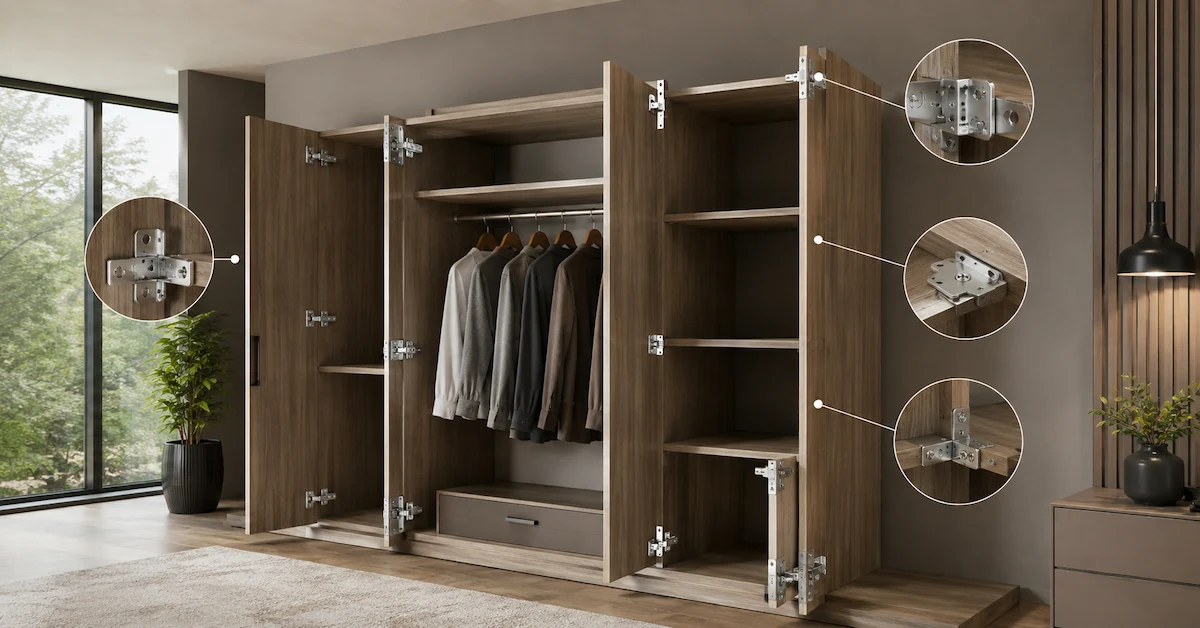
For cabinets, wardrobes, shelves, desks, storage boxes, and repair hardware packs, the cam lock system remains practical. The challenge is sourcing it properly.
Flat-pack furniture needs hardware that behaves predictably
Flat-pack furniture works because the difficult preparation happens before the box reaches the customer.
Panels are cut. Holes are drilled. Edges are finished. Hardware is counted and packed. The instruction sheet tells the user what to do next.
That model only works when the hardware behaves the same way every time.
A cam lock connector is useful because it allows panels to ship flat and then tighten together during assembly. It keeps the outside of the cabinet cleaner than large visible brackets. It also allows furniture brands to reduce carton volume, which is one reason this hardware remains common in RTA furniture and modular storage products.
Still, the connector does not work alone.
The cam needs the correct hole. The bolt needs the right length. The dowel needs to align the panels before tightening. The board needs enough strength around the drilled area. If one of those details is off, the whole joint feels wrong.
That is the part buyers sometimes underestimate.
Cam lock hardware looks simple because the engineering is hidden inside the panel.
Wholesale buyers are usually comparing systems, not single parts
When sourcing cam lock fasteners bulk, many buyers start with price. That is understandable. The quantities can be large, and even a small difference per piece can affect the total order.
But price alone does not tell buyers whether the kit will work in production.
A cheaper cam may need extra sorting. A low-cost bolt may have inconsistent length. A kit may arrive with the right number of total pieces but the wrong mix of cams, bolts, and dowels. The unit price looks good until the warehouse or assembly team starts fixing the mistake.
In real purchasing, buyers are usually comparing several things at once:
Part fit.
Packing method.
Count accuracy.
Surface finish.
Repeat supply.
Replacement support.
A good cam lock connector kit should make furniture assembly feel boring in the best possible way. The parts are there. They fit. They tighten. The next order behaves like the last one.
That kind of consistency is worth paying attention to.
The board decides more than the catalog photo
Cam lock hardware should always be reviewed with the panel material in mind.
Particleboard, MDF, plywood, laminated board, and other wood-based panels do not respond to fasteners in exactly the same way. One board may hold the bolt firmly. Another may need a different hole depth or thread type. A panel that looks strong on the surface can still fail around the hole if the connector is not matched well.
For cabinet programs, buyers should confirm the practical details before placing a bulk order:
What is the board material?
What is the panel thickness?
What cam diameter is required?
What bolt length matches the design?
What is the hole depth?
Is a dowel included for alignment?
Will the furniture be assembled once or moved and reassembled later?
These are not minor technical questions. They decide whether the cam lock latch fasteners will feel secure in the actual product.
A loose sample on a desk is useful for checking appearance. It does not prove assembly performance.
The better test is simple: build the cabinet with the actual panel, actual hole pattern, and actual hardware kit.
The cam is only one part of the kit
A cam lock is easy to recognize, so buyers often focus on it first.
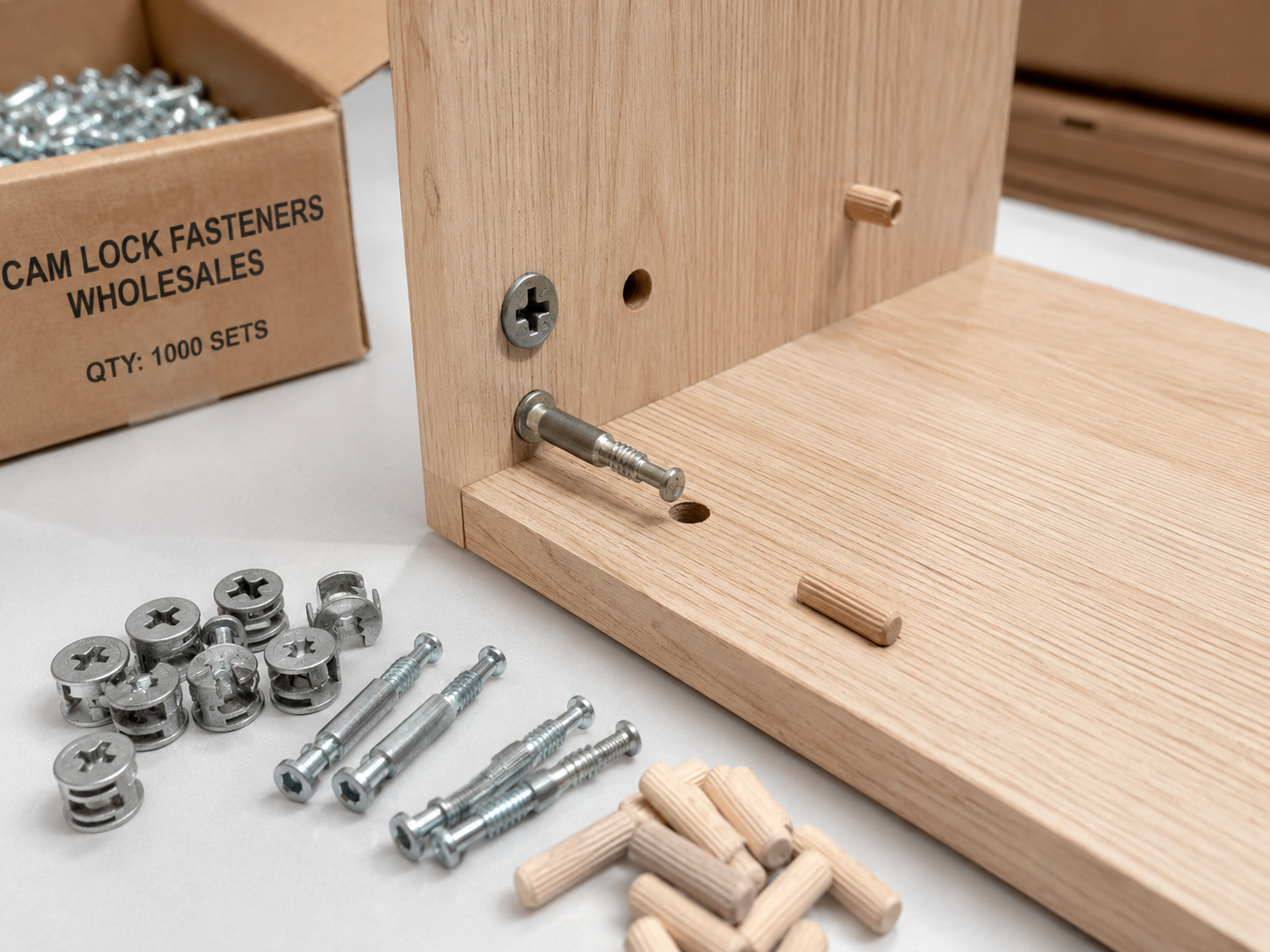
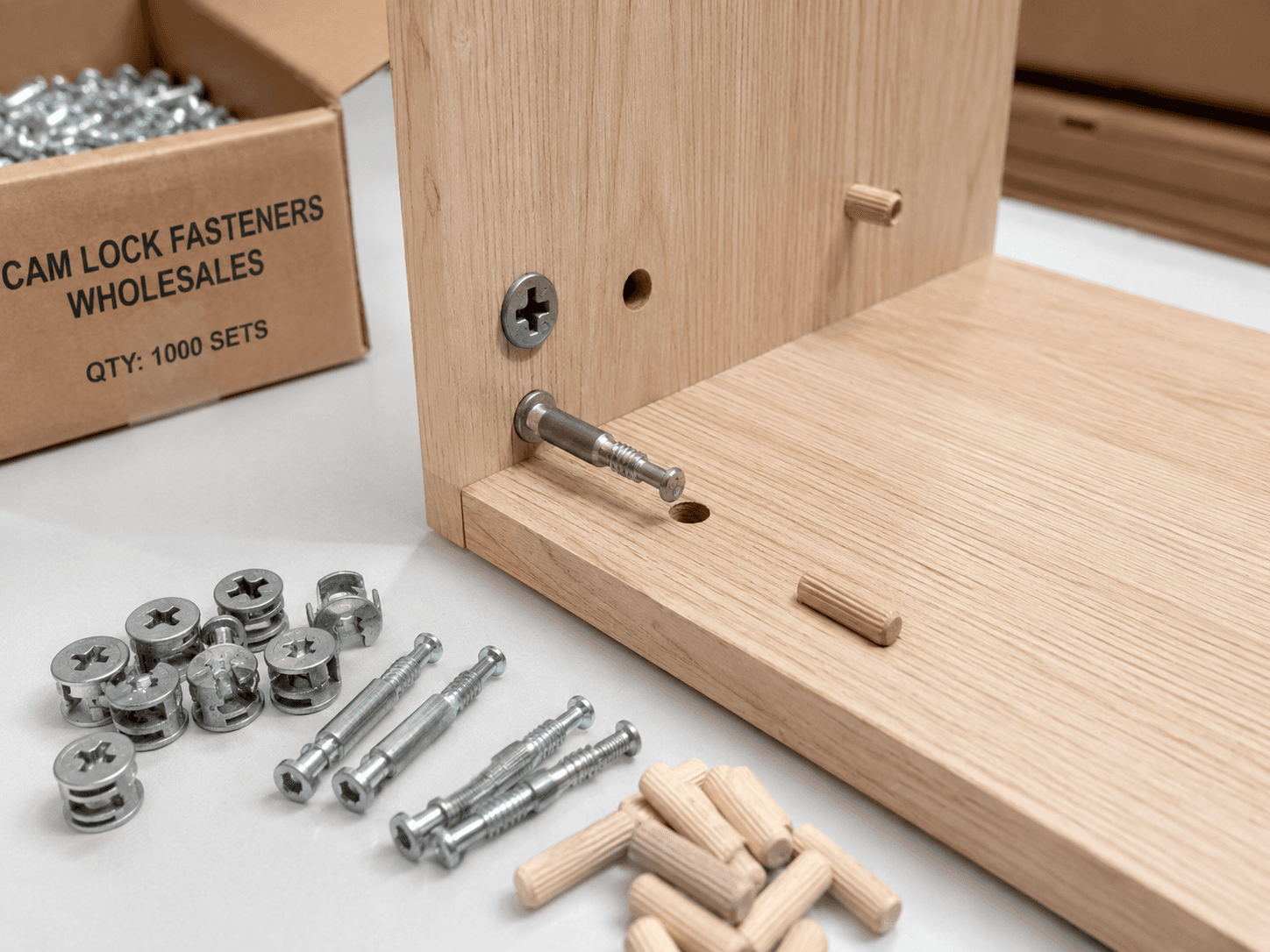
But a flat-pack furniture joint usually depends on several pieces working together. The cam pulls the joint tight. The connector bolt gives the cam something to grip. The dowel helps guide the panels into position. Other screws, brackets, caps, or small fittings may be part of the same cabinet hardware package.
If the bolt head is wrong, the cam cannot lock properly.
If the dowel is too loose, the panels may shift.
If the screw is too long, the board may be damaged.
If the kit is missing one small part, assembly stops.
That is why cam lock hardware should be sourced as a complete set, not only as loose metal components.
For furniture factories, the set needs to support the production flow. For repair-kit sellers, the set needs to be easy for customers to identify. For wholesalers, the set needs to be packed in a way that makes replenishment and stock control easier.
The same hardware can serve different channels, but the kit format may need to change.
Packaging can create or solve the problem
Cam locks, bolts, dowels, and screws are small enough to mix easily.
That is why packaging deserves attention early in the sourcing process.
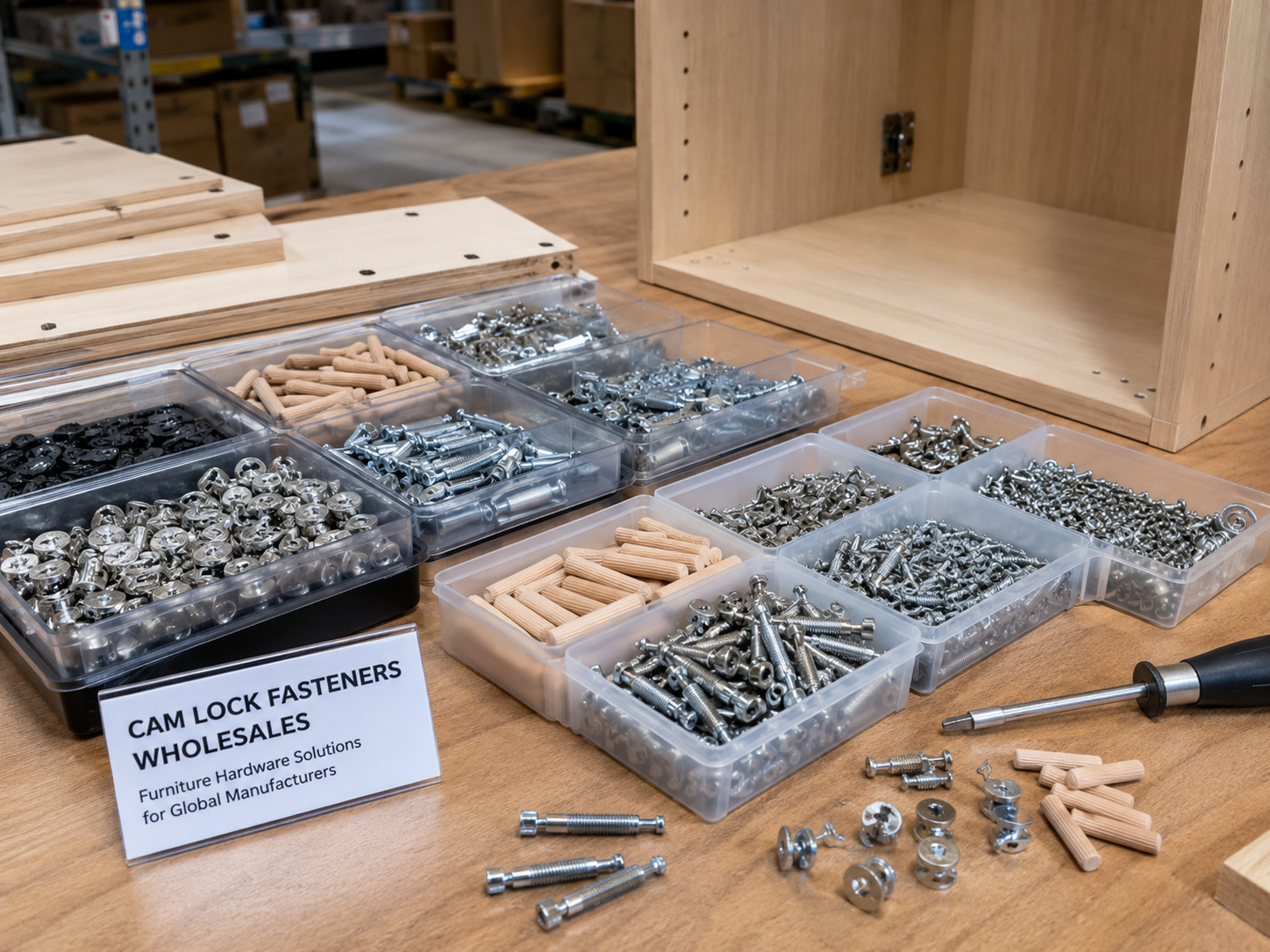
Bulk cartons may be practical for furniture factories that already have their own internal sorting and kitting process. Inner bags can work when the set is simple. Compartment boxes or retail packs may be better for repair kits, e-commerce sales, or hardware distributors.
The best format depends on who opens the pack next.
A factory worker needs speed.
A warehouse team needs clear counts.
A retail buyer needs presentation.
A customer buying repair hardware needs easy identification.
If the pack is confusing, someone pays for that confusion later. Maybe it is the assembly line. Maybe it is the warehouse. Maybe it is customer service.
A supplier that understands kitting can reduce a lot of hidden labor. The hardware may be technically correct, but if similar parts are mixed together, the order is not truly ready to use.
Finish and material should be confirmed, not guessed
Many cam lock fasteners have a bright silver or zinc-like finish. That is common in furniture hardware, but buyers should still confirm what the part is actually made from.
A cam may be zinc alloy. A bolt may be plated steel. Dowels may be wood or plastic. Screws may use another finish. None of this is a problem when the specifications are clear.
Problems begin when buyers assume from appearance alone.
For indoor furniture, standard plated hardware may be enough. For humid spaces, long storage, export shipping, or retail replacement packs, finish and corrosion behavior may deserve closer review.
Before placing volume orders, buyers should confirm base material, surface treatment, cam size, bolt length, thread type, dowel size, finish consistency, packaging protection, and substitution rules.
A sample that looks fine today should still match the next shipment.
That is the real test of wholesale supply.
Where Jiangmen Jinhe Hardware fits
Jiangmen Jinhe Hardware Co., Ltd. was founded in 2016 in Jiangmen City, Guangdong Province. The company works with machine screws, self-tapping screws, micro screws, precision screws, standard parts, and non-standard customization. Its materials include stainless steel, iron, and aluminum, with production aligned to standards such as GB, DIN, ANSI, BS, JIS, and ISO.
For buyers sourcing cam lock hardware wholesale, that fastener background is relevant because a cabinet connector program is rarely about one part only. A complete kit may include cams, bolts, screws, dowels, labels, packaging, inspection, and repeat supply control.
Jiangmen Jinhe also notes support for inspection before delivery, documentation, foreign trade, logistics, warehousing, and supply chain services. For furniture brands, repair hardware sellers, wholesalers, and cross-border e-commerce buyers, that kind of support can help when sample orders turn into repeated shipments.
A useful supplier in this category should not simply send a carton of hardware.
It should help keep the whole kit stable.
Mistakes that make cam lock sourcing harder
One common mistake is assuming all cam lock systems are interchangeable.
They are not.
Cam diameter, cam depth, bolt head shape, bolt length, thread style, board thickness, and hole position all affect how the joint works.
Another mistake is judging from product photos only. Two cam lock kits may look nearly identical online but behave differently in the actual cabinet.
A third mistake is separating hardware sourcing from packaging. If the cams, bolts, dowels, and screws are not packed clearly, the kit can still fail even when the parts themselves are acceptable.
Buyers also sometimes blame the connector when the real problem is panel drilling. Hole position and hole depth are critical in flat-pack furniture. A good hardware set cannot fully correct a poor drilling pattern.
The safest approach is to test the full chain: board, holes, cam, bolt, dowel, packaging, and assembly sequence.
Questions buyers should ask before ordering
Before buying cam lock fasteners bulk, buyers should ask practical questions.
What cam sizes are available?
Which bolt lengths match each cam?
What board thickness is the kit designed for?
What materials and finishes are used?
Can the set be tested with our actual panel?
Are dowels, screws, caps, or other fittings included?
How are similar parts separated during packing?
Can the hardware be supplied in bulk cartons, repair packs, or retail kits?
Can OEM labels or model numbers be added?
How is the kit count checked before shipment?
What inspection documents are available?
Can the same specification be repeated in later orders?
Can logistics or warehousing support be included?
A supplier that understands furniture hardware should be able to answer in relation to the cabinet structure, not only the piece price.
Frequently Asked Questions
What is cam lock hardware used for?
Cam lock hardware is commonly used to join panels in flat-pack furniture, cabinets, wardrobes, shelves, desks, and modular storage units.
Are cam lock latch fasteners reusable?
Many cam lock joints can be disassembled and reassembled, but performance depends on board material, hole quality, hardware fit, and how carefully the joint is handled.
Are all cam lock fasteners the same?
No. Cam locks vary by diameter, depth, bolt length, bolt head style, thread, material, finish, and panel compatibility.
Can cam lock hardware be ordered in bulk?
Yes. Cam lock fasteners bulk orders are common for furniture factories, hardware distributors, repair-kit sellers, and e-commerce suppliers.
Why does packaging matter for cam lock hardware?
Because the system usually includes several matching parts. If one cam, bolt, dowel, or screw is missing or mixed, the assembly may stop.
What should buyers test before bulk ordering?
Buyers should test the cam lock, bolt, dowel, board material, drilling pattern, packaging format, and real assembly sequence before placing large orders.
Good cam lock hardware keeps assembly quiet
The best cam lock hardware does not make the customer think about the connector.
The panels align. The cam catches. The bolt pulls. The dowel guides. The kit is complete. The next shipment matches the approved sample.
That is what buyers should expect when sourcing cam lock hardware wholesale.
For cam lock connector kits, cam lock latch fasteners, cam lock fasteners bulk, cabinet hardware kits, flat-pack furniture hardware, and custom fastener packaging, Jiangmen Jinhe Hardware Co., Ltd. can discuss fastener selection, kit structure, packaging formats, inspection, logistics, warehousing, and repeat supply needs.
For direct inquiries:
Tel/WeChat: +86 13729150102
WhatsApp: +86 13322893939
Email: sharon@hkhomeideas.com
Start with the panel material, cam size, bolt length, drilling pattern, packing method, and expected order volume.
Once the full assembly system is clear, the right cam lock hardware becomes much easier to source and repeat.