
Short answer: Cold heading vs CNC machining is a choice between forming metal and cutting it away. Cold heading is usually the lower-cost and stronger route for round, headed screws at volume, because the grain flow follows the part and very little material becomes chips. CNC machining wins when the part needs tight tolerances on several features, non-round geometry, or a quantity too low to justify dies. Many custom screws use both routes in sequence.
By the JHFIX technical team
Most buyers meet this question in the wrong order. They receive two quotes for the same drawing, see a large gap, and assume one supplier is overcharging. Usually the two suppliers have proposed two different process routes, and neither quote explains it. The process decision comes first; the price only means something after it.
The short verdict
The cold heading vs CNC machining decision is really three decisions: quantity, geometry and failure mode. If the part is round, has a formed head, and you will buy it in the tens of thousands or more, cold heading should be the first route you cost. If the part has tight tolerances on several features, a non-round body, cross holes, or a volume in the hundreds, machining is usually cheaper to start and cheaper to change. If the part is a headed screw with two or three precision features, the answer is often heading plus a short machining operation — not one process instead of the other.
| Choose cold heading when | Choose CNC machining when |
|---|---|
| The part is a screw, bolt, rivet, pin or nut with a round body and an upset head | The body is non-round, or the part needs milled flats, slots, pockets or cross holes |
| Annual volume is high enough to absorb a die set | Volume is low, uncertain, or still in prototype |
| Strength and fatigue life at the head-to-shank fillet matter | Several dimensions must hold tight tolerance in one setup |
| The design is stable and unlikely to change after approval | The design is still moving and changes weekly |
| You want the lowest material waste per piece | You want the shortest path from drawing to first part |
What each process actually does
Cold heading: forming a screw from wire
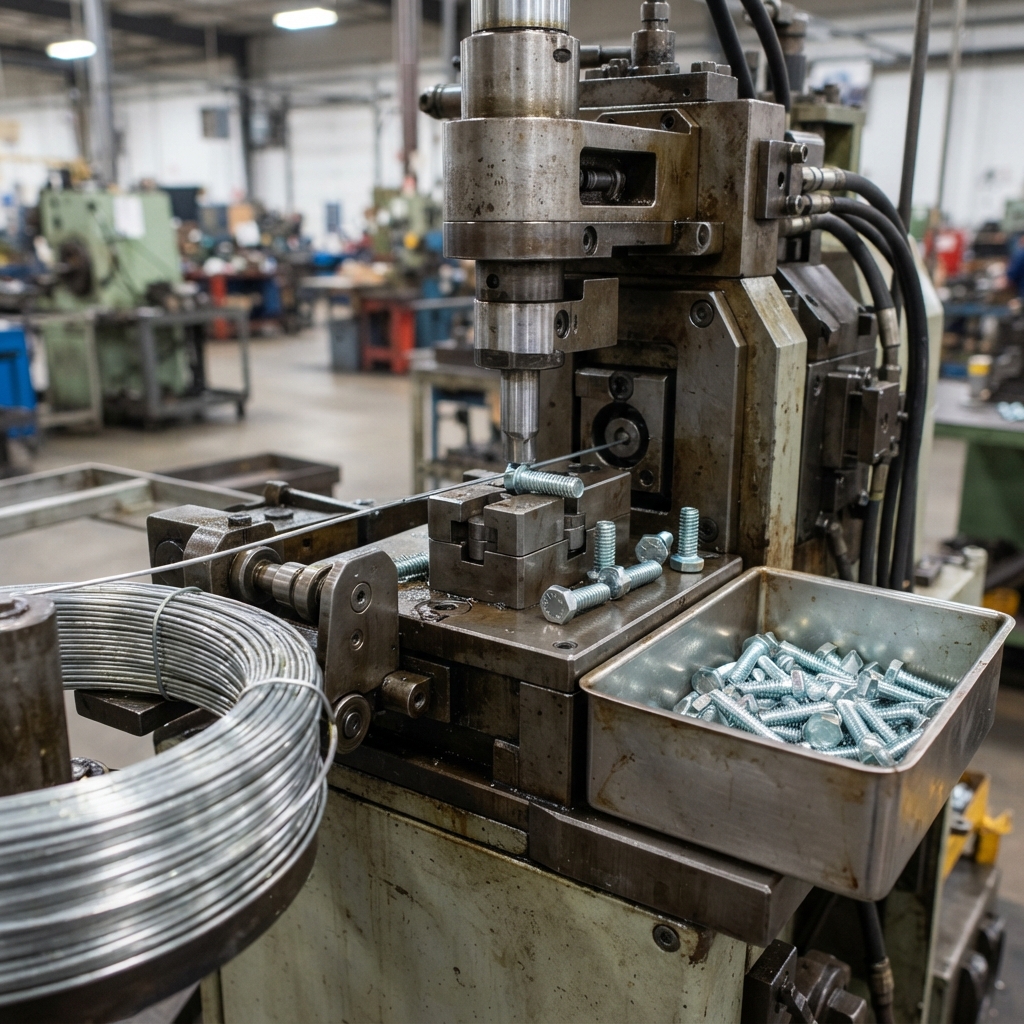
The cold heading process starts with coiled wire rather than a cut blank. The wire is cleaned and lubricated, sometimes annealed, then fed into a former that shears a slug and upsets it into a die. The slug volume is fixed, so the metal is redistributed rather than removed.
- Wire preparation. Cleaning, coating and, for harder grades, an anneal that restores ductility before forming.
- Shearing. The wire is cut to a slug whose volume equals the finished part plus a small allowance.
- Upsetting and extrusion. One blow or several stations form the head, shank, step, taper or recess inside dies.
- Thread rolling. Flat or cylindrical dies displace material into the thread form instead of cutting it.
- Secondary and finishing. Pointing, slotting, drilling, heat treatment, coating, sorting and packing.
The economics follow the tooling: the die set is paid once, then the per-piece cost falls as quantity rises. That is why heading quotes become dramatically cheaper at high volume and barely move at low volume.
CNC machining: cutting a screw from bar or blank
Screw machining starts with bar stock, a forged blank or a headed blank and removes material with turning, milling, drilling and threading tools. The route is program-driven: setup is short compared with die making, design changes are cheap, and one machine can produce several geometries in a day.
- Bar feed and primary turning. Diameter, shoulder, undercut and end geometry are established.
- Secondary features. Cross holes, slots, flats, hex sockets or eccentric features are milled or drilled.
- Threading. The thread is cut, milled or, on some machines, rolled with an attachment.
- Finishing. Deburring, heat treatment, coating, inspection and packing.
The trade-off is cycle time and scrap. Every feature costs machine minutes, and the more material removed from the bar, the longer the cycle and the larger the chip pile. CNC turned screws are therefore at their best when the part is simple enough to finish in one or two setups, or when the quantity is too small to justify a die.
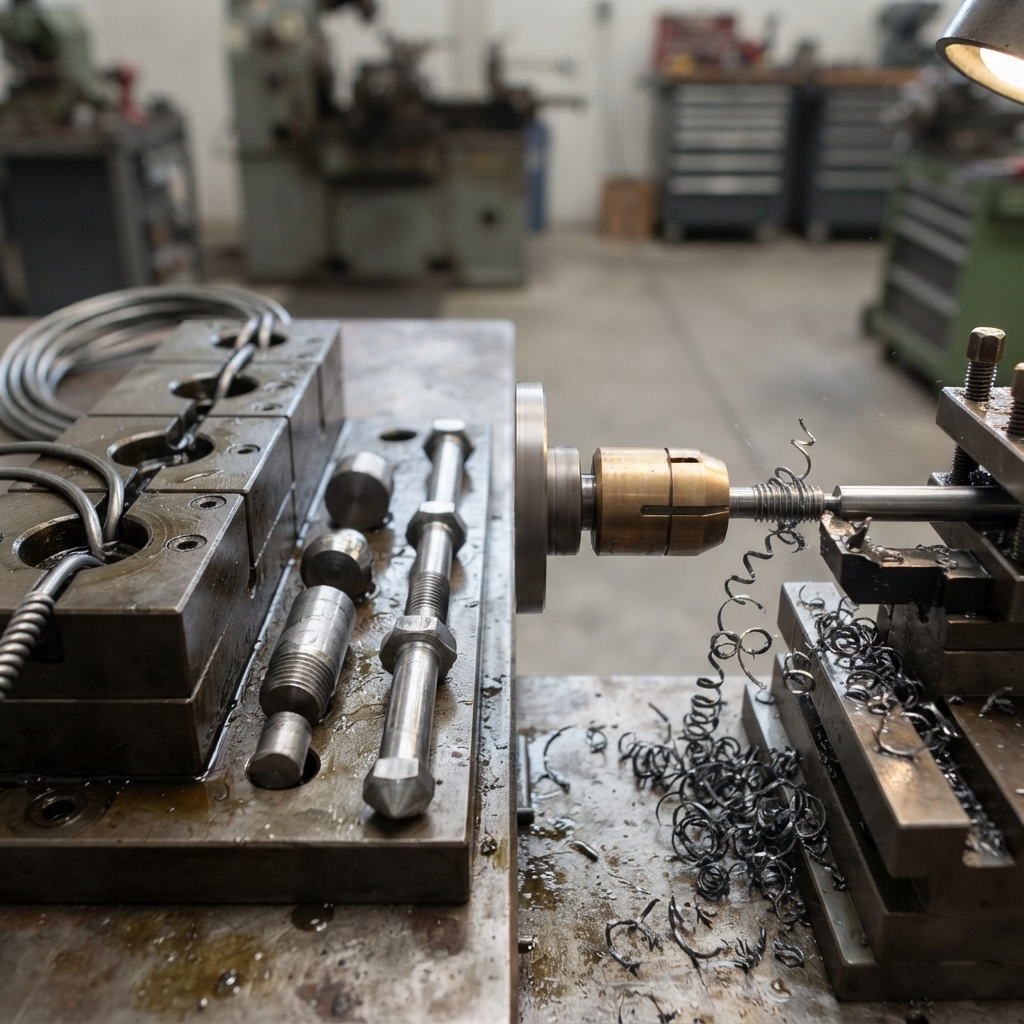
Cold heading vs CNC machining: side-by-side comparison
| Criterion | Cold heading | CNC machining |
|---|---|---|
| Material use | Very high; waste is mainly shear loss and trim | Lower; chips can be a large share of the bar |
| Grain flow | Continuous, following the part contour | Cut through; grain ends at machined surfaces |
| Typical tolerance | Commercial on formed features; critical dimensions need secondary operations | Tight on turned and milled features, especially in one setup |
| One-time cost | Dies, punches and thread rolls | Program, fixtures and cutting tools |
| Economic quantity | High volume; unit cost falls with quantity | Low to medium volume; unit cost is nearly flat |
| Geometry freedom | Round bodies, heads, steps, tapers, forward and backward extrusion | Almost any shape the tool can reach |
| Design changes | Usually require a die change | Usually require a program change |
| Lead time | Die build, trial, first article, then production | Material and programming, then machine time |
| Best fit | Standard and custom screws at volume | Prototypes, low volume, complex or non-round parts |
1. Strength and grain flow
Cold heading does not only shape the metal; it moves the grain. A headed screw has grain flow running continuously from shank into head, following the contour instead of being cut off at a shoulder. At the head-to-shank fillet, where bending stress concentrates, that continuity is an advantage. The same logic applies to threads: rolling displaces material and leaves an uninterrupted grain structure at the thread root, while cutting interrupts it. Industry process guides describe this as one of the main reasons cold-formed fasteners perform well under fatigue (TFG USA, 2025; Component Solutions Group, 2026).
Screw grain flow is also why the head rarely separates from the shank in a headed part, even when the screw is overloaded: the failure usually moves to the thread or the joint rather than to the transition. Cold working also work-hardens the material, raising strength and reducing ductility. That is helpful in a screw that must resist stripping and unhelpful in a part that must absorb impact. Harder grades may need an anneal between forming blows, which adds a step and a cost that a heading quote should show.
Where the advantage stops
A machined screw is not automatically weak. With the right material and heat treatment, a machined part can meet the same property class as a headed one; ISO 898-1 defines property classes by measured mechanical properties, not by process route. What machining gives up is grain continuity at stress concentrations and the compressive residual stress that forming leaves at the surface. For a furniture connector under static load, this rarely decides anything. For a part that sees vibration, repeated bending or impact, it can decide the failure mode. That is a question about the joint, not about the supplier's brochure.
2. Tolerance and feature capability
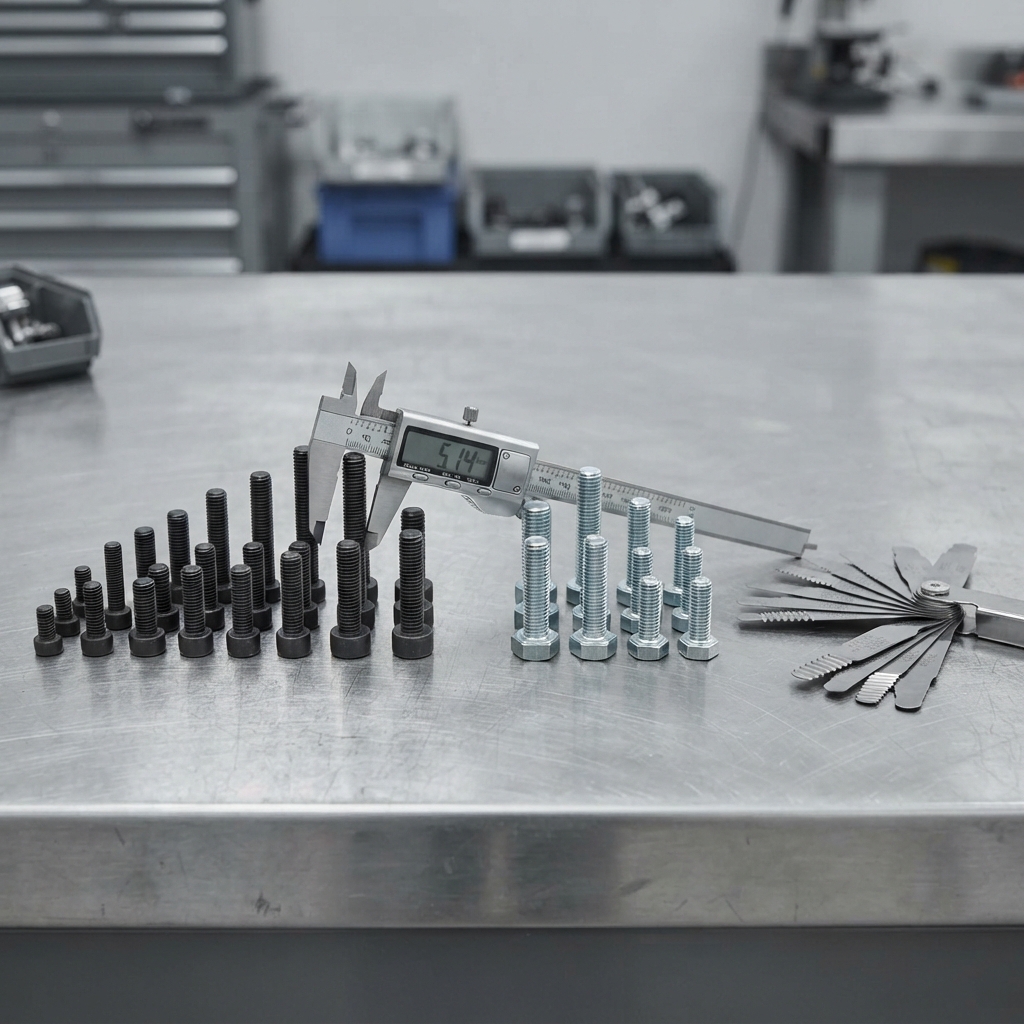
Cold heading is a high-speed forming process. Die wear, springback and metal flow mean formed features sit inside commercial tolerances rather than precision ones. ISO 4759-1 sets out tolerance grades for fasteners and gives both sides a common language during drawing review. When a dimension is critical — a shank diameter used as a bearing surface, a shoulder used for location, a recess used for driver fit — the usual answer is not to change the whole process but to add a secondary operation: turn the shank, mill the slot, broach the recess.
Machining starts with the tolerance advantage. A single setup can hold diameter, concentricity and length relationships that heading would need two operations and a fixture to reach. The cost is time: every tight dimension is machine minutes, and every extra operation is another setup and another chance for handling damage. This is why a drawing that calls out six tight dimensions is usually a machining drawing, whatever the part looks like.
| Feature | Usual route | Why |
|---|---|---|
| Head, washer face, basic shank | Cold heading | Formed in the die at high speed |
| Thread on a headed part | Thread rolling | Faster than cutting and stronger at the root |
| Precision shank or locating shoulder | Head, then turn | Forming tolerance is not enough; machining brings it in |
| Cross hole, slot, offset hex | Machine, or head then machine | The die cannot form it on the main axis |
| Long, slender part | Machine from bar, or head a long shank | Buckling and die length limit heading |
| Non-round body | Machine or stamp | Heading produces round sections |
3. Tooling, MOQ and the volume where the economics flip
Screw tooling cost is the first line that separates the two routes. Cold heading carries a one-time cost for dies, punches and often thread rolls. The supplier either charges it separately or spreads it across the piece price. Both are legitimate, but they are not comparable until you put them on the same basis. A quote with "free" tooling has not removed the cost; it has moved it, and it may also mean the die is not yours.
The comparison that matters is:
Effective cost per piece = quoted unit price + (tooling and setup ÷ order quantity)
Run it on every offer, including the ones that look obviously cheap or obviously expensive. A hypothetical example makes the mechanics clear; the numbers are illustrative, not a market price.
| Cold heading | CNC machining | |
|---|---|---|
| One-time tooling and setup | USD 3,000 | USD 300 |
| Quoted unit price | USD 0.020 | USD 0.055 |
| Effective cost at 10,000 pcs | USD 0.320 | USD 0.085 |
| Effective cost at 50,000 pcs | USD 0.080 | USD 0.061 |
| Effective cost at 100,000 pcs | USD 0.050 | USD 0.058 |
The crossover in this example sits at about 77,000 pieces: (3,000 − 300) ÷ (0.055 − 0.020). Below it, machining is cheaper once tooling is counted. Above it, heading wins and keeps winning. This is why "we only need 20,000 for the trial" and "we need two million a year" should produce different processes, not the same drawing at a different price.
Tooling ownership matters as much as tooling cost. If you pay for a die, the terms should say the die is yours, tagged to your part number, maintained by the supplier and transferable if you move. Without that sentence, "free tooling" can become a lock-in, and the second order is where it gets priced. Our guide to fastener tooling cost and ownership sets out the three common quoting models and what each one leaves in the buyer's hands.
4. Lead time: two different queues
The lead-time comparison in cold heading vs CNC machining is really a comparison of queues. Heading lead time is mostly waiting: die design, die making, trial, first-article approval, then production. Machining lead time is mostly machine time: material, programming, setup, then a cycle that is slower per piece. Neither is automatically faster. A simple machined part can ship in days; a headed part with a new die can take weeks before the first good piece exists.
Ask for the milestone schedule instead of a single date: die drawing approval, die trial, first article, first-article approval, production start, finishing, packing and dispatch. A supplier who can only give one date has not planned the route. Our guide to verifying custom screw lead time explains how to test a quoted delivery date against those milestones.
5. Material waste, material choice and finishing
Heading buys wire in coil and uses nearly all of it; the scrap is the shear allowance and the trim. Machining buys bar and turns a large part of it into chips. On a small screw machined from a large bar, the material yield can be poor enough to matter more than the machine rate. On a large part from a near-net forging, the gap narrows.
In custom screw manufacturing, material behaviour decides as much as price. Low-carbon steel heads easily. Medium-carbon and alloy grades may need a spheroidise anneal before heading, or an anneal between blows. Stainless grades such as 304 and 316 work-harden quickly, which limits the number of forming blows and can require intermediate annealing; the same grades are prone to galling when machined and tapped. Neither route removes the need to specify the grade, condition and heat treatment properly.
Finishing is largely independent of the forming route: zinc plating, zinc flake, Ruspert-type coatings, electrophoretic coating, blackening and plated colours can follow either process, provided the substrate and pre-treatment suit them. Two points do depend on process. Formed surfaces have a different roughness and texture from machined surfaces, which changes coating appearance. And high-strength parts that are electroplated need hydrogen embrittlement relief baking; ISO 4042 covers electroplated coating systems and the classes used to specify them, and it is worth naming in the purchase specification rather than writing "zinc plated".
The hybrid route most buyers overlook
The real question is not cold heading vs CNC machining as a binary choice. The two are not mutually exclusive, and heading the body while machining only the features that need it often delivers most of the cost benefit with all of the function. A hex or Torx recess can be formed and then broached; a shank can be headed oversize and turned to a bearing fit; a cross hole can be drilled after heading; a slot can be milled into a formed head.
The cost logic is simple. Every minute of machining removed from the route is money back, and every tolerance moved to a secondary operation is control regained. Ask for the route sheet and look for the operations that exist only because the blank was formed.
This is also where most "headed versus machined" arguments go wrong. Buyers compare a fully machined quote with a fully headed quote and conclude that one process is cheaper. The real choice is usually which features to machine, and that decision sits with the drawing, not with the supplier's price list.
Decision checklist before you send the RFQ
Use this checklist to turn the cold heading vs CNC machining question into six facts a supplier can quote against.
| Question | Why it changes the route |
|---|---|
| What is the annual quantity, and what is the first order? | Sets whether tooling amortisation is trivial or dominant |
| Which three dimensions actually control assembly? | Separates formed features from features that must be machined |
| Is the body round, and can the head be upset? | Heading needs a round section and a formable head |
| Are there cross holes, slots, flats or non-round sections? | These usually force a machining operation |
| What is the joint: static, vibration, impact or repeated bending? | Decides whether grain flow and fatigue life matter |
| What material and condition are specified? | Some grades need annealing before or during heading |
| What coating and class are required? | Affects pre-treatment, baking and handling |
| Is the design frozen? | Changing a die is slower and costlier than changing a program |
| Who owns the tooling, and is it transferable? | Determines your leverage on the second and third order |
| What happens if the part fails in service? | Sets how much process evidence is worth paying for |
Common mistakes in process selection
Most cold heading vs CNC machining mistakes are made before the RFQ leaves the building, not on the shop floor.
- Specifying the process on the drawing. A drawing should define the part, not the route. When a buyer writes "CNC machined" on a part that could be headed, the supplier quotes what was asked and the comparison is over before it starts.
- Assuming machining means precision. Machining can hold tight tolerance, but a badly set up machine or a worn tool holds nothing. Precision comes from the tolerance callout and the inspection, not the process name.
- Comparing quotes made by different routes. A headed quote and a machined quote are not two prices for one thing. Normalise the route, the operations and the tooling before comparing the numbers.
- Forgetting secondary operations. Deburring, drilling, slotting, heat treatment and sorting all appear on the route sheet. A quote that omits them is not cheaper; it is incomplete.
- Ignoring tooling ownership. Paying for a die without written ownership is paying for someone else's asset, and it shows up in the price of every later order.
- Approving a sample made outside the production route. A hand-machined sample can pass every dimension check and tell you nothing about a headed production part. Ask for the first article from the production process.
How we approach process selection at JHFIX
We treat cold heading vs CNC machining as a quotation question, not a preference. Our plant in Jiangmen, Guangdong runs cold heading, tapping, punching, injection moulding, assembly, packing and an inspection room under one roof, and has supplied fasteners and furniture hardware to buyers in more than 40 countries over two decades. Manufacturing is carried out by Jiangmen Jinhe Hardware Products Co., Ltd.; international sales, contracts and export coordination are handled by its authorised export partner, Jiangmen Shenxin Trading Co., Ltd. We publish both names so that buyers can check the plant and the contracting entity separately.
In practice we review the drawing before quoting and ask three questions: what is the annual quantity, which dimensions actually control assembly, and what happens if the part fails. Those answers decide whether we propose heading, machining or heading with secondary machining. For the products in our range, self-tapping and machine-thread configurations from M1 to M12 and lengths from 3 mm to 200 mm can be reviewed where compatible with the confirmed subtype, and MOQ starts at 10,000 pcs per confirmed specification. We quote both made-to-drawing and made-to-sample, and finish options include zinc plating, Ruspert coating, spray painting, electrophoretic coating, blackening and plated colours.
We do not claim that one route is always better. We do claim that the route should be chosen before the price is compared, because a price without a route is just a number.
Two examples from our range
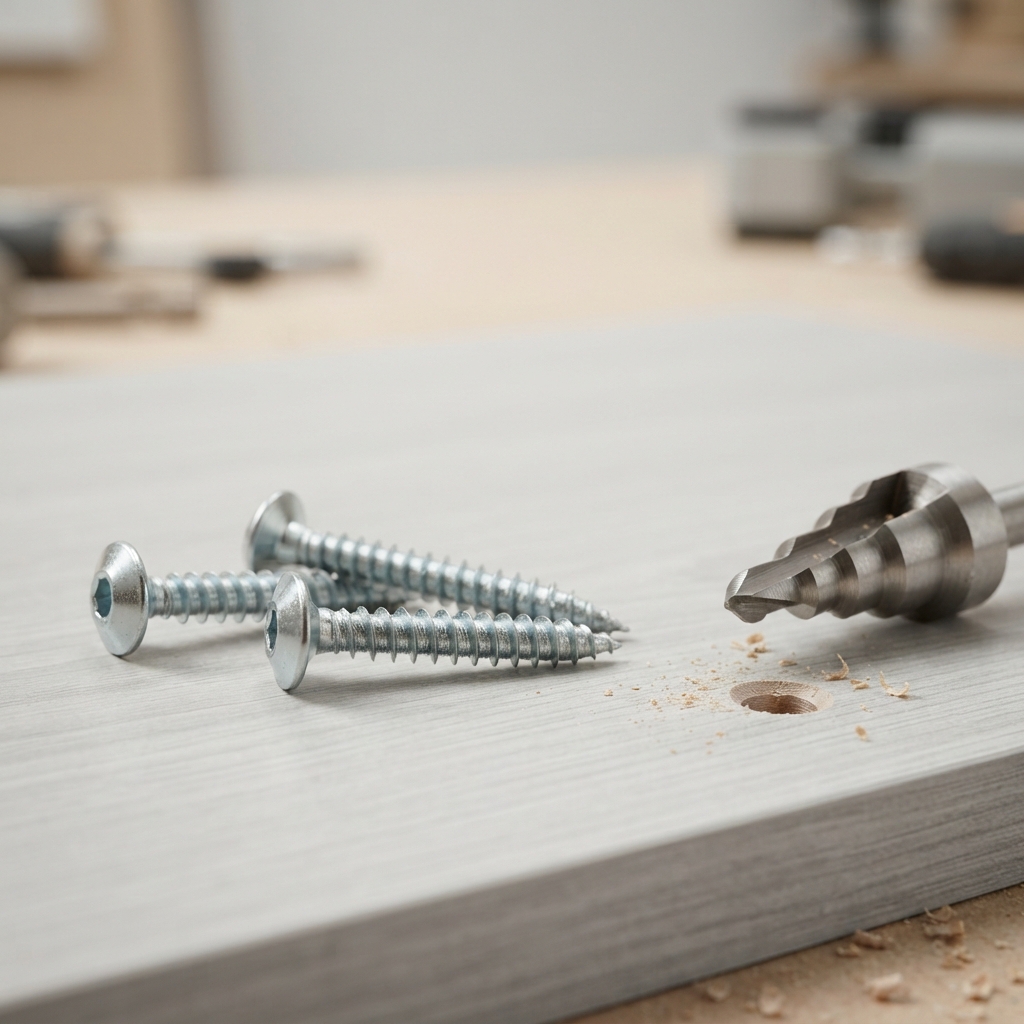
The cross-drive countersunk self-tapping screw is a shape that normally starts as a headed blank: a countersunk head, a coarse full-length thread and a sharp point, shown at M3.5 × 25 mm. The features that decide whether it works are the countersink angle and seat, the cross-recess fit, and the point geometry relative to the substrate and pilot hole. All three are checked against the approved drawing or sample rather than against the photograph.
The hex-socket low-profile wide-head machine screw is a fully threaded machine screw with a low, wide bearing head, an internal hex and a blunt end, listed in M6 and M8 with lengths from 12 mm to 150 mm. Here the hex recess and the bearing face are the features that decide driver fit and clamp load, so they are the ones to control first. It is not a self-tapping screw; it needs a confirmed nut, threaded insert or tapped hole.
Both examples show why the cold heading vs CNC machining question has to be asked part by part, with the joint in view rather than the photograph alone.
FAQ
Is cold heading always stronger than machining?
No. It is usually stronger in fatigue at the head-to-shank fillet and at rolled thread roots, because the grain flow is continuous. A machined part made from the correct material and heat treated to the specified class can meet the same mechanical property requirements. The advantage depends on the failure mode, not on the process name alone.
Can a cold-headed screw hold tight tolerances?
Formed features sit in commercial tolerance ranges. When a dimension must be tighter, it is normally brought in by a secondary operation such as turning, broaching or grinding. The mistake is to demand precision from the die instead of paying for the operation that delivers it.
What quantity justifies cold heading tooling?
There is no universal number. Calculate the effective cost per piece at your real annual quantity with tooling included, then compare it with the machined alternative at the same quantity. In the illustrative model above, the crossover was around 77,000 pieces. Your tooling cost, unit prices and volume will move that point.
Why do machined screws cost more per piece?
Because the price is dominated by machine time and material waste. Each feature is cut in sequence, and the chips are material you paid for and cannot use. Heading spreads its cost over a die and a high-speed stroke, which is why its unit price drops sharply with volume.
Can a supplier combine cold heading and CNC machining?
Yes, and it is common on custom parts. The body is headed, then the features that need precision or cannot be formed on the main axis are machined. This usually gives a lower piece price than full machining while keeping the tolerances that matter.
Does cold heading work with stainless steel?
It does, but stainless grades work-harden quickly, which limits the number of forming blows and may require intermediate annealing. Grade, condition and forming route should be reviewed together. Machining stainless brings its own issue: 304 and 316 are prone to galling, so tooling, lubrication and tapping strategy matter.
What should I send with an RFQ to get a process recommendation?
Send the part drawing with tolerances and material, the mating components and joint section, the annual and first-order quantity, the coating and acceptance requirements, and the packaging requirement. Say whether the design is frozen. With those six items, a supplier can propose a route instead of guessing at one.
Conclusion
Cold heading vs CNC machining is a decision about volume, geometry and failure mode, and it should be made before prices are compared. Heading gives continuous grain flow, near-complete material use and a unit cost that falls with quantity, at the price of tooling and a longer setup. Machining gives tolerance, shape freedom and fast changes, at the price of cycle time and scrap. Most custom screws sit between the two, with a headed body and a few machined features.
If you are not sure which route your part belongs on, send the drawing, the annual quantity and the joint details through our contact page. We will tell you which route we would quote, which features we would machine, and what the tooling would cover — before anyone argues about the piece price.