
What Should a Concealed Furniture Connector Supplier Actually Help You Solve?
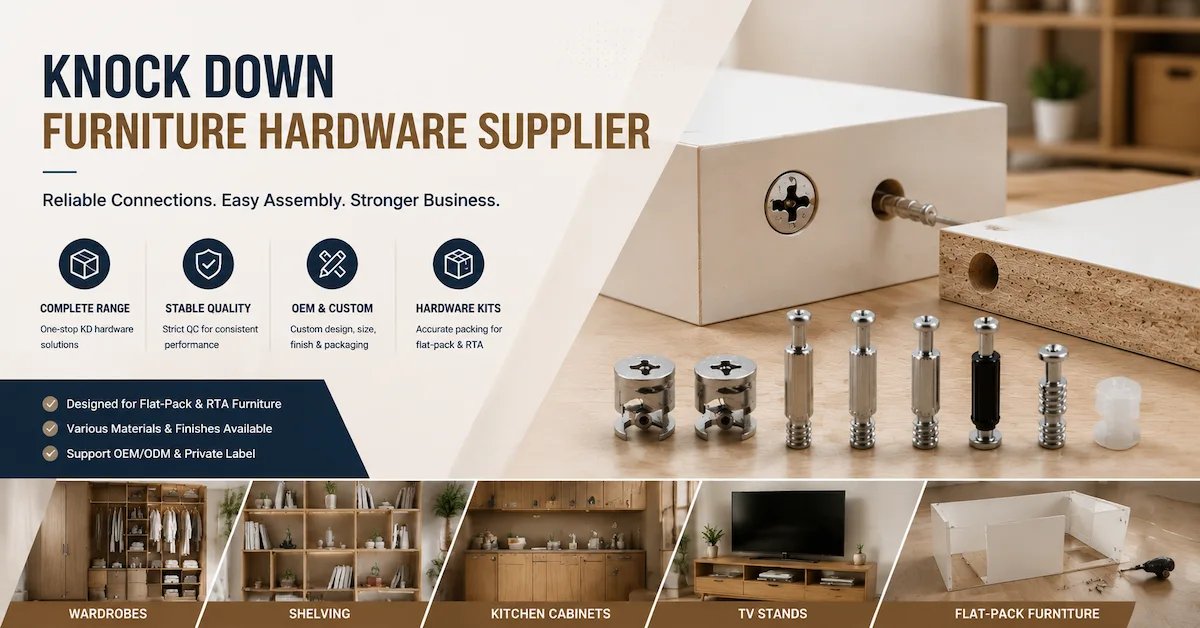
A concealed furniture connector supplier is not simply selling hardware that disappears inside a cabinet panel.
For furniture manufacturers, the more important issue is whether that hidden connection can be reproduced reliably across hundreds or thousands of assemblies.
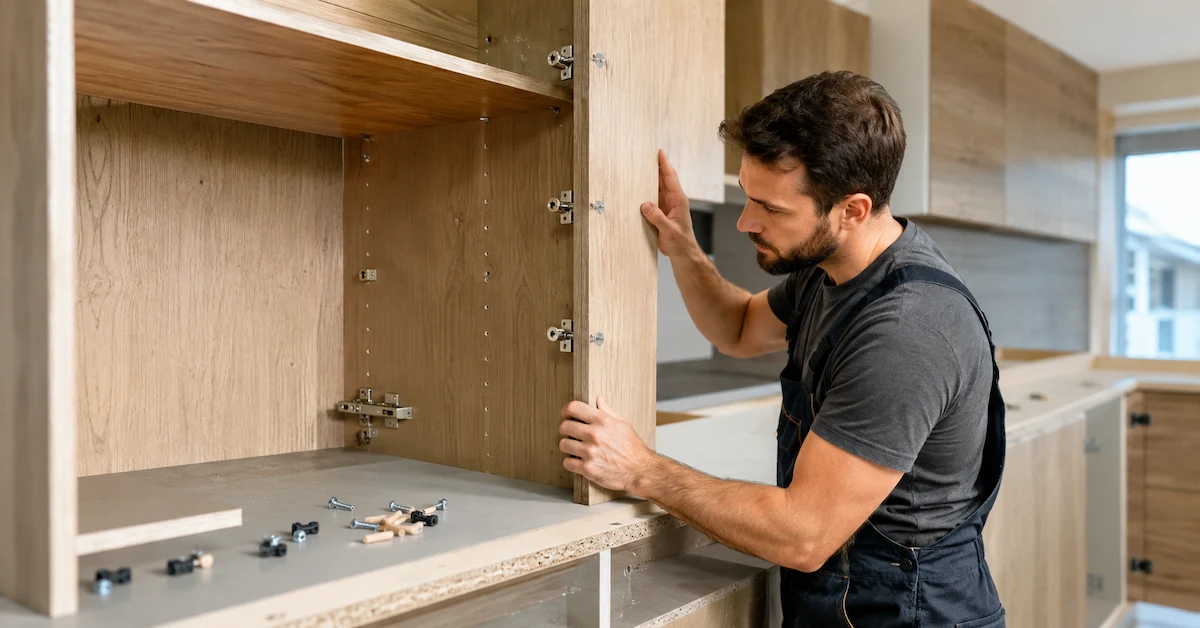
A connector may look correct on a sample table and still create trouble when it reaches production. The bolt can sit a little too high. The drilling depth may not match the connector. A cam may pull correctly in one panel but feel loose in another. Packaging may mix two visually similar fittings that belong to different furniture models.
Those are supplier problems as much as product problems.
For cabinet, wardrobe, shelving, and flat-pack furniture projects, buyers should evaluate the complete connection:
panel → drilling → connector → mating part → tightening → final joint
The supplier's job is to help make that sequence repeatable.
Who Is Usually Searching for Concealed Furniture Connectors?
This keyword has strong B2B purchasing intent.
Typical buyers include:
- Cabinet factories
- Flat-pack furniture manufacturers
- RTA furniture brands
- Wardrobe manufacturers
- Kitchen furniture factories
- Modular furniture manufacturers
- Furniture importers
- Hardware distributors
- Private-label furniture brands
- OEM purchasing teams
These buyers are normally past the basic question of “what is a furniture connector?”
They are more likely asking:
- Will this connector work with our panel thickness?
- Can you match our current fitting?
- Can you manufacture from our drawing?
- Will the connector remain invisible after assembly?
- Can we purchase the mating bolt from the same source?
- Can you pack the parts according to our furniture BOM?
- How will you control dimensions between repeat orders?
- What affects MOQ and tooling?
- Can samples be approved before bulk production?
A strong article—and a strong supplier—needs to answer those questions directly.
Concealed, Hidden and Invisible Furniture Connectors: Are They the Same?
In purchasing enquiries, the terms are often used loosely.
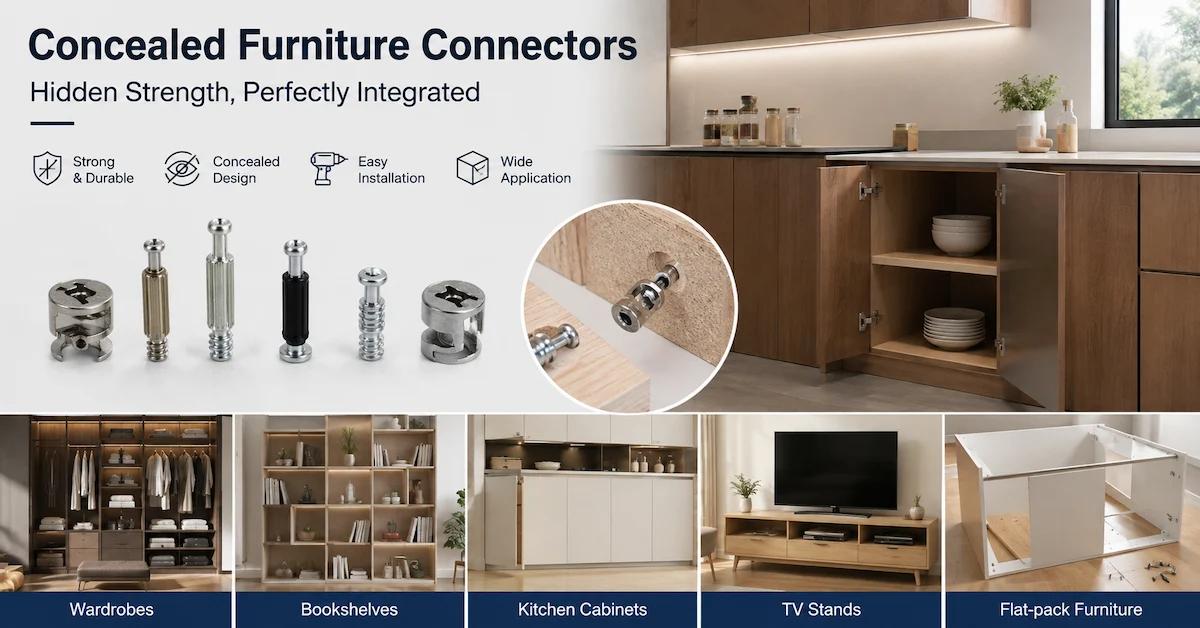
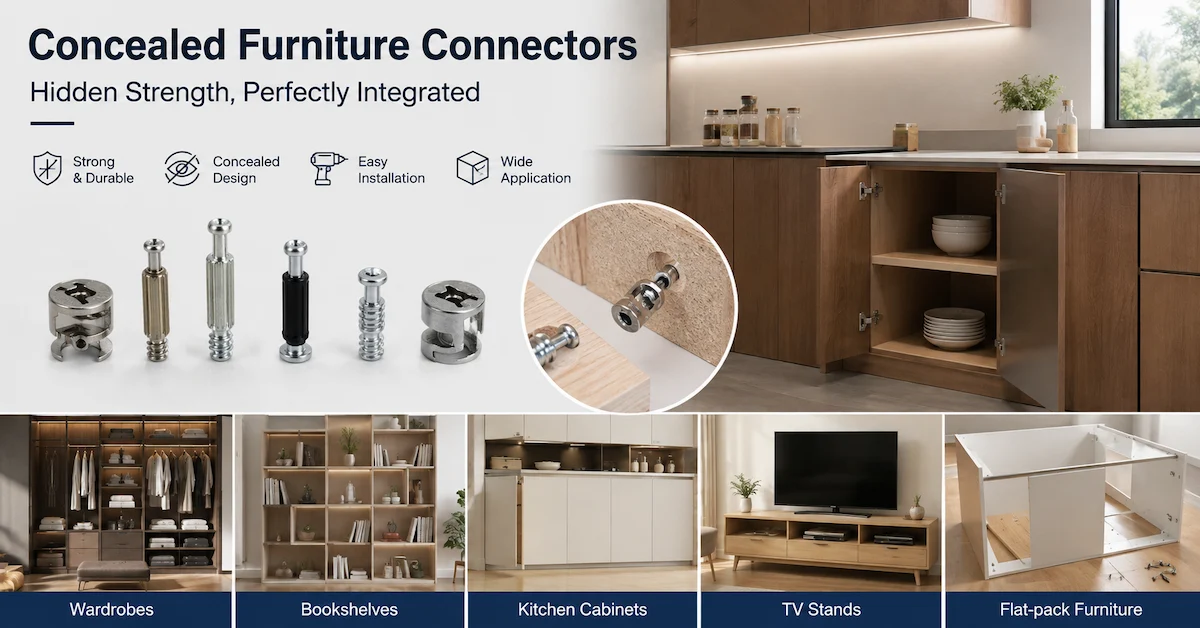
Concealed furniture connectors generally refer to hardware designed so that most or all of the joint is hidden after furniture assembly.
Hidden furniture connectors is a closely related commercial term. Buyers may use it for cam systems, concealed bolts, internally mounted fittings, and other connection systems that minimize visible hardware.
Invisible furniture connectors usually expresses the same design goal: a clean finished surface without an exposed screw head or bracket.
The actual hardware structure can still differ significantly.
That is why an invisible furniture connector supplier should not quote only from the phrase “invisible connector.” A drawing, sample, panel specification, or assembly photo is far more useful.
JHFIX currently lists invisible furniture connectors for cabinet, storage, kitchen, bedroom, dining, office, and flat-pack furniture applications, while advising buyers to confirm panel material, drilling pattern, mating hardware, and assembly drawing before ordering.
Why Furniture Manufacturers Use Concealed Connection Systems
The most obvious reason is appearance, but production buyers usually have more practical reasons.
Cleaner Furniture Surfaces
Visible screw heads and brackets may conflict with minimalist furniture design.
Concealed connectors allow the outside surface to remain visually cleaner.
Knock-Down Assembly
Many connector systems make it possible to assemble furniture after transportation rather than shipping a fully assembled unit.
This is particularly relevant for:
- Flat-pack cabinets
- Wardrobes
- Shelving
- Office furniture
- Modular storage
- RTA furniture
Repeatable Production
Once drilling and connector geometry are standardized, the same connection can be repeated across a furniture model.
That repeatability is valuable in volume manufacturing.
Easier Hardware Kitting
A standardized connection system can be incorporated into a model-specific hardware bag or kit.
That becomes especially useful for furniture shipped directly to installers or end users.
Which Concealed Connector Types Should Buyers Compare?
There is no single connector that works best for every furniture project.
| Connector Type | Typical Use | Key Buyer Concern |
|---|---|---|
| Cam lock + bolt | Flat-pack cabinet panels | Drilling and mating accuracy |
| Minifix-type connector | RTA and modular furniture | Panel thickness and alignment |
| Concealed connecting bolt | Hidden structural joint | Length and mating component |
| Insert nut + bolt | Reusable threaded assembly | Thread and panel installation |
| Internal metal fitting | Custom furniture structure | Geometry and mounting position |
| OEM hidden connector | Special furniture design | Drawing control and tooling |
A buyer should choose according to the finished joint—not according to which product photograph looks most familiar.
Cam Locks and Connecting Bolts Need to Be Treated as One System
This sounds simple, but it is one of the easiest sourcing mistakes to make.
A buyer purchases the cam from one specification and the connecting bolt from another. Both components are individually within their own dimensions, yet assembly does not feel right.
Possible symptoms include:
- The joint does not pull tight
- The bolt sits too deeply
- The cam cannot rotate fully
- The panels do not align
- The fitting damages the board
- Assembly requires excessive force
For this reason, a good concealed cabinet connector supplier should ask about the mating components.
At minimum,an RFQ should identify:
| Parameter | Why It Matters |
|---|---|
| Panel material | Influences drilling and fixing behavior |
| Panel thickness | Controls usable connector geometry |
| Cam diameter | Must match the prepared hole |
| Bolt length | Controls engagement position |
| Hole diameter | Affects component fit |
| Drilling depth | Prevents shallow or excessive insertion |
| Center position | Determines joint alignment |
| Mating hardware | Prevents component mismatch |
| Finish | Affects appearance and surface requirement |
| Packaging | Determines how parts reach assembly |
If you already have a working connection, sending the physical components together is often more useful than describing them in an email.
Panel Material Changes the Connector Requirement
The connector is only half of the joint.
The board surrounding it matters just as much.
Particleboard
Particleboard is widely used in flat-pack and cabinet furniture.
Buyers should pay attention to:
- Drilling accuracy
- Edge distance
- Connector insertion
- Local board density
- Tightening force
Excessive installation force can damage material around the joint.
MDF
MDF has a relatively uniform structure, but edge connections and drilled pockets still need to be checked carefully.
A connector approved in the center of a panel may behave differently close to an edge.
Plywood
Plywood's layered construction means the interaction between a fitting and the board differs from MDF or particleboard.
The actual panel should be used during sample validation.
Solid Wood
Species, grain direction, moisture, density, and machining can all influence the connection.
The practical rule is simple:
approve the connector inside the real panel, not only as a loose metal part.
What Should a Hidden Furniture Connector Manufacturer Check Before Sampling?
For an OEM project, sampling should begin only after the main variables are clear.
A capable hidden furniture connector manufacturer should review:
- Drawing revision
- Existing sample
- Furniture application
- Panel material
- Panel thickness
- Drilling map
- Mating hardware
- Installation direction
- Material preference
- Surface finish
- Estimated order volume
- Packaging requirement
That review often exposes misunderstandings before tooling or production begins.
It also gives the buyer a useful signal.
If a factory receives a custom connector enquiry and immediately quotes without asking how the fitting is used, the low-friction quotation may become a high-friction production project later.
What Makes OEM Concealed Furniture Connectors Different From Standard Parts?
Standard connectors are useful when the furniture design can be adapted to an existing specification.
OEM development becomes relevant when the furniture design is already fixed or requires a distinctive joint.
OEM concealed furniture connectors may involve customization of:
- Connector dimensions
- Bolt length
- Thread
- Head geometry
- Cam geometry
- Material
- Surface finish
- Plastic components
- Matching parts
- Packaging
But customization should have a reason.
Changing a connector simply to make it “unique” can add tooling and supply complexity without improving the finished product.
Good OEM engineering starts with a functional requirement:
What does the joint need to do that the standard connector does not?
That question often saves time and tooling cost.
A Practical OEM Development Process
JHFIX's current manufacturing information shows support for custom configurations as well as cold heading, tapping, punching, injection molding, assembly, packing, and inspection.
For a concealed-connector project, a practical workflow looks like this:
1.Send the Existing Part, Drawing or Assembly Detail
Useful inputs include:
- 2D drawing
- 3D file where applicable
- Existing hardware
- Furniture assembly drawing
- Measurement photos
2. Explain Where the Connector Goes
Do not assume the supplier knows the full furniture structure from the component alone.
State:
- Furniture type
- Panel material
- Panel thickness
- Joint position
- Drilling direction
- Assembly sequence
3.Review Manufacturability
The supplier can then assess:
- Geometry
- Material
- Manufacturing process
- Tooling
- Mating components
- Surface treatment
- Packaging
4. Produce and Test Samples
The sample should be assembled into representative furniture panels.
Check:
- Fit
- Alignment
- Tightening
- Visibility
- Tool access
- Removal where relevant
- Mating-part compatibility
5. Freeze the Approved Reference
The approved drawing, physical sample, finish, mating hardware, and packaging arrangement should become controlled references.
6. Move Into Production
Production inspection should focus on the characteristics that actually affect the joint.
Which Dimensions Matter Most?
Not every dimension deserves the same inspection priority.
A good drawing distinguishes between ordinary dimensions and those that can stop assembly.
For concealed connector systems, critical points often include:
- Connector diameter
- Bolt length
- Thread dimensions
- Cam engagement geometry
- Shoulder position
- Drilling reference position
- Mating-part dimensions
A buyer should ask:
Which dimensions will you treat as critical during production?
That question is more useful than asking only whether the factory “checks quality.”
Quality Control Should Include Functional Fit
Dimensional inspection is important, but it does not always tell the entire story.
For example, a bolt can meet its drawing while still fitting poorly with a cam from another revision.
A better QC plan can include:
Incoming Material Review
Where relevant:
- Material specification
- Wire dimensions
- Purchased component condition
Dimensional Inspection
According to approved drawings and critical characteristics.
Mating-Part Check
Confirm that paired components work together.
Assembly Check
Install parts into a representative panel or fixture where appropriate.
Surface Inspection
Check:
- Coating coverage
- Scratches
- Burrs
- Visible defects
- Color consistency
Packaging Verification
Confirm:
- Correct SKU
- Correct quantity
- Correct mating components
- Correct label
- Correct furniture model
ISO 9001 provides a framework for establishing, controlling, evaluating, and continually improving a quality management system; it does not replace product-specific inspection requirements.
That distinction matters when evaluating a supplier: a certificate is useful, but your drawing and acceptance criteria still need to define the actual product.
Flat-Pack Furniture Adds a Packaging Problem
A flat pack furniture connector supplier has to think beyond manufacturing.
When the furniture reaches the final customer, all of the small parts must still be present and understandable.
A connector system for one wardrobe might include:
- 24 cams
- 24 bolts
- 12 shelf supports
- Several screws
- Brackets
- Plastic covers
- Spare pieces where specified
If one of those quantities is wrong, a technically good connector still becomes a customer complaint.
That is why flat-pack buyers should discuss:
- BOM control
- Counting
- Sorting
- Bagging
- Part separation
- Labels
- Model identification
- Final kit inspection
JHFIX's current furniture-hardware product structure includes cam locks and connector sets, furniture connecting bolts and dowels, shelf supports and pins, furniture brackets, nuts, screws, and multiple packaging categories.
Bulk Connectors or Complete Hardware Kits?
The answer depends on the buyer's own production setup.
| Supply Format | Best For | Main Benefit | Main Risk |
|---|---|---|---|
| Bulk connectors | Factories with internal sorting | Lower packaging complexity | Buyer handles counting |
| Separated component bags | Assembly factories | Easier SKU control | Multiple bags to manage |
| Model-specific kits | Flat-pack brands | Ready for final packing | BOM accuracy is critical |
| Private-label kits | Retail/distributor programs | Brand-ready | More packaging coordination |
A supplier that offers kitting is not automatically the best choice.
The kit only adds value when quantity control and component matching are reliable.
What Affects the Price of Concealed Furniture Connectors?
Buyers often ask for a unit price before enough technical details are available.
Several factors can change the quotation:
- Material
- Connector geometry
- Size
- Thread
- Manufacturing process
- Tooling
- Surface treatment
- Tolerance
- Order volume
- Number of mating parts
- Inspection requirements
- Packaging
- Private labeling
A standard connector supplied in bulk is commercially different from a custom system requiring tooling, sample development, mating bolts, and model-specific packaging.
Compare quotations only after confirming that the scopes match.
What About MOQ and Lead Time?
There is no responsible universal MOQ or production time for every concealed connector project.
They can vary with:
- Standard or custom design
- Tooling requirement
- Material
- Finish
- Quantity
- Number of SKUs
- Sampling
- Inspection
- Packaging complexity
For an OEM project, send the drawing and expected volume before asking for a final production schedule.
That gives the supplier enough information to provide a useful answer rather than a generic sales estimate.
Five Supplier Questions That Reveal More Than a Price List
When comparing suppliers, ask questions that expose how they think.
“What information do you need before recommending a connector?”
A technical supplier should ask about the panel and mating components.
“Which dimensions are critical to assembly?”
The answer should be specific to the connector.
“Can the cam and bolt be sampled together?”
This helps identify whether the supplier treats the connection as a system.
“How do you control repeat orders?”
Look for drawing revisions, approved samples, inspection references, and labeling controls.
“Can hardware be packed according to our furniture BOM?”
This is particularly important for RTA and flat-pack programs.
Red Flags When Comparing Concealed Connector Suppliers
Price pressure is normal in B2B sourcing. The bigger risk is accepting ambiguity.
Be cautious when a supplier:
- Quotes custom hardware without requesting dimensions
- Does not ask about panel thickness
- Ignores mating parts
- Cannot explain which dimensions will be inspected
- Makes strength or corrosion claims without test conditions
- Skips sample approval
- Changes materials or finishes without revision control
- Cannot explain how hardware-kit quantities are checked
None of these automatically proves a supplier is unsuitable.
They are signals that require clarification before the purchase order.
When Does It Make Sense to Use One Supplier for Related Hardware?
A single-source arrangement can simplify purchasing when a furniture model requires:
concealed connector + bolt + screw + insert nut + bracket + plastic part + packaging
Potential benefits include:
- Fewer RFQs
- Better component coordination
- Simplified incoming inspection
- Easier BOM management
- More consistent packaging
But consolidation should never override technical qualification.
If another component requires a different specialist process, splitting the supply chain may still be the better decision.
How JHFIX Supports Concealed Furniture Connector Projects
JHFIX's current product range includes furniture hardware, cam-lock systems, connecting bolts, shelf supports, screws, nuts, stamped hardware, and packaging categories.Its About Us information lists cold heading, tapping, punching, injection molding, assembly, packing, inspection, and related production facilities.
For a buyer looking for a concealed furniture connector supplier, the useful starting point is not a generic catalogue request.
Send:
- Drawing or existing sample
- Furniture application
- Panel material
- Panel thickness
- Mating hardware
- Quantity
- Finish requirement
- Packaging requirement
JHFIX's existing invisible-connector product information also recommends checking board thickness, hole diameter, installation depth, joint position, mating parts, and trial assembly before volume production.
You can review the JHFIX product range or contact JHFIX with your assembly requirements.
RFQ Checklist for Concealed Furniture Connectors
Before sending an enquiry, prepare:
| RFQ Field | Information |
|---|---|
| Furniture type | Cabinet, wardrobe, shelf, desk, etc. |
| Panel material | MDF, particleboard, plywood, wood |
| Panel thickness | Actual production size |
| Connector type | Cam, bolt, invisible fitting, custom part |
| Drawing/sample | Preferred where available |
| Critical dimensions | According to assembly |
| Mating components | Cam, bolt, insert,screw |
| Material | Required or open to review |
| Finish | Zinc, nickel, black, other |
| Quantity | Trial and forecast volume |
| Packaging | Bulk, bagged, kit, private label |
| Target market | Where relevant |
| Inspection | Product-specific requirements |
The more complete this information is, the more useful the first quotation becomes.
FAQ
What is a concealed furniture connector?
A concealed furniture connector is hardware designed to join furniture components while keeping most or all of the connection hidden after assembly. Examples can include cam systems, concealed bolts, internal fittings, and custom hidden connectors.
How do I choose a concealed furniture connector supplier?
Evaluate whether the supplier understands panel material, drilling, mating components, OEM development, critical dimensions, sample testing, QC, repeat-order control, and packaging—not only product price.
Is a hidden furniture connector manufacturer different from a general furniture hardware supplier?
A manufacturer may directly control selected production processes, while a general supplier may source parts externally. For OEM projects, buyers should verify actual engineering access, process control, sampling, QC, and packaging capability.
What should I send to a concealed cabinet connector supplier for a quotation?
Send your connector drawing or sample, furniture application, panel material, panel thickness, drilling details, mating hardware, material, finish, quantity, and packaging requirement.
Can invisible furniture connectors be customized?
Yes, subject to manufacturing feasibility. Dimensions, geometry, matching components, materials, finishes, and packaging may be customized for OEM programs.
Are concealed connectors suitable for flat-pack furniture?
Many concealed connector systems are well suited to flat-pack furniture because they allow panels to be joined after shipping while minimizing exposed hardware. The exact system should be validated against the furniture design.
How should cam locks and connecting bolts be tested?
They should be tested as a matched system in representative furniture panels. Check drilling, engagement, alignment, tightening behavior, appearance, and assembly efficiency.
What affects the cost of OEM concealed furniture connectors?
Material, geometry, tooling, finish, tolerance, quantity, number of mating components, inspection requirements, and packaging can all influence cost.
Can a flat pack furniture connector supplier provide complete hardware kits?
Yes, when the supplier has the relevant component and packaging capabilities.The kit should follow an approved BOM and include quantity and model verification.
How can buyers reduce risk before mass production?
Lock the drawing and mating components, test samples in actual panels, define critical QC points, approve the finish, confirm packaging, and maintain revision control for repeat orders.
Conclusion
The right concealed furniture connector supplier does not begin with a catalogue.
The conversation should begin with the joint.
What is the panel made from? How thick is it? Where is the connector drilled? Which bolt engages it? How will the furniture be assembled? Will the components arrive in bulk or inside a model-specific kit?
Once those questions are answered, supplier comparison becomes much more useful.
For cabinet factories, RTA furniture manufacturers, distributors, and OEM brands, a strong sourcing process follows a straightforward sequence:
define the joint → confirm the connector system → sample in the real panel → lock the specification → define QC → approve packaging → scale production
JHFIX supports furniture connector projects with furniture hardware, screws, nuts, stamped parts, assembly and packaging capabilities. Buyers developing a new concealed connection—or replacing an existing part—can send drawings, samples, mating hardware, panel information, and expected quantities for project-specific evaluation.
Request a concealed furniture connector quotation from JHFIX.