
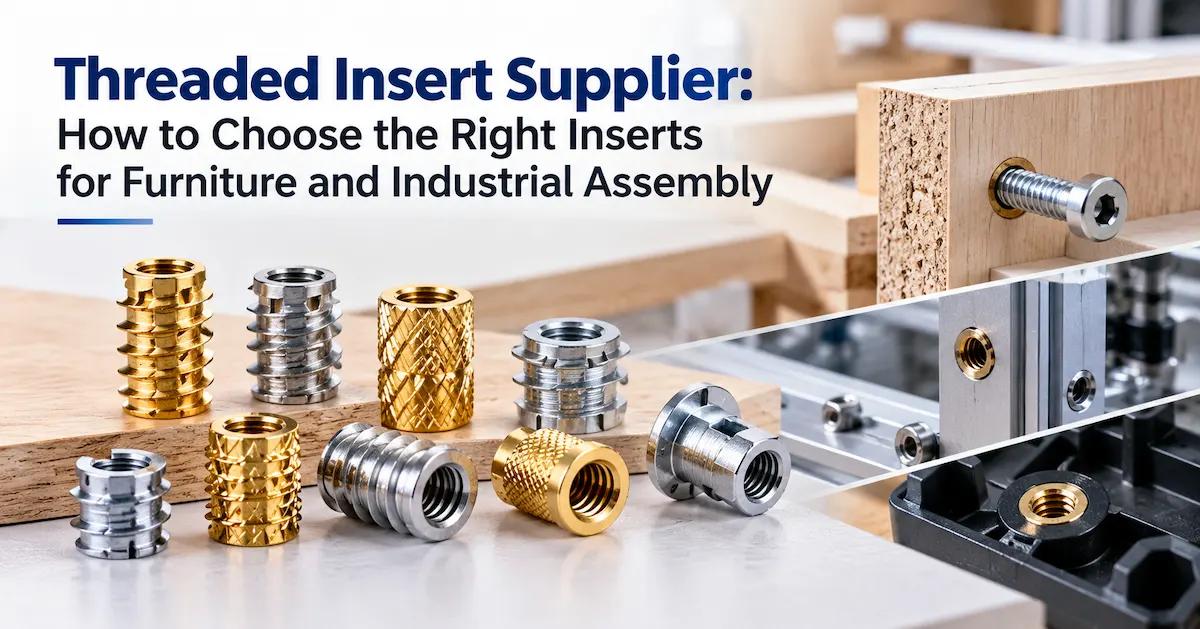
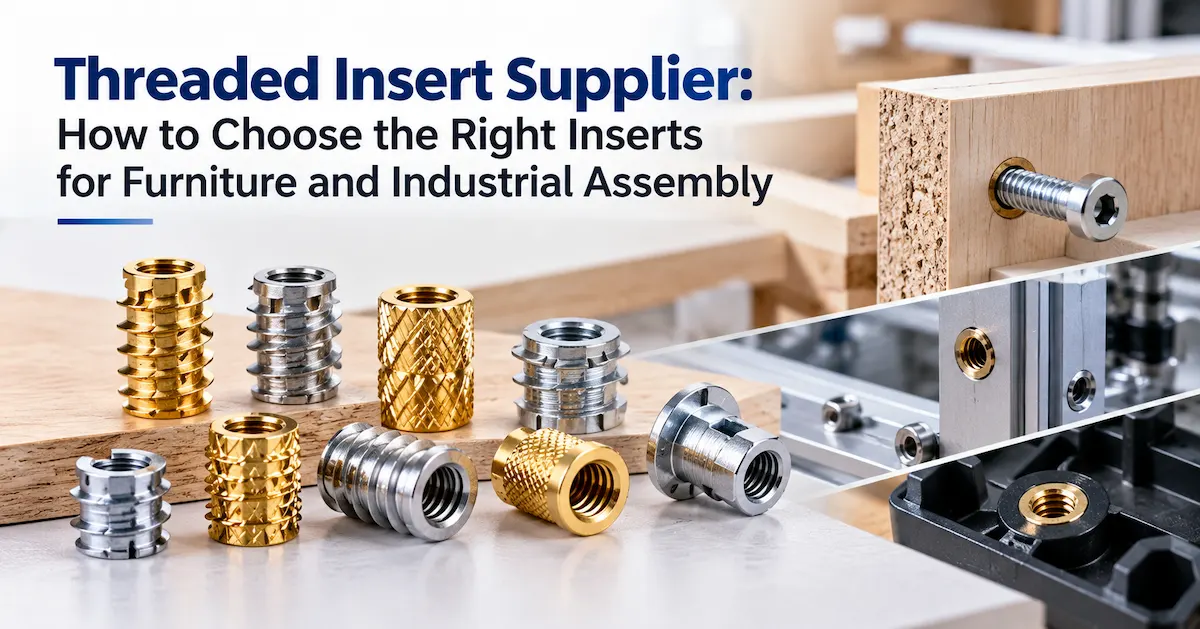
Selecting the right threaded insert supplier is essential for manufacturers that need reliable threaded connections, repeatable assembly, and consistent fastening quality. Threaded inserts are used in many applications where a component needs a threaded attachment point, particularly when the surrounding material cannot provide a suitable durable thread on its own.
For furniture manufacturers, cabinet factories, woodworking businesses, and industrial assembly companies, the wrong insert can lead to loose connections, damaged panels, installation difficulties, or costly rework. These problems are not always caused by the insert itself. Base-material properties, hole dimensions, installation methods, screw compatibility, and application loads also affect the final result.
A reliable sourcing process therefore starts with the application rather than the lowest unit price.
This guide explains how to select threaded inserts, evaluate suppliers, compare installation requirements, establish quality-control criteria, and prepare an effective request for quotation (RFQ).
1. What Is a Threaded Insert?
A threaded insert is a fastening component installed into a base material to provide an internal thread for a compatible screw or bolt. Depending on its design, the insert may be installed by screwing, pressing, molding, or another specified method.
Threaded inserts are commonly used in furniture panels, wooden assemblies, plastic components, equipment housings, and other products requiring repeatable threaded fastening.
Their main purpose is to provide a suitable threaded interface between the fastener and the surrounding material.
Typical benefits include:
-
Creating a defined threaded attachment point in a base material.
-
Supporting repeatable assembly and disassembly where the design permits.
-
Reducing dependence on threads formed directly in relatively soft materials.
-
Helping standardize fastening across manufactured products.
-
Supporting modular construction and component replacement.
However, not every insert is suitable for every material or loading condition. A threaded insert designed for solid wood may not perform the same way in MDF, particleboard, or injection-molded plastic.
The correct choice depends on the material, thread specification, installation method, and service requirements.
For buyers sourcing multiple fastening components, the JHFIX product range provides a starting point for discussing relevant furniture hardware and fastener requirements.
2. Common Types of Threaded Inserts
Threaded inserts differ in their external geometry, internal thread, installation method, and intended base material.
Understanding these differences helps buyers specify the correct component before requesting quotations.
| Insert type | Typical applications | Main selection considerations |
|---|---|---|
| Wood threaded inserts | Solid wood furniture and selected wooden assemblies | Wood species, pilot-hole size, insertion depth |
| Inserts for engineered wood | MDF, particleboard, and furniture panels | Panel density, edge distance, pull-out resistance |
| Metal threaded inserts | Selected metal components and mechanical assemblies | Base-metal compatibility, retention method, thread specification |
| Plastic threaded inserts | Plastic housings and molded components | Polymer type, wall thickness, installation process |
| Press-fit inserts | Applications designed for interference or press installation | Hole tolerance, retention, installation force |
| Heat-set inserts | Suitable thermoplastic components | Polymer compatibility, installation temperature, surrounding wall geometry |
These categories describe general industry applications, not a guarantee that every design is available from every supplier.
Wood Threaded Inserts
Wood inserts are used when a wooden component requires a threaded connection. Their external features may be designed to engage with the surrounding material during installation.
The correct insert depends on the wood or panel type, the available installation space, and the forces acting on the connection.
For furniture manufacturers, testing in the actual panel material is especially important because solid wood, MDF, and particleboard have different structural characteristics.
Inserts for Plastic Components
Plastic assemblies may require threaded inserts when repeated fastening or a more durable threaded interface is needed.
The insert design must match the polymer, component geometry, wall thickness, and manufacturing process. Heat-set, molded-in, and press-fit solutions have different installation requirements and should not be treated as interchangeable.
Metal Threaded Inserts
Metal components may use inserts when a particular thread, repair method, or assembly configuration is required. Selection depends on the host material, insert design, installation method, and operating conditions.
Buyers should specify whether they need a new threaded attachment point, a replacement component, or a solution for an existing damaged thread.
3. How to Choose the Right Threaded Insert
A professional threaded insert supplier should be able to evaluate the technical requirements of the application rather than select a product based on appearance alone.
The following five factors are particularly important.
3.1 Identify the Base Material
Start by identifying the material into which the insert will be installed.
Examples include:
-
Solid hardwood or softwood.
-
MDF and particleboard.
-
Plywood.
-
Thermoplastic components.
-
Metal parts.
Material density, internal structure, thickness, and resistance to deformation influence how an insert can be retained.
For engineered wood panels, buyers should also consider whether the insert will be installed near an edge, in a narrow panel, or in an area exposed to repeated loading.
3.2 Confirm the Internal Thread
The internal thread must match the screw or bolt used in the assembly.
Important details include the thread standard, nominal size, pitch where applicable, and required engagement length.
Do not assume that inserts with similar external dimensions have interchangeable internal threads.
Where a project involves international manufacturing or multiple suppliers, specify the thread system explicitly rather than relying on informal descriptions.
3.3 Select the Installation Method
Installation method affects both product design and assembly performance.
A screw-in insert requires suitable external geometry and an appropriate installation hole. A press-fit insert requires a compatible hole size and controlled installation force. A heat-set insert requires a compatible thermoplastic and an appropriate installation process.
Using the wrong method can damage the insert or the surrounding material.
Before approving a product, confirm the recommended installation procedure and test the insert under representative production conditions.
3.4 Evaluate Retention Requirements
The insert must remain securely positioned during its intended service life.
Depending on the application, relevant failure modes may include pull-out, rotation, cracking of the surrounding material, or damage to the internal thread.
Retention depends on the complete system—not just the insert.
For example, an insert that performs adequately in solid wood may not provide equivalent results in a low-density composite panel.
3.5 Consider the Operating Environment
Moisture, temperature, vibration, cleaning chemicals, and corrosion exposure may influence material and finish selection.
A fitting used in indoor furniture may have different environmental requirements from one installed in equipment exposed to humidity or frequent cleaning.
Buyers should communicate the intended environment and any applicable testing requirements before finalizing the specification.
4. Material and Surface-Finish Considerations
Threaded inserts may be produced from different metals or other materials, depending on their intended applications.
Material selection should reflect mechanical requirements, corrosion exposure, installation conditions, and compatibility with the surrounding component.
| Requirement | What buyers should confirm |
|---|---|
| Mechanical performance | Required loads and relevant failure modes |
| Corrosion resistance | Environmental exposure and specified protection |
| Dimensional consistency | Critical dimensions and acceptable tolerances |
| Installation compatibility | Base material and installation process |
| Surface requirements | Finish, appearance, and functional needs |
| Documentation | Material identification and agreed inspection records |
A corrosion-resistant finish does not automatically make a component suitable for every environment. Similarly, a particular material designation does not establish the performance of the complete assembly.
Where corrosion testing is necessary, the purchasing specification should identify the applicable method and acceptance criteria.
For custom or repeat orders, material and finish requirements should be recorded in the approved drawing or product specification.
5. Threaded Insert Quality Control: What Buyers Should Check
Quality control should cover both the individual insert and its performance in the intended assembly.
A component can look acceptable while still having an incorrect internal thread, unsuitable external dimensions, or inadequate retention.
A practical inspection framework includes the following checks.
Dimensional Inspection
Verify the critical dimensions identified in the drawing, including external diameter, overall length, internal thread, and other functional features.
Tolerances should be defined for the actual application rather than assumed to be identical across all insert types.
Thread Verification
Confirm that the internal thread matches the specified screw or bolt. Suitable thread gauges and other appropriate inspection methods can help verify conformity.
Functional assembly checks may also be necessary when the insert works with a particular mating component.
Visual Inspection
Check for visible defects such as cracks, damaged threads, burrs, deformation, or unacceptable surface conditions.
Acceptance criteria should distinguish between cosmetic variation and defects that affect fit, function, or safety.
Installation and Retention Testing
Where required, test installation force, pull-out resistance, resistance to rotation, or other application-specific properties.
The test method and acceptance limits must reflect the intended base material and operating conditions.
A pull-out result obtained from one panel type should not automatically be applied to another material or thickness.
Batch Consistency
For repeat orders, compare production batches against the approved specification and sample.
A defined inspection plan helps buyers and suppliers communicate about defects, corrective actions, and product changes.
6. Why Threaded Insert Compatibility Matters in Furniture Manufacturing
Furniture manufacturers often work with several panel materials, connecting bolts, screws, and installation processes within one production system.
The insert must match the prepared hole and the fastener used in the assembly.
Incorrect compatibility can create problems such as difficult installation, loose connections, damaged panels, and inconsistent assembly results.
Before approving an insert for production, verify:
-
Panel material and thickness.
-
Hole diameter and depth.
-
Insert dimensions and installation direction.
-
Internal thread and mating fastener.
-
Required engagement length.
-
Edge distance and surrounding material.
-
Expected assembly and service loads.
A sample should be tested in the actual or representative furniture material.
This is particularly important for flat-pack furniture and modular products, where components may be assembled at different facilities or by end users.
For projects involving multiple fastening components, buyers can review JHFIX furniture hardware and related products and discuss the required combination of components with the supplier.
7. How to Evaluate a Threaded Insert Supplier
Choosing a supplier requires evaluating more than the quoted price. Buyers should establish whether the supplier can meet the product specification, communicate technical requirements clearly, and maintain consistency across repeat orders.
Use the following checklist when comparing potential suppliers.
| Evaluation area | Questions to ask |
|---|---|
| Product range | Are suitable insert types available for the intended application? |
| Technical communication | Can the supplier review drawings, samples, and specifications? |
| Material control | Can the required material and finish be confirmed? |
| Dimensional quality | Are critical dimensions and thread requirements defined? |
| Testing | Can agreed functional checks be performed or arranged? |
| Customization | Can nonstandard requirements be evaluated? |
| Packaging | Can products be identified and packed according to the order? |
| Repeat orders | Can approved specifications and revisions be controlled? |
| Commercial terms | Are MOQ, lead time, payment, and delivery responsibilities clear? |
A supplier should not be considered qualified solely because it lists similar products.
Buyers should request confirmation of the exact product specification and determine which manufacturing and inspection activities are performed by the supplier or other parties.
For company background and available business information, visit JHFIX About Us.
8. Custom Threaded Inserts and OEM Purchasing
Custom insert projects may involve changes to external geometry, dimensions, internal threads, material, surface treatment, or packaging.
A structured development process can reduce misunderstandings before mass production.
Step 1: Submit the technical requirements. Provide drawings, samples, thread specifications, base-material details, and application photographs where useful.
Step 2: Confirm feasibility. Discuss the proposed geometry, installation method, material requirements, and any unresolved technical questions.
Step 3: Review the quotation. Confirm unit pricing, tooling charges where applicable, minimum order quantity, production lead time, packaging, and shipping terms.
Step 4: Approve samples. Check dimensions, thread compatibility, installation performance, and the intended assembly.
Step 5: Confirm production specifications. Record the approved drawing revision, inspection criteria, finish, packaging, and order quantity.
Step 6: Inspect the production batch. Verify conformity against the agreed requirements before shipment.
For customized components, buyers should also clarify drawing ownership, confidentiality expectations, tooling ownership, and approval procedures for future design changes.
Do not assume that customization, tooling, or particular testing services are available for every product. Confirm the scope with the supplier before committing to a project.
9. What Determines Threaded Insert Pricing?
Threaded insert prices vary according to product design, material, manufacturing method, order volume, finishing, inspection, and packaging requirements.
A useful quotation should clarify the cost structure rather than focus exclusively on unit price.
Important cost factors include:
-
Insert dimensions and material consumption.
-
External geometry and manufacturing complexity.
-
Internal thread specification.
-
Surface treatment or corrosion protection.
-
Tooling and development requirements.
-
Order quantity and production planning.
-
Inspection and testing requirements.
-
Individual packaging or bulk packaging.
-
Freight and delivery arrangements.
A standard insert and a newly developed custom component may have substantially different commercial requirements.
Buyers should also consider the potential cost of incompatible parts, damaged panels, production downtime, and assembly rework.
For recurring orders, consistent specifications and clear revision control can help reduce avoidable purchasing and quality problems.
10. RFQ Checklist: Information to Send Your Supplier
A complete request for quotation helps the supplier understand the application and reduces unnecessary clarification.
Prepare the following information whenever possible.
| RFQ field | Recommended information |
|---|---|
| Product type | Wood insert, metal insert, plastic insert, or other design |
| Application | Furniture, cabinet, equipment, or another assembly |
| Drawing or sample | Dimensioned drawing and revision number |
| Internal thread | Thread standard, nominal size, and pitch |
| Base material | Wood, engineered panel, plastic, metal, or other material |
| Installation method | Screw-in, press-fit, heat-set, or specified alternative |
| Material and finish | Required material and environmental protection |
| Quality requirements | Tolerances, inspection, and functional testing |
| Order quantity | Initial order and expected repeat demand |
| Packaging | Bulk, bagged, labeled, or customized packaging |
| Destination | Delivery country and preferred shipping arrangement |
If replacing an existing insert, provide a physical sample or clear photographs with dimensions. Explain the problem being solved, such as thread damage, rotation, difficult installation, or insufficient retention.
If the design is still under development, describe the application and performance requirements first. The supplier can then determine which technical details need further clarification.
Ready to discuss your threaded insert requirements?
Contact JHFIX with your drawings, samples, target quantities, and application details to begin a product and quotation review.
Contact JHFIX for a Hardware Inquiry
11. Frequently Asked Questions
What does a threaded insert supplier provide?
A threaded insert supplier provides threaded fastening components for specified applications. Depending on the supplier and project, buyers may also discuss product selection, technical review, packaging, and customized requirements. The available scope should be confirmed for each order.
Which threaded insert is best for MDF or particleboard?
The appropriate insert depends on panel density, thickness, hole geometry, insertion method, and the forces acting on the connection. Buyers should test the selected design in the actual panel material rather than assume that an insert suitable for solid wood will perform equally well.
How do I choose the correct insert thread size?
Identify the mating screw or bolt and specify its thread standard, nominal diameter, and pitch where applicable. Confirm the required engagement length and ensure that the insert's internal thread matches the fastener.
Can threaded inserts be removed and reused?
Some designs permit removal and reinstallation, while others may be damaged during removal or lose retention after repeated use. Reusability depends on the insert design, installation method, and condition of the surrounding material.
What information is needed for a custom threaded insert quotation?
Provide a drawing or sample, internal thread specification, base material, installation method, material and finish requirements, expected quantity, and packaging details. Include application loads or testing requirements when relevant.
How can buyers check threaded insert quality?
Check critical dimensions, thread conformity, visible defects, and compatibility with the mating fastener. Where necessary, perform installation and retention testing in the intended base material using defined acceptance criteria.
What affects MOQ and production lead time?
Minimum order quantity and lead time depend on the product design, manufacturing process, material, tooling requirements, finishing, inspection, order volume, and packaging. Buyers should obtain project-specific confirmation before placing an order.
Conclusion
Choosing the right threaded insert supplier requires a clear understanding of the base material, internal thread, installation method, retention requirements, and quality-control expectations. A technically suitable insert can improve assembly consistency, while an incorrect match may lead to damaged components, loose connections, and costly rework.
For furniture manufacturers and industrial buyers, the best sourcing process combines precise specifications, representative sample testing, transparent commercial terms, and consistent inspection.
Prepare your drawings, mating-fastener details, application requirements, and target quantities before requesting a quotation. Visit JHFIX or contact the team to discuss your furniture hardware and fastening requirements.