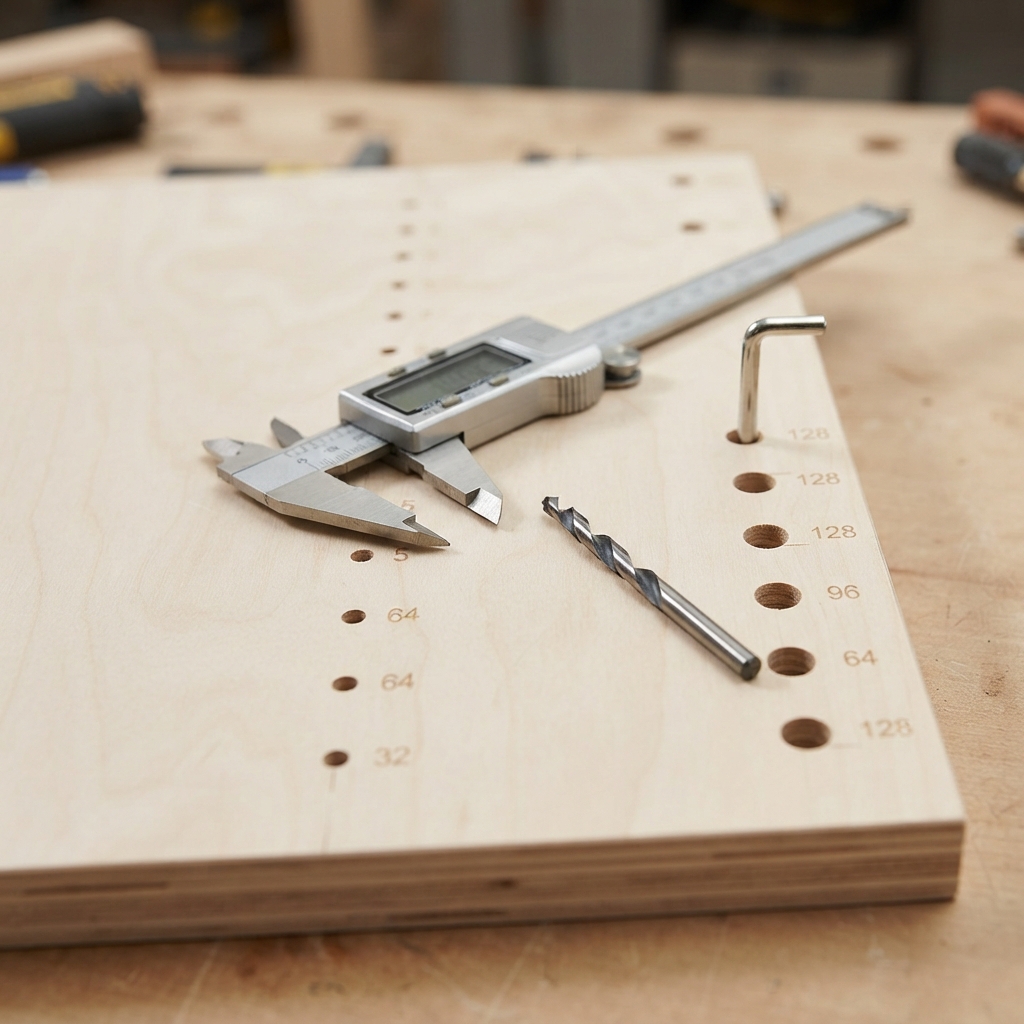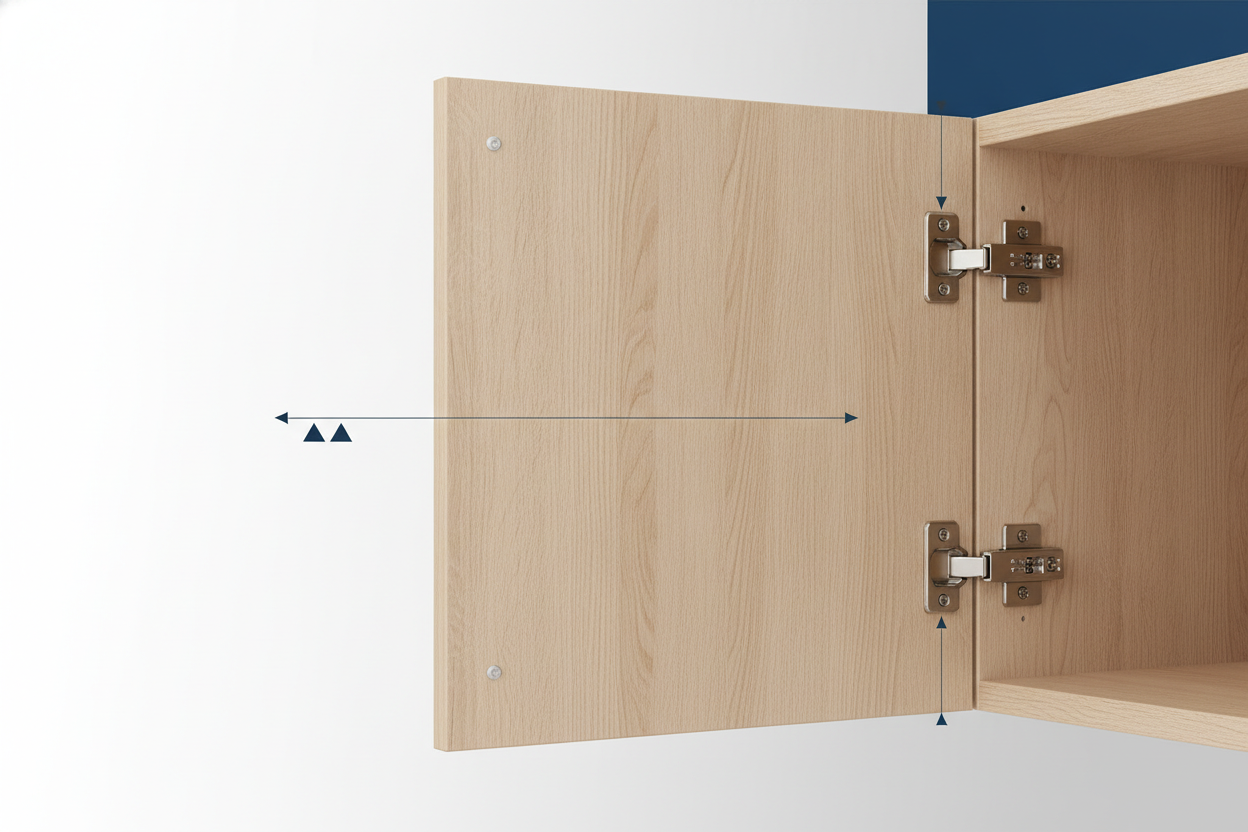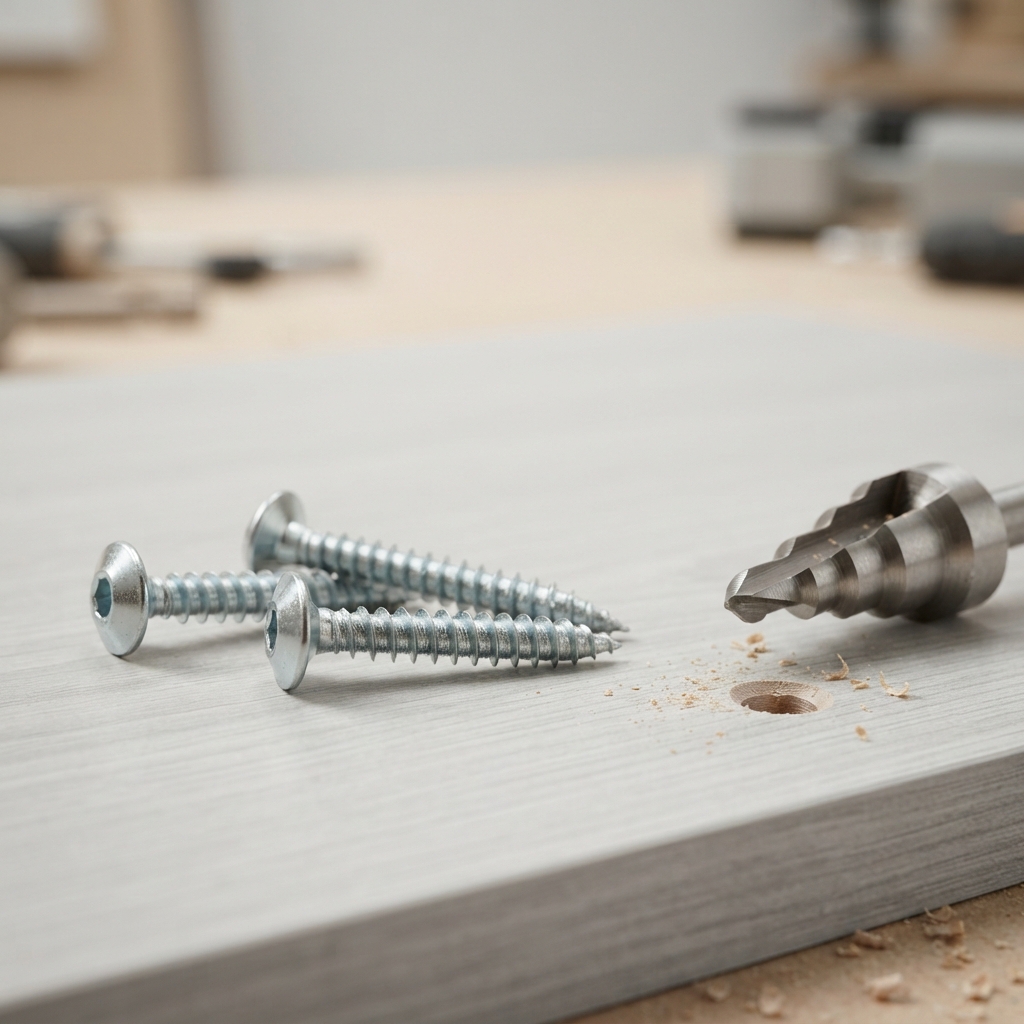

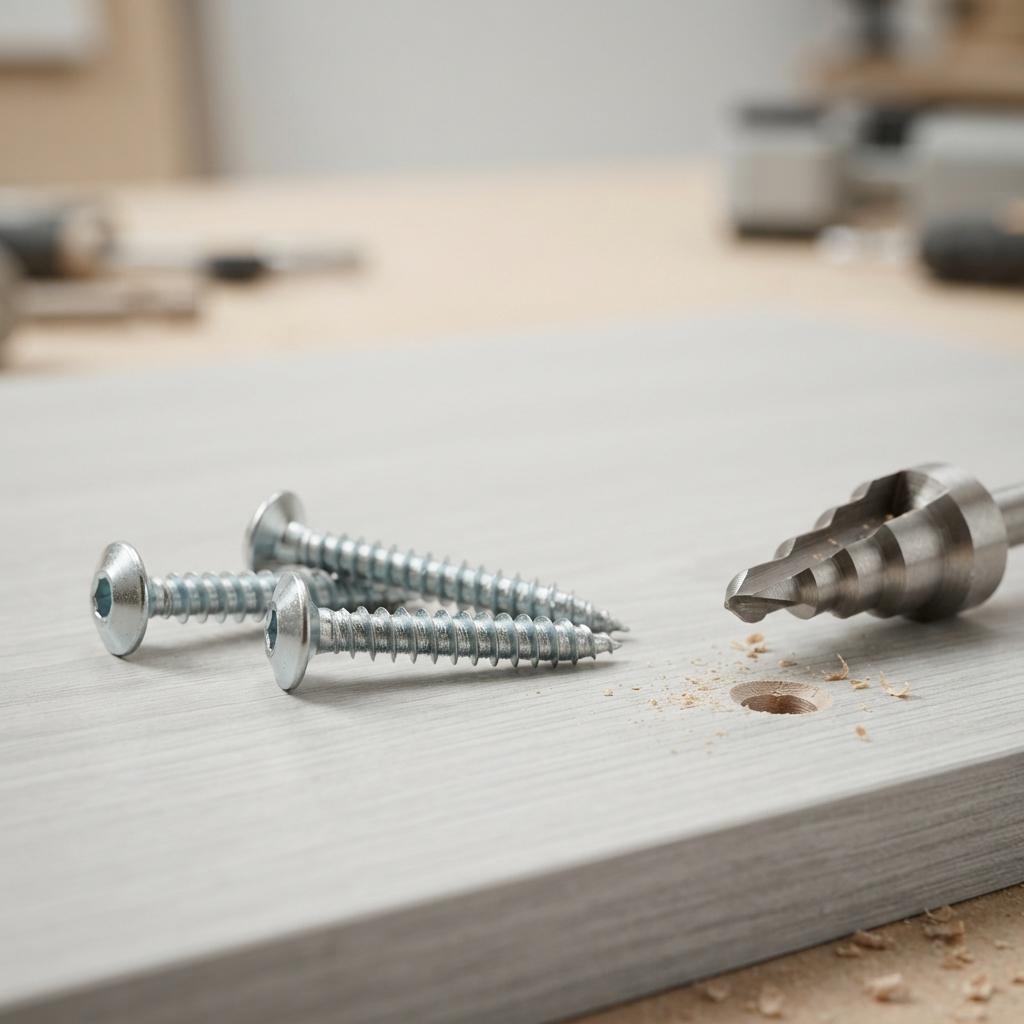
Confirmat screw sizes are matched to panel thickness, not to thread size alone. As a working rule, a 5 × 50 mm confirmat suits 16 mm (5/8 in) board, a 7 × 50 mm confirmat suits 18–19 mm (3/4 in) board, and a 7 × 70 mm confirmat covers thicker clamped panels such as 25 mm worktops. Each size needs a matching three-step drill bit that cuts the head recess, the through hole and the pilot in one pass, because a confirmat has a blunt end and cannot make its own hole.
The short answer: confirmat screw size chart
If you only need the pairing, start here. These are the common nominal combinations used in cabinet and flat-pack production. They are a starting point for a drawing, not a substitute for a test on your own board.
| Confirmat size | Panel thickness it typically suits | Head recess (counterbore) | Through hole, first panel | Pilot, second panel | Typical joint |
|---|---|---|---|---|---|
| 5 × 50 mm | 16 mm (5/8 in) | 8 mm | 5 mm | 4 mm | 16 mm carcass sides, drawer boxes, light shelving |
| 5 × 70 mm | 16–20 mm, or where more edge engagement is needed | 8 mm | 5 mm | 4 mm | Narrow edges, repairs, thin-board cabinets |
| 6.3 × 50 mm | 18 mm (11/16–3/4 in) | 8–10 mm, matched to the head | 6.3 mm | 4–5 mm | Programs that mix metric and inch board |
| 7 × 50 mm | 18–19 mm (3/4 in) | 10 mm | 7 mm | 4–5 mm | The standard 3/4 in melamine or MDF carcass joint |
| 7 × 70 mm | 25–30 mm (1–1.2 in) | 10 mm | 7 mm | 4–5 mm | Worktops, thick shelves, 25 mm board, double-panel joints |
The head recess and pilot columns are the ones buyers get wrong most often, because they are not printed on the screw and they are not the same as the screw diameter. A 7 mm confirmat does not want a 7 mm hole through both panels; it wants a 10 mm recess for the head, a 7 mm clearance hole through the first panel and a smaller pilot in the panel edge that carries the thread.
What a confirmat screw actually is
A confirmat is a one-piece furniture assembly screw for joining two wood-based panels at 90 degrees, driven through the face of one panel into the edge of the other. Four features separate it from an ordinary wood screw:
- A wide, flat bearing head. It seats in a machined recess and clamps the first panel flat against the second. The head is large enough to spread load across the face veneer instead of crushing it.
- An unthreaded neck under the head. This smooth section passes freely through the first panel and pulls it tight, which is where the joint gets its rigidity.
- A deep, coarse thread with a wide pitch. The thread form is designed to bite into the pressed fibre or chip structure without cutting a thin sliver out of it.
- A blunt end. Because the point does not centre itself, the screw depends entirely on a prepared hole. That is the single most important fact about the part.
In engineered wood the failure that matters is not the screw breaking. It is the board crumbling around the thread, or the face veneer dimpling as the head seats. Confirmat geometry answers both with a thick core and a broad head.
Confirmat screws for MDF, melamine-faced chipboard and particle board
- Confirmat screws for MDF: dense, uniform fibre gives a strong thread hold but almost no forgiveness once a hole strips, so pilot size and driving torque must be fixed by trial.
- For melamine-faced chipboard: the decorative face is thin, so the counterbore and a low clutch setting protect the surface finish; chipped edges around the recess are a seating problem, not a screw defect.
- For particle board: the flake structure grips a coarse thread well but crumbles if a hole is enlarged or reused, which is why screw positions and quantities are set on the drawing rather than at the bench.
How to read the callout and choose the length
A confirmat is written as diameter × length, for example 7 × 50 mm — often typed as 7x50. The first number is the thread diameter, which sets the through hole and the drill bit. The second is the overall length, measured from under the head, which sets how much thread lands in the panel edge.
Choose length with one piece of arithmetic rather than by habit:
Length ≈ thickness of the clamped panel + 25–32 mm of thread engagement in the edge.
On a 50 mm screw through an 18 mm panel, roughly 30 mm of threaded length remains for the edge, less the depth of the head recess. That is why 7 × 50 mm became the default for 3/4 in carcasses. Use the same logic when the numbers change: a 25 mm worktop clamped to a 25 mm gable needs the 70 mm screw, because a 50 mm screw would leave too little thread in the second panel.
Two limits constrain the choice. The screw must not break out of the far face of the second panel, and the hole must stay centred in the edge with enough material on both sides. On 18 mm board, a 7 mm bore leaves about 5.5 mm of material either side of the hole; on 16 mm board it leaves about 4.5 mm, which is why 5 mm screws are used there. If the engagement calculation does not fit inside the board, change the joint system rather than forcing a longer screw into a thin edge. Our guide to thread engagement length covers the same calculation from the fastener side.
The three-step drill bit: what each step does
A confirmat screw drill bit is not an accessory. It is the other half of the specification. The bit cuts three concentric features in one plunge, all sized from the screw:
- Head recess. A counterbore that matches the head diameter and height, so the head finishes flush with the panel face. Sizes commonly run 8 mm for 5 mm screws and 10 mm for 7 mm screws.
- Clearance hole. A bore matching the shank, so the unthreaded neck passes through the first panel without biting. This is 5 mm or 7 mm on the same screws.
- Pilot. A smaller bore in the second panel that matches the thread core, typically around 4–5 mm, deep enough for the full threaded length.
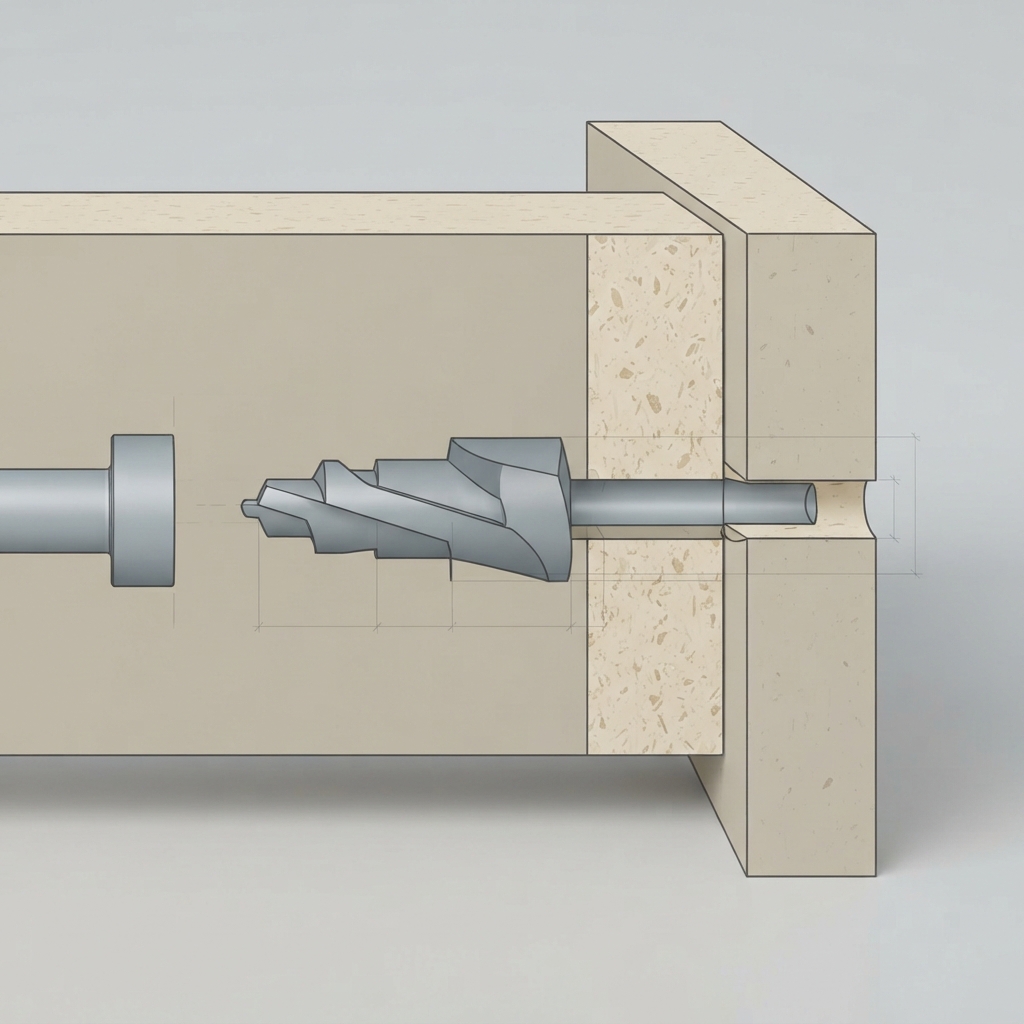
The bit also sets depth. Typical cutting lengths are 40 mm for 5 mm screws and 50 mm for 7 mm screws, which matches the screws they are designed for. Set the drilling depth so the pilot step reaches slightly deeper than the thread will travel, and drill square to the panel face: a bit that is 1–2 degrees off square tilts the screw, seats the head on one side and lifts the veneer on the other.
This is also why a confirmat cannot be substituted with a standard 7 mm drill and a countersink. You get a hole, but no clearance step and no controlled pilot, so the joint either strips or fails to clamp.
How to use confirmat screws: installation sequence
- Clamp the joint square. The screws pull panels together but do not align them. A 1 mm offset before drilling stays in the finished cabinet.
- Mark positions from the drawing, not by eye. Set out screws at the ends of the joint and at spacing that suits the panel span; two screws on a short partition, three or more on a tall side.
- Drill to full depth in one pass with the three-step bit, square to the face, with the depth stop set.
- Drive with the clutch engaged. Use a low clutch setting and let the screw draw itself in until the head seats. Driving in drill mode is how most MDF joints are destroyed.
- Check the seam. The two panels should meet with no visible gap and no veneer lift around the head.
- Fit cover caps if the joint is visible, matched to the panel decor.
Torque deserves its own note. The thread is strong; the board is not. A screw driven to the point where the driver stalls has already compressed the hole walls. If your line uses powered drivers, set the clutch by test on production panels and record the setting, in the same way you would control any other screw torque specification.
Common mistakes buyers and assemblers make
- Using a wood screw pilot size. A confirmat pilot matches the thread core, not the outside diameter.
- Drilling both panels at the clearance diameter. The screw then has nothing to bite in the edge, and the joint pulls out under load.
- Drilling the pilot too shallow. The blunt end bottoms out, the head stands proud, and the seam stays open.
- Skipping the counterbore. Without it the head sits on the surface, the veneer dimples, and the clamping force goes into crushing the face.
- Over-tightening into MDF. MDF has little tolerance for a stripped hole; recovery usually means gluing in a dowel and re-drilling.
- Specifying by appearance. Two fasteners with the same 7 mm thread can differ in head diameter, neck length and thread pitch, and each needs its own bit.
- Assuming one size fits a whole cabinet. A 16 mm back-panel rail and a 25 mm worktop are different joints with different screws.
Confirmat screw vs cam lock, dowel and wood screw
Confirmat is not the only way to join two panels, and the right answer depends on whether the joint stays visible and whether the furniture will be taken apart again.
| Criterion | Confirmat screw | Cam lock and dowel | Wood screw |
|---|---|---|---|
| Visibility after assembly | Head visible on one face; cap covers the recess | Fully concealed | Head visible |
| Hole preparation | Three-step bit, one pass | Face bore plus edge bore, two setups | Pilot only |
| Assembly speed | Fast, one tool, no mating part | Slower, two parts must engage | Fast |
| Repeated disassembly | Limited; each cycle loosens the hole | Designed for it | Poor in MDF |
| Edge material needed | Moderate; needs a sound edge | Moderate | Low |
| Best use | Fixed carcass joints, drawer boxes, shop fittings | Flat-pack and RTA furniture that ships knocked down | Back panels, fittings, light duty |
The practical split is simple. If the cabinet ships flat and the end user assembles it, a concealed cam lock and dowel system is usually the better choice, because the joint hides and survives being opened. If the cabinet is assembled once in the factory or on site and never reopened, confirmat screws are faster, need no mating component, and give a very stiff box. Many programs use both: cam locks where the customer sees the joint, confirmats where they do not. Our joint-by-joint walkthrough of furniture fasteners for flat-pack cabinets shows where each system fits.
What to put on the purchase order
Confirmat is a family of similar-looking parts, not a single standard item. A purchase order that says "confirmat screws, 7 × 50" leaves the dimensions that decide whether the joint assembles undefined. Specify at least:
- Thread diameter and overall length, with the length datum (under head) stated.
- Head diameter, head height and seating angle or bearing face.
- Neck (unthreaded) length, and the drive recess with its size — a 4 mm hex and a PZ3 are not interchangeable on a production line.
- Thread form and pitch, and the end profile.
- Panel material, density and finished thickness the part will be driven into.
- Drill bit specification and hole diameters, so the screw and bit are approved together.
- Finish and corrosion requirement for the service environment.
- Piece count, packing format, labelling and any driver or bit supplied in the kit.
For repeat orders, add a retained approved sample and a stated inspection criterion. Three checks catch most batch variation: head and recess geometry, thread form and neck length, and a driving trial in production panels. These belong in the goods-in routine alongside dimensional inspection, and they follow the same count and identification controls described in our packaging specification guide. If joints must meet a formal furniture test requirement, agree the method up front; ISO 7170:2021 sets out test methods for the strength and durability of storage units, but the acceptance criteria come from your own specification or your retailer's.
The confirmat range we supply
JHFIX supplies a hex-socket confirmat-style furniture screw with a wide countersunk bearing head, a coarse full-length thread and a blunt end, intended for prepared holes in engineered wood panels. The current listing covers M5, M6.3 and M7 threads in lengths from 30 mm to 70 mm, so the common 5 × 50, 7 × 50 and 7 × 70 pairings can be sourced from one item family. Finish is confirmed against the service environment; zinc plating and other coating options are reviewed per order rather than assumed from a photograph. Minimum order quantity is stated as 10,000 pieces per confirmed specification.
Manufacturing is carried out by Jiangmen Jinhe Hardware Products Co., Ltd., which has operated since 2004 and runs cold heading, tapping, punch press, injection moulding, assembly, packing and inspection in-house. International sales are handled by its authorized export partner, Jiangmen Shenxin Trading Co., Ltd. The range sits alongside our other furniture screws, so a cabinet program can be quoted with its connectors, shelf supports and panel screws together.
Because a confirmat only works with its matching hole, we review the screw, the drill bit and the panel section together before quoting. Send the joint section, panel material and thickness, and a sample if one exists.
FAQ
What size confirmat screw do I need for 3/4 in melamine?
7 × 50 mm is the standard pairing for 18–19 mm (3/4 in) melamine-faced board, drilled with a three-step bit that cuts a 10 mm head recess, a 7 mm through hole and a 4–5 mm pilot. Confirm the actual finished thickness first: nominal 3/4 in board varies, and a screw that is marginal on engagement will loosen over time.
Can you use confirmat screws in MDF?
Yes, and MDF is one of the materials the fastener was developed for, but the edge is the weak point. MDF has no grain to spread load, so a stripped hole stays stripped. Use the correct pilot, drive with the clutch set low, and avoid designs that need the same hole reopened repeatedly.
Do I really need a special drill bit?
Yes. A plain drill makes one diameter through both panels, so the screw has no head seat and no controlled engagement. A three-step bit produces the recess, the clearance hole and the pilot at the right depths in a single pass, which is faster than three separate operations as well as more accurate.
How deep should the pilot hole be?
Deep enough for the full threaded length plus a small margin, and no deeper than the remaining material allows. In practice you match the bit's cutting length to the screw — about 40 mm for a 5 mm screw and 50 mm for a 7 mm screw — and set the depth stop so the screw does not bottom out before the head seats.
Are confirmat screws reusable?
They can be removed and refitted a limited number of times. The thread re-enters its own path, but each cycle removes a little material from the hole wall, and in particle board or MDF the loss adds up. For furniture that will be moved and rebuilt repeatedly, use a system designed for it, such as a cam lock with a dowel or a threaded insert.
What drive does a confirmat screw use?
The two common options are a hex socket, typically 4 mm on 5 mm screws, and a Pozi (PZ3) cross recess on 7 mm screws; some ranges offer a combination recess. Pick one drive per program and state it on the drawing, because mixing drives adds a tool change at every station and increases cam-out damage.
Can confirmat screws be used in plywood?
They can, but plywood behaves differently from particle board: the thread bites into alternating layers, and the edge is more prone to splitting along a glue line. Reduce driving speed, keep the hole centred, and run a trial on the actual plywood construction and thickness before approving the joint.
Confirmat screw or cam lock for flat-pack furniture?
Cam locks hide completely and are built for repeated assembly, which suits furniture that ships knocked down to the end user. Confirmats are faster, need no mating part and produce a very stiff joint, which suits factory-assembled carcasses, drawer boxes and shop fittings where the head can be capped.
Conclusion
Getting these joints right comes down to three matched numbers: the screw size against the panel thickness, the drill bit against the screw, and the driving torque against the board. A 7 × 50 mm confirmat with a 10/7/4–5 mm step bit is the workhorse for 3/4 in carcasses; a 5 × 50 mm suits 16 mm board; a 7 × 70 mm covers 25 mm panels. Write the head geometry, neck length, drive and hole sizes onto the purchase order, and the joint stops depending on the assembler's judgement.
If you are specifying confirmat screws for a cabinet or flat-pack program, send your joint section, panel thickness and target quantity through our contact page so the screw, bit and packing can be reviewed together before the first production run.