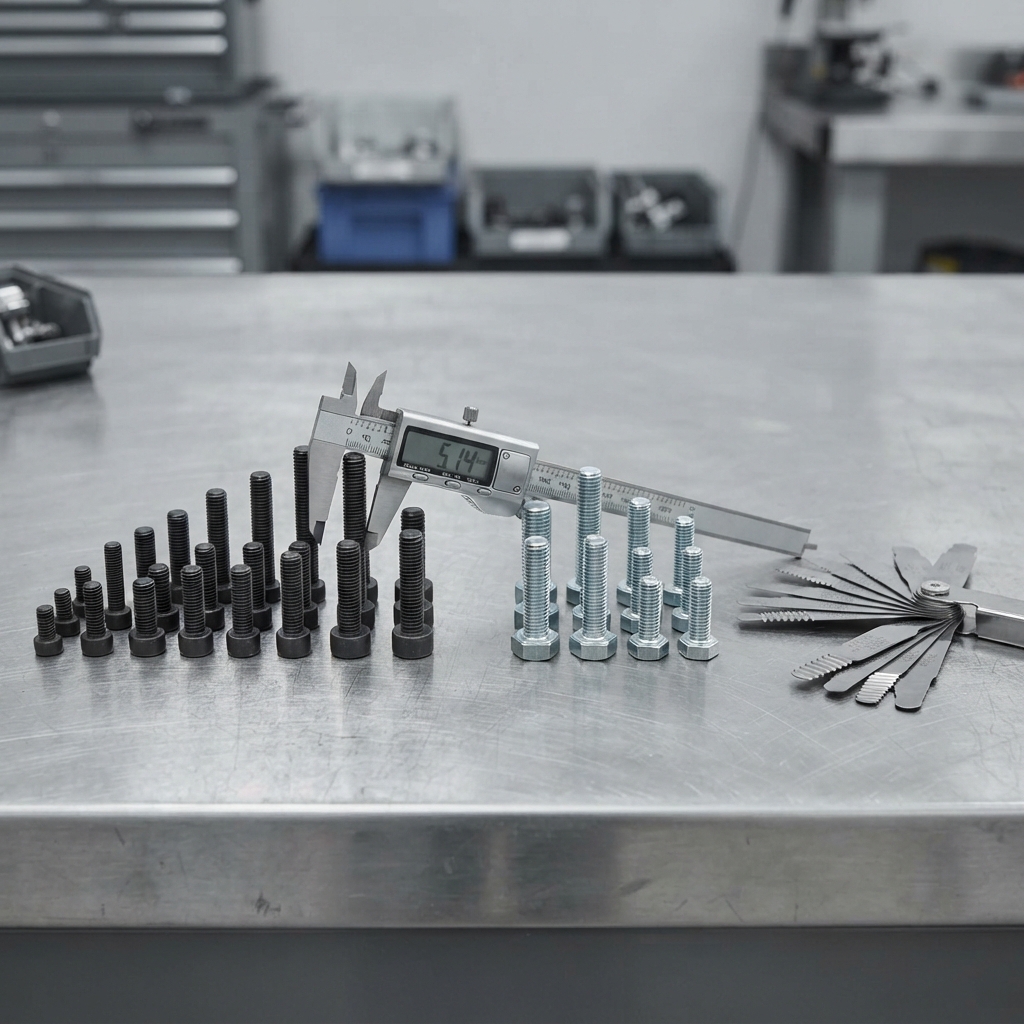

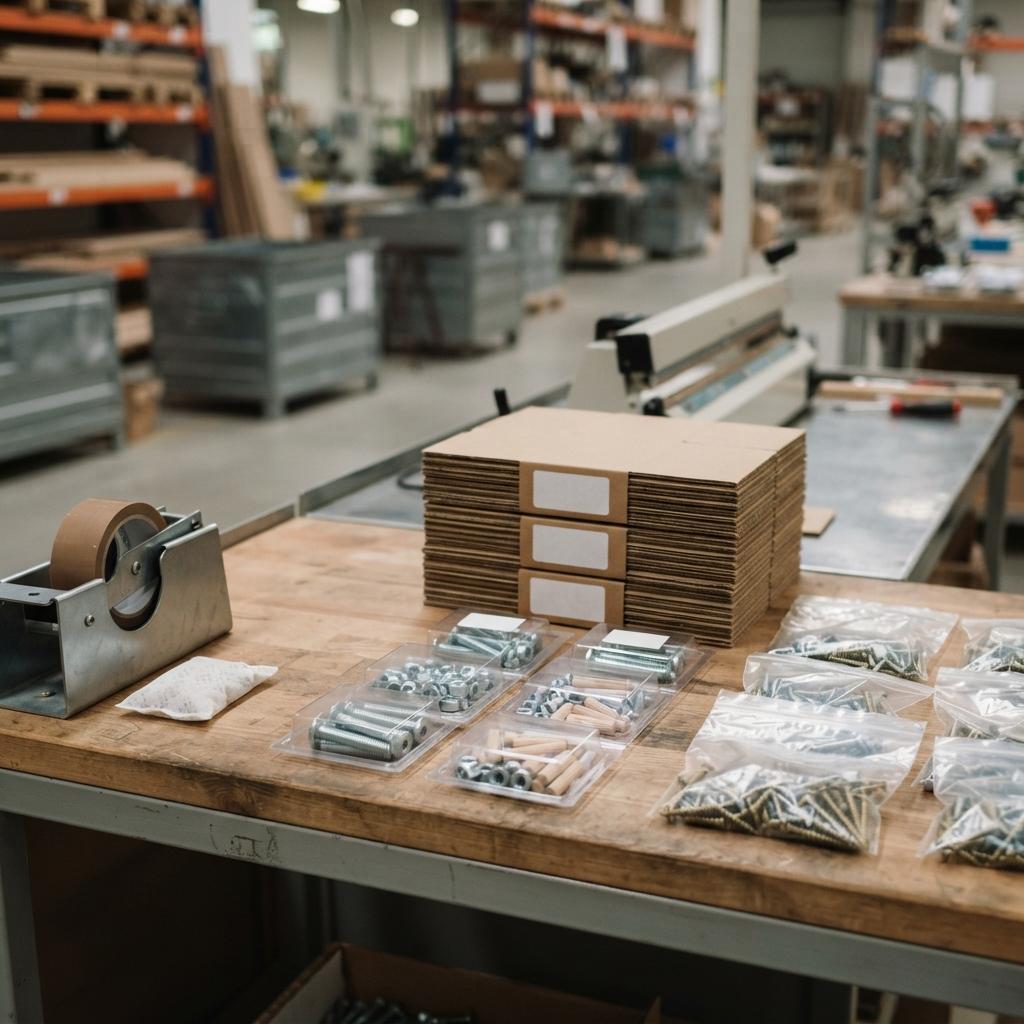
A fastener packaging specification is the written document that fixes how a screw, nut, bolt or hardware kit is counted, protected, labelled, cased and palletised before it leaves the factory. It converts packaging from a vague promise into acceptance criteria, so a short shipment, a rusted carton or a mislabelled box becomes a documented non-conformance instead of an argument after the container arrives. This guide sets out the twelve fields that belong in a fastener packaging specification and shows how to audit them on receipt.
Why packaging disputes outnumber dimensional disputes
Dimensional problems are usually caught early. A drawing defines the thread, the head, the length and the tolerance, and a go/no-go gauge or a first-article check reveals a bad part before the lot is packed.
Packaging problems are different. They surface at the worst moment: at the destination warehouse, after the balance has been paid, when production labour has already been scheduled. The common failures are mundane and repetitive:
- A bag declared as 1,000 pieces holds 960.
- Two lengths of the same diameter end up in one carton.
- Zinc-plated screws show white rust after five weeks at sea.
- A carton collapses in a stack and crushes the bags inside.
- The label carries the right description but the wrong barcode.
Each of these turns into labour at your site: recounting, sorting, re-bagging, re-labelling, and filing a claim that may take longer to settle than the parts took to make. The specification exists to move that work upstream, where it is cheap. A fastener packaging audit therefore starts with the document, not with the carton.
The 12 fields of a fastener packaging specification
A packaging spec sheet works better than a paragraph of prose. Each row should be specific enough that two different people could inspect the same carton and reach the same conclusion.
| Field | What to write | Dispute it prevents |
|---|---|---|
| 1. Part identity | Part number, drawing number and revision, material and finish | "That is the old revision" |
| 2. Unit pack quantity | Pieces per bag, bag per inner box, inner box per carton | Short or over-declared packs |
| 3. Counting method | Piece count, weight count or automatic counter, plus tolerance | "We counted by weight" |
| 4. Inner protection | Bag gauge, VCI or oil film, desiccant quantity, seal type | Rust and moisture claims |
| 5. Material separation | One material and one finish per bag; no carbon steel with stainless | Cross-contamination, sorting cost |
| 6. Label content | Part number, description, quantity, batch, date, barcode, origin | Wrong SKU picked at your warehouse |
| 7. Carton construction | Board grade, ply, gross weight limit, tape and strapping | Crushed cartons in a stack |
| 8. Carton marks | Carton x of y, gross and net weight, dimensions, shipping marks | "Two cartons were never loaded" |
| 9. Pallet pattern | Layer count, stack height, stretch wrap, edge boards | Collapse and corner damage |
| 10. Loading rules | Heavy low, light high, dunnage, no mixed lots in one pocket | Shifting damage in transit |
| 11. Sampling | AQL level, defect classes for count, label and packaging, and the receiving inspection sample size | "We only checked the top layer" |
| 12. Evidence pack | Packing photos, count records, packing list, seal numbers | Claims with no proof either way |
Fields 1 to 3 decide whether you receive the right quantity. Fields 4 to 6 decide whether the parts are usable when you open the bag. Fields 7 to 12 decide whether you can prove what happened.
Count control: piece count, weight count, or both
There are three practical counting methods, and a fastener packaging specification should name the one that applies to each part rather than leaving it to the packing line. Piece count, weight count and carton count verification are not interchangeable controls.
Piece count
Hand or machine counting is the reference method for kits, high-value parts and small order quantities. It is slow, so it is normally applied to unit packs of a few hundred pieces rather than bulk cartons.
Weight count
Weight counting is faster and is common for bulk screws. It is also an estimate, because piece weight varies within the manufacturing tolerance. The accuracy depends on three things the buyer can specify: the sample used to establish the piece weight, the resolution of the scale, and the accepted deviation.
A worked example makes the logic clear. If a sample of 100 screws weighs 412 g, the average piece weight is 4.12 g, so 5,000 pieces should weigh about 20.6 kg before the bag is added. A one-percent band allows 20.4 to 20.8 kg. That band is not a standard — it is a decision. The buyer sets it, writes it into the specification, and states what happens when a bag falls outside it. Without a stated band, a supplier can defend almost any shortfall as "normal weight variation".
Count-by-kit ratio
For hardware kits, weight is the wrong control. A furniture connector kit should be counted by compartment against the bill of materials, because a kit with the right total weight but the wrong mix of bolts and nuts still stops an assembly line.
For bulk cartons, carton count verification against the packing list comes first, before any bag is opened. A fastener short shipment is rarely a single missing piece; it is usually a count method and a label that disagreed somewhere upstream.
Protection that matches the finish
Rust is the most expensive packaging failure because it is usually discovered late and affects the whole bag, not one piece. Protection has to match the finish and the route, not the supplier's default. VCI packaging is the usual answer for carbon steel on long sea routes, and the specification should name the VCI format rather than accepting "rust-proof" as a description.
| Finish | Typical inner protection | What to avoid |
|---|---|---|
| Zinc-plated carbon steel | Light oil film or VCI paper, sealed PE bag, desiccant on long sea routes | Unsealed bags on humid routes; wet hands at packing |
| Zinc flake or coated | Abrasion-free packing, compatible VCI, no hard contact between bags | Tight packing that rubs the coating at edges |
| Stainless steel | Clean, dry, sealed, separated from carbon steel | Carbon dust or mixed bins causing contamination spots |
| Black oxide | Oil film plus moisture control | Dry packing with no oil film |
| Brass or nickel-plated | Tarnish protection, soft liner, low compression | Abrasive contact and heavy stacking |
Two rules apply across finishes. First, never pack carbon steel and stainless steel in the same bag or the same carton cavity — contamination and sorting cost follow. Second, the protection has to survive the whole route, not just the factory gate. A 30-day sea voyage with several handling points is a different requirement from a two-day truck move, and the specification should say which one it is covering.
ISO 4180 sets out general rules for compiling performance test schedules for complete, filled transport packages, which is the formal way to test whether a pack survives the route you actually ship on rather than the route the supplier assumes.
Labels and carton marks: the cheapest claim prevention
Most receiving errors are reading errors. A label that carries a description but no part number, or a barcode that does not match the packing list, forces your warehouse team to guess. Carton marking is where most claims are won or lost, because it is the only part of the pack your team reads before opening anything.
A minimum label should carry the part number, description, quantity per unit pack, quantity per carton, batch or lot number, production date, gross and net weight, carton number, barcode, country of origin and your purchase order number. Where the destination market requires specific marks, those go into the same field rather than being handled by email later.
Two details are worth insisting on. The barcode should be test-scanned at approval against your own system, not just printed and photographed. And every carton should say "carton 3 of 12", because a missing carton is easy to spot against a numbered set and almost impossible to prove against an unnumbered one.
The 30-minute receiving audit
A fastener packaging audit at goods-in takes about thirty minutes per shipment and catches most failures before the goods are put away.
- Count before you sign. Match the carton count on the pallet to the packing list and the bill of lading. Note any discrepancy on the delivery document at the door.
- Weigh three cartons. Compare gross weight with the declared figure. A deviation outside your stated band is a hold, not a note.
- Open one carton per batch. Check the bag seal, the presence of VCI or desiccant, and the surface condition of the top and bottom layers.
- Count one unit pack by hand. Compare the result with the label and with the count method declared in the specification.
- Scan the barcode. Confirm it resolves to the correct SKU in your system, not merely to a valid number.
- Photograph before you move anything. Carton marking, label, open bag, damaged corners and the pallet pattern. Photos taken after the goods are put away prove very little.
- Record and notify. Put deviations on a receiving report and notify the supplier inside the claim window written into the purchase order.

ISO 2859-1 sets out acceptance sampling plans for inspection by attributes, and it is the usual basis for deciding how many cartons to open and how many defects to accept during receiving inspection. The standard provides the tables; the buyer still has to define which packaging faults count as critical, major and minor.
Common mistakes buyers make
- Negotiating packaging after the price is fixed. The cheapest compliant-sounding option, "standard export packing", then wins by default.
- Accepting a photo of one good carton as evidence for the lot. One photographed carton proves that one carton was packed well.
- Leaving weight-count tolerance unstated. The supplier then chooses the tolerance, and it will not be the one you wanted.
- Approving artwork over chat. Without a signed proof, the printed card, barcode position and legal text are all open to interpretation.
- Ignoring packed volume. Retail packaging that looks cheap per unit can add containers, because you pay freight on cube as well as weight.
- Mixing lots in one container pocket. It saves a little space and costs a full re-inspection at destination.
How packaging changes the cost per 1,000 pieces
Packaging is usually quoted as a single line, which makes it hard to compare. The line is built from a small number of drivers, and asking for them separately makes two quotes comparable.
A practical formula is: packaging cost per 1,000 pieces = (unit pack material + packing labour + label and print + carton share + pallet share) ÷ pieces per unit pack × 1,000. Add the packed volume and gross weight per 1,000 pieces, and the freight element becomes visible instead of arriving later as a surprise.
The trade-off is rarely "cheap versus expensive". A bulk bag is low in material and labour but shifts counting and dispensing work to your warehouse. A blister card or printed compartment case costs more upstream and less at the shelf or the assembly line. In hardware kit packaging the labour share is often the largest single driver, because every compartment has to be counted and filled. The comparison that matters is total landed cost per usable piece, not the packaging line on the quotation. Setup costs for printing plates and artwork also behave like tooling: they are worth amortising over a larger run or owning outright, and the same logic is set out in our guide to fastener tooling cost and ownership.
What our packaging line can support
Our manufacturing base in Jiangmen, Guangdong produces screws, furniture hardware, nuts and stamping parts, and packs them in bag, blister, box and plastic bucket formats. For buyers who need a defined kit rather than bulk parts, we can review counted bags, retail bags, blister packs, compartment cases and private-label cartons once the part identity, quantity, protection, labels and artwork are approved — the same fields a fastener packaging specification fixes.
The blister-packed furniture connector kit in our catalogue, for example, is quoted at a minimum of 10,000 pieces per confirmed specification, with component identity, geometry, thread, finish and count checked against the approved bill of materials. That figure belongs to that kit; other parts and formats are quoted against their own specification rather than a blanket minimum.
If you are still at the stage of comparing suppliers rather than pack formats, the checks in our fastener quote comparison guide and custom screw MOQ and trial order guide cover the commercial side. The packaging specification should be attached to the purchase order before the first production run, not agreed afterwards.
FAQ
What should a fastener packaging specification include?
A packaging spec sheet should include part identity and drawing revision, unit pack quantity, counting method and tolerance, inner protection, material separation rules, label content, carton construction and weight limit, carton numbering, pallet pattern, loading rules, sampling plan and the evidence the supplier must provide.
How do you verify screw count in a sealed bag?
Weigh the bag, subtract the tare, and divide by the average piece weight established from a counted sample. Then confirm the result against the tolerance in your specification. For kits, count by compartment against the bill of materials instead.
Is weight counting accurate enough for fasteners?
It is accurate enough for bulk standard parts when the piece weight is stable and the buyer has stated a tolerance. It is not suitable as the only control for high-value parts, mixed kits or parts with a wide weight spread.
Should carbon steel and stainless steel be packed together?
No. Carbon steel particles can contaminate stainless steel and cause localised corrosion, and a mixed bag forces your warehouse to sort before use. Specify one material and one finish per bag.
What gross weight should an export carton have?
There is no universal figure. Set a limit your own warehouse can handle safely and that the carton board can support when stacked, then write it into the specification. Manual handling limits and container stacking patterns both affect the answer.
Who pays for repacking after a short shipment?
That is a commercial term, not a technical one. Decide it in the purchase order: whether shortages are credited, replaced in the next shipment, or repacked locally at the supplier's cost, and what evidence triggers the remedy.
How should packaging artwork be approved?
With a signed proof or a sealed golden sample that carries the final print, barcode, legal text and carton marks. Email approval of a design file does not normally prove what the production line actually printed.
Conclusion
A fastener packaging specification is a short document with an outsized effect on landed cost. It fixes the count, the protection, the label and the evidence trail before production starts, which is the only point where correcting them is still cheap. The twelve fields above are a working template: adapt the tolerances and protection to your route, attach the document to the purchase order, and audit the first shipment properly rather than the tenth.
If you are sourcing screws, furniture hardware or packed kits and want the packaging defined alongside the part, send your drawing, bill of materials and destination market through our contact page, or browse the packaging formats on our product range.