
Custom screw MOQ is the smallest quantity a factory will produce for one confirmed specification. It is set by tooling and setup time, wire or bar minimums, plating and heat-treatment batch sizes, and inspection load, not by a sales rule. The practical question is therefore not how to get below the number, but how to structure a first order so both sides carry a fair share of the fixed cost behind it.
Most buyers meet this problem at the worst moment. The drawing is finished, the assembly is waiting, and every quotation comes back with a minimum several times larger than the trial quantity they wanted. Comparing those quotations by unit price then produces a decision that looks cheap and is not, because the quotes describe different quantities, different process routes and different scopes.
A custom screw MOQ quotation answers one question: what is the minimum order quantity for screws made to this drawing, in this material and finish, on this process route. Everything else in the price follows from that answer, which is why two suppliers can quote the same part and appear to be selling different products.
This guide explains what the number contains, how it changes with the manufacturing route, three workable ways to structure a screw trial order, and the terms to settle in writing before you release an order.
What custom screw MOQ actually covers
MOQ is used loosely for four or five different limits, and most arguments about it are really arguments about which limit applies. Ask a supplier to name the one they are quoting.
| Term | What it controls | Where the surprise appears |
|---|---|---|
| MOQ per part specification | The minimum run for one drawing, material, thread and finish | A "small" finish change can create a new minimum |
| Material lot minimum | The smallest quantity a mill or wire drawer will supply | Special grades and small wire diameters carry their own floor |
| Finishing batch minimum | The load a plating barrel or heat-treatment furnace needs to run economically | Your 5,000 pieces may be processed with another customer's lot, or not at all |
| MPQ (minimum packing quantity) | Carton, bag or kit count | Packaging can set a floor above the part MOQ |
| Price-break quantity | The quantity at which the unit price steps down | The best unit price may require a stock commitment you cannot use |
| Tooling amortization quantity | The volume over which die cost is recovered | The same die spread over 10,000 or 100,000 pieces gives two different prices |
A quotation that says only "MOQ 10,000 pcs" has told you one number and left five questions open. That is not dishonesty; it is shorthand that becomes expensive when two suppliers use it differently.
Why a factory cannot simply divide the minimum
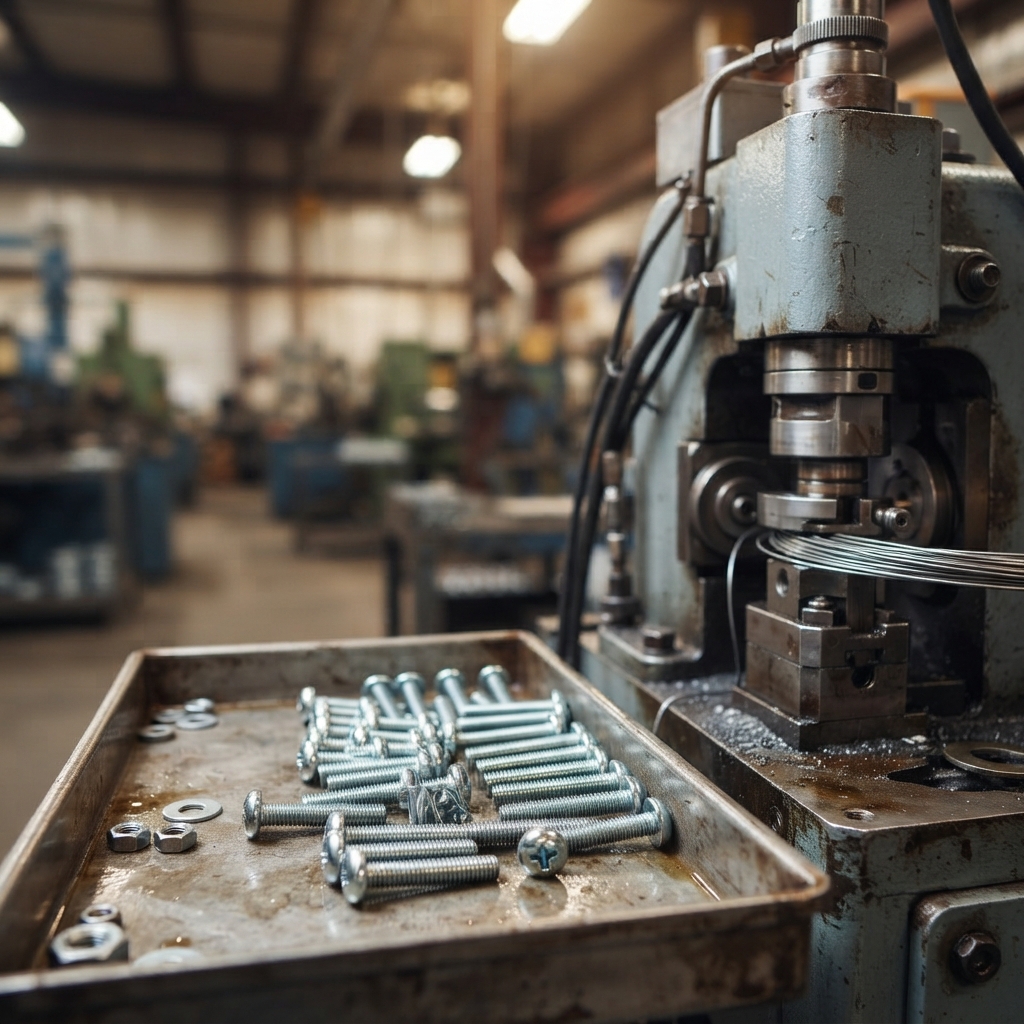
Cold heading produces parts in fractions of a second, but preparing the machine takes far longer than making a small batch. The fixed work is concentrated at the start of the run, which is why the cost per piece falls steeply and then flattens. A custom screw MOQ is simply that fixed work divided by a quantity the supplier can recover it across.
Setup and changeover
A heading machine needs the correct dies, a set stroke, an adjusted cut-off and a trial run before the first good part appears. Thread rolling, slotting, drilling or knurling each add another setup. Those hours are consumed whether the run is 2,000 pieces or 200,000.
Material lots
Wire and bar arrive in coils or bundles with a minimum weight, and the grade may have to be ordered in. A buyer who specifies an unusual stainless grade for a 3,000-piece trial is often asking the supplier to buy a mill quantity and carry the remainder.
Finishing and heat treatment
Plating and heat treatment are batch processes. A barrel has a working load, and a furnace has a zone that must be filled to run at a sensible cost. Small lots are possible, but they are usually priced as if they occupied the whole batch, because in scheduling terms they do.
Inspection and packing
Inspection cost is partly fixed: the sampling plan, the gauges, the dimensional report, the material certificate and the first-article record all have to be prepared once. Packing adds a second setup for labels, bag counts and carton marks. Both are small per large order and disproportionate in small batch screw production, which is why a 2,000-piece trial can cost more per piece than four times its number at volume.
| Cost element | How it behaves | What a buyer can change |
|---|---|---|
| Dies and tooling | One-off cost per geometry | Reuse an existing design, or accept a standard head and thread |
| Machine setup | Fixed per run | Longer runs, fewer changeovers, combined sizes |
| Raw material | Lot minimum with price steps | Standard grade, realistic annual quantity |
| Heat treatment | Furnace lot | Combine parts of the same class and material |
| Plating | Barrel or rack load | Standard finish specification, batching with other work |
| Inspection and records | Partly fixed per order | Agree the document set and AQL in advance |
| Packing | Setup per pack design | Bulk pack first, retail or kit packing later |
How the minimum changes with the manufacturing route
The same drawing can carry three different minimums depending on how it is made, and the cheapest quotation at low volume is often the route that will not be used in production. Tooling cost for custom screws is the clearest signal of which route a supplier has in mind: a dedicated die points to heading, while programming time and little tooling points to machining.
| Route | What sets the floor | Cost behaviour at low volume | Best used when |
|---|---|---|---|
| Cold heading plus thread rolling | Dies and machine setup; very high output rate | High fixed cost, low variable cost, so small runs look expensive | Repeat production of a stable design |
| CNC turning or milling from bar | Programming and setup; little or no dedicated tooling | Low entry cost, high cost per piece | Prototypes, low volume, complex features |
| Standard screw with secondary modification | Setup per added operation | Moderate, limited by the base part's own minimum | Length, point or drive changes on a proven part |
| Purchased standard part plus kitting | Pack design and labour | Low tooling, labour driven | Assortments and retail hardware kits |
This is the first place a trial goes wrong. A machined prototype can be dimensionally perfect and commercially meaningless if production will be cold-headed, because the two routes produce different collar geometry, thread root form and surface finish. A trial that does not use the production route proves the drawing, not the process.
Three ways to structure a screw trial order
1. Pay the fixed cost as a separate line
Tooling and setup are invoiced openly, and a smaller run follows at a higher unit price. The advantage is transparency: the buyer can see what the die costs and what the parts cost. The condition is that the run must still be made on the production route, with production tooling, or the information it produces is weak.
2. Place the MOQ and release it in stages
The buyer commits to the full minimum but takes delivery in scheduled call-offs, for example a first release for assembly trials and later releases against a build plan. Cash exposure is higher and the buyer carries the stock, but the process is proven at volume and the unit price is the real one.
3. Start from a standard part and modify
Where the design allows, a standard screw with a changed length, point or drive avoids a new die and usually lowers the entry quantity. It trades design freedom for speed and cost, and it is often the fastest route to a working assembly while a custom part is developed.
| Structure | Cash exposure | What it proves | Main risk |
|---|---|---|---|
| Separate tooling plus small run | Low piece count, visible tooling cost | Design fit, if made on the production route | An unrepresentative trial that approves the wrong process |
| MOQ with staged releases | Full minimum committed | Capability and consistency at volume | Forecast error, storage and cash tied up |
| Standard part plus modification | Low tooling | Fit on a proven, repeatable process | Limited geometry, possible compromise on function |
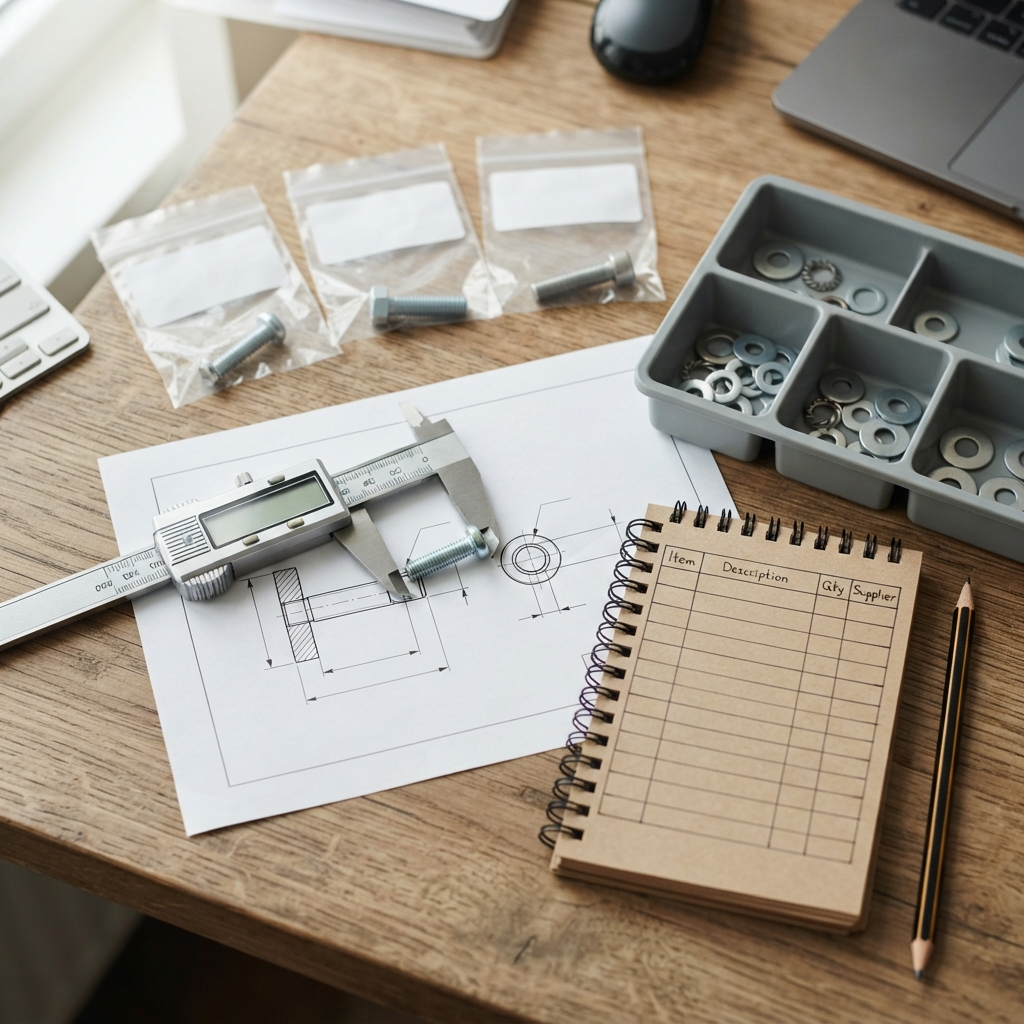
Worked example: what a small trial really costs per piece
The comparison that matters is cost per accepted piece, not unit price:
Cost per accepted piece = (tooling + setup + material and conversion + inspection + packing + freight) ÷ accepted pieces
The figures below are an illustration only, not a quotation or a market price. They show how fixed cost behaves, and why screw price breaks look so steep between a trial and a production order.
| Cost line | 2,000-piece trial | 20,000-piece order |
|---|---|---|
| Tooling | 600 | 600 |
| Setup | 250 | 250 |
| Material and conversion | 90 | 900 |
| Inspection | 120 | 120 |
| Packing | 80 | 300 |
| Freight | 180 | 600 |
| Total | 1,320 | 2,770 |
| Per piece | 0.66 | 0.14 |
Roughly four fifths of the trial cost is fixed. That is the honest reason a small order is expensive, and it is also the reason a trial should be treated as purchased information rather than as a cheap batch of parts. Skipping the trial does not remove the fixed cost; it moves the cost into the risk of a wrong production run.
One technical note worth writing into the drawing: for carbon and alloy steel screws, property classes and their test methods are defined in ISO 898-1:2013. A custom screw MOQ quote that does not name the property class is quoting a shape, not a fastened joint.
What buyers can trade instead of arguing about the number
MOQ negotiation works better when the buyer offers something the supplier can bank. The number itself is rarely the real obstacle; the uncertainty around it is.
- A written twelve-month forecast with a quarterly release schedule, rather than a verbal promise.
- Permission to combine sizes within one material and finish family to fill a batch.
- Standard material and a standard finish for the first lot, with the premium finish added later.
- Bulk packing for the trial, with retail or kit packaging introduced on the repeat order.
- A documented first-lot premium instead of demanding the volume price at trial quantity.
- Tooling paid up front in exchange for clear ownership and transfer terms.
- A planned delivery slot that accepts a longer lead time in return for a smaller run.
Each of these gives the supplier something real, which is why they work better than asking for a discount on a quantity that does not cover the setup. A forecast the buyer does not intend to keep is worse than no forecast, because it destroys credibility for the next negotiation.
Common mistakes that make a trial expensive
- Comparing unit prices at different quantities. A price at 2,000 pieces and a price at 50,000 pieces are not the same offer, even from the same supplier.
- Treating MOQ as one number for the whole purchase order. It is normally per specification, so four sizes mean four minimums unless the supplier agrees to combine them.
- Approving a sample made by a different process. The classic version is a CNC-turned sample for a part that will be cold-headed.
- No written price-break table. Without agreed steps, the volume price is a conversation rather than a term.
- Ignoring MPQ. A carton count that exceeds the intended order quantity turns a 9,000-piece requirement into a 10,000-piece purchase.
- Leaving tooling ownership unstated. If the relationship ends, the question of who holds the die decides whether you can move the part.
- Mistaking a free sample for sincerity. A custom part needs a die and a setup, so a supplier who promises free custom samples without asking a technical question is likely to recover the cost elsewhere. Our custom screw sample approval checklist covers what a sample should actually prove.
- Tolerancing after the quote. Tightening a tolerance or adding a coating after pricing changes both the route and the minimum.
What to put in the RFQ before asking for a trial
A trial request is only useful if the supplier can price the production case at the same time. Include:
- A quantity ladder, for example 2,000, 10,000 and 50,000 pieces, so the screw price breaks are visible.
- Annual forecast and release pattern, stated separately from the first order.
- Per-specification MOQ and per-order MOQ, quoted as two different figures.
- Tooling fee, tooling ownership, expected tool life and who pays for replacement.
- Sample charge, and whether it is credited against the first production order.
- Price validity, incoterm and the delivery point the price refers to.
- Packaging MPQ, label content and who owns the artwork.
- Inspection documents, sampling level and the acceptance standard, including the property class where it applies.
- Responsibility for rework, sorting and freight if production deviates from the approved sample.
Put the custom screw MOQ question in writing, as a request for two numbers rather than one. Our screw RFQ checklist lists the drawing and commercial fields in the order a factory actually reviews them, which shortens the back-and-forth before a trial can be quoted.
How we quote MOQ on custom screws
Our product pages state the minimum openly rather than hiding it behind "contact us". For the silver cross-drive pan-head machine screw, the published figure is 10,000 pcs per confirmed specification, and machine threads from M1 to M12 with lengths from 3 mm to 200 mm can be reviewed where they suit the confirmed subtype, mating thread and application.
That figure is a consequence of how the part is made, not a negotiating position. Jiangmen Jinhe Hardware Products Co., Ltd. has manufactured fasteners since 2004 and exports to more than 40 countries through its authorized export partner, Jiangmen Shenxin Trading Co., Ltd. Cold heading, tapping, punching, injection molding, assembly, packing and inspection are carried out in our own workshops, which is exactly why a run has to cover die setting, machine time and a plating batch before it can be priced sensibly. You can see the workshop sequence on our manufacturing page.
The same custom fastener MOQ logic applies to kits. The metric socket screw, nut and washer assortment kit is quoted at 10,000 pcs per confirmed specification, because the component mix, compartment layout and packaging have to be fixed before the run, not during it. Finishes such as zinc plating, Ruspert coating, spray painting, electrophoretic coating, blackening and gold, silver or copper plating can be reviewed where they suit the base material and service environment. The full range is on our product pages.
Where a requirement sits below the published figure, the productive conversation is about structure, such as a staged call-off against the minimum, a standard part with a modification, or a different route. It is not about a number the process cannot hold.
FAQ
What is a typical custom screw MOQ?
There is no universal figure. A cold-headed custom screw typically carries a higher minimum than a machined part because the die and setup cost must be recovered, while a standard screw with a minor modification can often be supplied in smaller quantities. The only meaningful answer comes from a specific drawing, material, finish and route.
Can I order less than the MOQ for a custom screw?
Sometimes, but not by asking for a lower number. A smaller quantity usually becomes possible when the fixed cost is paid separately, when the unit price carries a documented premium, or when the buyer commits to a staged release against the full minimum. Any of these should be written into the quotation.
Is tooling charged on top of the MOQ price?
Often yes, and it should be a separate line rather than buried in the unit price. Ask whether the fee is one-off or repeatable, what its expected life is, and who owns the tooling. Ownership matters if you later move the part to another supplier.
Does a sample order count toward the MOQ?
Usually not, unless the supplier agrees to credit the sample charge against the first production order. A sample is normally a separate short run with its own setup, so treating it as part of the minimum understates the work involved.
Why is MOQ quoted per specification rather than per purchase order?
Because each specification needs its own die, setup and inspection plan. Two sizes of the same screw are two production events. Some suppliers will combine sizes of the same material, diameter family and finish to meet a batch minimum, but that is a concession to negotiate, not a default.
Can I combine sizes to reach the MOQ?
It is worth asking when the parts share material, finish and a similar diameter, because they can then share a plating batch and some setup work. Combining different materials or finishes usually defeats the purpose, since each still needs its own process run.
Who owns the tooling?
It depends on the agreement, and it should never be left implicit. Common arrangements are that the buyer pays for the tooling and owns it, or that the supplier owns it and amortizes the cost into the unit price. Ask for the answer in writing, including what happens to the tooling at the end of the relationship.
How does MOQ affect lead time?
A larger run takes longer to produce but usually waits less for a machine slot, while a small run may be scheduled around larger jobs. The lead time that matters starts from drawing and sample approval, not from the purchase order date, so confirm which event starts the clock.
Conclusion
Custom screw MOQ is a cost-recovery number, and it becomes negotiable only when the buyer addresses the fixed cost behind it. Read the quotation as a set of limits rather than a single figure, insist that any trial uses the production route, and settle tooling, screw price breaks and packaging quantities before the first order is released.
A practical sequence for the next enquiry:
- Send one controlled drawing with material, thread class, finish and acceptance standard.
- Ask for a quantity ladder and a separate per-specification MOQ.
- Ask what the tooling costs, who owns it and how long it lasts.
- Ask whether the trial will be made on the production route and with production tooling.
- Agree the sample approval record and the documents that will accompany each shipment.
If you have a drawing and a target annual quantity, send both through our contact page and we can quote the production case rather than a generic table. If you are still comparing suppliers, the screw manufacturer audit guide sets out what to verify before the first order.