
Custom Wholesale Screws for Production Buying: What Sourcing Teams Should Check First
Choosing a custom wholesale screws supplier is rarely a simple purchasing task.
For engineers, sourcing managers, and product teams, screws are tied to assembly reliability, line efficiency, inventory control, and long-term maintenance. A screw that looks acceptable on paper can still create problems in real production. It may slow installation, strip during driving, loosen under use, damage a mating part, or arrive in packaging that forces workers to sort parts by hand.
That is why many buyers searching for a custom wholesale screws supplier are not only looking for a catalog item. They need a partner that can support special dimensions, head styles, material choices, surface finishes, packaging formats, inspection, and bulk supply.
In production buying, the screw is small. The decision around it is not.
Why standard screws are not always enough
Standard catalog screws are useful when the application is simple, the design is already proven, and the assembly does not require special control.
But many real projects are less forgiving.
An electronics product may need a smaller head profile to avoid interference.
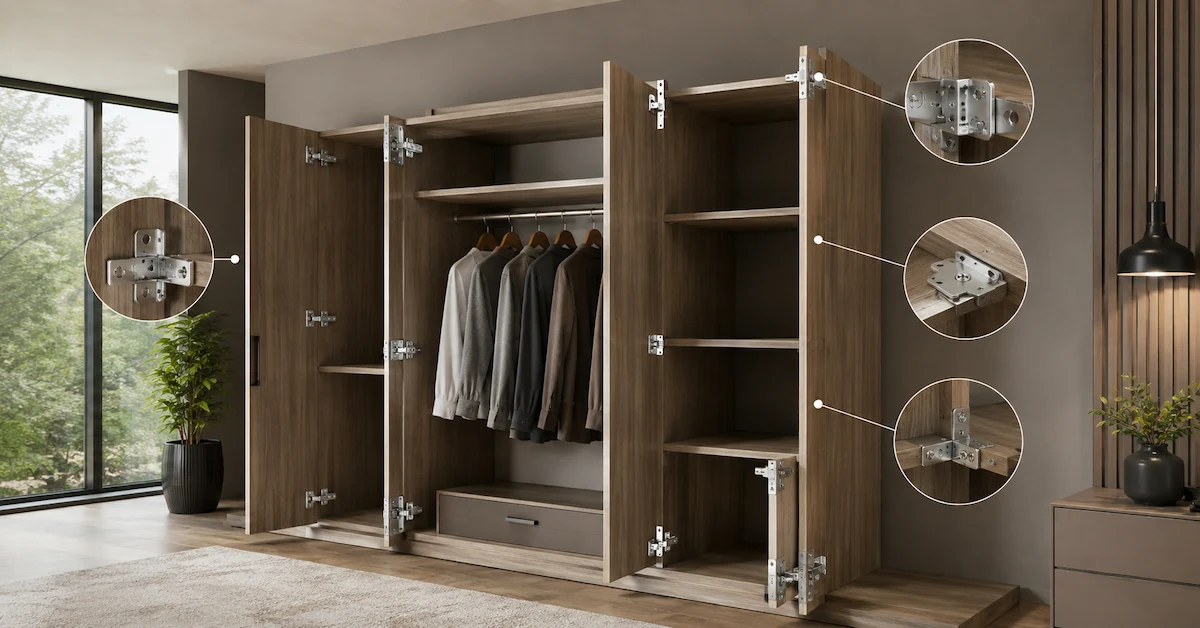
A furniture component may need a screw that holds well in engineered wood.
A home appliance part may need a finish that matches the visible housing.
A medical or automation assembly may require tighter dimensional consistency.
A maintenance kit may need screws packed by size, not thrown into one mixed bag.
Once these requirements appear, buyers often need a custom screw manufacturer for bulk orders instead of a basic stock supplier.
Customization may involve changing the screw length, thread type, head style, drive recess, coating, material, or packing method. Sometimes the change is small. Even then, it can affect assembly speed and product quality.
What Jiangmen Jinhe Hardware Co., Ltd. says it supports
Jiangmen Jinhe Hardware Co., Ltd. describes its core work as fastener production and non-standard customization. Its product range includes machine screws, self-tapping screws, micro screws, and precision screws.
The company says it works with materials such as stainless steel, iron, and aluminum, and serves industries including electronics, medical devices, automation, home appliances, furniture, and building materials.
For buyers, this type of range is useful because bulk fastener programs often involve more than one screw family. One project may need standard machine screws. Another may require self-tapping screws. A later product revision may need a custom head style, different finish, or revised packaging.
A supplier that can support both standard and non-standard requirements can make procurement easier, especially when buyers are trying to reduce supplier fragmentation.
What buyers usually need from a bulk fastener partner
Most sourcing teams are not only comparing unit price. They are trying to control three things at the same time: fit, consistency, and supply continuity.
A capable custom fastener manufacturer should be able to help buyers confirm:
| Buyer Requirement | Why It Matters |
|---|---|
| Screw type | Machine screw, self-tapping screw, micro screw, or precision screw |
| Head style | Affects clearance, appearance, and tool access |
| Drive style | Influences installation speed and stripping risk |
| Thread type | Must match the mating material and fastening method |
| Material | Impacts strength, corrosion behavior, weight, and cost |
| Finish | Affects appearance, storage, and service environment |
| Packaging | Controls receiving, sorting, kitting, and warehouse flow |
| Inspection | Helps reduce variation before delivery |
| Documentation | Supports internal quality and purchasing systems |
| Repeat supply | Keeps future batches aligned with approved samples |
These points may look basic, but they prevent many common sourcing problems.
A screw order can fail even when the part itself is usable. Poor labeling, unclear packaging, mixed batches, or missing documents can still slow production.
The warehouse side of screw sourcing
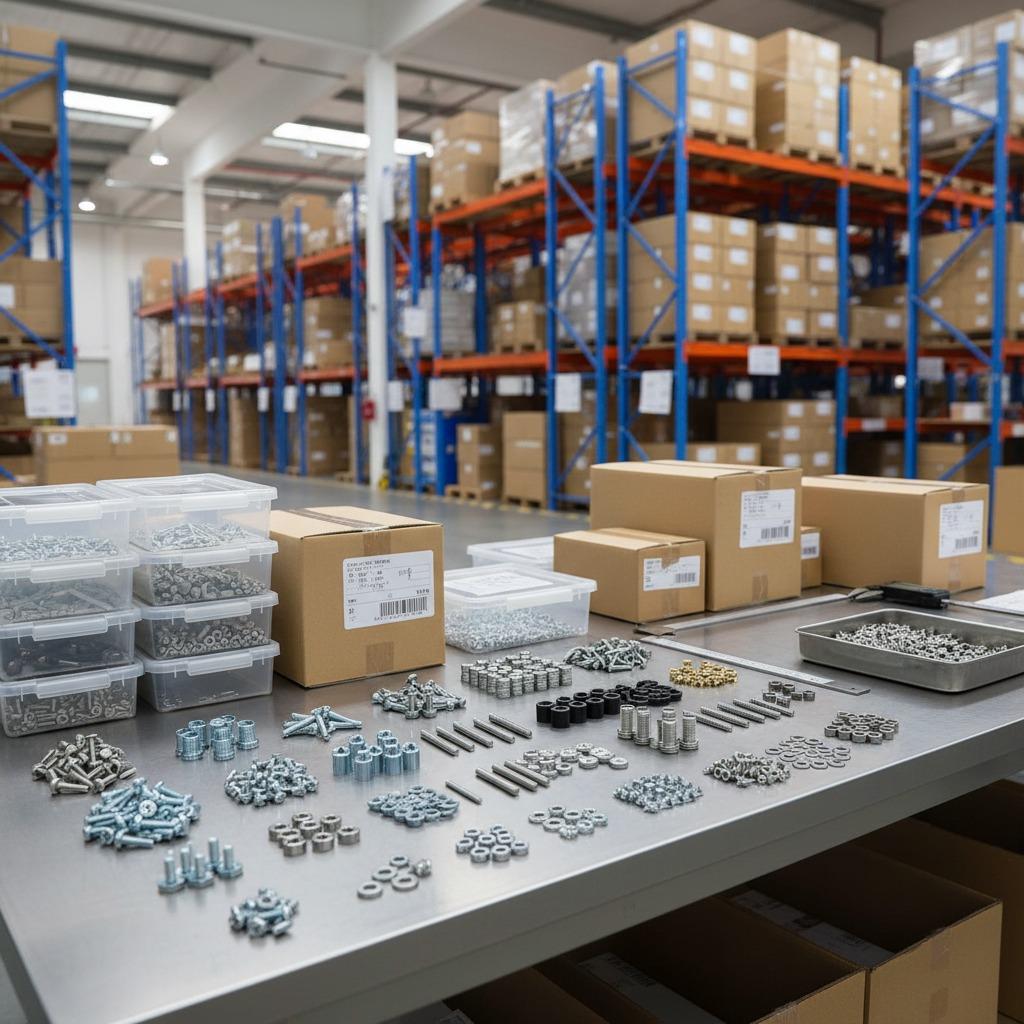
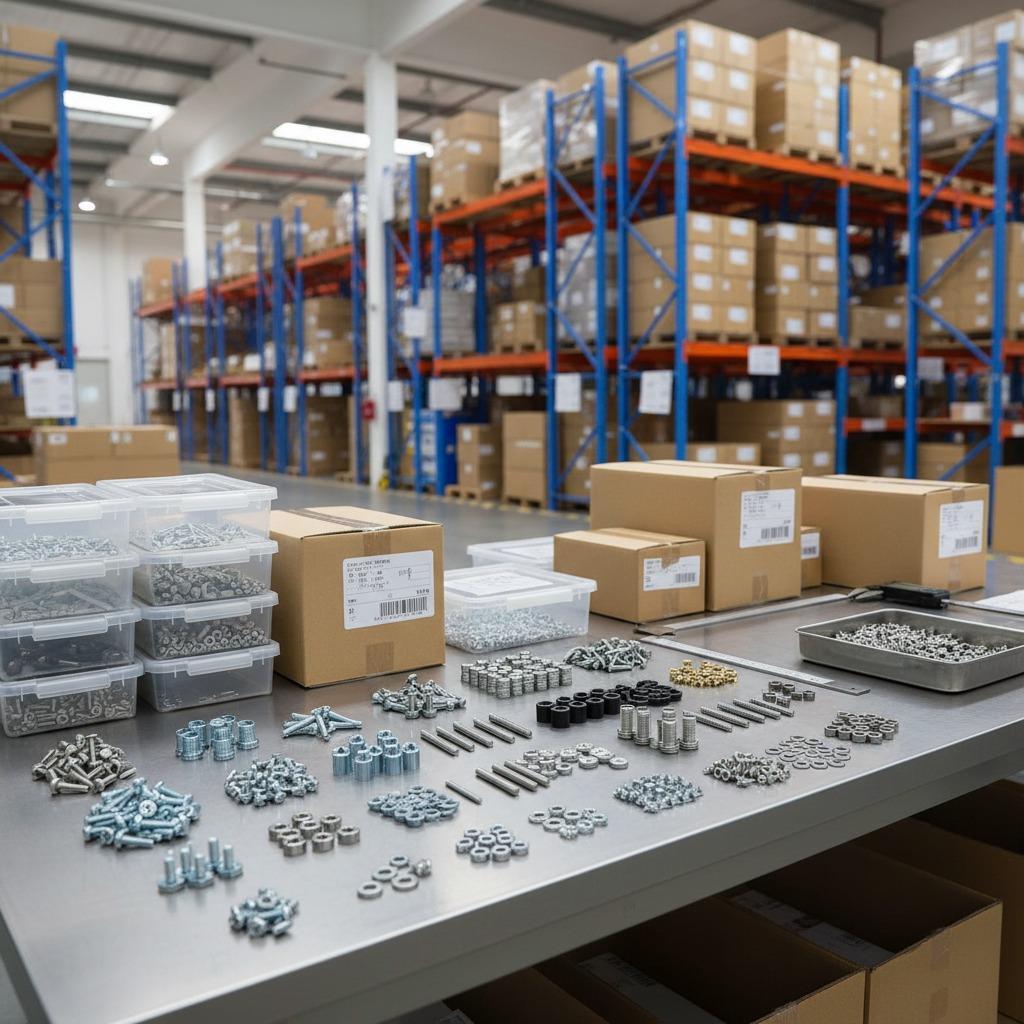
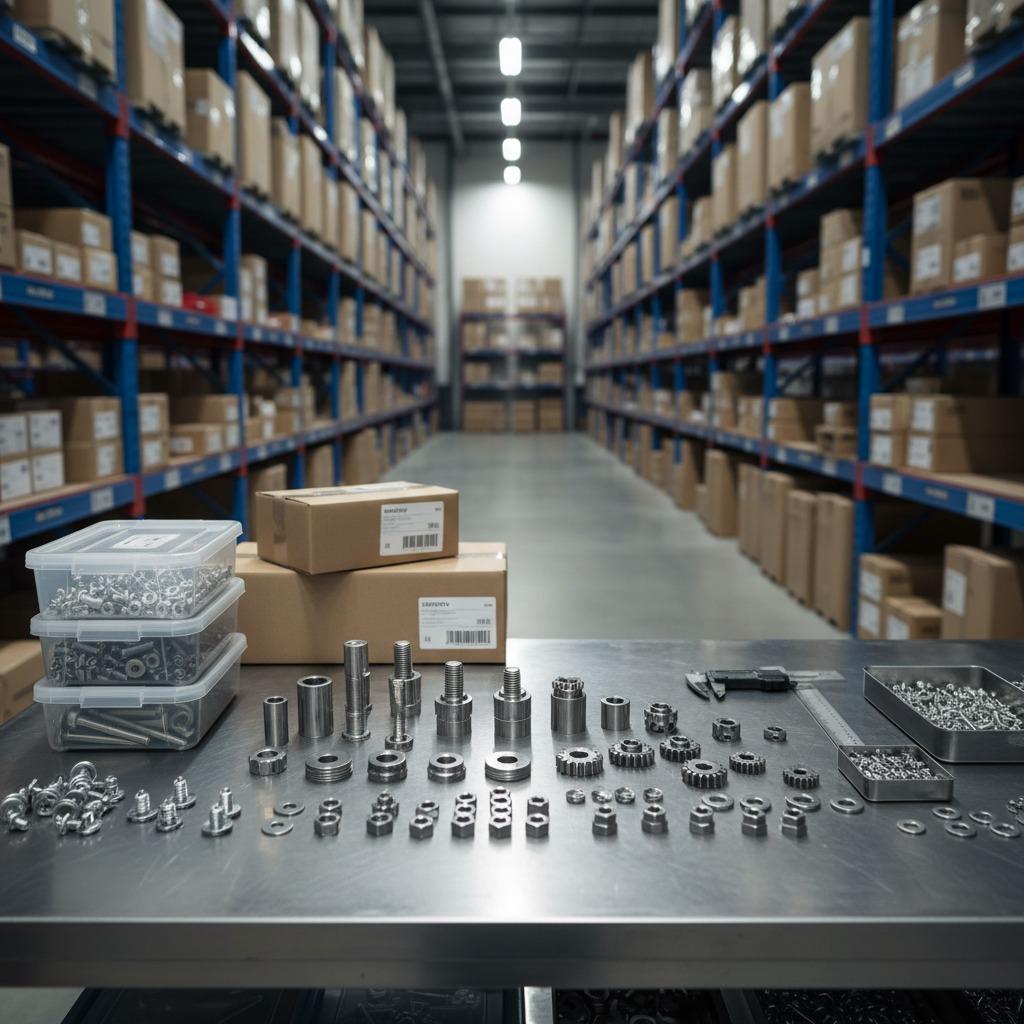
The product information points to a warehouse-style assortment: screws, bolts, washers, nuts, spacers or standoffs, threaded inserts or bushings, pins, clips, and coated components sorted into clear bins.
That matters because fastener supply is often connected to kitting, pick-and-pack work, and assembly-line staging.
Some buyers need bulk cartons for factory storage.
Some need labeled bags for furniture assembly.
Some need compartment boxes for repair kits.
Some need mixed fastener assortments for maintenance teams.
Some need export-ready cartons with clear part numbers and documents.
Packaging is not a small afterthought. It affects how fast the buyer can receive, count, store, issue, and use the screws.
If a supplier can produce fasteners but cannot keep mixed parts organized, the buyer may still face extra labor after delivery.
Standard or custom: how to decide
Not every screw needs to be custom. In fact, many sourcing projects work better when buyers use standard parts wherever possible.
The question is where standard parts stop working.
Use standard screws when:
The application is common, the fit has already been tested, the finish requirement is simple, and the buyer mainly needs stable replenishment.
Use custom screws when:
The assembly has limited space, special appearance requirements, unusual torque behavior, a specific material stack-up, or a screw that no stock item matches cleanly.
Use OEM supply when:
The screw is tied to a branded product, controlled production process, custom packaging format, or repeated bulk order.
For some projects, the best choice is not fully custom manufacturing. It may be a modified standard part with adjusted length, finish, packaging, or head style. That approach can save time while still meeting the application requirement.
Inspection and documentation should be discussed early
Jiangmen Jinhe says it conducts strict inspection before delivery and provides necessary documentation. For buyers in electronics, appliances, medical devices, automation, or export-oriented supply chains, that kind of support can be important.
Still, every buyer should confirm the exact inspection and document requirements before placing an order.
Useful questions include:
What dimensions will be checked?
How is the finish inspected?
Are material documents available if needed?
Can the supplier provide inspection reports?
How are nonconforming parts handled?
How are approved samples recorded for future orders?
Can carton labels or part numbers be customized?
These details may feel routine, but they help prevent confusion when the order moves into volume.
Common mistakes in bulk screw buying
One common mistake is treating all screws as interchangeable.
They are not.
Two screws may share the same nominal size but behave differently because of head style, drive recess, thread form, coating, material, or tolerance.
Another mistake is focusing only on price. The cheapest screw can become expensive if it causes rework, requires manual sorting, or does not arrive with the required documentation.
A third mistake is under-specifying packaging. A screw can be correct on paper but still inconvenient in practice if it arrives in loose bulk format when the production line needs sorted packs.
Buyers also sometimes approve a sample without checking how the supplier will maintain the same specification in repeat orders. A good sample matters, but repeatability matters more.
How to judge a supplier beyond the sample
Samples are useful, but they do not tell the whole story.
A well-made sample does not automatically prove stable bulk output. Buyers should ask how the supplier controls production, sorting, inspection, packaging, and logistics after sample approval.
Jiangmen Jinhe’s company profile mentions domestic logistics, warehousing, supply chain services, and international freight forwarding. For buyers managing multi-step distribution or overseas purchasing, these services may reduce friction.
The company also states compliance with GB, DIN, ANSI, BS, JIS, and ISO standards. That gives buyers and engineers a useful communication framework, but it does not replace project-specific confirmation. The final standard, grade, finish, and inspection plan should always be written clearly.
Practical advice for OEM and custom screw projects
When approaching a custom wholesale screws supplier, bring more than a part name.
A good RFQ should include:
- drawing or sample
- target application
- screw size
- thread type
- head style
- drive style
- material requirement
- finish requirement
- expected quantity
- packaging method
- inspection requirement
- delivery destination
- documentation needs
If the screw will be used in electronics, medical devices, or automation, say so early. These industries may be less forgiving about dimensional variation, finish inconsistency, or unclear documentation.
If your team is still deciding between standard and custom screws, ask the supplier to quote both options. That comparison can show whether customization is truly necessary or whether the design can be simplified without affecting function.
FAQ
Is a custom supplier only for very large buyers?
No. Bulk orders help, but small-to-mid volume programs may also need customization when the assembly, finish, or packaging requirement is unusual.
Can one supplier handle both standard and non-standard screws?
Often yes, if the supplier has production capability, customization experience, and stable communication. Buyers should still verify the supplier’s ability for each product family.
What should buyers verify before approval?
Buyers should verify material, finish, dimensions, drive style, head style, thread type, packaging, inspection documents, and the supplier’s ability to support the production schedule.
Why is packaging important in screw sourcing?
Packaging affects receiving, sorting, storage, assembly, resale, and customer experience. Poor packaging can create extra work even when the screw itself is correct.
When should buyers choose a custom screw manufacturer?
Buyers should choose a custom screw manufacturer when standard screws do not fully meet the product’s fit, appearance, performance, packaging, or repeat-order requirements.
Next step for sourcing teams
If you are evaluating a custom screw manufacturer for bulk orders, start with a short technical brief and a clear packaging requirement.
That will quickly show whether the supplier understands production realities or only sells individual parts.
For projects involving mixed hardware, kitting, standard screws, non-standard screws, or export supply, Jiangmen Jinhe Hardware Co., Ltd. can be reviewed as a potential custom fastener manufacturer for your application and procurement process.
Contact:
Tel / WeChat: +86 13729150102
WhatsApp: +86 13322893939
Email: sharon@hkhomeideas.com
The right supplier should help buyers control more than the screw itself. It should help control specification, packaging, inspection, delivery, and repeat supply.