
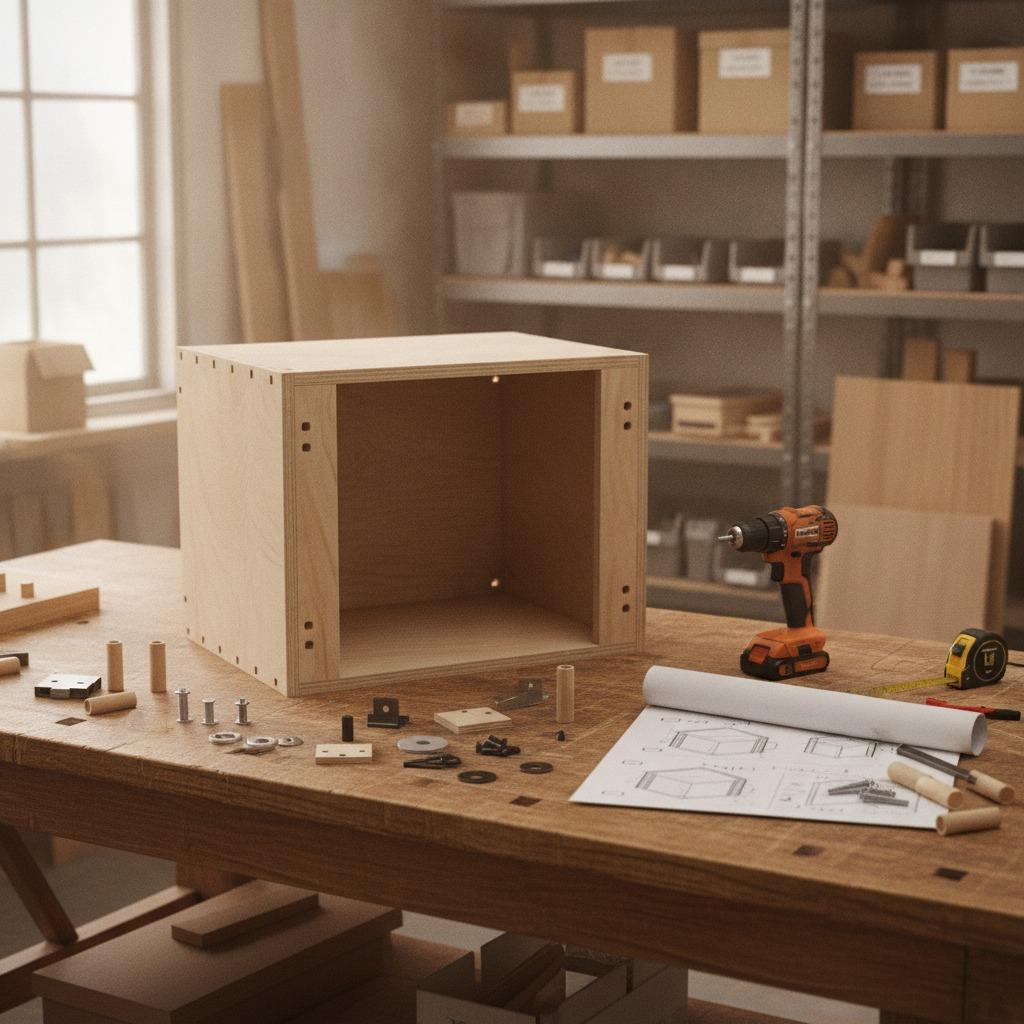
Flat Pack Cabinet Hardware: What Buyers Should Really Check Before Production Starts
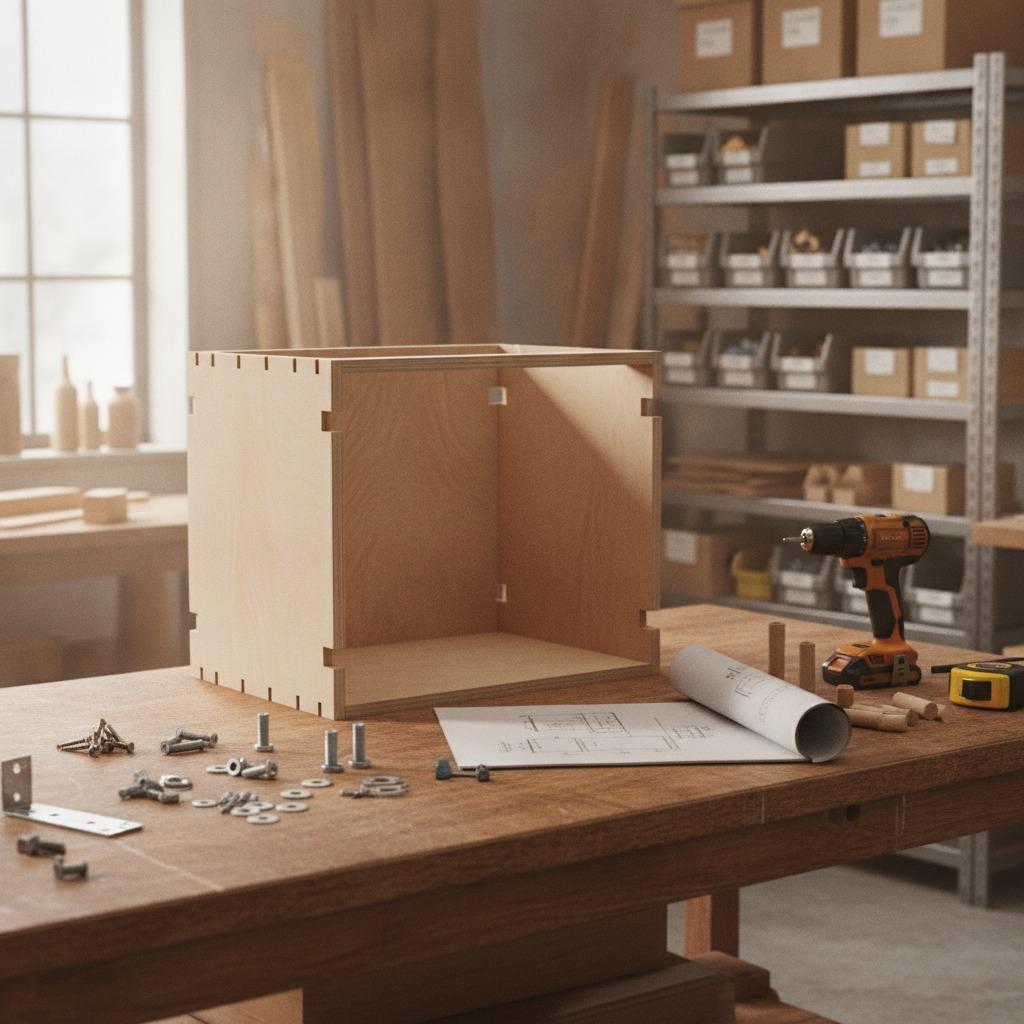
A flat-pack cabinet looks simple when it is still in the carton.
Panels are stacked neatly. The instruction sheet is folded on top. The small hardware bag sits in one corner, almost like an afterthought. To the customer, it may look like the easy part.
People who work in furniture production know better.
That small bag can decide whether the cabinet goes together smoothly or turns into a slow, irritating job. One screw is too long. One cam lock does not pull tight. One dowel feels loose. One bracket is packed with the wrong fastener. The panels may be cut well, but the assembly still feels wrong.
That is why flat pack cabinet hardware should be reviewed before production starts, not after the cabinet design is already finished.
For engineers, sourcing managers, furniture brands, and kit suppliers, the real question is not simply “which screw goes where?” The better question is: will this hardware work with the panel material, drilling pattern, packing method, and user assembly process?
That is where good flat-pack furniture sourcing begins.
The hardware is small, but it controls the assembly
Flat-pack furniture depends on a simple promise: the product can be shipped in pieces and assembled later without too much trouble.
The panels create the shape. The hardware makes that shape usable.
A typical cabinet kit may include screws, cam locks, connector bolts, dowels, shelf pins, brackets, washers, plugs, caps, and sometimes small plastic guide parts. None of these parts looks complicated alone. Together, they control alignment, tightening, shelf support, and final stability.
When the kit is right, nobody thinks much about it. The panels come together, the corners stay square, and the customer finishes the build without sending a complaint.
When the kit is wrong, even a decent cabinet can feel cheap.
A loose connector changes the feel of the whole product. A missing fitting stops the build completely. A poorly labeled hardware bag makes the user slow down and guess. In flat-pack furniture, that guessing is dangerous because customers often do not know whether the problem is the part, the panel, or their own assembly.
Good flat pack assembly hardware removes that uncertainty.
Panel material should guide the hardware choice
A cabinet hardware kit should never be selected without checking the board.
MDF, particleboard, plywood, veneered board, laminated panels, and other sheet materials behave differently around screws and connectors. Some boards hold threads better. Some split more easily near the edge. Some machine cleanly but do not tolerate repeated tightening very well.
A screw that works in plywood may be too aggressive for particleboard.
A dowel that fits one board tightly may feel loose in another.
A cam fitting that works in a thicker panel may not seat correctly in a thinner one.
This is one of the reasons “universal” hardware kits can be risky.
They may be convenient for repair packs or general resale, but production furniture needs better matching. The hardware should be chosen around board thickness, hole diameter, hole depth, edge distance, and the expected assembly load.
A good flat pack furniture hardware supplier should ask about these details before recommending a kit.
If the supplier only asks for quantity and price target, the discussion is not complete.
Pre-drilled holes make mistakes easier to see
Pre-drilled panels are supposed to make assembly faster.
They also make the hardware less forgiving.
Once the holes are drilled, the connector has to match them. If the cam hole is too shallow, the cam may sit too high. If the bolt length is slightly wrong, the joint may not pull tight. If the screw pilot hole is too loose, the fastener may not hold. If the edge distance is too small, the board can crack during tightening.
These problems may not show up in a product photo.
They show up at the bench.
For that reason, buyers should test the hardware in the actual cabinet structure. Use the real panel material. Use the real hole pattern. Use the same driver or hand tool that will be used later. Assemble the cabinet in the same order shown in the instruction sheet.
Then check what happens.
Do the panels pull together cleanly? Does the corner stay square? Does the screw seat without damaging the surface? Does the cam lock feel firm? Can the user identify the parts easily?
That short test often tells buyers more than a long catalog page.
A good kit follows the assembly sequence
The best cabinet hardware kits are not only complete. They are easy to use in the right order.
That part matters.
A kit may include every screw, dowel, bracket, and cam connector required for the cabinet, yet still create confusion if the parts are mixed poorly. A customer may use the wrong screw in the wrong hole. A worker may stop to compare two similar lengths. A warehouse team may need to open packs again because the label is unclear.
For factory assembly, this wastes time. For home assembly, it creates frustration. For e-commerce sellers, it often becomes a support message or a replacement request.
Flat pack assembly hardware should be packed with the user in mind.
Sometimes that means separate bags for different steps. Sometimes a compartment tray is better. Sometimes a simple printed label matching the instruction sheet is enough. The packaging does not need to be fancy, but it must be clear.
The person opening the kit should not need to become a hardware expert.
Packaging is part of product quality
Packaging is often discussed too late.
The cabinet is designed. The hardware is chosen. Then someone asks how the parts should be packed.
That order can create problems.
Small hardware moves easily during transport. Washers stick together. Screws scratch visible parts. Dowels hide under larger fittings. A bag can tear. A label can fall off. A kit can look complete at the factory and arrive confusing at the customer’s home.
For flat-pack cabinets, packaging should be treated as part of the hardware specification.
A proper kit may need separated bags, model labels, barcodes, carton references, spare-part packs, or stronger inner packing for export shipments. For retail or repair kits, clear packaging can also help customers see what they are buying before opening the pack.
The goal is simple: the right part should be easy to find at the right moment.
A cabinet connector hardware set that is packed badly will still create complaints, even if the metal parts are acceptable.
Standard hardware can work well, but it still needs control
Many flat-pack cabinet programs use standard hardware.
That is not a problem. In fact, standard parts are often the best option when they match the design. They are easier to reorder, easier to replace, and usually easier to manage across multiple product lines.
But standard does not mean careless.
A standard cam lock still needs the right matching bolt. A standard screw still needs the right length and head style. A standard dowel still needs the correct diameter. A standard bracket still has to match the hole pattern.
Custom furniture fasteners become useful when the standard part does not quite fit the job. Maybe the board thickness is unusual. Maybe the fastener needs a different finish. Maybe the kit needs a special pack count or private label. Maybe the design needs a modified connector to keep the cabinet exterior cleaner.
Customization should solve a real assembly problem.
It should not create extra complexity without a reason.
Where Jiangmen Jinhe Hardware fits
Jiangmen Jinhe Hardware Co., Ltd. works with fasteners, standard parts, and non-standard customization. Its product range includes machine screws, self-tapping screws, micro screws, and precision screws in materials such as stainless steel, iron, and aluminum. The company also works with standards such as GB, DIN, ANSI, BS, JIS, and ISO.
For buyers sourcing flat pack cabinet hardware, this background is relevant because cabinet kits often include several fastener types, not just one connector. A full hardware set may involve screws, bolts, cam-related fittings, brackets, dowels, labels, packaging, inspection, and repeat-order control.
Jiangmen Jinhe also notes support for inspection before delivery, documentation, foreign trade, logistics, warehousing, and supply chain services. For furniture manufacturers, cabinet suppliers, hardware wholesalers, and cross-border e-commerce sellers, that support can help when sample orders become repeated shipments.
A useful supplier should not only quote parts.
It should help keep the hardware package stable from one order to the next.
Replacement parts should be planned early
Flat-pack cabinet hardware is not only used during the first assembly.
Customers lose parts. Installers misplace screws. Cabinets are moved. Shelves are adjusted. Doors are repaired. A small replacement kit can prevent one missing connector from becoming a larger customer-service issue.
This is especially important for modular cabinet hardware and e-commerce furniture.
If the product is sold across markets, the replacement kit should be easy to identify. The parts should match the original cabinet. The label should be clear. The supplier should be able to repeat the same specification later.
Buyers who ignore replacement hardware often pay for it later through support work.
A spare pack costs little compared with a frustrated customer.
Common mistakes buyers still make
One common mistake is treating all flat-pack hardware as interchangeable.
It is not.
Cam locks, dowels, screws, brackets, inserts, shelf pins, caps, and washers all have different jobs. A part that works in one cabinet line may not suit another board thickness or drilling pattern.
Another mistake is choosing hardware before the panel design is stable. When board material, hole size, or edge distance changes, the hardware may need to change too.
A third mistake is approving loose parts without testing the packed kit. The supplier may send good parts, but the customer receives a confusing hardware bag.
Buyers also sometimes forget the assembly sequence. A kit should match the order of the build, not only the final bill of materials.
The final mistake is focusing only on unit price. A cheaper kit can become expensive if it causes damaged panels, missing-part claims, slower assembly, or extra replacement shipments.
What buyers should ask before ordering
Before choosing flat pack cabinet hardware, buyers should ask practical questions.
What panel material is being used?
What board thickness and hole pattern are required?
Which parts are included in the complete kit?
Are the holes pre-drilled?
What screw lengths and connector sizes are needed?
Will the cabinet be assembled once or repeatedly?
Can the hardware be tested with the actual panel?
How are similar parts separated in packaging?
Can labels match the assembly instructions?
How is kit count checked before shipment?
Can replacement packs be supplied later?
Can non-standard fasteners be customized?
What inspection documents are available?
Can logistics or export support be included?
These questions help buyers find out whether the supplier understands the cabinet system or only sells loose hardware.
Frequently Asked Questions
What is flat pack cabinet hardware?
Flat pack cabinet hardware includes screws, cam locks, connector bolts, dowels, brackets, shelf pins, plugs, caps, washers, and other fittings used to assemble ready-to-assemble cabinets and panel furniture.
Why does panel material matter?
Different boards hold hardware differently. MDF, plywood, particleboard, laminated board, and veneered panels may require different screws, connector types, pilot holes, or tightening methods.
What should buyers test before bulk orders?
Buyers should test the hardware with the actual panel material, hole pattern, tools, packaging format, and assembly sequence before placing volume orders.
Can one hardware kit fit several cabinet models?
Sometimes, but only when the panel thickness, hole pattern, load requirement, and assembly method are compatible. Buyers should not assume universal fit without testing.
Why is packaging important for flat-pack cabinet hardware?
Packaging helps prevent missing parts, mixed fasteners, unclear assembly steps, and customer complaints. In flat-pack cabinets, the hardware kit is part of the user experience.
Can flat pack cabinet hardware be customized?
Yes. Screw length, connector type, finish, kit quantity, labels, packaging, and non-standard fasteners can be customized when the project requires it.
Good hardware makes the cabinet easier to build
Good flat pack cabinet hardware does not need to impress the customer.
It needs to work.
The panels align. The screws hold. The cam fittings tighten. The dowels guide the structure. The kit is complete. The packaging is clear. The next shipment matches the approved sample.
That is what buyers should expect from a reliable flat pack furniture hardware supplier.
For flat pack cabinet hardware, flat pack assembly hardware, cabinet connector hardware, modular cabinet hardware, custom furniture fasteners, and organized furniture hardware kits, Jiangmen Jinhe Hardware Co., Ltd. can discuss material options, standard parts, non-standard customization, inspection, packaging, warehousing, logistics, and repeat supply requirements.
For direct inquiries:
Tel/WeChat: +86 13729150102
WhatsApp: +86 13322893939
Email: sharon@hkhomeideas.com
Start with the panel material, board thickness, hole pattern, hardware list, assembly sequence, packaging method, and expected order quantity.
Once those details are clear, the right flat pack cabinet hardware becomes much easier to source and repeat.