
How to Choose a Flat Pack Furniture Hardware Kit Supplier for Better Assembly Control
A flat pack furniture hardware kit supplier is not only selling screws, brackets, and connectors.
In a real assembly project, the hardware choice affects how quickly a cabinet goes together, how square the finished product feels, how often customers misunderstand the instructions, and whether the furniture can survive packing, shipping, and repeated handling.
That matters whether the product is a small open-top storage cube, a desktop organizer, a shelving module, or a larger knock-down cabinet system.
Many buyers spend most of their time discussing panel material, surface finish, and carton design. Those details are important. But the hardware is what turns a stack of panels into a usable product.
If the connector is wrong, the whole furniture piece feels cheap.
If the screw is too long, the panel edge may split.
If the bracket does not sit square, the frame may twist.
If the hardware kit is poorly labeled, the customer may blame the entire product.
For sourcing managers and product teams, the real decision is not simply whether to buy fasteners. The question is whether you need a general hardware vendor, a flat pack hardware kit manufacturer, or a flat pack furniture fittings supplier that can match parts to your panel system, assembly sequence, and packaging logic.
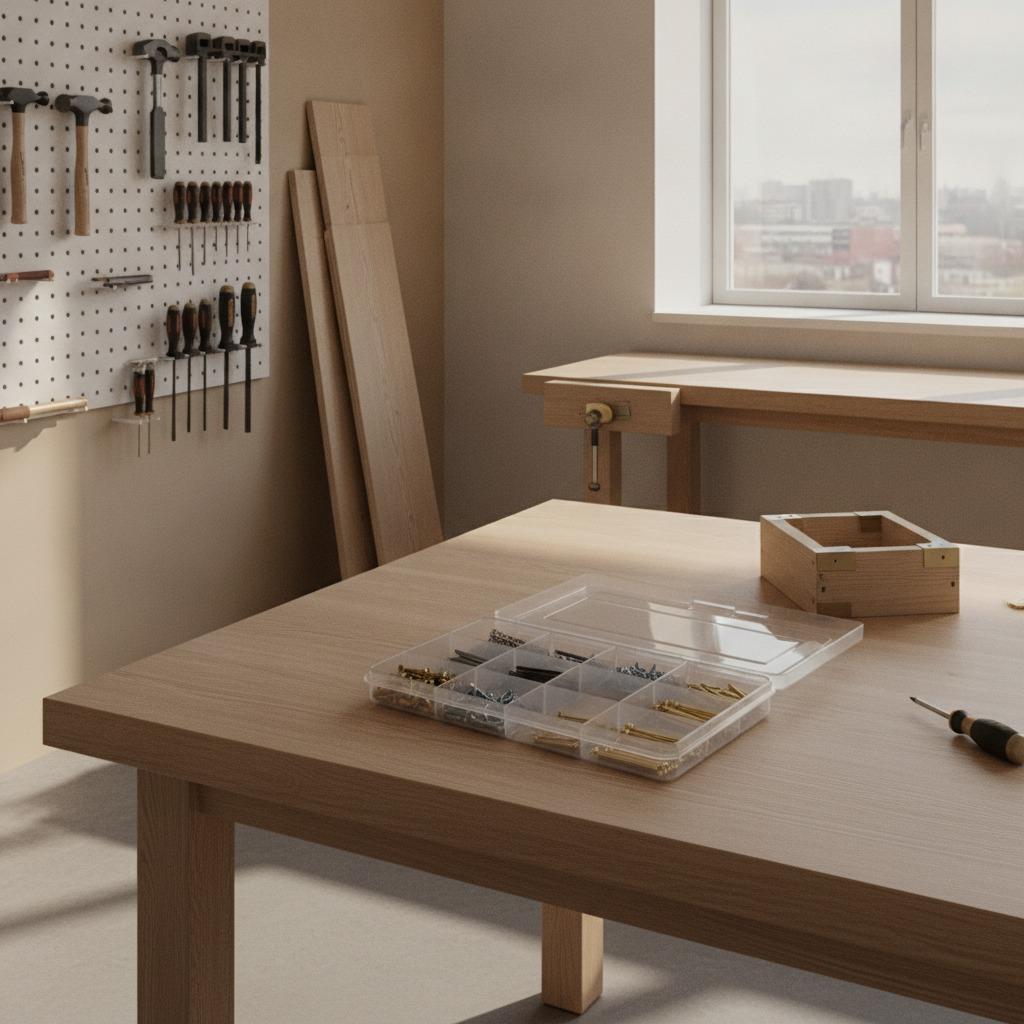
What a practical flat pack hardware kit usually contains
In furniture production, “hardware” refers to the small components that make the structure work.
A practical flat pack furniture hardware kit may include:
| Hardware Type | Typical Function |
|---|---|
| Machine screws | Used with metal fittings or threaded parts |
| Self-tapping screws | Used for wood-based panels or compatible substrates |
| Micro screws | Used for compact fittings or small accessories |
| Precision screws | Used where alignment and fit need tighter control |
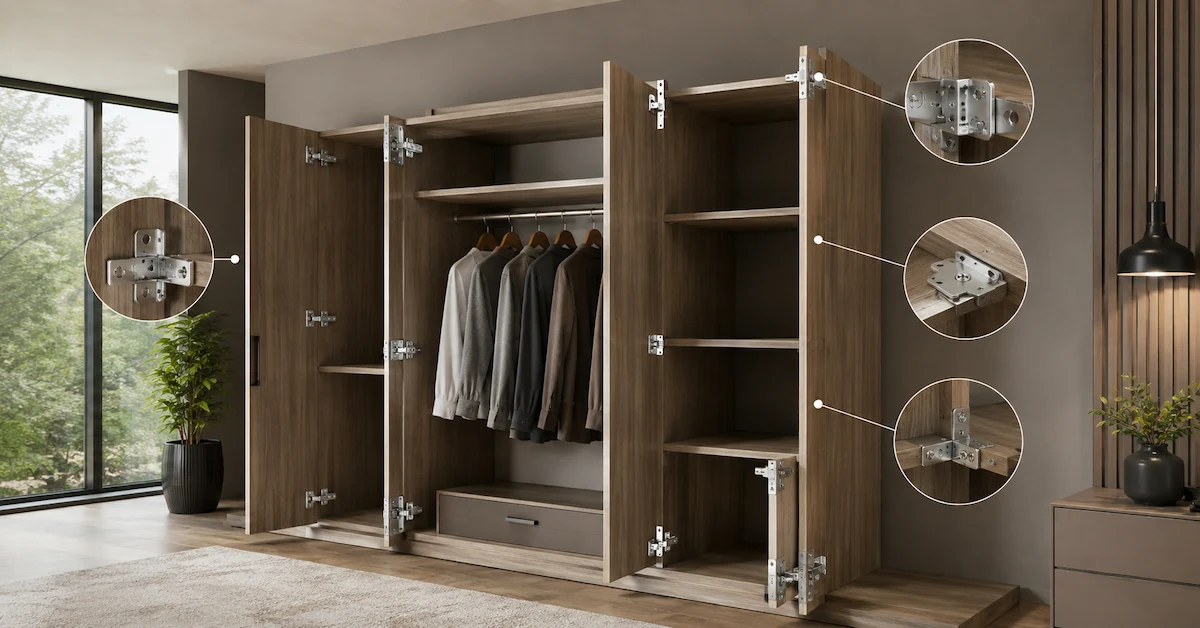
| Corner brackets | Reinforce corners and help keep frames square |
| Dowels | Align panels during assembly |
| Connectors | Join panels in knock-down furniture systems |
| Washers, nuts, inserts | Support fastening and load distribution |
| Plastic caps or spacers | Improve appearance, spacing, or protection |
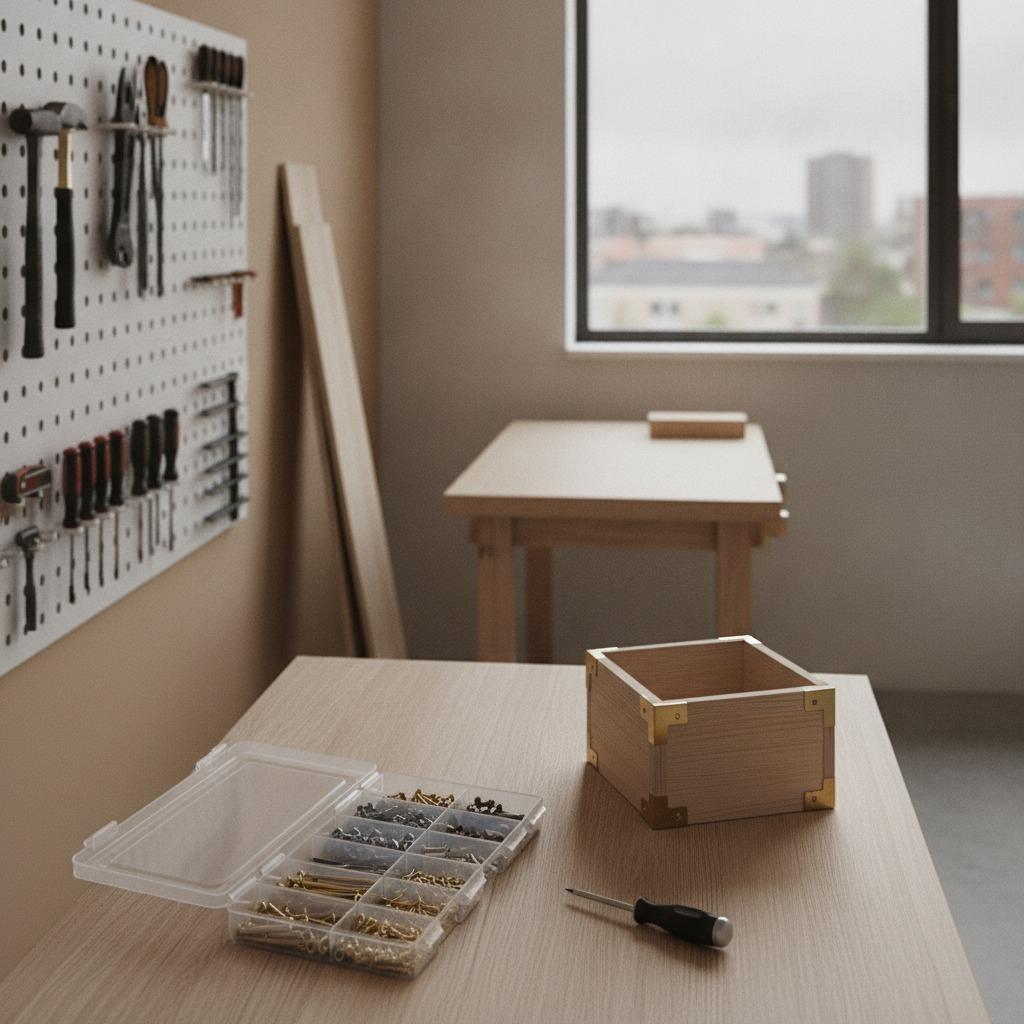
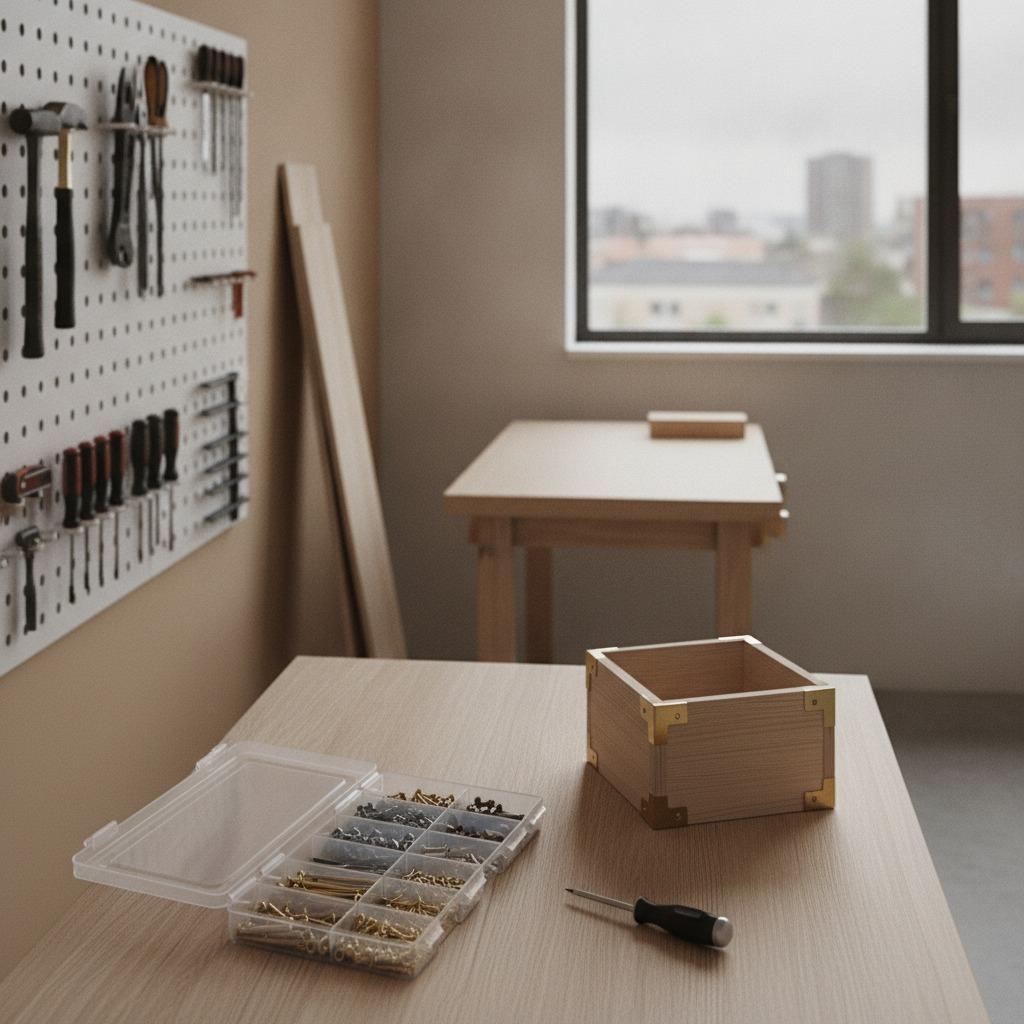
In a small cabinet carcass or cube-style storage box, visible corner reinforcement often plays a bigger role than buyers first expect. It helps keep the product stable during assembly and transport.
The best kits are built around the product, not around whatever happens to be in the supplier’s stock bins.
A small desktop organizer may need shorter screws and light corner reinforcement. A larger knock-down cabinet may require stronger connectors, better step-by-step packaging, and more careful part separation.
The key question is simple:
Does the kit reflect the furniture design, or is the furniture design being forced to fit a generic hardware kit?
Details buyers should check first
Before comparing quotations, buyers should confirm the basic engineering details.
Thread type, screw length, head style, bracket thickness, connector depth, and anti-loosening behavior all deserve attention. So do material pairings.
Stainless steel, iron, and aluminum are common options in hardware supply, but the correct choice depends on the application.
A hidden fastener inside a dry cabinet may not require the same material as a visible bracket on a consumer-facing product. A furniture item that goes through repeated logistics handling may need stronger fastening than a simple display prototype.
Buyers should also think about the assembly environment. Will the product be assembled by factory workers, installers, or end users? The answer changes the hardware kit design.
A professional supplier should be able to discuss these points clearly before the order reaches mass production.
How to compare supplier types without wasting time
A broad hardware seller can be useful for commodity parts. But a flat-pack furniture project often needs more than a price sheet.
A specialized flat pack furniture hardware supplier should be able to discuss:
-
panel thickness
-
assembly sequence
-
drawing review
-
screw and connector matching
-
packaging compatibility
-
repeat-order control
-
inspection requirements
-
export packing needs
This is especially important for cross-border e-commerce and retail furniture products. A confusing bag of mixed parts can quickly become a support problem.
A dedicated flat pack hardware kit manufacturer may be more suitable when the buyer needs repeatable parts, tighter control over the bill of materials, or customized packing by model.
If your product is still being developed, supplier flexibility matters even more. Flat-pack furniture often looks simple until the first prototype is assembled. That is when small hardware decisions become very visible.
Selection criteria that matter in production
The first filter is manufacturing capability.
Jiangmen Jinhe Hardware Co., Ltd. produces machine screws, self-tapping screws, micro screws, and precision screws in materials including stainless steel, iron, and aluminum. The company states that it works to GB, DIN, ANSI, BS, JIS, and ISO standards.
For buyers, standards matter because they create a clearer path when drawings, purchasing requirements, or customer specifications refer to recognized fastener systems.
The second filter is customization.
Jiangmen Jinhe focuses on fasteners, standard parts, and non-standard customization. That is relevant for furniture buyers because not every hardware kit can be built from off-the-shelf parts. Sometimes the screw length, bracket shape, connector type, finish, or packaging method must be adjusted for the product.
The third filter is inspection and documentation.
A supplier that can provide necessary paperwork and checks before delivery is easier to work with when the buyer’s own customer audits or quality systems are strict. In furniture sourcing, this is sometimes ignored at the first order and regretted later.
The fourth filter is response speed.
Jiangmen Jinhe notes customer support responses within 30 to 60 minutes for issues, with solutions within 2 hours. Service speed does not replace technical fit, but it can help when a drawing revision, packing change, or shipment issue appears late in the process.
Packaging should be treated as part of the kit
Packaging is not only about how the parts look in a box.
It affects assembly speed, warehouse control, and customer experience.
In flat-pack furniture, a tidy hardware set is part of the product. Mixed parts, weak labels, missing step separation, or unclear pack counts can create complaints that have nothing to do with the panels themselves.
Good packaging may include:
-
labeled bags
-
compartment boxes
-
model-specific kits
-
carton labels
-
barcode labels
-
assembly-step separation
-
spare-part packs
-
branded OEM packaging
A factory may need hardware packed for line-side efficiency.
A retailer may need clean customer-facing packaging.
A distributor may need clear SKU control.
An e-commerce seller may need replacement kits that are easy for customers to understand.
A capable supplier should think beyond the metal and into the carton.
Common mistakes in flat pack hardware sourcing
One common mistake is treating all fasteners as interchangeable.
They are not.
A slightly different head profile can affect tool engagement. A screw length that works in one panel thickness may damage another. A bracket that looks strong may still create alignment problems if the corner geometry is tight.
Another mistake is leaving the hardware discussion until after the panel design is frozen. This often leads to avoidable redesign work.
Buyers also sometimes approve a sample kit based only on appearance. That is risky. If the screws arrive neatly packed but do not match the real panel interface, the sample has still failed.
For products using visible corner brackets, such as open-top wooden boxes, small storage cubes, or modular carcass furniture, the hardware should be tested against the real corner geometry, not only a simplified mockup.
Why Jiangmen Jinhe Hardware is relevant to furniture buyers
Jiangmen Jinhe Hardware Co., Ltd., founded in 2016 in Jiangmen City, Guangdong Province, operates from a 4,000-square-meter base and serves industries that care about precision, consistency, and repeatability.
Its core business includes fasteners, standard parts, and non-standard customization. For furniture buyers, this makes the company relevant when the project requires the hardware portion of a flat-pack system rather than a generic catalog item.
The company also works across domestic and international markets, offers foreign trade services, and provides logistics support including international freight forwarding, domestic logistics, warehousing, and supply chain services.
For buyers, this can reduce friction when hardware needs to move as part of a broader furniture program.
Jiangmen Jinhe also reports cooperation with brands such as Liansu, Futian Electric, Midea, Hisense, and Sleemon, which suggests experience with established industrial supply chains.
For a furniture project, that background can be useful when the specification is still evolving and the buyer needs a supplier that understands production, customization, inspection, and delivery.
What to send in your first inquiry
A good inquiry does not need to be complicated, but it should be specific.
Send:
-
panel thickness
-
assembly drawing
-
target market
-
preferred standards
-
hardware list
-
estimated quantity
-
packaging format
-
surface finish requirement
-
whether OEM labels are needed
-
delivery destination
-
whether the project is prototype or mass production
If your design uses corner brackets, mention them early. If the kit must match a specific assembly step, explain that too. If the project is still being tested, say so clearly.
A supplier can usually help more when the uncertainty is stated early instead of hidden behind a rushed RFQ.
For buyers moving from prototype to repeatable supply, the next step is usually a drawing review and sample plan.
FAQ: High-Conversion Questions for Furniture Hardware Buyers
1. Can you customize a flat pack furniture hardware kit according to my drawing?
Yes. For OEM furniture projects, the kit can usually be customized based on drawings, panel thickness, connector type, assembly sequence, and packaging requirements.
Customization may include screw length, bracket size, connector type, finish, label format, carton marking, and full hardware kit configuration.
2. What information should I provide before requesting a quotation?
To receive an accurate quotation, buyers should provide furniture drawings, panel thickness, hardware list, target quantity, material or finish requirements, packaging method, and delivery destination.
If you already have a sample kit, photos or physical samples can also help the supplier match the hardware more accurately.
3. Can I request samples before placing a bulk order?
Yes. Sample testing is strongly recommended.
Buyers should assemble the sample kit with real panels and check screw fit, bracket alignment, connector performance, packaging clarity, and whether all parts match the assembly sequence.
4. What is the MOQ for customized hardware kits?
MOQ depends on the hardware type, customization level, finish, packaging method, and production process.
Standard parts usually allow more flexible quantities. Customized screws, special brackets, non-standard connectors, OEM packaging, or project-specific kits may require a higher MOQ.
5. Can you provide OEM packaging or branded labels?
Yes, OEM packaging can usually be discussed for furniture brands, distributors, and cross-border e-commerce sellers.
Options may include labeled bags, compartment boxes, branded stickers, barcode labels, carton labels, retail-ready packaging, and assembly-step packaging.
6. How do you control missing parts in each kit?
A reliable supplier should use counting, sorting, inspection, and packaging control before shipment.
Buyers can ask whether packing photos, inspection records, sample approval, or part-list confirmation can be provided for important orders.
7. How long does production usually take?
Lead time depends on whether the hardware is standard or customized, as well as order quantity, surface finish, packaging requirements, and production schedule.
Standard parts are usually faster. Custom parts, special finishes, branded labels, or new packaging may require additional sample approval time.
8. Can one supplier provide screws, brackets, connectors, and packaging together?
Yes, if the supplier has fastener supply and kitting capability.
Working with one supplier can reduce communication costs, improve consistency, and make repeat orders easier than sourcing screws, brackets, connectors, and packaging from several vendors.
9. Can you support both prototype development and mass production?
Yes, this should be discussed at the beginning of the project.
For prototype work, buyers usually need flexible sample support and drawing review. For mass production, the focus shifts to repeat quality, inspection, packaging control, and delivery stability.
10. Can you help with international shipping or export orders?
Jiangmen Jinhe Hardware states that it provides foreign trade services, warehousing, domestic logistics, international freight forwarding, and supply chain support.
For overseas buyers, this can simplify purchasing when hardware kits need to move as part of a larger furniture supply program.
Next step
If you are evaluating a flat pack furniture hardware kit supplier, start with the drawings, fastening requirements, and assembly sequence.
Then compare suppliers on more than price.
Look at material options, inspection practice, documentation, customization ability, packaging design, logistics support, and repeat-order consistency.
For buyers who want to discuss fastener specifications, non-standard customization, or the hardware side of a flat-pack furniture program, Jiangmen Jinhe Hardware Co., Ltd. can be contacted at:
Tel / WeChat: +86 13729150102
WhatsApp: +86 13322893939
Email: sharon@hkhomeideas.com