
Flat Pack Furniture Hardware Supplier: Why the Hardware Choice Is Really a Production Decision
A flat-pack furniture project rarely fails because the buyer forgot to order hardware.
The problem is usually more specific.
The connector looks right but does not pull the panel tight.
The screw drives well in a sample board but strips during repeated line assembly.
The black plastic fitting seems minor until workers discover it controls alignment.
The kit is complete on paper, yet the person opening it still has to sort through a small pile of mixed parts.
That is why choosing a flat pack furniture hardware supplier is not simply a purchasing decision. It is a production decision.
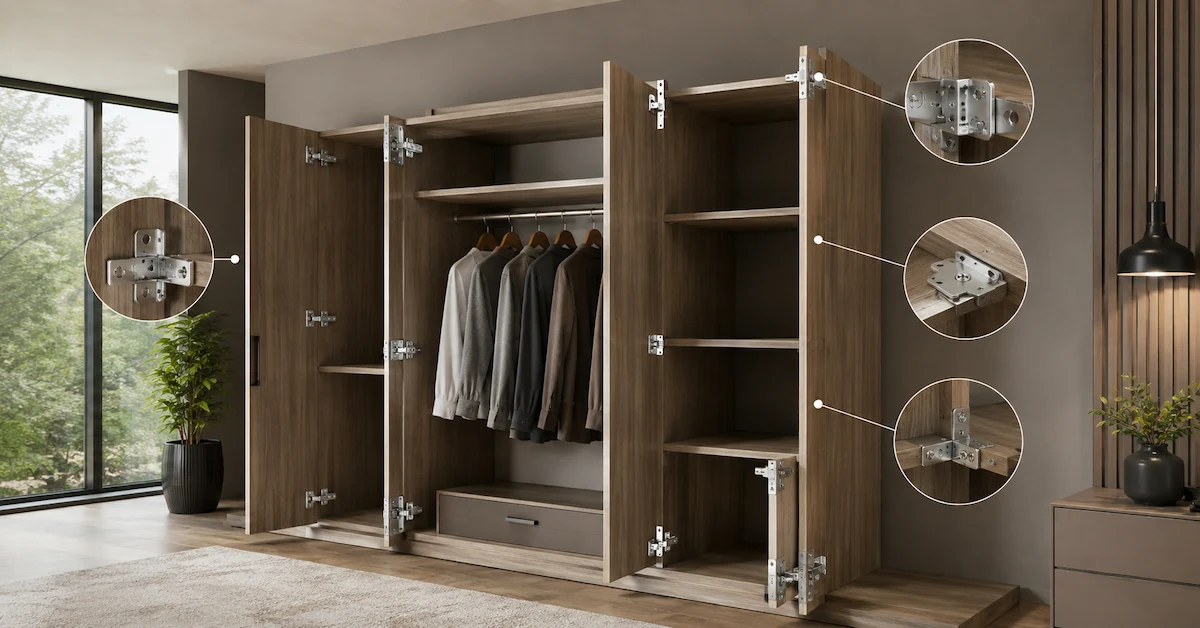
For cabinets, wardrobes, desks, shelving units, bed frames, and modular storage products, the hardware sits between the design file and the finished customer experience. If the small parts work together, assembly feels easy. If they do not, the whole product can feel less reliable, even when the panels are well made.
A furniture brand may talk about material, finish, packaging design, or retail positioning. On the assembly bench, however, the conversation often comes back to screws, connectors, inserts, dowels, brackets, and whether the kit behaves the same way every time.
What the hardware kit is really telling buyers
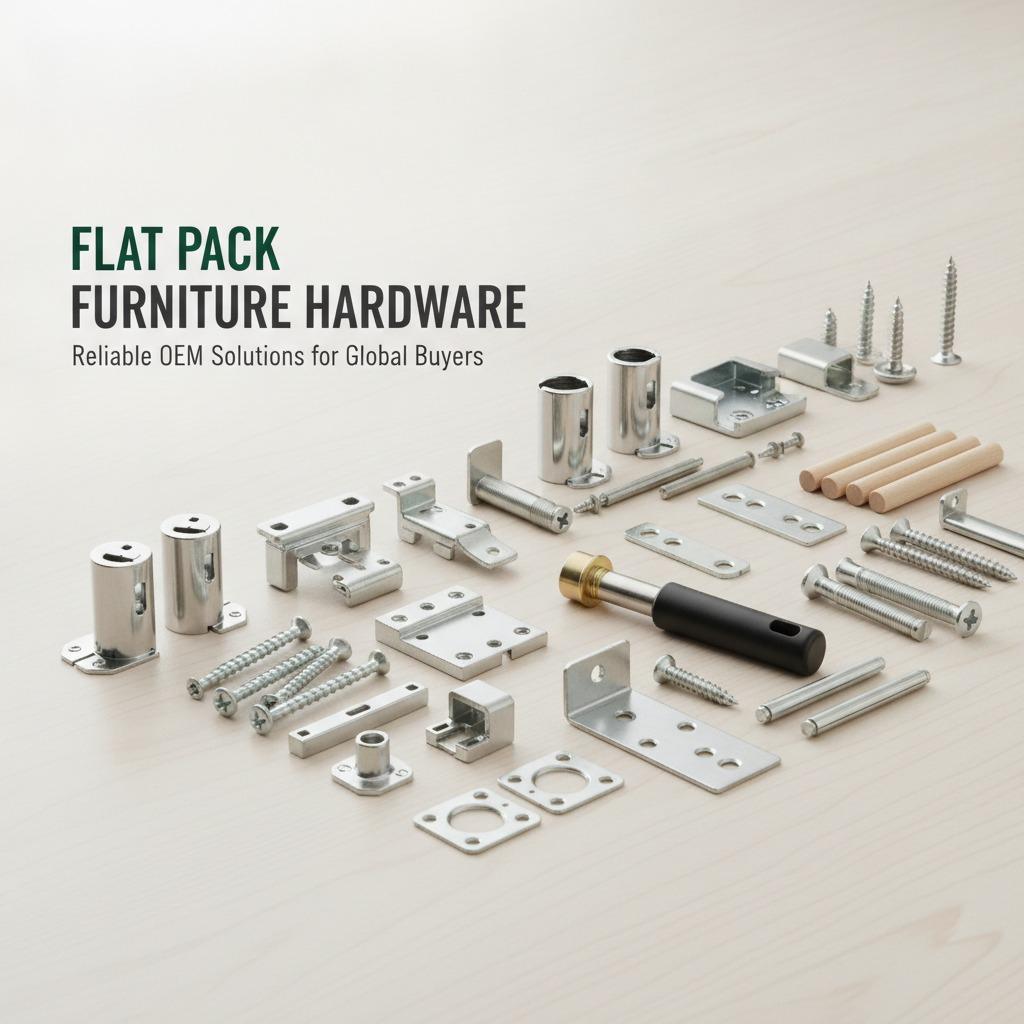
A typical OEM furniture hardware assortment does not look dramatic.
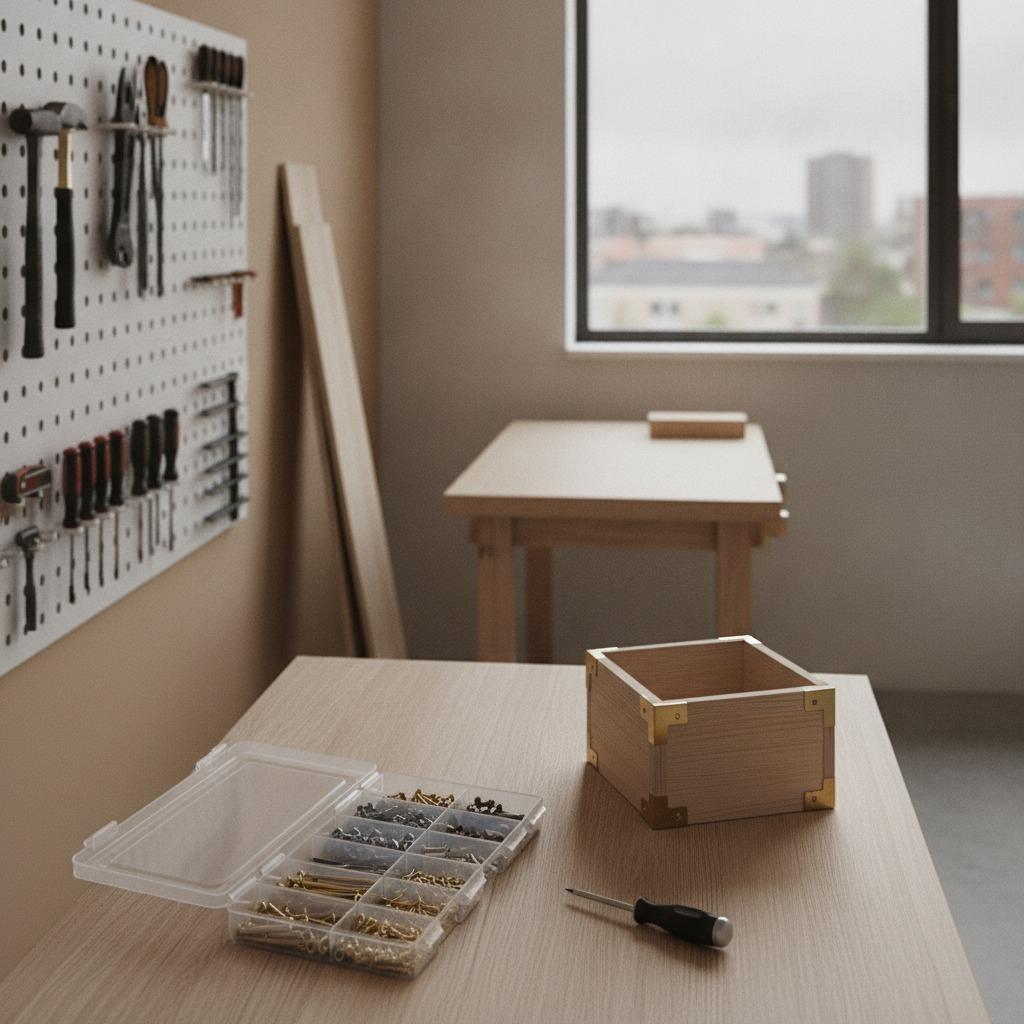
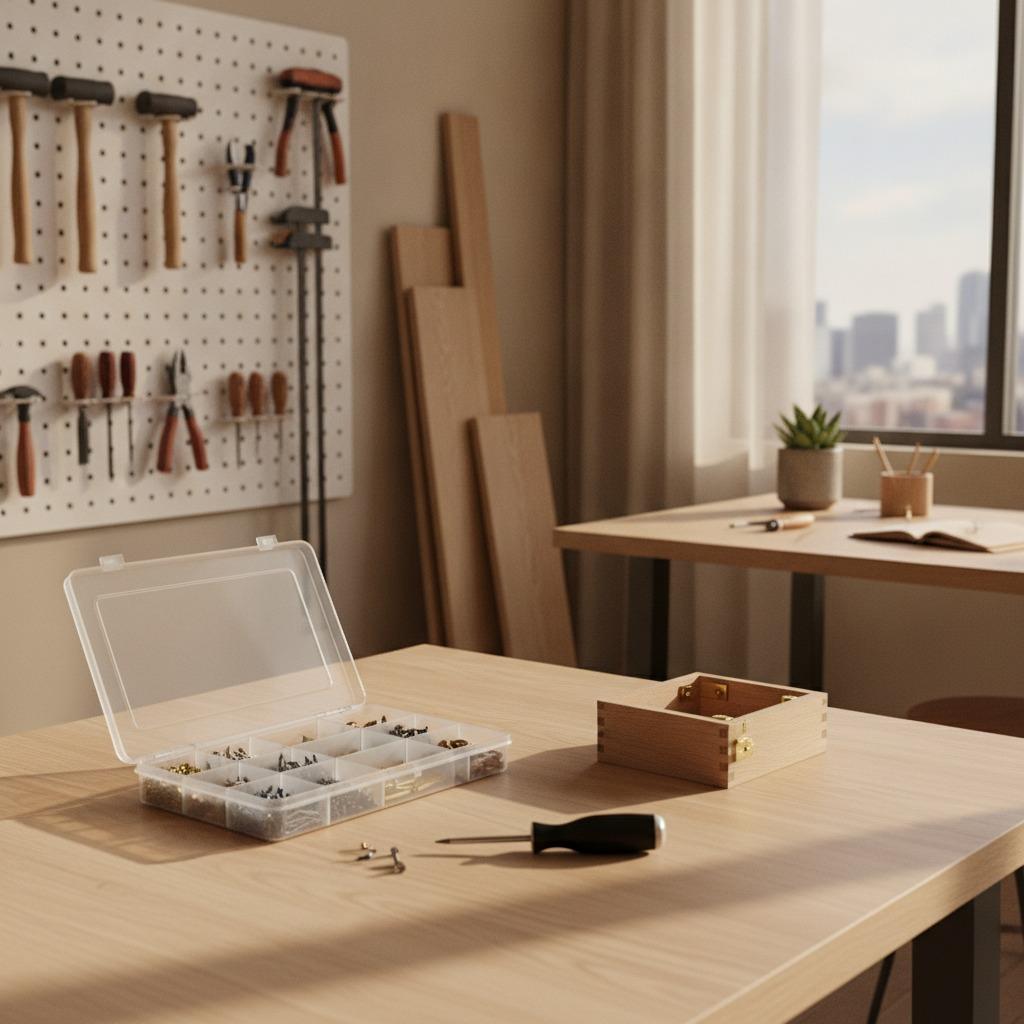
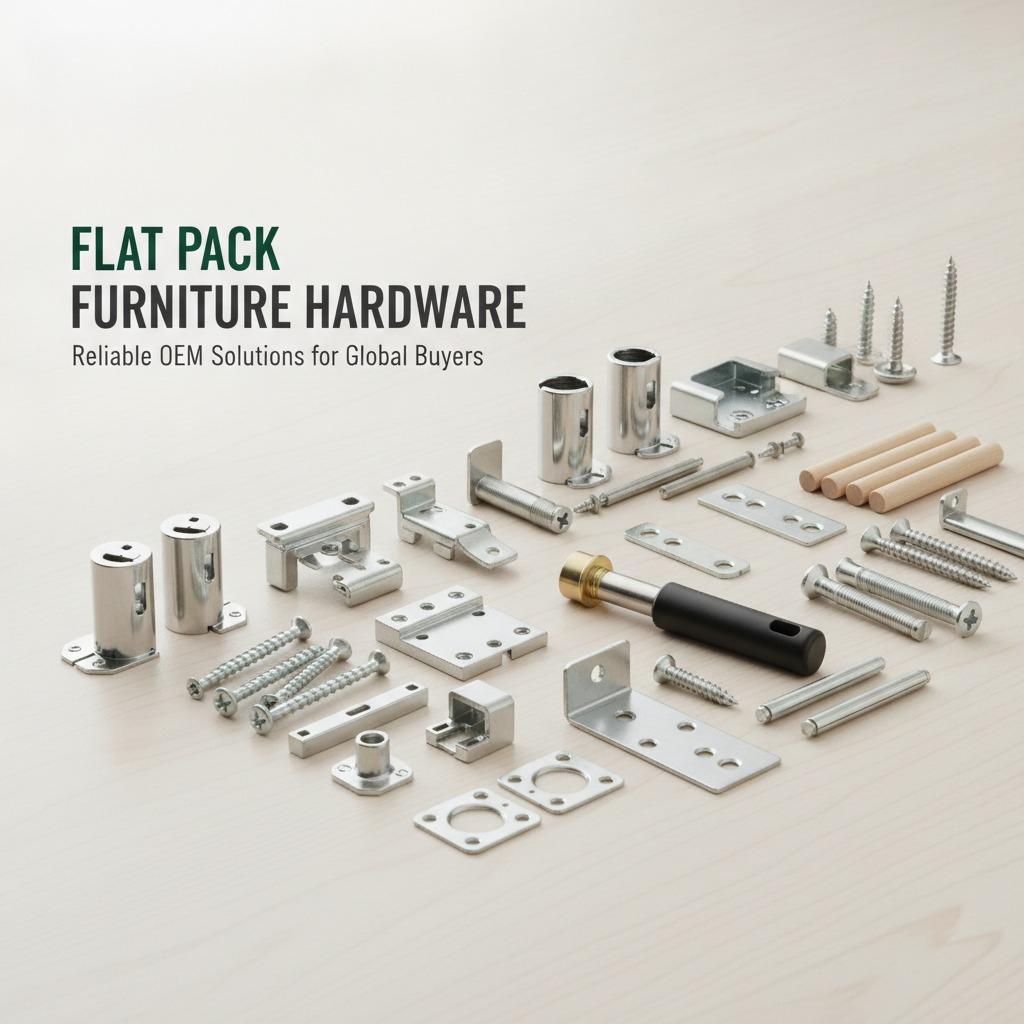
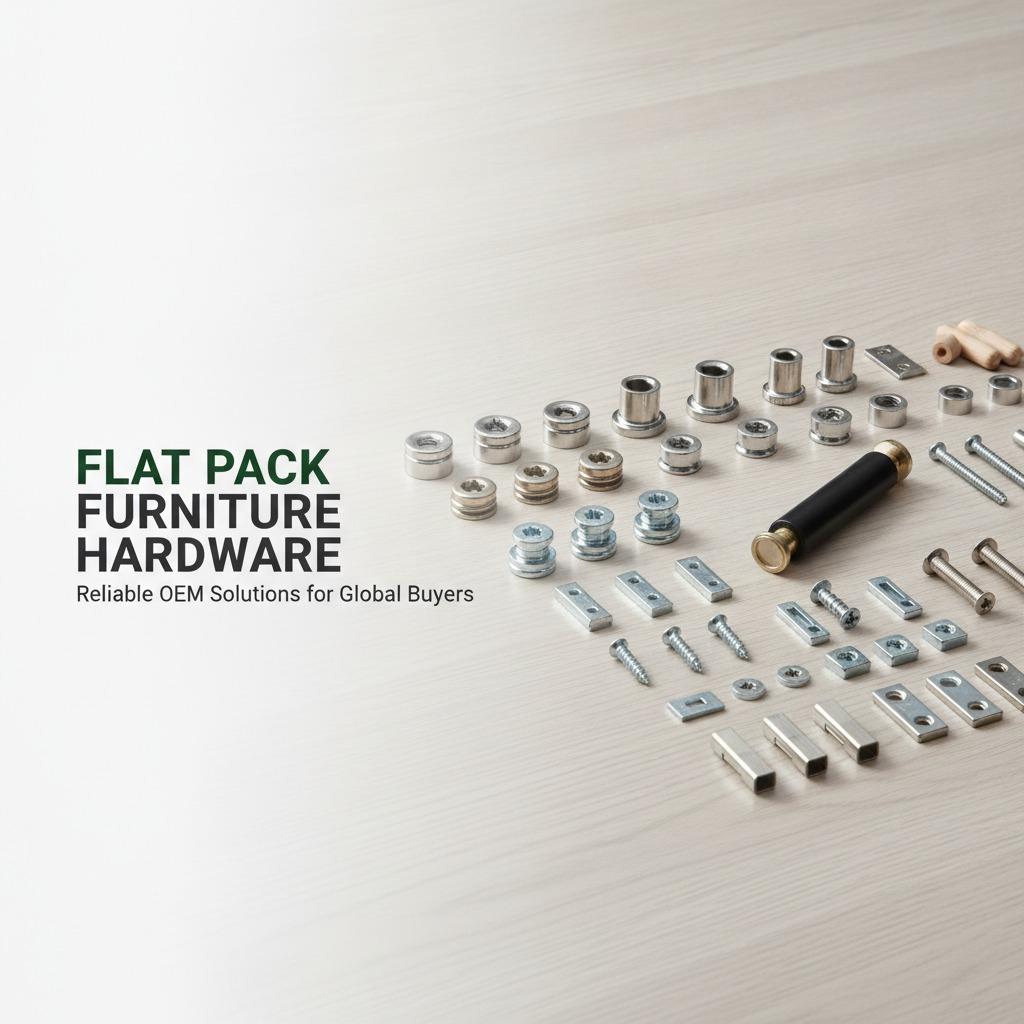
You may see cam-style connectors, cross-head screws, threaded inserts, dowels or locating pins, angle plates, hinge-like plates, black plastic sleeves, and small connector bodies. Some parts are silver or zinc-like. One or two may be brass-colored. Others may be black plastic or coated metal.
At first glance, it looks like a practical mix of small parts.
That is exactly the point.
This kind of kit is usually built for knock-down or ready-to-assemble furniture. It is not meant to impress the customer with decoration. It is meant to make a flat product become a usable cabinet, shelf, or frame after assembly.
Each part has a job. The cam connector may pull panels together. The dowel may help with alignment. The bracket may support a corner or internal part. The threaded insert may allow stronger repeated fastening. The black plastic component may guide, space, protect, or lock another part into position.
If one piece is chosen carelessly, the problem may not appear in the sample photo. It will appear when the furniture is assembled.
That is why buyers should judge the kit as a system, not as loose hardware.
Flat-pack furniture depends on repeatability
Flat-pack furniture works because the process is repeatable.
Panels are cut to size. Holes are drilled. Edges are processed. Hardware is packed. The customer, installer, or factory worker follows the assembly steps and expects everything to meet cleanly.
A good hardware kit supports that rhythm.
A poor kit interrupts it.
In real production, the small interruptions matter. Workers lose time comparing screw lengths. Packers recheck bags because one item is too easy to miss. Customers call because a connector does not match the hole. A supplier sends a second batch that looks similar but feels different during tightening.
None of these issues sounds large by itself. Together, they create cost.
For sourcing teams, this is why consistency matters more than a polished catalog page. A furniture hardware supplier needs to hold dimensions, finish, material, packing method, and kit quantity steady across repeat orders.
One good sample is not enough.
The real question is whether the supplier can repeat it.
The panel design should guide the fastener choice
Hardware should not be selected after the furniture design is already locked.
That is a common mistake.
Flat-pack furniture depends heavily on panel material, hole position, board thickness, edge distance, and assembly sequence. MDF, particleboard, plywood, laminated board, and veneered panels do not behave the same way under screws or connectors.
A screw that works well in plywood may bite too aggressively in particleboard.
A threaded insert that holds in one board may rotate in another.
A cam connector that feels tight in a thicker panel may not seat properly in a thinner one.
This is why a reliable flat pack furniture hardware supplier should ask about the product structure before quoting the kit.
What material is the panel?
What thickness is being used?
Are the holes pre-drilled?
What hole diameter and depth are required?
Will the product be assembled once, or taken apart and moved later?
Is the hardware visible, hidden, or semi-visible?
These questions are not delays. They are part of getting the hardware right.
If a supplier only asks for quantity, target price, and delivery date, the risk moves back to the buyer.
A good kit reduces work on the assembly line
The best flat-pack hardware kit does not make workers stop and think.
The parts are easy to identify. The screw lengths are separated. The connectors match the panel. The bracket sits where it should. The kit follows the assembly logic instead of forcing the worker to create order from a mixed bag.
That sounds simple, but many kits fail here.
A hardware set may contain all the correct parts and still be inefficient if the packaging is unclear. Two screws that differ by a few millimeters should not be thrown together if both are used in the same product. A small insert should not hide under larger fittings. If the instruction sheet calls a part “B,” the kit should help the user find part B quickly.
This is especially important for cross-border e-commerce and consumer self-assembly.
Customers are less patient than factory workers. They may not know whether the problem is the hardware, the panel, or their own mistake. If the kit is confusing, frustration arrives quickly.
Good hardware packaging is not decoration.
It is assembly support.
Why supplier background matters
A supplier does not need to be furniture-only to be useful in this category.
In fact, a broader fastener background can be helpful when the project needs stable screws, custom dimensions, repeat inspection, and export coordination.
Jiangmen Jinhe Hardware Co., Ltd. works with machine screws, self-tapping screws, micro screws, precision screws, standard parts, and non-standard customization. The company uses materials such as stainless steel, iron, and aluminum, and works with standards including GB, DIN, ANSI, BS, JIS, and ISO.
For buyers sourcing OEM furniture hardware kits, that kind of fastener experience can matter.
A furniture hardware kit may include several part families at once: standard screws, modified screws, connector bolts, metal plates, inserts, plastic parts, labels, and packing requirements. The kit may also need to be repeated across multiple furniture models or future production runs.
Jiangmen Jinhe also notes support for inspection before delivery, documentation, logistics, warehousing, foreign trade, and supply chain services. For buyers moving from sample order to bulk supply, those services can reduce a lot of back-and-forth between production, packing, and shipment.
The useful supplier is not just the one that says “we have the part.”
It is the one that helps keep the whole kit under control.
Customization should solve a real problem
Custom furniture fasteners can be valuable.
They can also create unnecessary complexity if buyers use them without a clear reason.
Standard parts are often the better choice when they fit the panel and assembly method. They are easier to source, easier to replace, and usually easier to manage across future orders.
Customization becomes useful when the furniture design demands it.
Maybe the board thickness is unusual. Maybe the bracket needs a different hole position. Maybe the connector must sit more cleanly inside the panel. Maybe the product needs a special packing count or private-label hardware kit. Maybe a standard screw works mechanically but creates an appearance issue in a visible area.
In those cases, non-standard customization can help.
But the specification must be tight.
Loose drawings create loose results. If buyers need custom fasteners, they should confirm dimensions, material, finish, function, sample approval, inspection method, and repeat-order rules before mass production.
A custom part should make assembly easier, not make sourcing harder.
Finish and material cannot be judged from photos alone
Hardware photos can be misleading.
A silver screw may be zinc-plated steel or stainless steel. A gold-colored insert may be brass, plated steel, or zinc alloy with a decorative finish. A black piece may be plastic, nylon, coated steel, or another material.
The appearance may be similar. The performance may not be.
For furniture hardware, finish can affect corrosion resistance, handling, thread behavior, installation feel, and appearance after packing. If the product will be stored for a long time, shipped overseas, used in humid rooms, or sold as a replacement kit, those details become more important.
Buyers should confirm:
- base material
- surface treatment
- dimensions
- thread type
- finish consistency
- corrosion expectations
- packing protection
- whether substitutions are allowed
A sample that looks acceptable on the table should still match the production shipment later.
That is where supplier discipline matters.
Testing should happen with real panels
A hardware kit should not be approved only by checking loose parts.
The real test is assembly.
Use the actual panel material. Use the real drilled holes. Use the intended tools. Follow the real assembly order. Let the people who will build or install the product test the kit, not only the purchasing team.
This is where practical problems appear.
A screw may strip only when driven at normal line speed.
A connector may feel awkward after several repetitions.
A bracket may interfere with another part.
A plastic piece may be easy to misplace.
A kit may look complete but be hard to use when assembled under time pressure.
These are exactly the problems buyers want to find before volume production.
A short test at the sample stage is cheaper than a long return cycle later.
Packaging is part of the buying decision
A flat-pack furniture kit is not ready just because the parts are correct.
The kit also has to be countable, readable, and repeatable.
For OEM production, the packaging may need to follow the assembly sequence. For retail or e-commerce, it may need clearer labels and stronger protection. For warehouse handling, carton marks and SKU identification may matter more than appearance. For replacement kits, the part list must be easy to match to the original furniture model.
Packaging should answer practical questions:
What is inside?
How many pieces are included?
Which part is used first?
Can similar parts be confused?
Will the pack survive shipping?
Can the same pack be repeated later?
A kit with correct hardware but poor packaging is still a weak kit.
The buyer may not notice at the first sample review. The customer will notice during assembly.
Common mistakes buyers still make
One common mistake is comparing only price per set.
Price matters, but it does not show whether the kit will assemble smoothly, repeat consistently, or reduce customer complaints.
Another mistake is assuming one hardware set can fit several furniture models. Sometimes it can. Often it cannot. Panel thickness, hole pattern, load, and assembly method all affect the answer.
A third mistake is approving parts without checking the full pack. Loose samples show size and finish, but they do not show count control, labeling, packing sequence, or user clarity.
Buyers also sometimes treat plastic components as secondary. In many kits, the small plastic sleeve, cap, guide, or locking part helps the whole system work. Missing or poorly fitting plastic hardware can cause the same level of frustration as a missing screw.
The final mistake is waiting too long to involve the supplier.
If the panel drawing is already frozen, the carton design is finished, and the launch date is close, changing the hardware becomes much harder.
What buyers should ask before placing an OEM order
Before moving forward with a flat-pack furniture hardware supplier, buyers should ask:
What parts are included in the full kit?
Which parts are standard, and which are customized?
What panel material is the hardware designed for?
What board thickness and hole pattern are required?
Can the kit be tested with real production panels?
How are similar parts separated in packaging?
How is the kit count checked before shipment?
What inspection documents are available?
Can replacement kits be supplied later?
Can the same specification be repeated in future orders?
Can logistics, warehousing, or export support be included?
The answers should connect directly to the furniture program.
If the supplier can only discuss loose parts, the conversation is not complete.
Frequently Asked Questions
What does a flat pack furniture hardware supplier provide?
A flat pack furniture hardware supplier may provide screws, cam connectors, connector bolts, dowels, threaded inserts, brackets, plastic caps, sleeves, spacers, and custom furniture fasteners for knock-down furniture assembly.
Why do OEM furniture hardware kits need testing?
Because photos and drawings cannot show real assembly behavior. The kit should be tested with actual panels, hole patterns, tools, and packing format before mass production.
Can one hardware kit work for several furniture products?
Sometimes, but only when the board thickness, hole pattern, load requirement, and assembly method are compatible. Buyers should not assume universal fit without testing.
Why is packaging important for flat-pack furniture hardware?
Packaging helps prevent missing parts, mixed fasteners, unclear assembly steps, and customer complaints. It also supports warehouse handling and replacement service.
Can furniture hardware be customized?
Yes. Screw length, connector size, bracket shape, finish, kit quantity, labels, and packaging can be customized when the furniture design requires it.
What makes a supplier worth choosing?
A strong supplier should support standard parts, non-standard customization, inspection, documentation, packaging, repeat supply, logistics, and clear communication.
The right kit keeps production quieter
Good flat-pack furniture hardware does not need to look complicated.
It needs to work.
The connector tightens. The screw holds. The bracket lines up. The insert stays firm. The plastic piece fits. The package is complete. The next shipment matches the approved sample.
That is what buyers are really sourcing.
For OEM furniture hardware kits, flat-pack furniture hardware, cabinet connector kits, furniture fastener kits, custom furniture connectors, and knock-down furniture hardware, Jiangmen Jinhe Hardware Co., Ltd. can discuss standard parts, non-standard customization, material options, inspection, packaging, warehousing, logistics, and repeat supply requirements.
For direct inquiries:
Tel/WeChat: +86 13729150102
WhatsApp: +86 13322893939
Email: sharon@hkhomeideas.com
Start with the panel material, board thickness, hole pattern, hardware list, packaging method, and expected order quantity.
Once those details are clear, the right OEM hardware kit becomes much easier to build and repeat.