
A wardrobe can look perfectly square in a CAD drawing and still become troublesome on the assembly floor. Side panels refuse to sit flush. A connector rotates before reaching full clamping force. Installers spend another minute correcting alignment, while flat-pack customers discover that a joint that seemed straightforward in the instructions is surprisingly unforgiving.
For furniture brands and OEM manufacturers, these are not cosmetic inconveniences. They affect assembly time, cabinet rigidity, return rates, and ultimately the user's impression of the finished product.
Choosing the right wardrobe connector manufacturer therefore means looking beyond the connector's appearance. At JHFIX, our approach is based on matching connector geometry, material behavior, installation method, production consistency, and packaging configuration to the actual wardrobe structure. The aim is practical: connections should locate correctly, tighten predictably, and remain repeatable across large production batches.
Wardrobe Connectors Carry More Responsibility Than Their Size Suggests
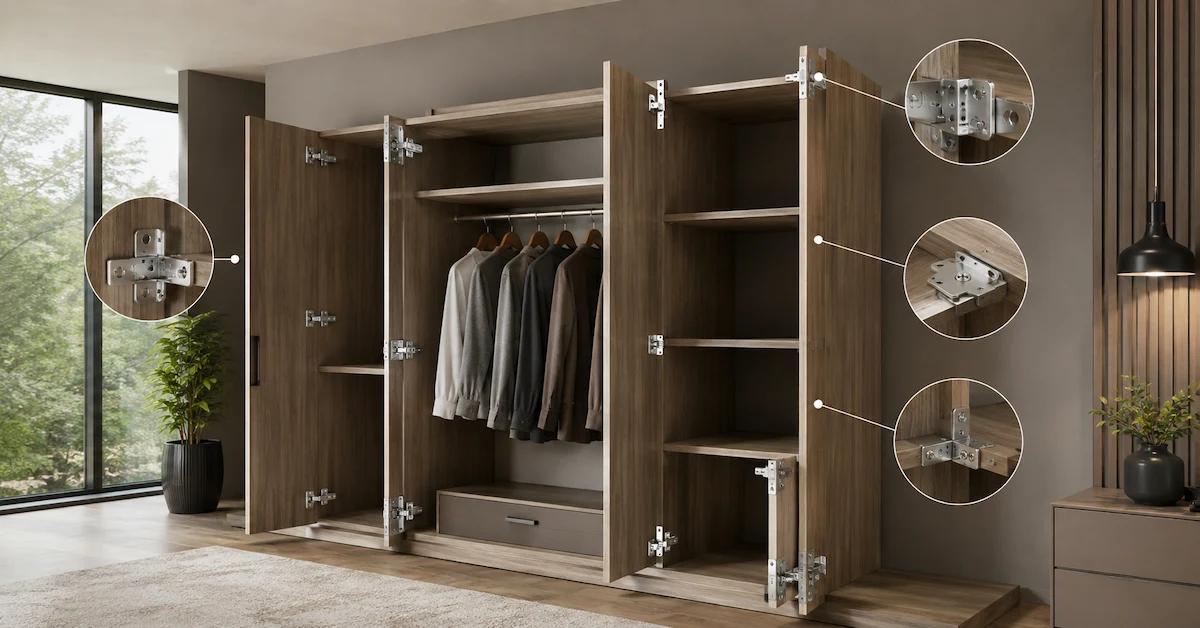
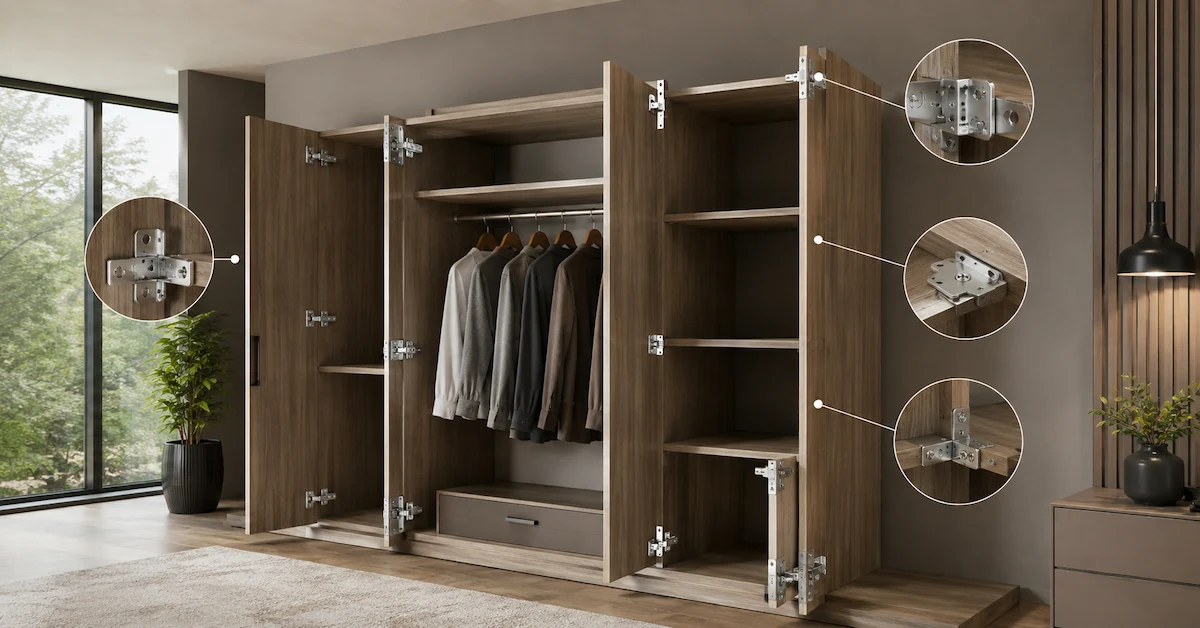
Wardrobe connectors sit at several structurally important points: side-to-top joints, shelves, partitions, bases, rails, and modular cabinet sections. Their job is not simply to “hold two boards together.” A well-designed fitting must establish position, generate clamping force, resist movement, and still remain practical for high-volume assembly.
That combination explains why the furniture hardware market contains so many connector architectures. Häfele, for example, lists more than 250 furniture connector options covering cabinetry, shelving, wood, metal, glass, and other assembly conditions. Hettich likewise separates cabinet-body connecting solutions into eccentric fittings, concealed connectors, block connectors, dowels, and related systems, reflecting the different mechanical and installation requirements found in furniture construction.
A wardrobe may therefore use several connection principles at once rather than relying on one universal fitting.
Typical wardrobe connection points include:
- Cabinet side panel to top or bottom panel
- Fixed shelf to cabinet side
- Center partition to horizontal panel
- Adjacent wardrobe modules
- Back-panel or structural reinforcement hardware
- Hanging-rail supports and related mounting hardware
- Flat-pack disassembly and reassembly points
The connector should be selected around the joint, not the other way around.
Material, Geometry, and Installation Method Shape Connector Performance
The material used in a connector influences strength, corrosion resistance, dimensional stability, and cost. Geometry determines how that material transfers force.
Common wardrobe hardware materials include zinc alloy, carbon steel, stainless steel, and engineered plastic used in selected secondary components. Zinc die casting is especially common in furniture fittings because complex shapes can be produced economically with good dimensional repeatability. Hettich, for example, specifies nickel-plated die-cast zinc for one of its wardrobe rail support products.
| Connector Material | Typical Advantage | Design Consideration | Common Wardrobe Use |
|---|---|---|---|
| Zinc alloy | Complex shapes, stable production | Avoid excessive localized load | Cam-style connectors, brackets |
| Carbon steel | Strength and cost efficiency | Surface protection may be required | Screws, plates, connecting hardware |
| Stainless steel | Corrosion resistance | Higher material cost | Humid or premium applications |
| Engineering plastic | Lightweight, low noise | Load limits must be verified | Covers, guides, secondary fittings |
Material alone, however, does not guarantee a good connection.
A poorly positioned eccentric cavity can make an otherwise strong cam connector difficult to tighten. An oversized bracket hole creates positional play. A screw that is too short may not develop sufficient engagement in particleboard; too aggressive a thread can damage the surrounding substrate.
This is why furniture hardware design should consider the connector and board material as a working pair.
Why Work With JHFIX for Wardrobe Connector Manufacturing?
Samples are relatively easy to make. Stable repeat orders are harder.
A furniture OEM does not need ten excellent connectors followed by ten thousand “almost identical” ones. Hole geometry, forming dimensions, coating thickness, threads, and packaging all need to remain sufficiently consistent for the assembly process to behave the same from batch to batch.
ISO describes quality assurance as building reliability into the process rather than depending solely on final inspection, including material testing, performance evaluation, and statistical process control where appropriate. That principle is especially relevant to furniture connectors because small dimensional changes are amplified when several fittings must line up across one cabinet body.
At JHFIX, the manufacturing approach is organized around practical OEM requirements:
- Product specification and application review before production
- Material selection based on connector structure and use conditions
- Dimensional control of critical mating features
- Stable forming, stamping, threading, and surface-finishing processes
- Batch inspection for repeat-order consistency
- Bag, box, blister, or bucket packaging according to project requirements
- Hardware kit organization for furniture assembly applications
You can learn more about our manufacturing background and business scope through the JHFIX About Us page.
Cam Connectors, Brackets, and Screw-Based Fittings Solve Different Problems
A buyer should not ask which wardrobe connector is “best” without defining what the joint needs to accomplish.
A cam-and-dowel system is useful where concealed fastening and flat-pack assembly matter. Angle brackets provide a simpler, visible reinforcement approach. Connecting screws can work well where the structure permits direct mechanical fastening. Concealed fittings are useful when appearance carries greater weight.
Hettich's cabinet connector portfolio reflects exactly this diversity, including eccentric fittings, block connectors, concealed solutions, and fastening accessories.
| Connector Type | Main Strength | Assembly Speed | Visibility | Typical Scenario |
| Cam + dowel connector | Knock-down assembly | High | Low | Flat-pack wardrobes |
| Metal angle bracket | Simple reinforcement | High | High | Internal structural support |
| Connecting screw | Direct clamping | High | Medium | Cabinet joining |
| Concealed connector | Clean appearance | Medium | Very low | Premium furniture |
| Stamped plate connector | Broad load distribution | Medium | Medium | Reinforcement joints |
There is no universal winner. The correct option depends on board thickness, machining process, required clamping force, visual requirements, and whether furniture must later be disassembled.
Precision Matters Most at the Mating Features
Furniture connectors frequently fail at interfaces rather than in the body of the component.
A cam is only useful if the mating dowel enters at the intended position. A stamped bracket performs poorly if mounting holes do not align with drilling patterns. A threaded fitting can become frustrating if coating buildup changes the effective fit.
For a wardrobe connector manufacturer, critical dimensions should therefore be identified according to function rather than treating every dimension on the drawing equally.
Typical critical-to-function features include:
- Hole center distance
- Cam cavity diameter
- Dowel engagement depth
- Screw or thread fit
- Bracket bend angle
- Plate flatness
- Across-part alignment
The tolerance strategy matters too. Tightening every dimension unnecessarily can increase manufacturing cost without improving the wardrobe. Experienced sourcing teams define tighter limits where mating and alignment occur, while allowing more economical tolerances on non-critical surfaces.
That is smarter engineering—and generally better purchasing.
Surface Finish Affects More Than Appearance
Furniture hardware spends most of its life hidden, but surface treatment still matters.
Zinc plating, nickel plating, black finishes, and other protective or decorative treatments can influence corrosion resistance, friction, appearance, and fit. A coating applied unevenly around a thread or mating feature can change how the connector installs.
For wardrobe hardware, buyers should confirm:
- Expected indoor or humid-use environment
- Decorative appearance requirements
- Surface color consistency
- Corrosion protection expectations
- Whether coating thickness affects mating geometry
- Scratch resistance during packing and transport
A bright finish means very little if the connector arrives scratched or no longer fits smoothly.
Packaging Can Determine Whether a Good Connector Creates a Good User Experience
Furniture hardware packaging deserves more attention than it usually receives.
Consider a flat-pack wardrobe with ten different small hardware items. The connectors may all be dimensionally correct, yet one missing fitting makes the entire product impossible to complete.
The failure happens at the packing stage, but the customer experiences it as a furniture failure.
JHFIX supports several packaging formats—including bag, box, blister, and plastic bucket packaging—allowing hardware supply to be organized according to assembly or distribution needs. You can review the broader product and packaging scope on the JHFIX Products page.
For furniture projects, hardware kits can be particularly valuable because components are grouped around the finished product rather than shipped only as generic bulk inventory.
| Supply Format | Sorting Requirement | End-User Convenience | Suitable For |
| Loose bulk | High | Low | Factory inventory |
| Counted bag | Medium-Low | Medium | Assembly stations |
| Product-specific kit | Very low | High | Flat-pack furniture |
| Retail blister/box | Very low | High | Hardware retail |
The correct package does not make the connector stronger. It makes the entire system easier to use.
Practical Case: Fixing Repeated Wardrobe Alignment Problems
Consider a typical wardrobe OEM project involving particleboard side panels joined to fixed shelves and top panels.
The factory begins seeing three complaints: assemblers need to push panels into alignment before tightening, some connectors require noticeably more force than others, and certain exported units generate customer feedback about difficult installation.
Replacing the entire furniture structure would be expensive.
A more focused investigation would start with the connection system:
- Check drilling coordinates against connector dimensions.
- Measure mating connector features across several production batches.
- Review whether material thickness or coating affects fit.
- Verify connector engagement depth in the actual board.
- Compare hardware packaging with the assembly sequence.
Suppose measurements reveal two modest sources of variation—connector hole position and mating-dowel length. Neither is dramatic alone. Together, they stack up into a visible assembly problem.
The correction is relatively small: tighten the critical mating dimensions, stabilize component inspection, and organize the hardware kit around the wardrobe SKU.
The important lesson is not the hypothetical percentage improvement. It is the method. Good furniture hardware troubleshooting follows the joint from drawing to machining, connector production, packaging, and final assembly instead of blaming the first component that looks suspicious.
Applications for Wardrobe Connector Solutions
A capable wardrobe connector manufacturer can support different furniture formats because wardrobe construction varies substantially between markets and brands.
Typical applications include:
- Flat-pack wardrobes
- Modular closet systems
- Freestanding bedroom wardrobes
- Built-in cabinets
- Office storage furniture
- Hotel and apartment furniture
- Retail-ready furniture kits
- OEM cabinet and closet programs
Flat-pack applications emphasize assembly simplicity and accurate hardware kits. Built-in furniture may place greater emphasis on structural stability and installation flexibility. Premium cabinetry often requires hidden fittings and better surface appearance.
The connector strategy should change with the product.
Selection Guide: What Furniture Buyers Should Confirm Before Ordering
Before approving production, confirm more than part dimensions.
Product requirements
- Wardrobe board material
- Panel thickness
- Connector type
- Mating hardware
- Expected load
- Assembly and disassembly requirements
Manufacturing requirements
- Material specification
- Critical dimensions and tolerances
- Surface treatment
- Thread or fastening requirements
- Inspection method
- Sample approval criteria
Supply requirements
- Quantity per furniture SKU
- Packaging format
- Mixed hardware kit requirements
- Labeling
- Export carton configuration
- Repeat-order planning
If the project uses a proprietary connection system, drawings and samples should be reviewed together. A drawing explains intention; a physical assembly often reveals the real problem faster.
Our FAQ page also covers common questions related to products, orders, and cooperation.
Frequently Asked Questions
What should I send to a wardrobe connector manufacturer for quotation?
Provide drawings or samples, material requirements, surface finish, quantities, packaging expectations, and information about the wardrobe application. Panel thickness and mating hardware are particularly useful for connector projects.
Can wardrobe connectors be customized for OEM furniture?
Yes. Depending on the project, customization can involve dimensions, hole patterns, threads, material, finish, packaging, or complete hardware-kit configuration.
How should I choose connectors for flat-pack wardrobes?
Prioritize repeatable alignment, straightforward installation, sufficient engagement in the board material, compact packaging, and clear hardware organization. A connector that is strong but difficult for the end user to identify or install can still create a poor product experience.
Better Wardrobe Hardware Starts at the Joint
The quality of a wardrobe is judged as a whole, but many of its most important details are hidden inside the joints. Reliable connectors keep panels aligned, transfer loads, simplify assembly, and help flat-pack products survive repeated transportation and installation.
As a wardrobe connector manufacturer, JHFIX combines furniture hardware production, fastener manufacturing, customization, and multiple packaging formats to support OEM furniture and hardware projects. The objective is not simply to deliver another fitting—it is to make the connection easier to manufacture, easier to assemble, and more predictable from one order to the next.
If you are developing a new wardrobe system or replacing an inconsistent hardware supply, discuss your drawings, samples, quantities, and packaging requirements with our team through the Contact Us page.