
OEM Screw Kit Manufacturer: What Buyers Should Check for Wood Enclosures and Small Assemblies
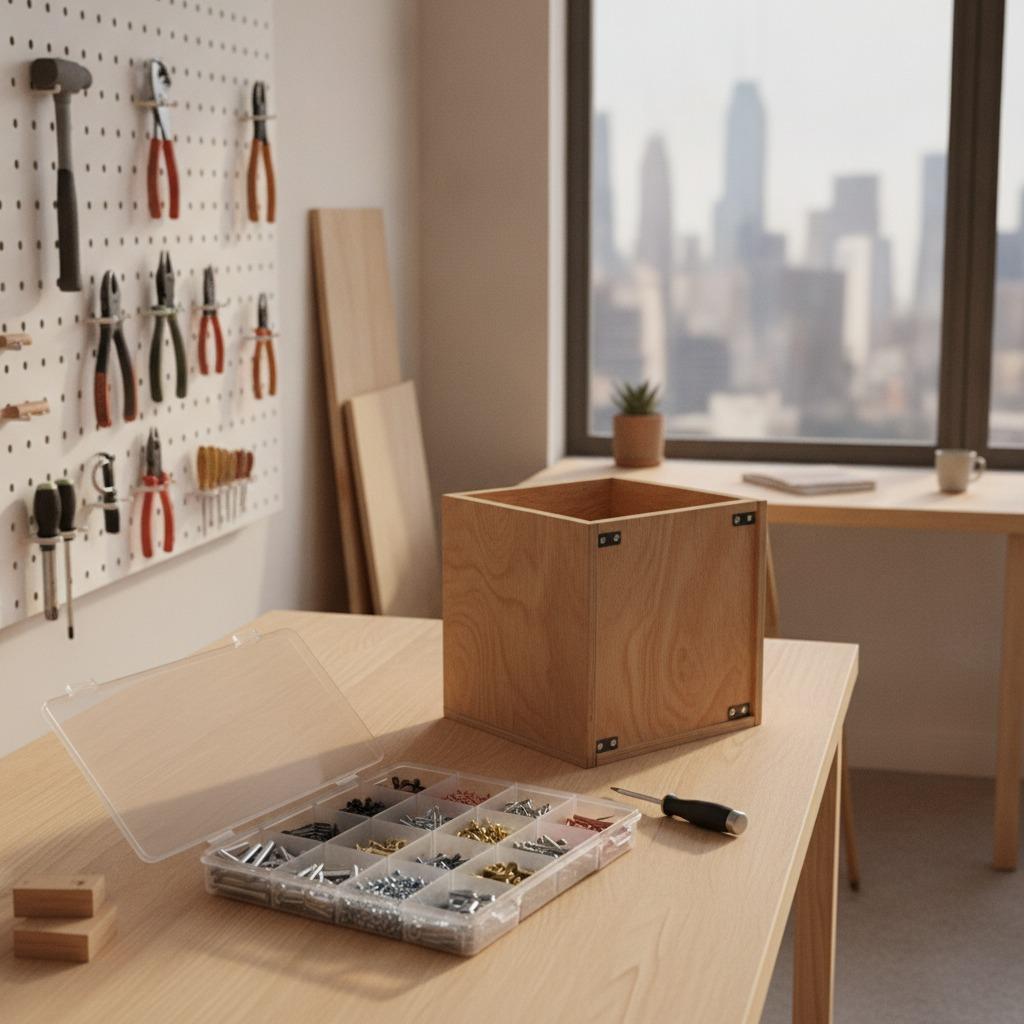
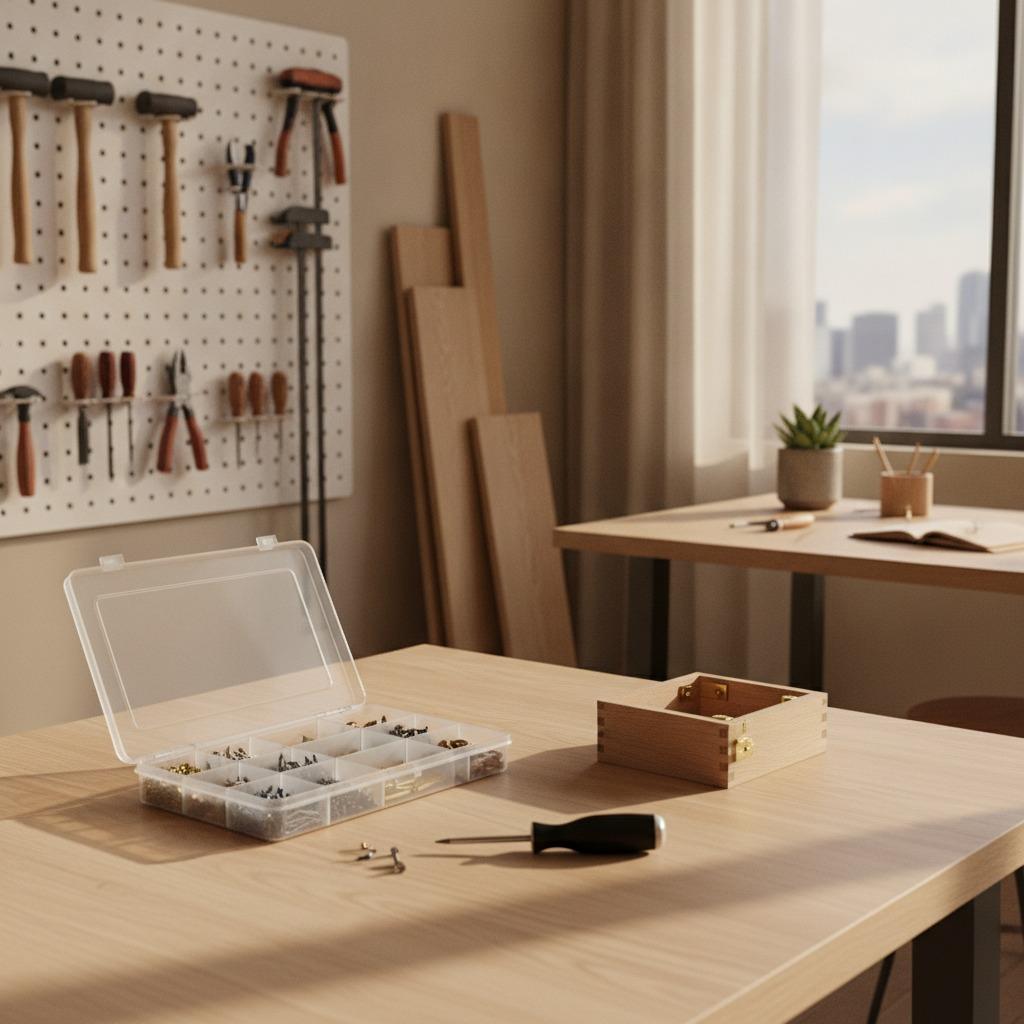
A wood enclosure can look straightforward before the hardware is installed.
There are panels, corner fittings, a few holes, and a small pile of screws on the bench. From a purchasing file, the job may look simple enough: order the right screws, pack them with the product, and send everything to assembly.
Real production is less forgiving.
One screw is slightly too long. One head style does not sit well in the bracket. One fastener looks correct but does not hold properly in the panel. A small Allen screw belongs to a visible fitting, but it gets mixed with another size. A worker stops to check the kit, and the whole assembly rhythm slows down.
That is where an OEM screw kit manufacturer becomes useful.
The supplier is not only providing screws. It is helping the buyer organize the fastening system around the product: panel material, bracket design, tool access, assembly sequence, labeling, packaging, inspection, and future repeat orders.
For wood boxes, cabinet parts, drawer bodies, equipment enclosures, small furniture assemblies, and compact storage modules, a screw kit can save time only when it is designed around the actual joint.
A screw kit should begin with the assembly, not the screw size
Many buyers start with the fastener size.
That is understandable, but it is not enough.
A request such as “M5 screw,” “M2 Allen screw,” or “self-tapping screw” gives the supplier a direction, but it does not explain the job. The same nominal size can behave differently depending on head style, drive type, material, finish, thread form, installation tool, and mating material.
A screw used through an external metal bracket into a wood-based panel is not doing the same job as a screw used in a threaded insert. A visible fastener on a decorative component is not judged the same way as a hidden screw inside an enclosure. A screw used by a trained operator on a production line is not the same as a screw installed by an end user with a small hand tool.
Before asking for a quote, buyers should clarify:
What material is the panel?
What thickness is the board?
Does the screw pass through metal first?
Is the mating hole pre-drilled?
Does the joint need a countersunk head or a raised head?
Will the screw be visible after assembly?
What driver or tool will be used?
How many screws are required per finished product?
Should the kit include spare screws?
A good custom screw kit supplier should be able to turn those answers into a controlled fastener package.
What the wood enclosure example tells us
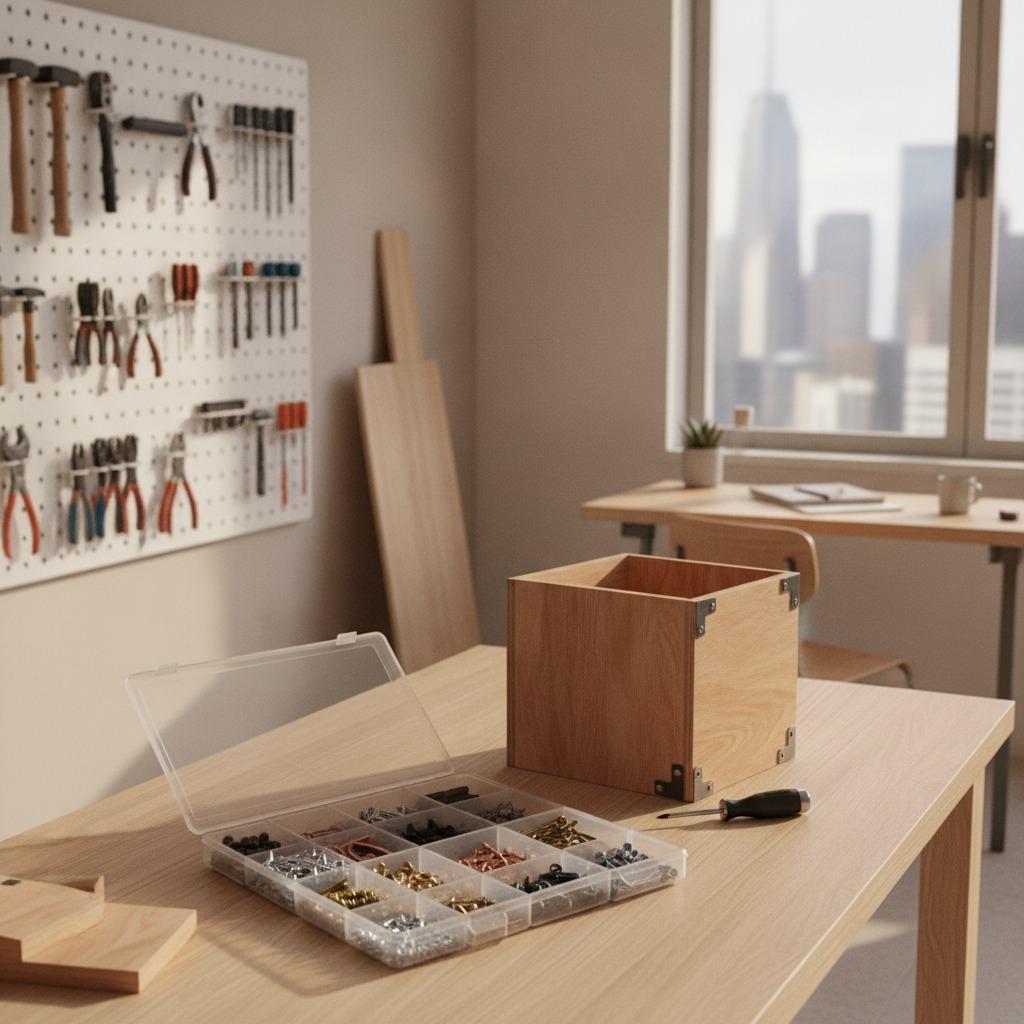
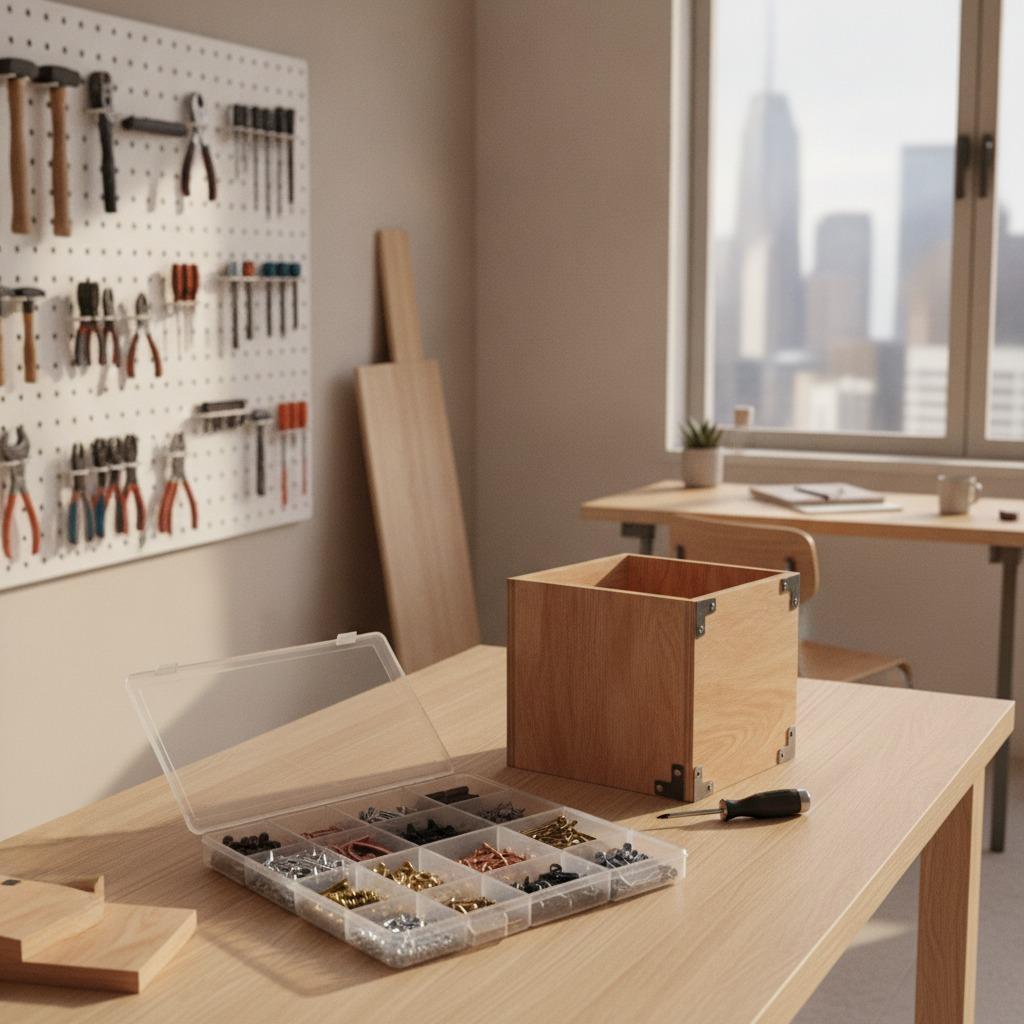
The referenced assembly is an open-top wooden box or enclosure with external corner brackets, visible screws, and small fittings. It may be used as a drawer body, cabinet component, small storage box, equipment enclosure, or prototype assembly.
The exact panel material is not confirmed from the image. It may be plywood, MDF, particleboard, veneered board, laminated board, or another wood-based material. That distinction matters because screw holding behavior changes from one panel type to another.
A screw that works well in plywood may not perform the same way in particleboard. A countersunk head that sits cleanly in one bracket may sit proud in another. A small socket screw may look neat, but it still needs the correct tool access and matching hole.
That is why buyers should not approve screw kits from photographs alone.
A supplier needs the real material stack:
| Assembly Detail | Why It Matters |
|---|---|
| Panel material | Affects screw holding, splitting risk, and torque behavior |
| Panel thickness | Controls screw length and available engagement depth |
| Bracket thickness | Affects head fit and thread engagement |
| Hole diameter | Determines whether the screw seats correctly |
| Head style | Changes surface finish and bracket clearance |
| Drive type | Affects assembly speed and tool control |
| Finish | Matters for appearance, corrosion expectations, and handling |
| Packaging format | Prevents mixed fasteners and missing parts |
A clean-looking sample is helpful.
A sample built with the real panels and brackets is much better.
Product example: M5 countersunk screws and M2 blue aluminum Allen screws
One related JHFix product page is titled Customizable M5 flat head countersunk screw, M2 blue aluminum, ISO standard Allen screw, factory anodized color. The readable page text confirms the product direction and also shows JHFix contact information, including sharon@hkhomeideas.com and +86 13322893939.
For OEM buyers, this product direction is useful because small assemblies often need several screw styles in one kit.
A wood enclosure may need larger screws for brackets, while a smaller fitting, handle, cover plate, hinge, label plate, or accessory may need compact metric screws. Some visible parts may need a colored anodized finish, while hidden parts may be selected mainly for function.
The page title points to several useful sourcing terms:
- M5 flat head countersunk screw
- M2 blue aluminum screw
- ISO standard Allen screw
- anodized color screw
- customizable screw
- metric fastener direction
Because the page does not show a complete specification table in the readable text, buyers should confirm exact details before ordering, including material grade, length, thread, head dimensions, drive size, finish process, color tolerance, packing quantity, and inspection requirements.
A product title can start a discussion.
It should not replace a drawing.
Why countersunk screws need more attention
Countersunk screws are often chosen when the screw head needs to sit flush or close to flush with the surface.
That can be useful in wood enclosures, cabinet hardware, small equipment covers, furniture fittings, bracket plates, and visible panels. A flat head can create a cleaner appearance and reduce interference with other components.
But countersunk screws are less forgiving than many buyers expect.
The countersink angle must match the screw head. The hole must be prepared correctly. The panel or bracket must have enough thickness. If the countersink is too shallow, the screw head sits proud. If it is too deep, the part may weaken or look uneven. If the screw is over-tightened in wood-based material, the surface can crush or split.
For an M5 countersunk screw, buyers should confirm:
- head diameter
- countersink angle
- thread length
- total length
- drive type
- material
- finish
- mating material
- whether the screw is structural or decorative
- whether the head must sit flush
A countersunk screw is not only a size.
It is a fit decision.
M2 aluminum Allen screws are small, but not simple
Small screws create their own problems.
An M2 aluminum Allen screw may be used in compact fittings, decorative hardware, small brackets, covers, control panels, light-duty assemblies, display pieces, or color-coded kits. The blue anodized appearance may help with branding, identification, or product style.
But small fasteners are easy to damage, mix, or lose.
The socket drive must match the tool. The aluminum material should suit the tightening requirement. The anodized finish should be protected during packing and installation. The screw should not be mixed with similar small parts unless the packaging is very clear.
A small screw can stop an assembly just as quickly as a large one.
For kits that include M2, M3, M4, or M5 screws together, packaging discipline becomes essential. A worker should not need to compare thread sizes by eye. An end user should not have to guess which screw belongs to which step.
Material and finish should be confirmed in writing
The product title includes blue aluminum and anodized color direction.
That is helpful, but buyers still need written confirmation.
Color does not prove material. An anodized appearance does not automatically define coating thickness, surface durability, or scratch resistance. Aluminum screws may suit some applications, but they are not automatically suitable for every load or substrate.
Before approving anodized color screws, buyers should ask:
Is the base material aluminum or another material?
What aluminum grade is used?
What finish process creates the color?
Is the color required for appearance or identification?
Will the screw be visible after assembly?
How will the finish be protected during packing?
Can color consistency be repeated in future orders?
Is the screw used for load-bearing or light-duty fastening?
What torque limit should be used during installation?
These questions prevent a common mistake: treating color as decoration only.
In production, finish affects appearance, handling, customer perception, and sometimes installation behavior.
How a mixed screw kit should be organized
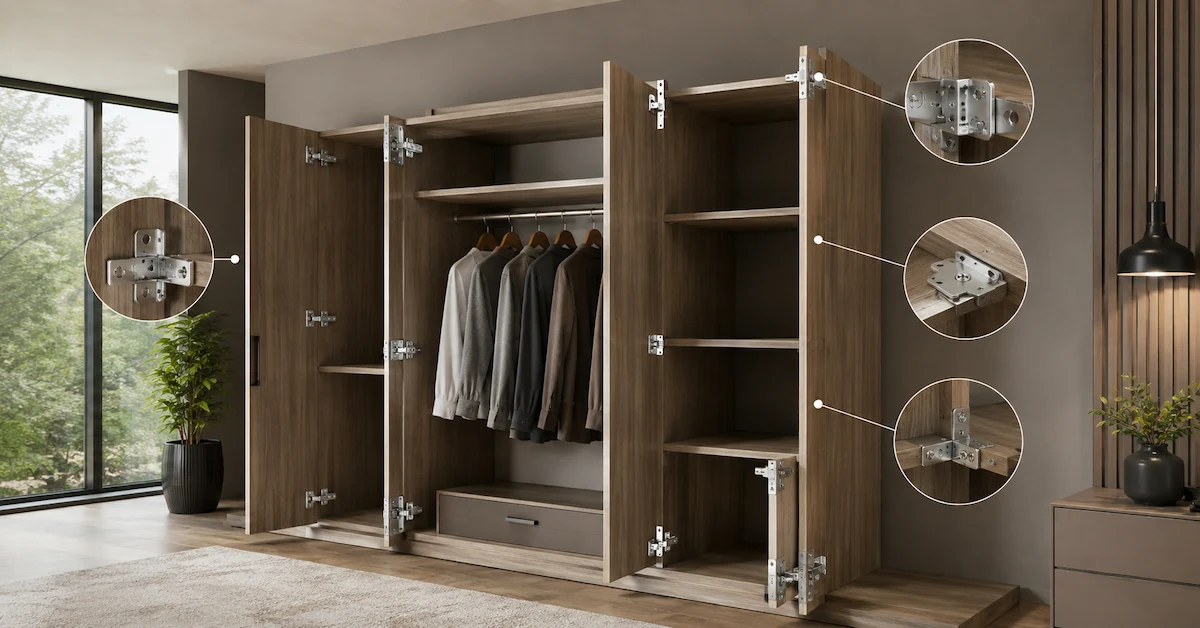
A wood enclosure or cabinet assembly may need several different fasteners.
One screw may secure a corner bracket. Another may fix a small fitting. A countersunk screw may sit flush on an exposed surface. A small Allen screw may be used for a decorative or compact component. A self-tapping screw may be needed for another material. Washers, nuts, or inserts may also be included.
The kit has to make this easy.
A practical screw kit may include:
- larger screws for corner brackets
- M5 flat head countersunk screws for flush fixing
- M2 Allen screws for small fittings
- washers or nuts where needed
- spare screws
- labels by step
- separated bags or compartments
- finish protection for anodized parts
- a printed part list
- batch identification
The kit should follow the assembly sequence.
If the operator installs brackets first, those screws should be grouped together. If visible blue screws are installed later, they should be separated and protected. If two screws have similar lengths, they should not be thrown into one unmarked bag.
A kit should reduce decision-making at the bench.
It should not create a sorting task.
When standard screws are enough, and when customization helps
A screw kit does not always need custom-made screws.
Often, the best kit uses standard screws in a smarter way: correct sizes, correct quantities, correct labels, and correct packaging.
Customization becomes useful when the assembly needs something standard parts do not provide.
That might mean:
- a special screw length
- a different head style
- anodized color matching
- a custom drive requirement
- special packaging
- private-label kits
- mixed standard and non-standard parts
- visible screws with stricter appearance control
- small screws for limited installation space
The JHFix product page emphasizes customizable M5 countersunk and M2 blue aluminum screw direction. For buyers, that means the sourcing discussion should include not only “Can you make this screw?” but also “Can this screw fit our assembly and repeat across future orders?”
Customization should solve a real assembly or presentation problem.
It should not add complexity without purpose.
What Jiangmen Jinhe Hardware can support
Jiangmen Jinhe Hardware Co., Ltd. works with machine screws, self-tapping screws, micro screws, precision screws, standard fasteners, and non-standard customization. Its material options include stainless steel, iron, and aluminum, and the company works with common standards such as GB, DIN, ANSI, BS, JIS, and ISO.
For wood enclosures and small assemblies, this range is useful because one product may need more than one fastener type. A kit may combine standard bracket screws, countersunk screws, small Allen screws, precision screws, washers, and customized packaging.
The important value is coordination.
A buyer should expect the manufacturer to review drawings, samples, hole locations, head style, drive type, material, finish, kit quantity, and packaging before bulk production. That is how a loose group of fasteners becomes a controlled OEM screw kit.
Documentation matters in repeat production
For one prototype, a simple labeled bag may be enough.
For repeat production, buyers need more control.
Useful documentation may include:
- product drawing
- fastener list
- material confirmation
- finish specification
- color sample approval
- dimensional inspection report
- packing list
- label format
- batch identification
- approved sample reference
- substitution control
The purpose is not paperwork for its own sake.
The purpose is to avoid confusion later.
If the blue anodized screw color changes, the buyer should know. If an M5 countersunk screw length changes, the drawing should be updated. If the packaging layout changes, the assembly team should not discover it after the shipment arrives.
A serious industrial screw kit factory should treat documentation as part of the product.
Common sourcing mistakes
One common mistake is specifying only diameter and length.
For screw kits, that is not enough. Head style, drive type, material, finish, thread, point, tool access, and packaging can all affect assembly.
Another mistake is approving screws from product images only. A photo can show color and general shape, but it cannot prove material, strength, tolerance, finish durability, or fit in the real joint.
A third mistake is mixing several screw sizes without clear labels. This is especially risky when M2, M3, M4, and M5 fasteners appear in one assembly.
Buyers also sometimes ignore finish protection. Anodized color screws may scratch if packed loosely with harder fasteners.
The final mistake is not testing the kit under realistic conditions. A kit can look complete in a sample bag and still be awkward on the production bench.
What buyers should ask before ordering
Before choosing an OEM screw kit manufacturer, buyers should ask:
What panel material is used?
What is the board thickness?
Which screws go into wood-based panels?
Which screws go through metal brackets?
Are M5 countersunk screws required?
Are M2 Allen screws used in small fittings?
Is aluminum material required, or would another material be better?
Is blue anodized finish used for appearance or identification?
What head style and drive type are needed?
Can the tool access every screw location?
How will visible screws be protected in packaging?
How are similar screws separated?
What documentation is provided?
Can the same kit be repeated in future orders?
These questions help buyers move away from vague screw purchasing and toward a controlled OEM fastener package.
Frequently Asked Questions
What does an OEM screw kit manufacturer provide?
An OEM screw kit manufacturer may provide machine screws, self-tapping screws, micro screws, precision screws, washers, nuts, inserts, labels, and customized packaging for a defined assembly.
Why use a screw kit instead of buying screws separately?
A screw kit reduces sorting work, helps prevent missing parts, supports line-side assembly, and makes repeat production easier to control.
What product information is confirmed from the JHFix link?
The readable product page confirms a product direction around customizable M5 flat head countersunk screws, M2 blue aluminum screws, ISO standard Allen screws, and factory anodized color. Full technical specifications should be confirmed directly before ordering.
Are anodized color screws only for appearance?
Not always. They may be used for appearance, identification, branding, or product design, but buyers still need to confirm material, finish durability, and application suitability.
Should buyers test screws before mass production?
Yes. Buyers should test screws with the actual panel material, bracket, tool, hole condition, and assembly sequence before approving bulk orders.
Why does packaging matter for screw kits?
Packaging helps prevent mixed fasteners, wrong installation, missing parts, scratched finishes, and assembly delays.
Final takeaway
A good OEM screw kit makes assembly less uncertain.
The right screw reaches the right joint. The bracket sits flat. The panel does not split. The countersunk head seats cleanly. The small Allen screw is easy to identify. The anodized finish is protected. The kit is complete. The next shipment matches the approved sample.
That is what buyers should expect from a reliable OEM screw kit manufacturer.
For OEM screw kits, custom screw kits, industrial screw kits, wood enclosure screws, cabinet assembly screws, M5 countersunk screws, M2 aluminum Allen screws, anodized color screws, ISO standard fasteners, and custom fastener packaging, Jiangmen Jinhe Hardware Co., Ltd. can discuss drawings, samples, material options, finish requirements, packaging, inspection, and repeat supply.
For direct inquiries:
Tel/WeChat: +86 13729150102
WhatsApp: +86 13322893939
Email: sharon@hkhomeideas.com
Start with the panel material, bracket design, hole size, screw list, head type, drive tool, finish requirement, packaging method, and expected order quantity.
Once those details are clear, the right screw kit becomes much easier to source, assemble, and repeat.