
Furniture hardware packaging solutions play an important role in furniture manufacturing, flat-pack assembly, retail presentation, warehouse management, and after-sales service.
For furniture factories, cabinet brands, hardware distributors, retailers, and e-commerce sellers, packaging is not only used to hold screws and connectors. It determines whether each kit contains the correct parts, whether installers can identify components quickly, and whether the finished product is suitable for retail or export distribution.
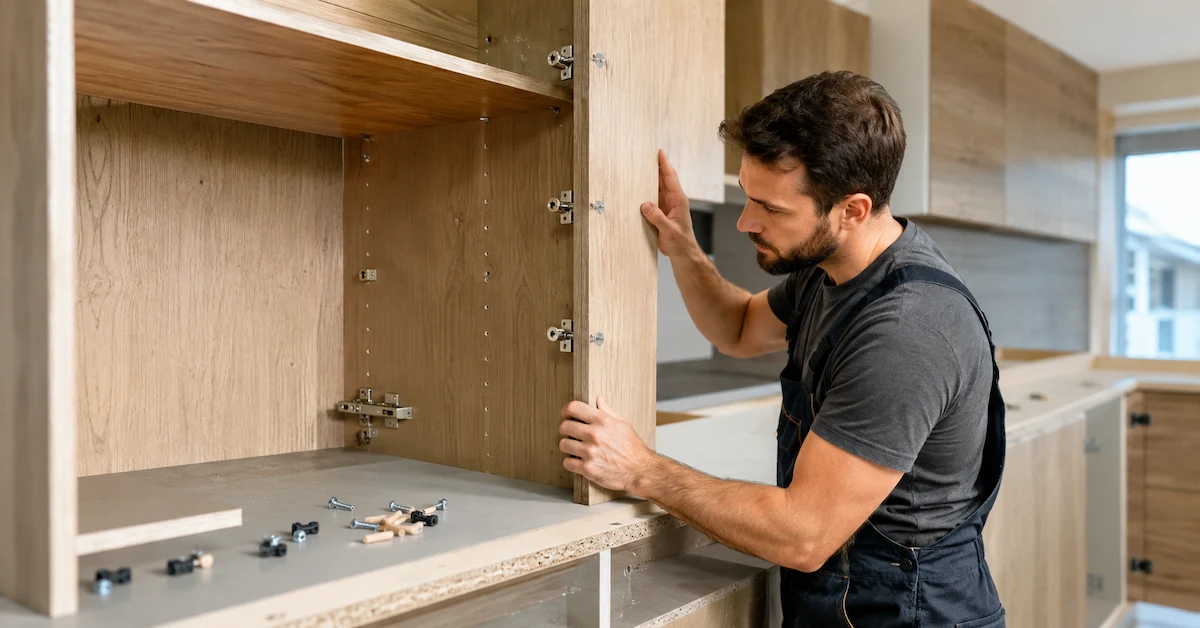
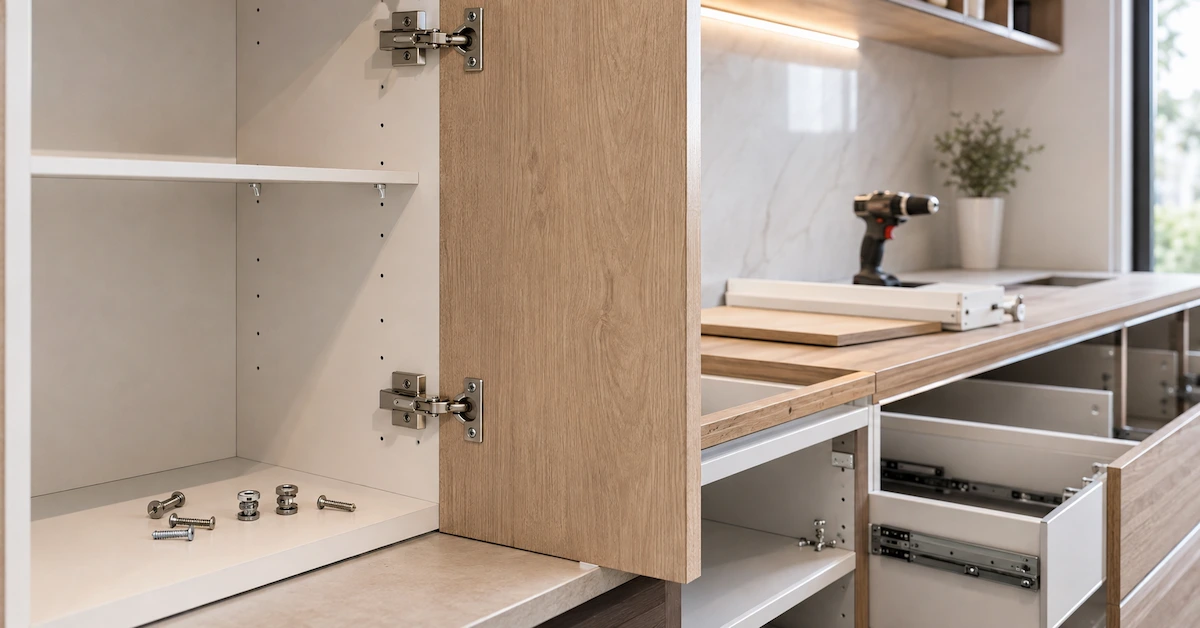
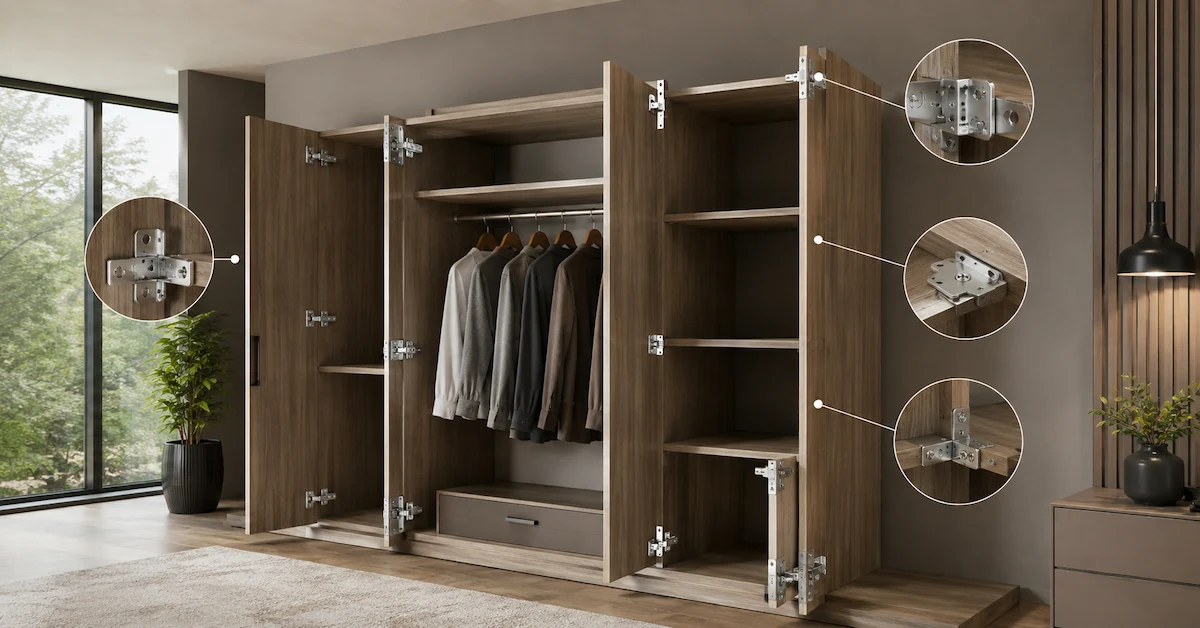
A furniture hardware set may include screws, cam locks, cabinet bolts, insert nuts, brackets, washers, anchors, plastic caps, and stamped fixing plates. If these parts are mixed incorrectly, missing from the package, or poorly labeled, the customer may not be able to complete assembly.
That is why buyers should evaluate packaging accuracy, material durability, labeling, BOM control, customization, and quality inspection before placing an order.
JHFIX provides screws, nuts, furniture hardware, stamping hardware, and multiple packaging options for global buyers. Explore the complete JHFIX product range for furniture hardware and packaging solutions.
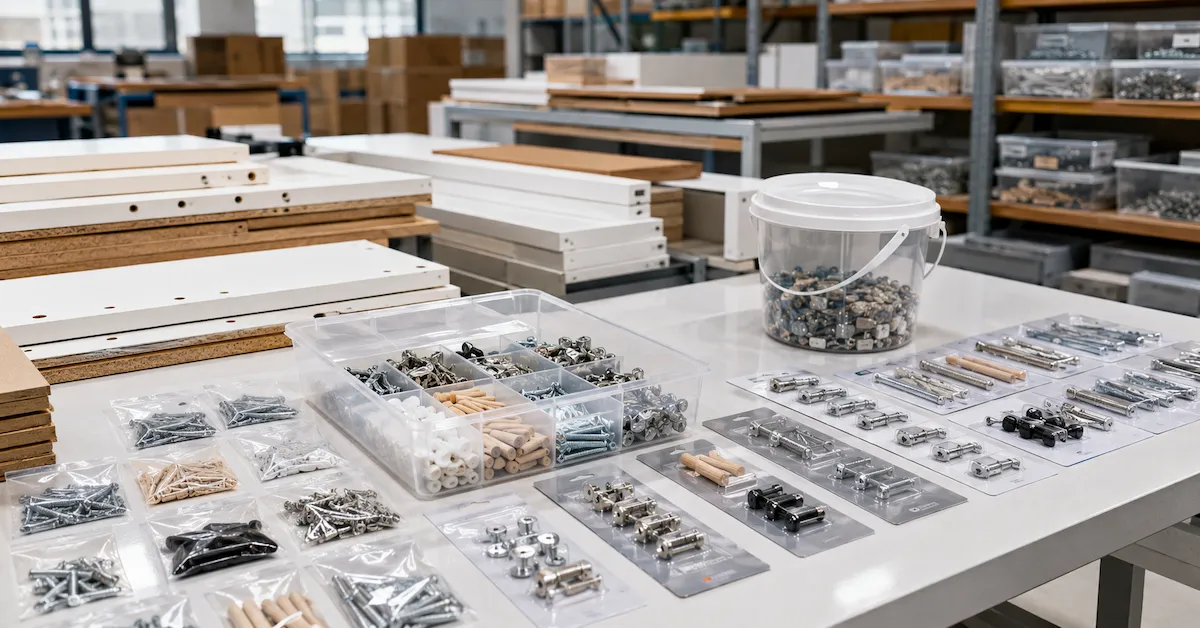
Quick Answer: What Are Furniture Hardware Packaging Solutions?
Furniture hardware packaging solutions are customized methods used to organize, protect, label, and distribute furniture screws, connectors, brackets, nuts, anchors, and complete assembly kits.
Common options include:
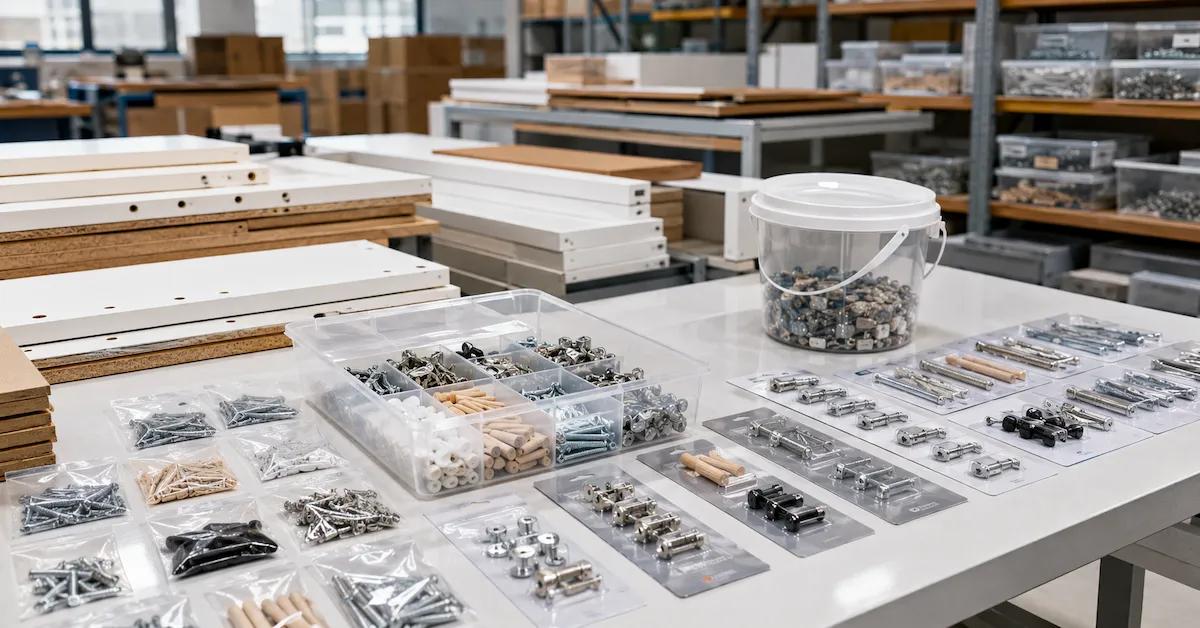
- Bag packaging
- Plastic blister packaging
- Box packaging
- Plastic bucket packaging
- Private-label hardware kits
- One-kit-per-furniture-unit packaging
- Barcode and SKU packaging
- Bulk export packaging
The right packaging depends on the hardware quantity, furniture model, sales channel, target market, product value, and end-user requirements.
Why Furniture Hardware Packaging Matters
Furniture hardware may represent only a small percentage of total furniture cost, but packaging errors can create expensive problems.
Poor packaging may cause:
- Missing-part complaints
- Mixed hardware sizes
- Installation delays
- Incorrect assembly
- Product returns
- Negative online reviews
- Replacement shipping costs
- Warehouse sorting problems
- Retail presentation issues
- Repeat-order inconsistencies
A reliable furniture hardware packaging solution helps buyers improve both operational efficiency and customer satisfaction.
For flat-pack furniture brands, the hardware kit is part of the customer’s first assembly experience. For hardware retailers, packaging is also part of product presentation and perceived value.
Main Types of Furniture Hardware Packaging
Different applications require different packaging methods.
| Packaging Type | Best For | Main Advantages | Main Considerations |
|---|---|---|---|
| Bag packaging | Furniture assembly kits | Economical, flexible, easy to pack by set | Limited retail presentation |
| Plastic blister packaging | Retail and DIY hardware | Clear product visibility and shelf display | Higher packaging cost |
| Box packaging | Multi-part hardware assortments | Organized, reusable, easy to label | Requires suitable internal layout |
| Plastic bucket packaging | Bulk screws and large projects | Large capacity and convenient handling | Not suitable for small furniture kits |
| Bulk carton packaging | Factories and distributors | Low packaging cost for large quantities | Buyer must sort parts |
| Private-label kits | Furniture brands and retailers | Supports branding and market differentiation | Artwork and label approval required |
A professional supplier should recommend packaging according to the buyer’s real application rather than offering only one standard option.
Bag Packaging for Furniture Assembly Kits
Bag packaging is one of the most common furniture hardware packaging solutions.
It is especially suitable for:
- Cabinets
- Wardrobes
- Shelves
- Office furniture
- Flat-pack furniture
- Hotel furniture
- One-kit-per-unit packaging
A bagged furniture hardware kit may contain:
- Cam locks
- Cam bolts
- Wood screws
- Insert nuts
- Brackets
- Washers
- Plastic caps
- Wall anchors
Each bag can be packed according to a confirmed BOM and labeled with the furniture model, part number, barcode, or assembly step.
Advantages of Bag Packaging
- Low packaging cost
- Flexible quantity combinations
- Easy to pack one kit per furniture unit
- Lightweight for export shipping
- Suitable for both manual and automated packing
- Easy to add labels and barcodes
Bag packaging is practical for furniture factories that prioritize assembly accuracy and production efficiency.
Plastic Blister Packaging for Retail Hardware
Plastic blister packaging is suitable for furniture hardware products sold through retail stores, hardware shops, supermarkets, and online channels.
The transparent packaging allows customers to see the hardware before purchasing.
Typical products include:
- Screw sets
- Cabinet connector kits
- Wall anchor kits
- Furniture repair kits
- Bracket sets
- Cam lock replacement kits
- DIY furniture hardware assortments
Advantages of Blister Packaging
- Clear product visibility
- Better shelf presentation
- Improved protection
- Easy product counting
- Suitable for printed cards
- Supports branding and product instructions
Blister packaging is often selected by retailers and private-label brands that need stronger visual presentation.
Box Packaging for Organized Hardware Sets
Box packaging is suitable for multi-size or multi-category hardware assortments.
A furniture hardware box may contain separate compartments for:
- Screws
- Washers
- Insert nuts
- Cam locks
- Brackets
- Anchors
- Plastic accessories
Box packaging is commonly used for:
- Furniture repair kits
- Hardware assortment sets
- DIY products
- E-commerce hardware kits
- Installer tool kits
- Distributor products
Advantages of Box Packaging
- Better product organization
- Easy storage and reuse
- Lower risk of mixing parts
- Supports multiple SKUs
- Suitable for printed labels and barcodes
- Higher perceived product value
For e-commerce products, the internal layout should prevent hardware from moving or mixing during transportation.
Plastic Bucket Packaging for Bulk Hardware
Plastic bucket packaging is mainly used for larger quantities of screws and fasteners.
It is suitable for:
- Furniture factories
- Cabinet production lines
- Installation contractors
- Construction projects
- Hardware distributors
- Bulk wood screw orders
Bucket packaging provides:
- Large capacity
- Easy transport and handling
- Reusable storage
- Better protection than simple cartons
- Convenient access during installation
Buyers should confirm bucket capacity, handle strength, lid design, label size, and quantity per bucket before production.
How to Choose the Right Furniture Hardware Packaging Solution
The correct packaging method depends on more than product quantity.
1. Identify the Buyer Type
Furniture factories usually need economical one-kit-per-unit packaging. Retailers need better visual presentation. Distributors may need bulk boxes or buckets. E-commerce brands often need compact and durable packaging.
2. Confirm the Hardware Combination
A package containing only screws is easier to design than a kit combining cam locks, brackets, insert nuts, washers, and plastic accessories.
The packaging should prevent:
- Part mixing
- Surface scratches
- Missing pieces
- Bag breakage
- Damage during shipment
3. Define the Sales Channel
| Sales Channel | Recommended Packaging |
| Furniture factory | Bag packaging or bulk cartons |
| Flat-pack furniture brand | One-kit-per-unit bag packaging |
| Hardware retail store | Blister or box packaging |
| E-commerce seller | Box or reinforced bag packaging |
| Construction contractor | Bucket or bulk packaging |
| Hardware distributor | Boxes, buckets, or cartons |
4. Consider Product Value
Premium stainless steel hardware or branded repair kits may require stronger and more attractive packaging than standard carbon steel screws.
5. Confirm Export Requirements
Export packaging should consider carton strength, humidity protection, barcode requirements, pallet loading, and destination-market labeling.
BOM Control for Furniture Hardware Packaging
A BOM is the foundation of accurate furniture hardware kit packaging.
It should define:
| BOM Information | Example |
| Part name | Cam lock, screw, bracket, insert nut |
| Part code | Customer or supplier item number |
| Size | Diameter, length, thickness |
| Material | Carbon steel, stainless steel, zinc alloy |
| Finish | Zinc plated, nickel plated, black |
| Quantity | Number of pieces per kit |
| Packaging | Bag, blister, box, bucket |
| Label | Model, barcode, logo, assembly step |
| Inspection | Quantity and appearance requirements |
Without a confirmed BOM, suppliers may pack the wrong quantity or mix similar-looking components.
For repeat orders, the approved BOM, sample kit, label artwork, and packaging standard should be saved as controlled production documents.
How Packaging Reduces Missing-Part Complaints
Missing parts are one of the most common problems in flat-pack furniture and DIY hardware products.
A supplier can reduce this risk through:
- Confirmed BOM documents
- Standardized part codes
- Pre-counted hardware sets
- Weight verification
- Visual inspection
- Separated sub-bags
- Barcode tracking
- Sample kit approval
- Final random inspection
- Carton quantity confirmation
For complex furniture products, the hardware can be separated into assembly stages.
For example:
- Bag A: Main cabinet connection
- Bag B: Shelf installation
- Bag C: Wall fixing
- Bag D: Handles and decorative parts
This makes the assembly process easier and reduces user confusion.
OEM and Private-Label Packaging Options
Furniture hardware packaging can be customized for different brands and markets.
Common OEM options include:
- Customer logo
- Custom labels
- Barcode and QR code
- Product model number
- Color printing
- Assembly instructions
- Warning labels
- Country-of-origin marking
- Multi-language information
- Custom carton marks
- Retail card design
- Private-label packaging
Private-label packaging is especially useful for:
- Hardware retailers
- Furniture brands
- DIY product companies
- E-commerce sellers
- Importers and distributors
Buyers should provide label artwork, dimensions, barcode files, packaging samples, and target-market requirements before mass production.
Packaging Materials and Protection
Packaging materials should be selected according to product weight, surface finish, and transportation conditions.
| Packaging Material | Main Use |
| PE bag | Standard hardware kits |
| Resealable bag | Reusable retail or repair kits |
| Blister tray | Retail display |
| Plastic box | Organized assortments |
| Plastic bucket | Bulk fasteners |
| Inner divider | Prevents part mixing |
| Protective film | Protects polished or coated parts |
| Export carton | Outer shipping protection |
Sharp brackets and stamped parts may require thicker bags or internal protection to prevent punctures.
Plated and decorative hardware may require separation to avoid scratches during transportation.
Quality Control for Furniture Hardware Packaging
Packaging inspection should cover both the hardware and the finished kit.
Important checks include:
- Correct product type
- Correct product size
- Correct quantity
- Surface finish
- Bag or box condition
- Label accuracy
- Barcode readability
- Logo position
- Packaging seal
- Internal part separation
- Export carton strength
- Carton quantity
For retail products, visual presentation should also be inspected.
For furniture assembly kits, quantity accuracy and part matching are usually the highest priorities.
Cost Factors of Furniture Hardware Packaging
The final packaging cost depends on:
- Number of hardware parts
- Packaging type
- Bag or box size
- Packaging material thickness
- Label design
- Barcode requirements
- Printing colors
- Internal dividers
- Manual or automated packing
- Order quantity
- Quality inspection requirements
- Export carton specifications
Bag packaging usually has the lowest cost, while custom blister packs and printed boxes require higher tooling and artwork investment.
Buyers should compare total value rather than packaging price alone. Better packaging may reduce missing-part claims, sorting labor, product returns, and replacement shipping costs.
What Buyers Should Prepare for a Packaging Quotation
To receive an accurate quotation, buyers should provide:
| RFQ Information | Details |
| Hardware list | Screws, connectors, brackets, nuts, anchors |
| BOM | Part name, size, quantity, finish |
| Packaging type | Bag, blister, box, bucket |
| Quantity | Units per order and annual demand |
| Label requirements | Logo, barcode, model number |
| Product market | Furniture factory, retail, e-commerce |
| Package dimensions | Existing specification or requested size |
| Artwork | AI, PDF, or high-resolution label file |
| Outer carton | Quantity per carton and carton marks |
| Inspection | Quantity, appearance, barcode, sealing |
Providing a sample package or photos can help the supplier understand the required presentation and structure.
Why Choose JHFIX for Furniture Hardware Packaging Solutions?
JHFIX is suitable for buyers who need both furniture hardware products and customized packaging services.
JHFIX can support:
- Screws
- Cam locks and cabinet connectors
- Insert nuts
- Brackets and stamped hardware
- Washers and anchors
- Plastic accessories
- Furniture assembly kits
- Bag packaging
- Plastic blister packaging
- Box packaging
- Plastic bucket packaging
- OEM and private-label solutions
- Pre-shipment inspection
By coordinating hardware manufacturing and packaging through one supplier, buyers can reduce communication, improve kit accuracy, and simplify repeat orders.
Learn more through the About Us page, explore available products on the Products page, review common questions on the FAQ page, or contact JHFIX with your BOM and packaging requirements.
FAQ
1. What are furniture hardware packaging solutions?
Furniture hardware packaging solutions are customized methods for packing screws, cam locks, brackets, nuts, anchors, and complete assembly kits for manufacturing, retail, or distribution.
2. What packaging is suitable for furniture assembly kits?
Bag packaging is usually the most practical option because it is economical, flexible, and suitable for one-kit-per-furniture-unit packing.
3. What packaging is best for retail furniture hardware?
Plastic blister packaging and box packaging are suitable for retail because they provide better visibility, organization, and branding.
4. Can furniture hardware packaging be customized?
Yes. Packaging can include custom sizes, labels, logos, barcodes, printed cards, instructions, private branding, and carton marks.
5. How can suppliers prevent missing parts?
Suppliers can use confirmed BOMs, part codes, pre-counting, weight checks, visual inspection, separated bags, and final quantity inspection.
6. Can different furniture hardware parts be packed together?
Yes. Screws, cam locks, insert nuts, brackets, washers, anchors, and plastic accessories can be combined into one customized kit.
7. What information is needed for a packaging quotation?
Buyers should provide a hardware list, BOM, package type, quantity, label requirements, artwork, target market, and carton information.
8. Which packaging is suitable for bulk screws?
Plastic bucket packaging, box packaging, and bulk carton packaging are suitable for large quantities of screws and fasteners.
Conclusion
Furniture hardware packaging solutions help furniture manufacturers, retailers, distributors, and e-commerce brands improve kit accuracy, reduce missing-part complaints, simplify assembly, and create market-ready hardware products.
The best packaging solution should match the hardware combination, buyer type, sales channel, order volume, branding needs, and target market.
If you need bag packaging, blister packs, boxes, plastic buckets, or private-label furniture hardware kits, JHFIX can help review your BOM, recommend suitable packaging, prepare samples, and support bulk production.
Browse the JHFIX product range, learn more about our manufacturing and packaging capabilities, check the FAQ section, or contact us for a customized quotation.