
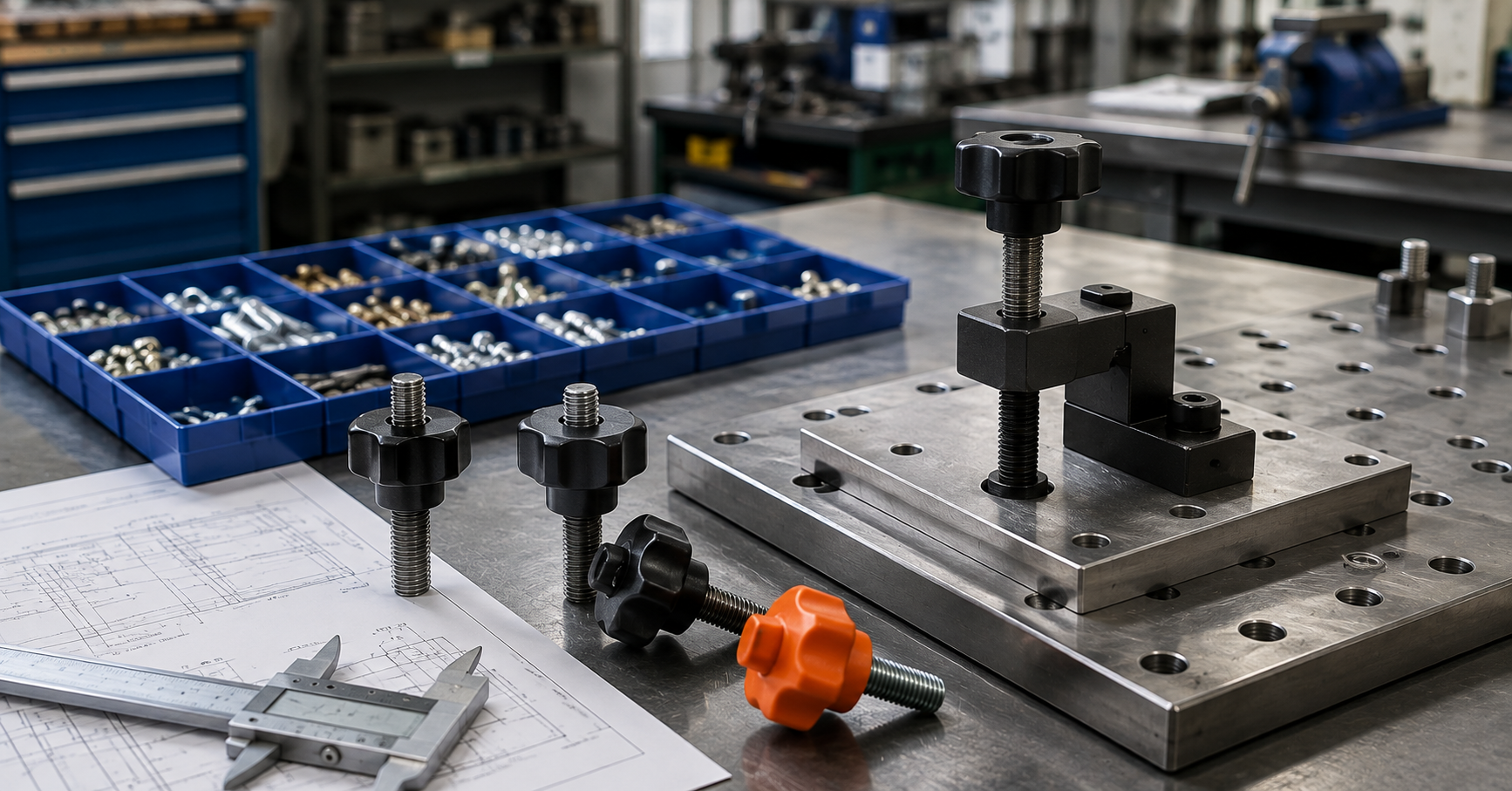

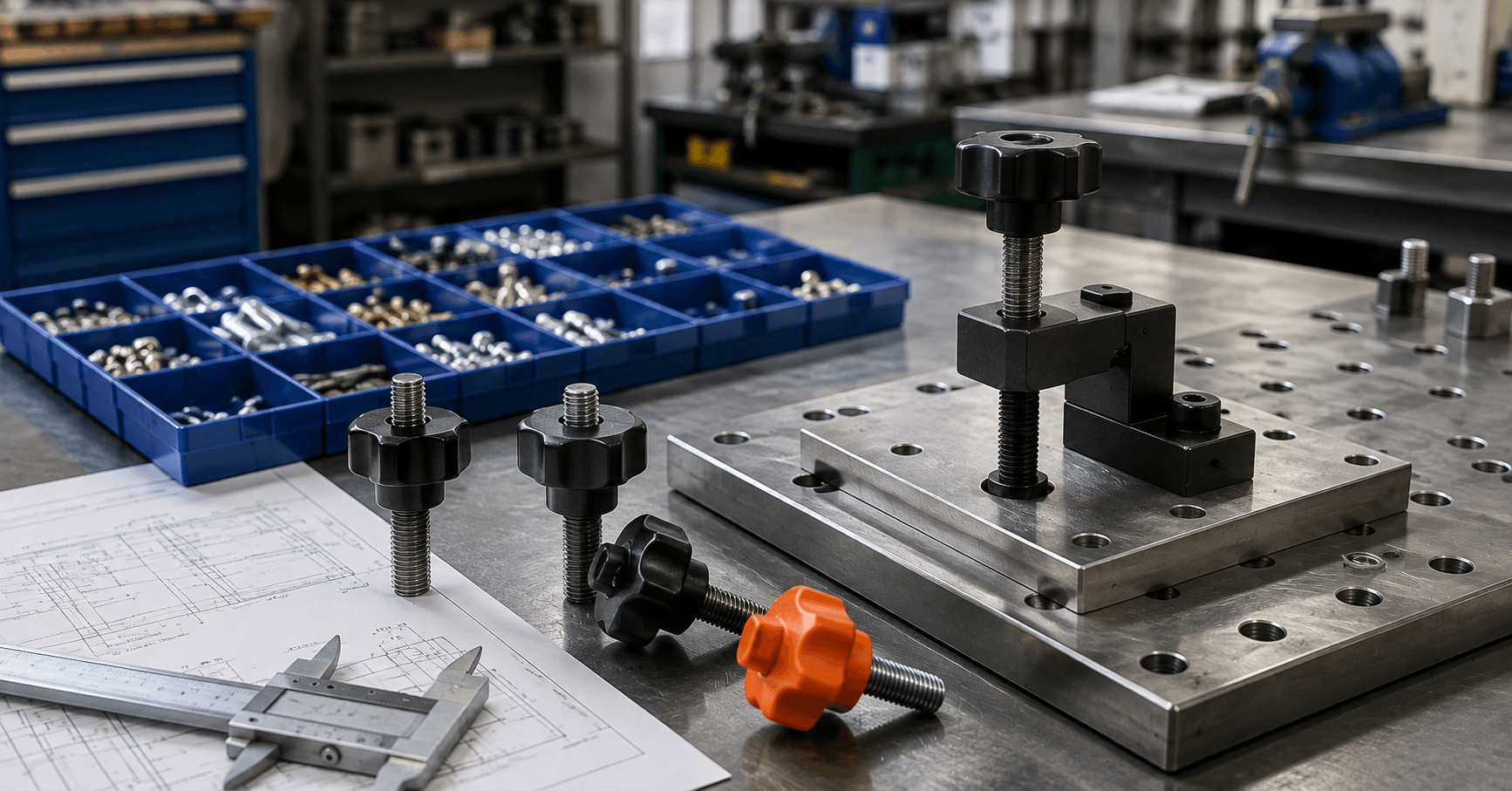
How to Choose Plum Hand Tight Nuts for Manual Clamping and Industrial Assembly
A plum hand tight nut looks like a small part.
It is not as large as a machine frame. It does not look as technical as a bearing, motor, or control unit. In many purchasing lists, it may appear as a simple knob nut or manual clamping accessory.
But anyone who has adjusted a jig, locked a guard, tightened a fixture, or removed an access panel by hand knows the difference between a good hand nut and a poor one.
A good plum hand tight nut feels easy to grip. It tightens without fighting the user. It matches the thread. It sits properly on the mating part. It can be removed again without damaging the assembly. It also survives repeated use, shipping, storage, and daily handling.
A poor one creates small frustrations every day.
The user may struggle to tighten it. The thread may feel rough. The finish may not suit the environment. The size may be almost right but not fully compatible. The knob may be packed poorly and arrive scratched, mixed, or hard to identify.
That is why buyers should not choose plum hand tight nuts only by appearance or price.
For industrial equipment, workshop tools, water treatment systems, mining-related equipment, healthcare equipment, jigs, fixtures, adjustable brackets, and OEM assemblies, the better question is simple:
Will this nut fit the real application, tighten comfortably, and repeat reliably across future orders?
Product data: Jinhe plum hand tight nuts
The JHFix product page lists the product name as Plum hand tight nuts, with Jinhe as the brand. The page also lists galvanized and blue phosphate finish options, metric measurement system, round body type, right-hand thread direction, insert diameter options of M4, M5, M6, M8, and M12, hole diameter M10, customized grade, carton packing, OEM support, and suitability for heavy industry, mining, water treatment, and healthcare. The product title also mentions M5 M6 M8 M10 galvanized heavy duty manual clamping knob, so buyers should confirm the exact size needed before placing an order.
| Item | Product Information |
|---|---|
| Product Name | Plum hand tight nuts |
| Brand Name | Jinhe |
| Finish | Galvanized, Blue Phosphate |
| Measurement System | Metric |
| Body Type | Round |
| Thread Direction | Right Hand |
| Hole Diameter | M10 |
| Insert Diameter | M4, M5, M6, M8, M12 |
| Grade | Customized |
| Place of Origin | China |
| Suitable For | Heavy Industry, Mining, Water Treatment, Healthcare |
| Packing | Carton |
| Design | New fashion design |
| OEM | Yes |
| Payment Terms | TT, L/C, D/A, D/P, Western Union, MoneyGram |
This table gives buyers a practical starting point.
Still, a specification table is not the same as a purchase approval. A hand nut may look correct online and still be wrong for the threaded rod, clamp, fixture, guard, or panel where it will be used.
The title mentions M5, M6, M8, and M10, while the visible specification table lists insert diameter options including M4, M5, M6, M8, and M12. This is not unusual for product family pages, but it does mean the buyer should confirm the exact size, insert diameter, drawing, and sample before ordering.
What is a plum hand tight nut used for?
A plum hand tight nut is usually selected when the user needs to tighten, loosen, adjust, or lock a component by hand.
That is the key difference between this product and an ordinary hex nut.
A hex nut normally needs a wrench or socket. A plum hand tight nut gives the user a larger gripping shape, so it is easier to tighten manually. This is useful when the part is adjusted often, removed for cleaning, or used in a position where tool access is inconvenient.
Common use scenarios include:
- machine guards
- adjustable brackets
- inspection covers
- positioning fixtures
- clamping devices
- equipment handles
- laboratory or healthcare equipment adjustments
- water treatment access panels
- mining equipment covers
- workshop jigs
- assembly line fixtures
- packaging machinery
- furniture or storage hardware
- temporary locking points
The product page lists heavy industry, mining, water treatment, and healthcare as suitable application areas.
That does not mean one hand tight nut automatically fits every one of those fields. A mining-related application may need stronger environmental review. A healthcare device may care more about cleaning, appearance, and repeatable operation. A water treatment system may need more attention to moisture and finish. Heavy industry may focus on durability, grip, and vibration exposure.
The same product family can serve several markets, but the final specification should come from the actual application.
Why consumers and B2B buyers choose hand tight nuts
From a user’s point of view, the main value is convenience.
If a part needs to be opened, adjusted, repositioned, or clamped by hand, a normal nut can be annoying. The operator has to find a tool. The tool may not fit. The part may be in a narrow area. The nut may be removed often enough that using a wrench every time wastes labor.
A plum hand tight nut solves this by making the tightening surface easier to grip.
For a workshop user, that can mean faster adjustment.
For an equipment operator, it can mean less downtime.
For a maintenance team, it can make inspection or cleaning easier.
For an OEM buyer, it can improve the end user’s experience without redesigning the full product.
In other words, the nut is small, but it changes how people interact with the product.
That is why a manual clamping knob supplier should not only provide sizes. The supplier should also help the buyer think through comfort, thread fit, finish, packaging, and repeated use.
Start with the thread size
The first selection point is thread size.
The JHFix product title mentions M5, M6, M8, and M10, while the visible specification table lists insert diameter options of M4, M5, M6, M8, and M12, plus hole diameter M10.
For buyers, the message is clear: do not assume the size from the title alone.
Before ordering, confirm:
- required thread size
- internal insert diameter
- mating screw or threaded rod
- thread pitch
- right-hand or left-hand thread
- whether the nut must fit an existing part
- whether a sample is needed before bulk order
The page lists right-hand thread direction, which is common in many assemblies. Still, if the application uses a special threaded rod or reverse-thread assembly, the buyer must confirm compatibility.
A hand tight nut that is one size off is not “close enough.”
It is unusable.
Check the grip shape and hand comfort
The product is described as a plum hand tight nut, and the title refers to a manual clamping knob.
That shape matters because users operate it by hand.
If the nut is tightened only once in the factory, hand comfort may not matter much. But if the nut is used every day, removed frequently, or adjusted in a wet or dusty environment, the shape becomes important.
A good hand nut should be easy to grip without sharp edges. It should not feel slippery. It should allow enough tightening force for the application without hurting the operator’s hand. It should also be large enough for practical use but not so large that it blocks nearby parts.
Buyers should ask:
Will users wear gloves?
Will the nut be handled with wet hands?
Is the area dusty, oily, or humid?
Does the operator need quick release or firm clamping?
Is there enough clearance around the knob?
Will the knob touch another moving part?
Will several knobs sit close together?
These questions are especially important for industrial clamping knobs, machine guards, inspection covers, and adjustable fixtures.
A nut that looks good in a product image may feel awkward on the real machine.
Match the finish to the working environment
The product page lists galvanized and blue phosphate finish options.
Finish is not only about appearance.
It affects corrosion expectations, surface feel, storage behavior, and how the part looks after repeated handling. A galvanized finish may be chosen for general protection and a familiar industrial appearance. Blue phosphate may be selected for another surface requirement or visual preference.
The right choice depends on use conditions.
For dry indoor equipment, a standard finish may be enough. For water treatment environments, buyers should ask more questions about moisture exposure. For mining or heavy industry, dust, impact, oil, and vibration may affect the service life of surrounding hardware. For healthcare equipment, the buyer may need to consider cleaning, appearance, and material compatibility.
Before approving the finish, confirm:
| Selection Point | What Buyers Should Check |
| Thread Size | M5, M6, M8, M10, or other confirmed option |
| Insert Diameter | Match the mating screw, bolt, or threaded rod |
| Thread Direction | Right-hand thread is listed; confirm if special thread is needed |
| Finish | Galvanized or blue phosphate based on use environment |
| Grip Size | Comfortable for the operator and clear of nearby parts |
| Application | Heavy industry, mining, water treatment, healthcare, fixture, or OEM use |
| Packing | Carton packing is listed; confirm labels and inner packaging |
| OEM Need | Confirm branding, size, finish, or custom packaging requirements |
| Sample Test | Test on the actual assembly before mass order |
| Repeat Supply | Ensure future shipments match the approved sample |
This kind of checklist prevents small mistakes from becoming production issues.
Think about clamping force and actual use
A hand tight nut is often used for manual clamping. That does not mean it can replace every high-torque fastening solution.
The user’s hand provides the tightening force. This is useful for quick adjustment, covers, guards, supports, and light-to-medium clamping points. But for heavy structural joints, safety-critical assemblies, or high-vibration applications, the nut should be evaluated carefully.
Buyers should ask:
How much clamping force is required?
Will the part carry load?
Will vibration loosen the nut?
Will users tighten it consistently by hand?
Is a washer, spring washer, or additional locking method needed?
Will the nut be removed often?
Is the assembly safety-related?
A plum hand tight nut is excellent where human adjustment is the main purpose.
It should not be selected blindly where controlled torque is required unless the design has been tested.
Confirm the mating part
The nut is only one side of the connection.
It must match the screw, bolt, stud, threaded rod, or insert that it engages with. If the mating part is wrong, the hand nut will not perform well.
The thread may bind.
The nut may loosen.
The insert may wear.
The assembly may not clamp fully.
The user may apply too much force and damage the part.
Before purchase, buyers should provide the supplier with the mating part details:
- screw size
- thread pitch
- material
- length
- exposed thread length
- load requirement
- whether the mating part is fixed or removable
- surface finish
- expected number of adjustment cycles
This is especially important when the hand tight nut will be part of an OEM product or replacement kit.
If the nut is sold as a spare part, the size and compatibility must be clear enough for users to reorder correctly.
Where these nuts fit in consumer-facing products
Although plum hand tight nuts are industrial components, they often appear in products used by non-engineers.
Examples include:
- adjustable furniture fixtures
- workbench accessories
- small equipment stands
- removable guards
- clamping guides
- camera or inspection fixtures
- medical support frames
- gym or rehabilitation equipment adjustments
- retail display fixtures
- water filter housing accessories
- portable machine panels
- DIY hardware kits
In these products, the nut affects how the user feels about the whole item.
If the hand nut is easy to tighten, the product feels thoughtful. If it is hard to grip or loosens too easily, the user may blame the entire product.
That is why consumer-facing equipment brands should treat hand knobs and hand tight nuts as part of the user experience, not only as a fastening cost.
Where these nuts fit in B2B industrial projects
For B2B buyers, the uses are broader and more operational.
Plum hand tight nuts can be useful in:
- line-side fixtures
- adjustable guides
- conveyor accessories
- temporary clamps
- machine covers
- inspection windows
- tool-free access panels
- maintenance lock points
- equipment setup parts
- prototype assemblies
- low-volume machines
- water treatment equipment
- mining support hardware
- healthcare device frames
The product page lists suitability for heavy industry, mining, water treatment, and healthcare.
Each field has its own buying logic. Heavy industry buyers may care about strength, stability, and supply consistency. Mining buyers may care about durability and harsh working conditions. Water treatment buyers may care about finish and corrosion-related questions. Healthcare buyers may care about clean handling and repeatable operation.
This is why a good supplier should not sell the same product the same way to every buyer.
The buyer should explain the real use case.
Packaging matters more than it first appears
The JHFix product page lists carton packing.
For many bulk industrial orders, carton packing is acceptable. But the buyer should still confirm the details.
If different sizes are ordered together, labels must be clear. If the nuts are used in an OEM kit, inner bags may need to match the assembly sequence. If the surface finish matters, the packaging should reduce scratches. If the product is sold to distributors, the outer carton may need barcode labels, part numbers, and size marking.
Packaging questions include:
How many pieces per bag or carton?
Are sizes packed separately?
Is the metric size printed clearly?
Can OEM labels be added?
Can the package include part numbers?
Can mixed orders avoid size confusion?
Will the finish be protected during shipping?
Can replacement packs be prepared?
A hand nut is easy to identify when there is only one size on the bench.
It becomes less simple when M5, M6, M8, M10, and other sizes are stored together.
OEM support and customization
The product page lists OEM support.
For buyers, OEM support may involve size selection, finish choice, packaging format, labeling, carton marks, private label supply, or project-specific documentation.
Customization does not always mean creating a new part from zero.
It may mean:
- selecting a specific metric size
- choosing galvanized or blue phosphate finish
- preparing size-separated bags
- adding custom labels
- supplying repeatable carton quantities
- matching a customer’s drawing
- supporting a hardware kit
- preparing replacement packs
- controlling future revisions
For industrial buyers, this can reduce internal work. For product brands, it can make the final kit easier to use. For distributors, it can make inventory easier to manage.
The most important point is to define the requirement clearly.
“Customized” should mean a controlled specification, not a vague promise.
Common mistakes when buying plum hand tight nuts
One common mistake is choosing by knob shape only.
The shape matters, but the thread fit matters more. A good-looking knob is useless if the insert does not match the mating screw or rod.
Another mistake is ignoring clearance. Plum-shaped knobs are larger than ordinary nuts, so they need space around them. If the assembly is compact, the knob may interfere with nearby parts.
A third mistake is assuming all finishes behave the same. Galvanized and blue phosphate should be chosen according to the environment, appearance expectation, and handling conditions.
Buyers also sometimes forget how often the nut will be used. A nut adjusted once during installation has different needs from one adjusted daily by operators.
Another mistake is not testing with gloves. In mining, heavy industry, maintenance, and water treatment environments, users may wear gloves. A knob that feels good bare-handed may feel smaller or more slippery with gloves.
The final mistake is ordering a product family without confirming exact size. Since the page title and specification table list related but not identical size language, buyers should confirm the exact item before ordering.
Questions to ask before placing an order
Before buying plum hand tight nuts, buyers should ask:
What metric size do we need?
Does the insert diameter match the mating part?
Is the thread right-hand or special?
Will the user tighten it by hand only?
How often will it be removed or adjusted?
Will users wear gloves?
Is there enough clearance around the knob?
What finish is suitable: galvanized or blue phosphate?
Will the part be used indoors, outdoors, or near moisture?
Is the application heavy industry, mining, water treatment, healthcare, or another field?
How should the parts be packed?
Do we need OEM labels or customized packaging?
Can the supplier provide samples before bulk order?
Can the same specification be repeated in future shipments?
These questions move the purchase away from “How much per piece?” and closer to real product performance.
That is how buyers avoid ordering a hand nut that looks right but fails in daily use.
How to test a sample before approval
Sample testing does not need to be complicated.
Install the hand tight nut on the real mating thread. Tighten it by hand. Remove it. Repeat the process. Try it with gloves if operators use gloves. Check whether the grip feels comfortable. Check whether the nut sits properly. Check whether the finish scratches too easily. Check whether it interferes with surrounding parts.
Then test the full assembly.
If it is used on a guard, open and close the guard several times. If it is used on a fixture, adjust the fixture repeatedly. If it is used on water treatment equipment, consider exposure conditions. If it is used in a healthcare product, review cleaning and handling expectations.
Look for ordinary problems:
The thread feels rough.
The knob is too small.
The knob is too large.
The finish marks easily.
The user cannot reach it.
It loosens too quickly.
It takes too much effort to remove.
It is confused with another size.
These are the problems a sample can reveal before they become bulk-order issues.
B2B keyword opportunities for this product
| Keyword | Best Page Use |
| plum hand tight nuts | Main blog and product keyword |
| hand tight nut manufacturer | Supplier introduction and company page |
| manual clamping knob supplier | Product category and inquiry section |
| galvanized hand nuts | Finish-focused product section |
| metric hand tight nuts | Size and specification section |
| M5 M6 M8 M10 hand nuts | Long-tail product keyword |
| heavy duty hand knob nuts | Industrial application section |
| industrial clamping knobs | Equipment and fixture use cases |
| OEM hand tight nuts | Customization and packaging section |
These keywords should be used naturally in the article, product page, FAQ, and image ALT text. Avoid repeating the same keyword mechanically. The better approach is to match each keyword with a real buyer question.
Frequently Asked Questions
What are plum hand tight nuts used for?
Plum hand tight nuts are used where a user needs to tighten, loosen, adjust, or clamp a part manually. They are often used in fixtures, equipment covers, adjustable brackets, machine guards, panels, and industrial assemblies.
What sizes are available?
The product title mentions M5, M6, M8, and M10, while the visible specification table lists insert diameter options of M4, M5, M6, M8, and M12. Buyers should confirm the exact required size before ordering.
What finish options are listed?
The product page lists galvanized and blue phosphate finish options.
What industries are listed as suitable?
The page lists heavy industry, mining, water treatment, and healthcare as suitable application areas.
Can plum hand tight nuts be used for OEM projects?
Yes. The product page lists OEM support. Buyers should confirm size, finish, packaging, label, quantity, and repeat-order requirements before placing a project order.
What should buyers check before ordering?
Buyers should check thread size, insert diameter, mating part, finish, grip clearance, hand comfort, application environment, packaging, OEM requirements, and sample performance.
Final takeaway
A plum hand tight nut is small, but it can change how easily a product is used.
The right nut fits the thread.
It feels comfortable in the hand.
It tightens without tools.
It clears nearby parts.
It suits the working environment.
It arrives clearly packed.
It can be reordered with the same specification.
That is what buyers should expect from a reliable hand tight nut manufacturer or manual clamping knob supplier.
For plum hand tight nuts, galvanized hand nuts, blue phosphate hand nuts, metric hand tight nuts, M5 M6 M8 M10 hand nuts, industrial clamping knobs, heavy duty hand knob nuts, and OEM hand tight nuts, Jiangmen Jinhe Hardware can discuss size selection, finish options, packaging, samples, and repeat supply.
For direct inquiries:
Tel/WeChat: +86 13729150102
WhatsApp: +86 13322893939
Email: sharon@hkhomeideas.com
Start with the mating thread, size, insert diameter, working environment, hand clearance, finish requirement, packaging method, and expected order quantity.
Once those details are clear, the right plum hand tight nut becomes much easier to choose, install, and repeat.