
Short answer: A screw manufacturer or trading company can both quote your drawing, send samples and look credible on a website. The difference appears when a batch drifts: the manufacturer owns the heading dies, the process route and the inspection records, while a trader owns a relationship. Verify the business licence scope, the certificate scope, the machine floor and the lot trail before you release a purchase order. A disclosed trader is not automatically a disqualification; an undisclosed one is.
Why the factory-or-trader question deserves ten minutes
Most sourcing guides treat this as a fraud question. It is really a control question. When you buy from a factory, one organisation controls heading, thread rolling, heat treatment scheduling, plating and final inspection, so a change in your part has one owner. When you buy from a trader, those steps are distributed across suppliers the trader manages, and your visibility depends on how well that trader documents them.
Whether the answer comes from a screw manufacturer or trading company, the practical test is the same: can this supplier show you the process, the records and the person accountable for both? That is what the checks below measure.
That gap creates three costs buyers usually discover late: a price that embeds an undisclosed margin, a quality problem that cannot be traced to a process step, and a change nobody told you about. It also creates a documentation problem. If your customer or regulator asks who manufactured the lot, "our supplier" is not an answer.
None of this means traders are bad suppliers. Aggregation, export paperwork and multi-item kits are real services. The point is to know which model you are buying, price it honestly, and write the responsibility into the order.
The 12 checks every screw manufacturer or trading company should pass
Run these in order. The first four are desk checks; the rest need a video call, a site visit or a third-party audit. Ask for evidence, not assurances. Fastener supplier verification is mostly a document-and-floor exercise, and each answer either produces a document or it does not.
1. Business licence scope
The supplier business license scope is the first place to look, not the company name. A manufacturer's scope normally contains manufacturing verbs and the specific product category. A trading company's scope is usually limited to sales, import and export. Cross-check the registration number on the national enterprise credit registry rather than trusting a PDF. If the scope is sales-only, you are talking to a trader, whatever the website says.
2. Certificate scope, not the certificate logo
An ISO 9001 certificate proves a quality management system exists at a named site for a named scope. Ask for the certificate number, the issuing body and the scope page, then check whether the ISO 9001 scope covers fastener manufacturing at the address that will produce your parts. Certificates can be verified through the issuing body or the IAF CertSearch certificate search. A logo on a catalogue page proves nothing; a number with a matching scope does.
3. Address consistency across documents
Compare four addresses: the licence, the audit or production address, the shipping origin on the invoice, and the bank beneficiary. They do not have to be identical, because offices and plants differ, but every difference should have a plain explanation. Three unexplained addresses are a warning that the entity you are paying is not the entity making the part.
4. Heading and thread-forming equipment
Ask for a short video of your part, or a similar part, running on the heading machine, with the die and the part visible in the same shot. Then ask how the thread is formed: rolled, machined or tapped. Rolled threads are the normal route for volume screw production because the material grain follows the thread profile; machined threads belong to low-volume or special features. A supplier who cannot describe the difference is not running the process.

5. A written process route
Request a one-page route: wire rod, heading, thread rolling, heat treatment, plating, sorting, packing, inspection. Mark each step as in-house or outsourced. Real factories know this document by heart because it drives their costing. Vague answers such as "we do everything" usually mean the supplier has never had to map it.
6. Heat treatment and plating control
These two steps decide hardness, ductility and corrosion life, and they are commonly subcontracted even by real factories. That is acceptable when the subcontractor is named, approved and reported per lot. Ask which company performs heat treatment and plating, what reports come back, and how a hardness or coating-thickness failure is handled. A supplier who cannot name the plating line cannot control the finish you specified.
7. A gauge room, not just calipers
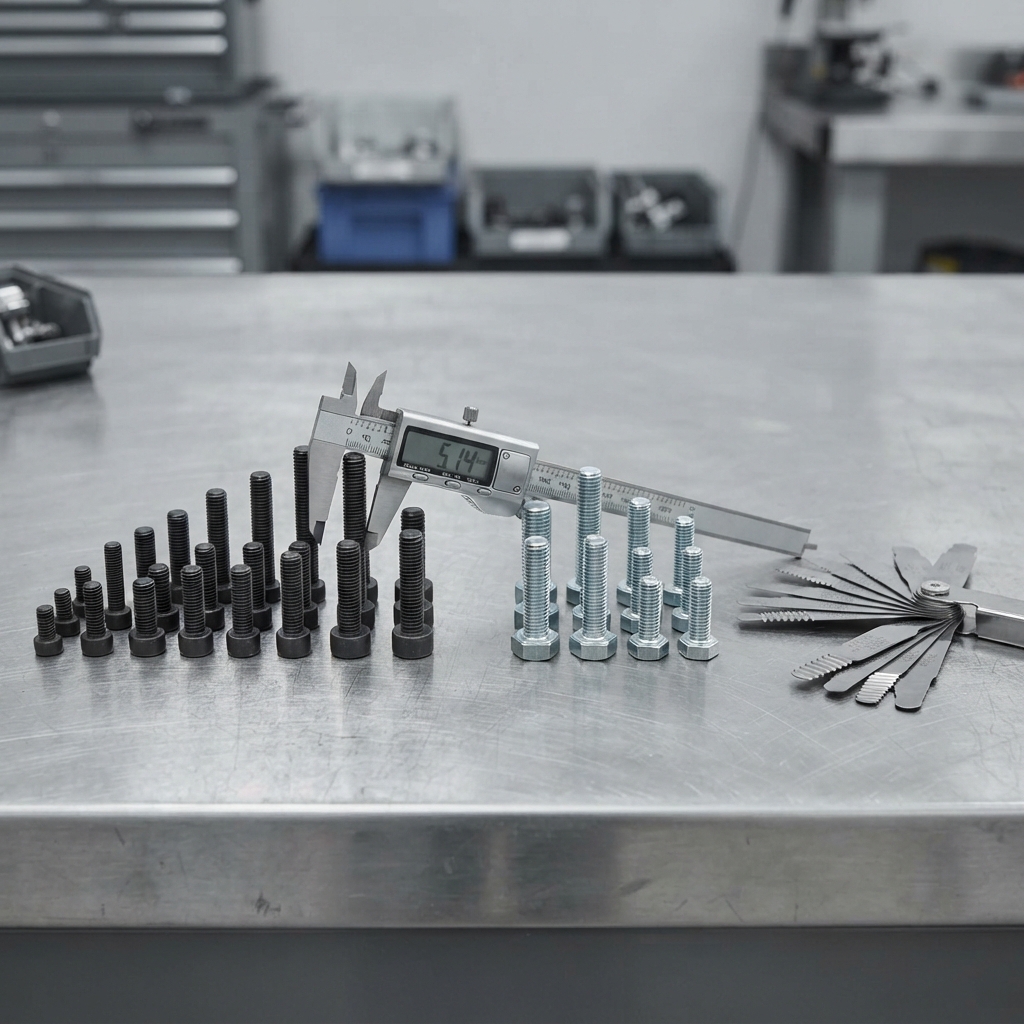
Ask for a photo of the gauges used for your part, with calibration labels visible and in date. Thread go/no-go gauges, a micrometer, a hardness tester and a coating thickness gauge are the minimum toolkit for screw production. Calipers alone can confirm a diameter but not a thread class, a thread angle or a plating thickness. If the answer is a photo of a desk caliper, the inspection claim is thin.
8. Lot traceability from carton to wire
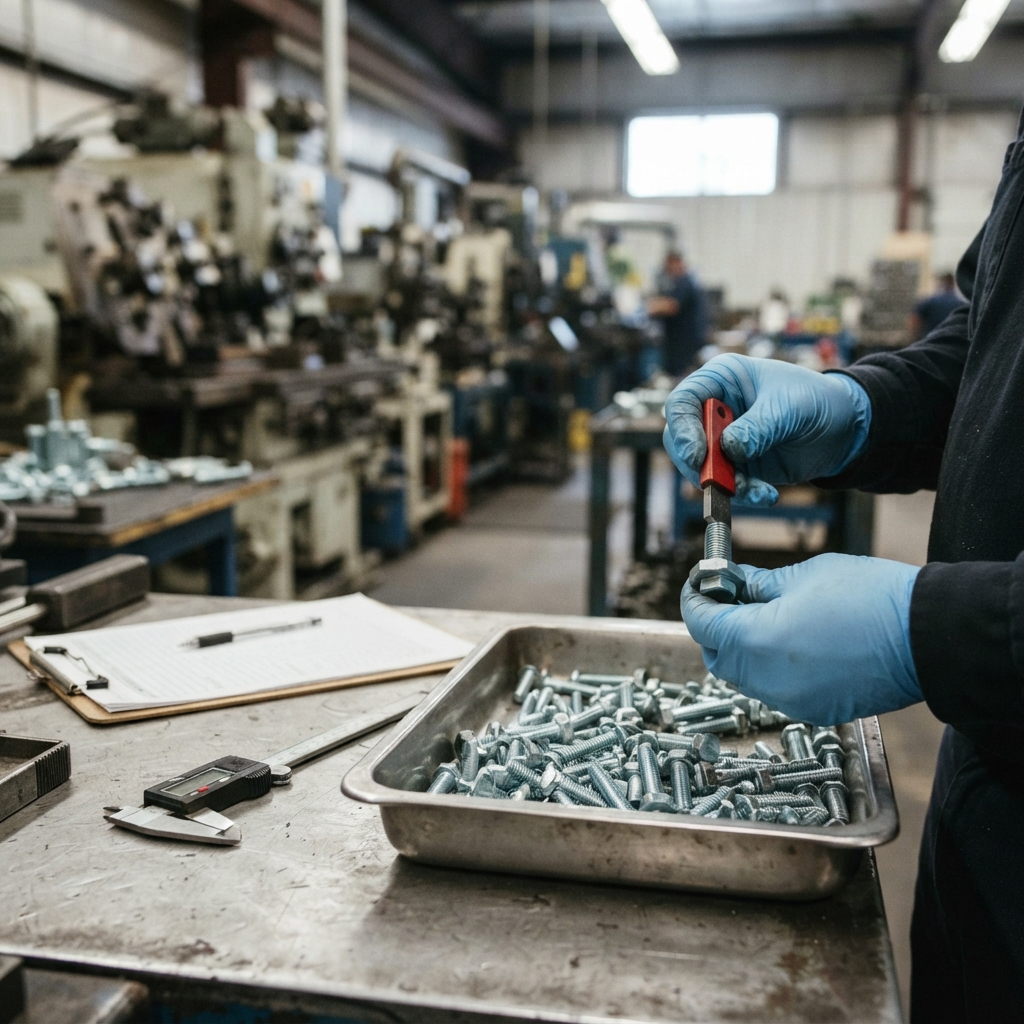
Pick a carton label from a previous order and ask the supplier to trace it back to the production lot and the wire rod heat number. Lot traceability is the test most traders cannot pass quickly. A factory with a working system can do this in a day, often in an hour, because production records, material certificates and packing labels point to the same lot number.
9. First article and in-process records
Ask what happens before a run starts. A serious supplier produces a first-article report against your drawing, signs it, and holds the run until approval. Ask to see a redacted example with dimensions, tolerances, results and the inspector's signature. A sample bag with no measurements is a sales tool, not an inspection record.
10. Capacity that matches the order size
Ask how many heading machines run, how many shifts, and what share of capacity is committed this month. Heading machine capacity should be coherent with the volume you are quoted. A workshop with two machines cannot ship twenty tonnes a month without buying from someone else. If the capacity story does not add up, the order will be brokered, and the process route you approved will not be the one used.
11. Die and tool ownership
If you pay for tooling, ask who owns the dies, how they are tagged, and whether they can be transferred if you change suppliers. Dies tagged with your part number and stored separately indicate a supplier used to handling custom work. "The dies belong to us" is a commercial position, not a technical one, and it should be resolved before you pay, not after.
12. Behaviour under three technical questions
Ask three questions that require your drawing: which dimension controls fit, what plating thickness was quoted and why, and which defect class would trigger rejection. A manufacturer answers with dimensions, standards and process limits. A trader answers with adjectives. This is the cheapest check on the list and often the fastest signal.
The 12 checks in one table
Use this table as a factory audit checklist for fasteners. It scores a screw manufacturer or trading company on the same evidence, so the comparison stays factual.
| Check | Evidence to request | Strong answer | Red flag |
|---|---|---|---|
| 1. Licence scope | Licence scan and registry lookup | Manufacturing verbs plus the product category | Sales-only scope |
| 2. Certificate scope | Number, body and scope page | Scope names fastener manufacture at the site | Logo with no number |
| 3. Address consistency | Licence, audit, invoice, bank details | Differences explained in one line | Three unexplained addresses |
| 4. Equipment | Video of your part running | Machine, die and part in one shot | Stock footage only |
| 5. Process route | One-page step list | In-house and outsourced steps named | "We do everything" |
| 6. Heat treatment and plating | Subcontractor name and lot reports | Named, approved and reported | "Standard treatment" |
| 7. Gauge room | Photo with calibration labels | Go/no-go gauges and hardness tester | Calipers only |
| 8. Traceability | Carton label to heat number | Traced within a day | "We can check" |
| 9. First article | Signed report against your drawing | Dimensioned, dated and signed | Sample bag only |
| 10. Capacity | Machines, shifts, current load | Coherent with your volume | Vague or oversized |
| 11. Die ownership | Die tag and written clause | Dies tagged to your part number | "Dies belong to us" |
| 12. Technical answers | Three drawing-specific questions | Answers cite dimensions and standards | Generic replies |
How to score the answers
Screw supplier due diligence rarely fails on price; it fails because nobody wrote the answers down. Score each check from 0 to 3: 3 for documented evidence, 2 for a credible verbal answer with partial documents, 1 for an evasive answer, 0 for a refusal. A simple rule works well: treat checks 1, 2, 4, 5 and 8 as disqualifying if any scores zero, because each one breaks the link between the part you approved and the part you receive. The rest can be fixed with contract terms, inspection or a corrective action plan.
Do not average away a zero. A supplier who cannot trace a carton to a heat number will not become traceable because the catalogue is well designed.
When a trading company is the right supplier
There are legitimate reasons to buy through a trader: small mixed orders that no single factory wants, hardware kits that combine screws, connectors and packaging from several plants, export documentation and consolidated shipping, or a category range wider than one factory can produce. In those cases the trader is doing real work and should be paid for it.
The conditions are what matter. The manufacturing site should be named, not hidden. You should be able to audit that site or send a third party. The trader should accept written responsibility for quality, claims and change notification, and should pass through lot-level inspection reports. If any of those is refused, the issue is not the business model but the accountability.
A screw manufacturer or trading company is not a moral category, and the trading company vs manufacturer question is settled by evidence rather than by a label. This is how we describe our own structure: manufacturing is carried out by Jiangmen Jinhe Hardware Products Co., Ltd., with international sales and export support from its authorised partner, Jiangmen Shenxin Trading Co., Ltd. Publishing both names lets a buyer check the plant and the contracting entity separately, which is exactly the check this article recommends.
Five mistakes that make the checks worthless
- Judging the website instead of the documents. A polished site is cheap; a licence scope and a certificate number are not.
- Accepting a certificate without reading the scope. A valid certificate for a different product or site proves nothing about your screws.
- Approving on samples alone. Samples are usually made with extra care. Ask for the production route and the first-article record instead.
- Ignoring subcontracted heat treatment and plating. These steps cause a large share of hardness and corrosion failures, and they are the easiest to lose visibility over.
- Treating "trader" as a verdict. The real question is whether the manufacturer, the process and the responsibility are documented. A disclosed trader with audit access can be safer than a "factory" that brokers your order.
What to put in the trial order
- The legal manufacturer name and the production address, written into the order, not just the quote.
- The approved process route and any named subcontractors for heat treatment and plating.
- A first-article report against your drawing, approved before the run continues.
- Lot-level inspection reports and material certificates with each shipment.
- A change-notification clause: no change to material, process, subcontractor or plating without written approval.
- Die ownership and transfer terms, if you paid for tooling.
- An audit right and a defined claim window with the evidence required.
For the document side of this, see our guides on what each screw manufacturer certificate actually proves and how to audit a screw manufacturer before you order. If you are comparing several candidates at once, this supplier comparison framework keeps the scoring consistent.
Screws and hardware we manufacture
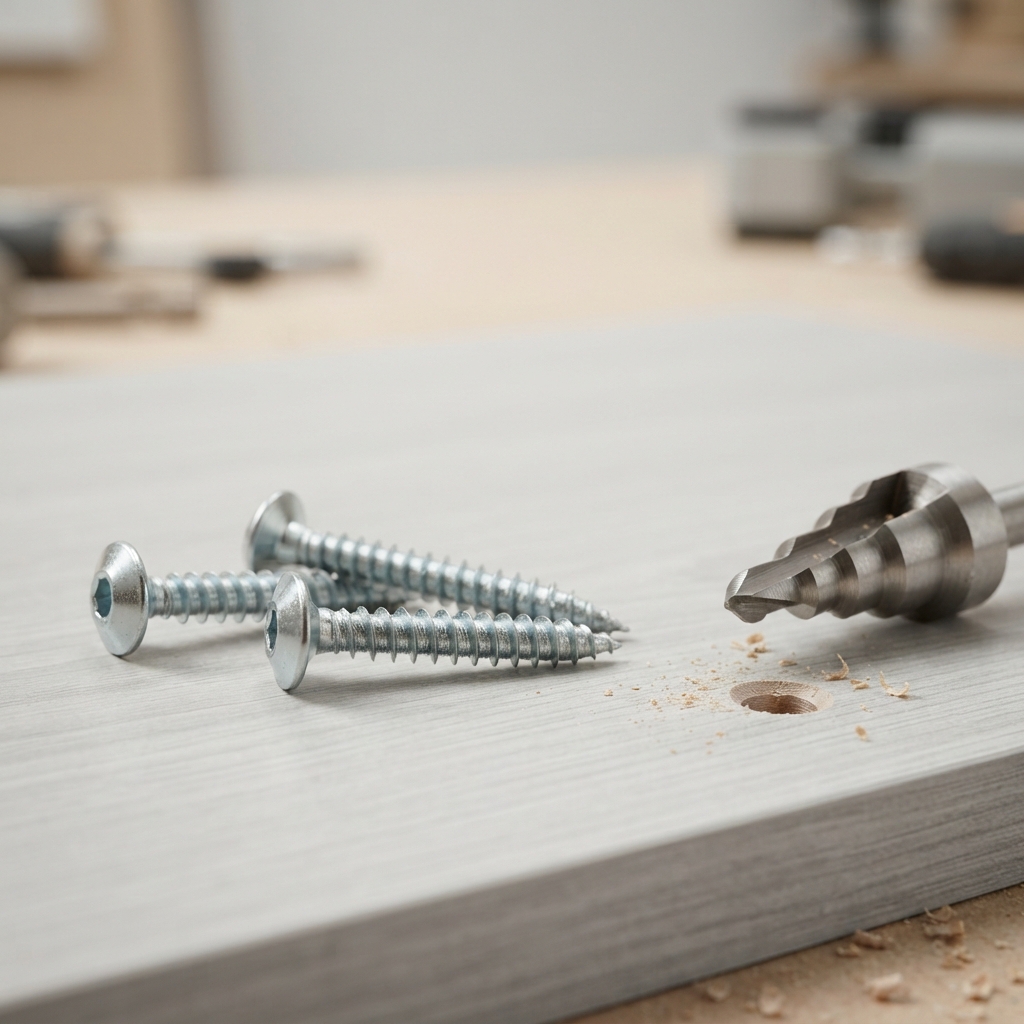
Our plant in Jiangmen, Guangdong produces screws, nuts and furniture hardware, and packs to a drawing, bill of materials or retail format. Two examples from the range show the level of detail a quotation should be built on: a cross-drive countersunk self-tapping screw shown in the listing as M3.5 × 25 mm with a coarse thread and sharp point, and a cross-drive pan-head machine screw shown as M4 × 35 mm, fully threaded with a blunt end. Sizes, finish and packaging are customised to the confirmed drawing or BOM, so the specification on the order governs, not the sample photo.
FAQ
Is a screw manufacturer or trading company always a red flag?
No. A trader that discloses the manufacturing site, allows audits and accepts written responsibility for quality can be a legitimate supplier, especially for mixed or small orders. The red flag is an undisclosed manufacturer, not the trading model itself.
How do I verify an ISO 9001 certificate in a few minutes?
Take the certificate number and issuing body, then check the scope wording and the certified site. Confirm the certificate through the issuing body or a public database such as IAF CertSearch. A certificate that cannot be found, or whose scope excludes fastener manufacturing, should not count in your evaluation.
Can a real factory outsource heat treatment and plating?
Yes, and many do. What matters is that the subcontractor is named, approved and reported per lot, and that hardness and coating thickness results come back with the shipment. Undisclosed outsourcing is the problem, not outsourcing itself.
What is the fastest single check?
Ask for a video of your part running on the heading machine with the die visible, then ask for the carton-to-heat-number trace on a previous order. Together they take minutes to request and are very hard to fake.
Should I pay for a third-party factory audit?
For a first order with custom tooling, a new category or a high claim exposure, yes. A short verification audit that confirms the legal entity, the production floor, the equipment list and the inspection records is usually enough. For repeat commodity orders, document checks and lot reports may be sufficient.
What if the supplier refuses a video call?
Score that check zero and ask for an alternative: a dated photo set of the machine with your part and the lot label, or a third-party inspection at the site. Consistent refusal across several checks is a stronger signal than any single answer.
Which documents should arrive with each lot?
At minimum: a packing list with lot and carton identification, an inspection report against the agreed characteristics, the material certificate where specified, and plating or hardness results where those properties are part of the requirement. The documents should reference the same lot number as the carton label.
Conclusion
The screw manufacturer or trading company question is answered by evidence, not by the word "factory" on a homepage. Check the licence scope, the certificate scope, the machine floor, the process route and the lot trail, score the answers, and write the manufacturer and the change rules into the order. A supplier that passes is worth keeping; one that cannot be checked is a risk you are choosing to carry.
If you want a quotation built on a real process route, send your drawing, material, finish, quantity and destination through our contact page, and we will confirm what we manufacture in-house and what needs to be quoted with a named partner.