
Choosing a furniture hardware screw and nut manufacturer is different from buying ordinary fasteners.
If you're sourcing cabinet hardware, it's not just about finding a manufacturer of screws and nuts. What you really need to choose is a partner who can ensure the predictability of modular furniture assembly: proper thread engagement, suitable connector fit, and enough stability so that assembly line workers don't have to "barely" complete the assembly with drills and bad tempers. This is crucial in kitchens, wardrobes, shelving systems, and retrofit kits, as loose joints or mismatched connectors quickly become glaring defects.
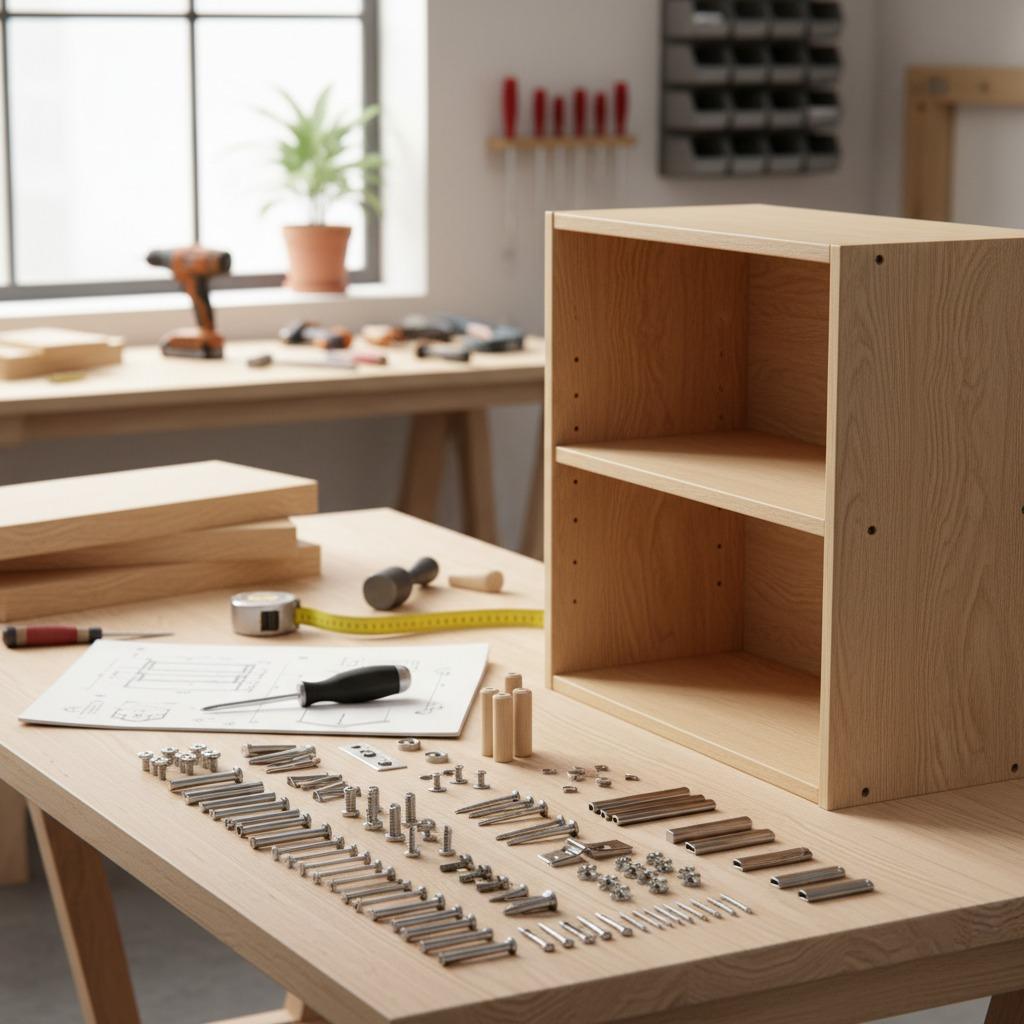
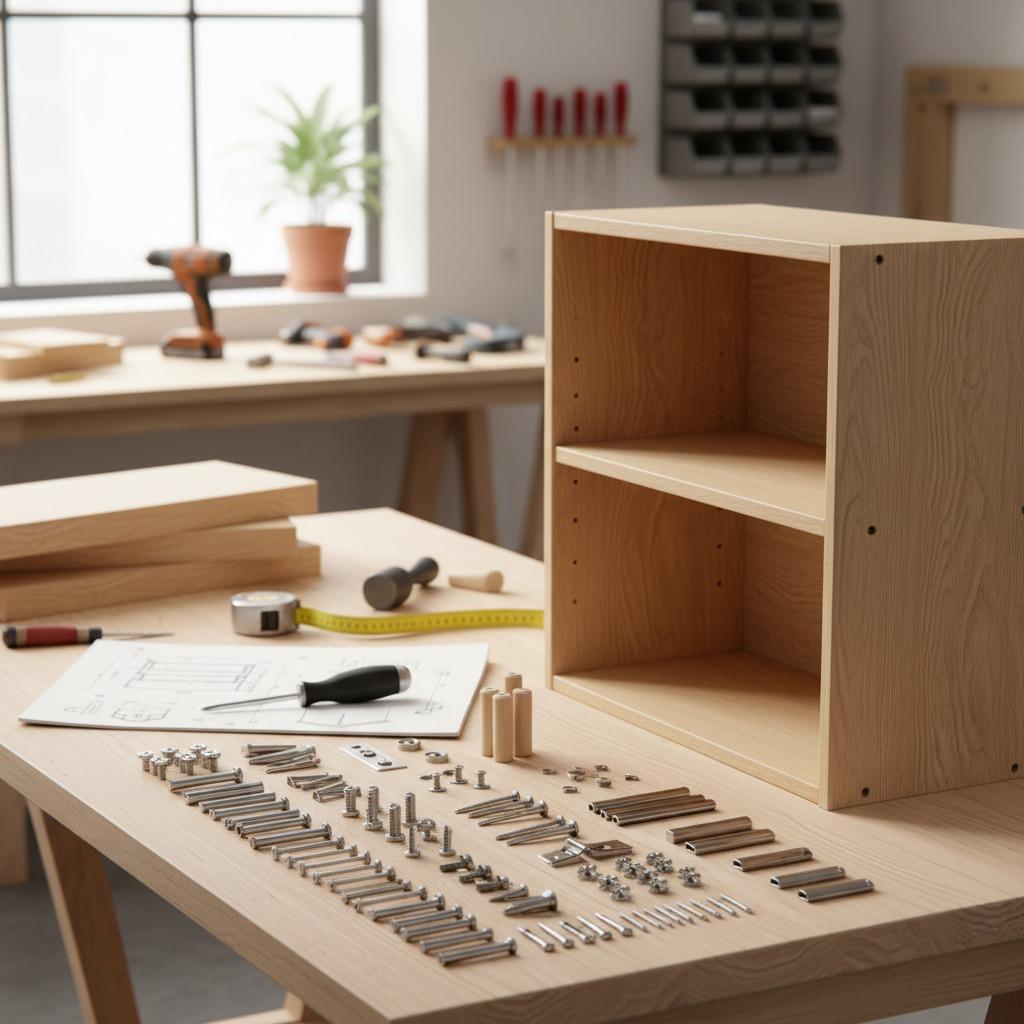
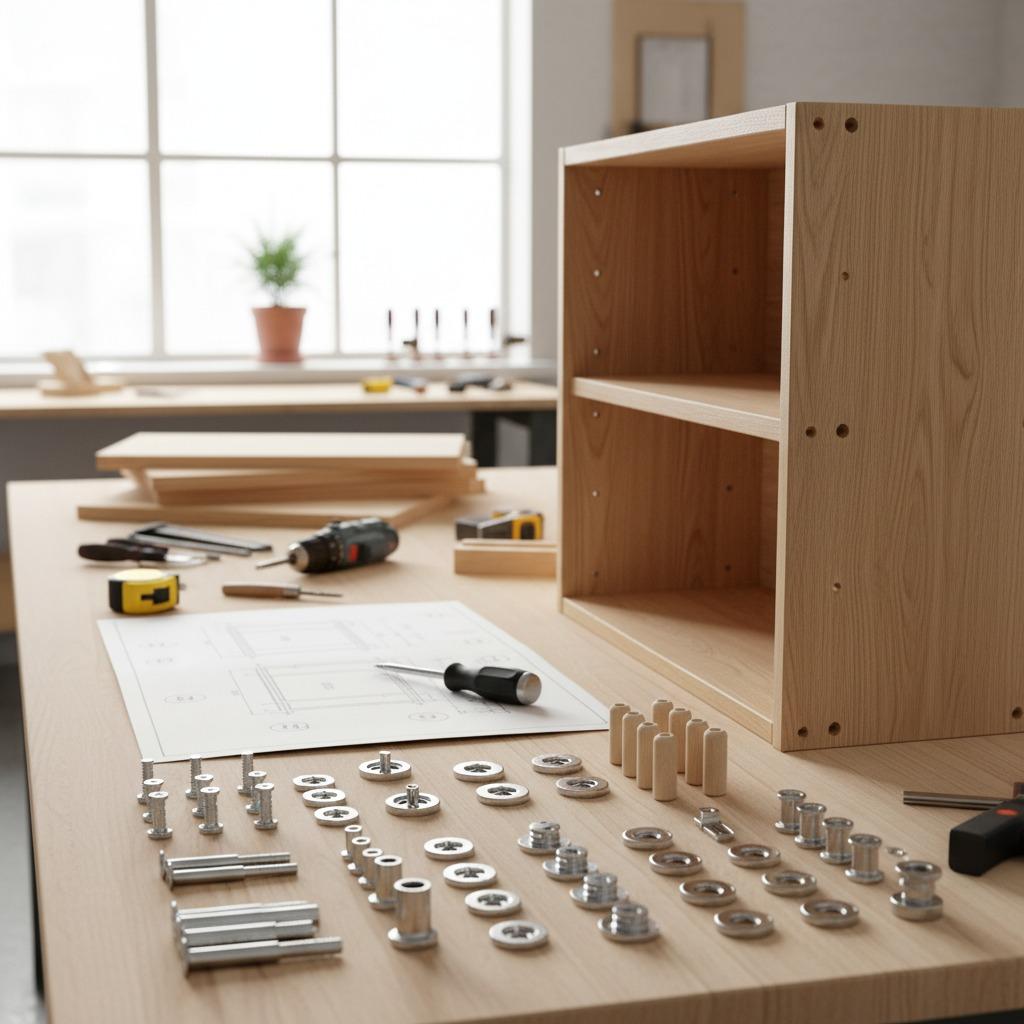
The hardware showcased here exemplifies this application. It includes screws, bolts, threaded inserts or pins, cam-lock connectors, and small fittings for modular furniture. The grid of holes for adjustable shelves on the adjacent cabinet frame serves as a reminder that the value of furniture hardware depends more on the repeatability of its assembly than on its appearance.
What aspects should furniture buyers compare first?
When comparing suppliers, it's helpful to break the discussion down into three levels: basic fastener production, furniture-specific hardware compatibility, and customization support. A fastener manufacturer may be strong in machine screws or self-tapping screws, but that doesn't necessarily mean they're best suited for cabinet connectors, shelf supports, or hybrid hardware kits.
For furniture and cabinets, the key question is whether the supplier understands the complete assembly process. Can the parts be installed quickly? Can the connectors fit perfectly? Can the screws be securely driven into the target board? These are practical questions, far more important than beautiful product catalog photos.
Fastener types and assembly operations
Machine screws, self-tapping screws, miniature screws, and precision screws each address different problems. Machine screws are typically used for precisely screwing into matching nuts or inserts. Self-tapping screws are more suitable for applications requiring high speed. Miniature and precision screws are suitable for compact fittings or small hardware components where high alignment accuracy is required. In cabinet manufacturing, the actual combinations used often include multiple types of screws, and even some connectors that are not strictly speaking "screws."
Therefore, if the buyer wants a complete solution that can be used directly in the cabinetry, the bolt and nut supplier may still need to demonstrate capabilities beyond simple standard parts. The best approach is usually to choose a supplier who can provide both standard parts and custom fasteners, rather than forcing the purchasing department to split the bill of materials among too many suppliers.
Why are stainless steel screws so common, but not always necessary?
Stainless steel screws are favored for their simpler appearance and superior corrosion resistance. In the furniture hardware industry, stainless steel screws are a wise choice for exposed fittings or in humid environments. However, stainless steel is not a panacea. Depending on the specific application, steel plating or other surface treatments may also be perfectly adequate, especially for cabinet interior components where cost, appearance, and availability need to be balanced.
A more appropriate question is whether the fastener is suitable for the actual application scenario, rather than whether it sounds high-end. A good industrial screw supplier should be able to explain the various advantages and disadvantages, rather than simply pushing a certain material for all projects.
What did Jiangmen Jinhe Hardware Co., Ltd. bring to this dialogue?
Jiangmen Jinhe Hardware Co., Ltd., established in 2016 and located in Jiangmen City, Guangdong Province, primarily manufactures machine screws, self-tapping screws, miniature screws, and precision screws. The company states that its products are made from materials such as stainless steel, iron, and aluminum, and comply with standards including GB, DIN, ANSI, BS, JIS, and ISO. This standardization is crucial for buyers, as it reduces friction during the procurement process, especially when parts are needed to fulfill large production projects rather than single orders.
The company serves multiple industries, including electronics, medical devices, automation, home appliances, building materials, and furniture. This broad scope indicates a commitment to rigorous parts control, rather than simple bulk packaging. Based on available information, the company conducts strict inspections before shipment, provides necessary documentation, and supports domestic and international logistics, warehousing, and supply chain services. For the procurement team, this support is just as important as the fasteners themselves.
Selection criteria that truly save production line time
Buyers often focus on the unit price too early. But in the furniture hardware industry, the real cost driver is rework. Even slightly off-specification connectors, screws with inconsistent drive quality, or poor thread sealing can delay assembly and increase scrap rates. This is especially true for flat-pack and modular cabinets, where repeated assembly across multiple units quickly reveals discrepancies.
Inquire with the supplier about their handling of repetitive issues, packaging, documentation, and non-standard customization. If the application involves adjustable shelves or detachable connectors, request samples that include actual sheet metal and the actual assembly sequence. This small step can uncover problems that cannot be found with drawings alone.
Common mistakes when purchasing furniture fasteners
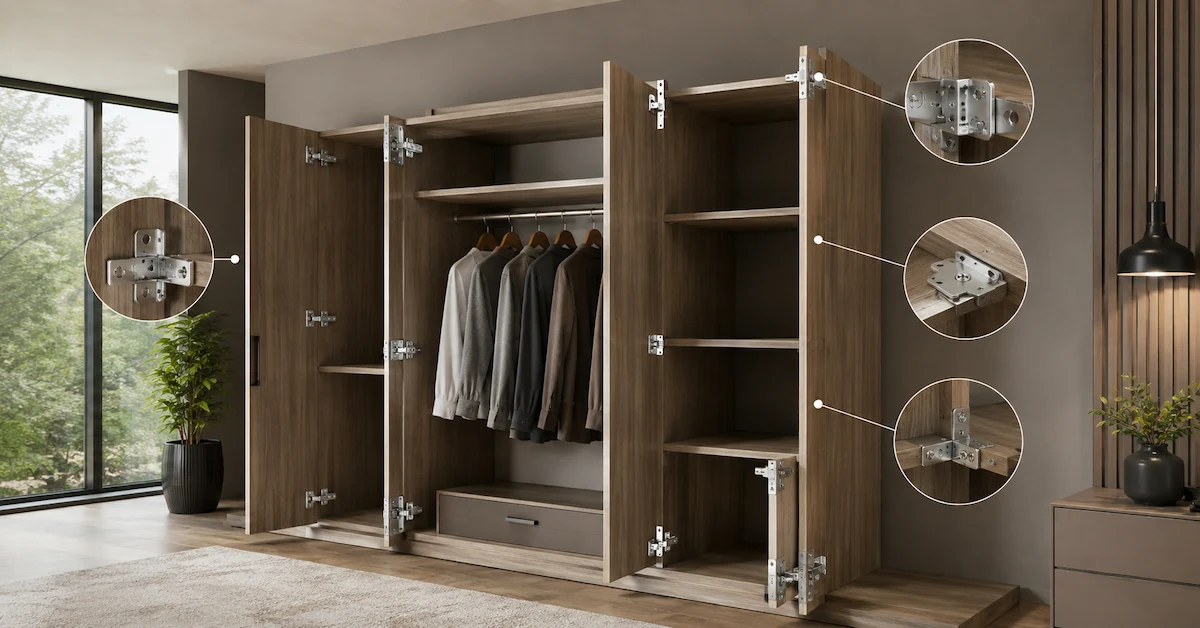
A common mistake is assuming all fasteners are interchangeable. This is not the case. Another mistake is buying based solely on the name: "nut manufacturer," "bolt and nut supplier," or "industrial screw supplier" are just search terms and do not indicate suitability. A third mistake is ignoring the hardware ecosystem. Cabinet connectors, shelf support holes, inserts, cams, and connectors all need to work together.
One more practical piece of advice worth emphasizing: if the supplier cannot discuss the installation sequence, sheet metal thickness limitations, or the limitations of the connector system, think twice before placing a large order. For furniture hardware, the assembly method is also part of the product itself.
Buyer questions worth asking before requesting a quote
Inquire whether the supplier can provide both standard parts and custom fasteners. Ask which materials are available for your application. Inquire about the pre-shipment inspection process. Ask if they support mixed hardware combinations for cabinet or shelving components, not just a single fastener series. If you require export support, confirm their foreign trade and logistics capabilities as early as possible before the technical solution is approved.
For teams building kitchen systems, wardrobes, or bookcase product lines, a good screw and nut manufacturer should not just be a product seller, but a process partner. This is precisely the difference between hardware procurement and building a stable assembly platform.
Next step
If you are comparing furniture hardware suppliers, it is recommended to first request sample kits and conduct actual assembly tests. Then examine the supplier's standards, documentation, and customization capabilities. Jiangmen Jinhe Hardware Co., Ltd. can provide you with standard fasteners, precision screws, and non-standard customized services for furniture and other industrial applications.