
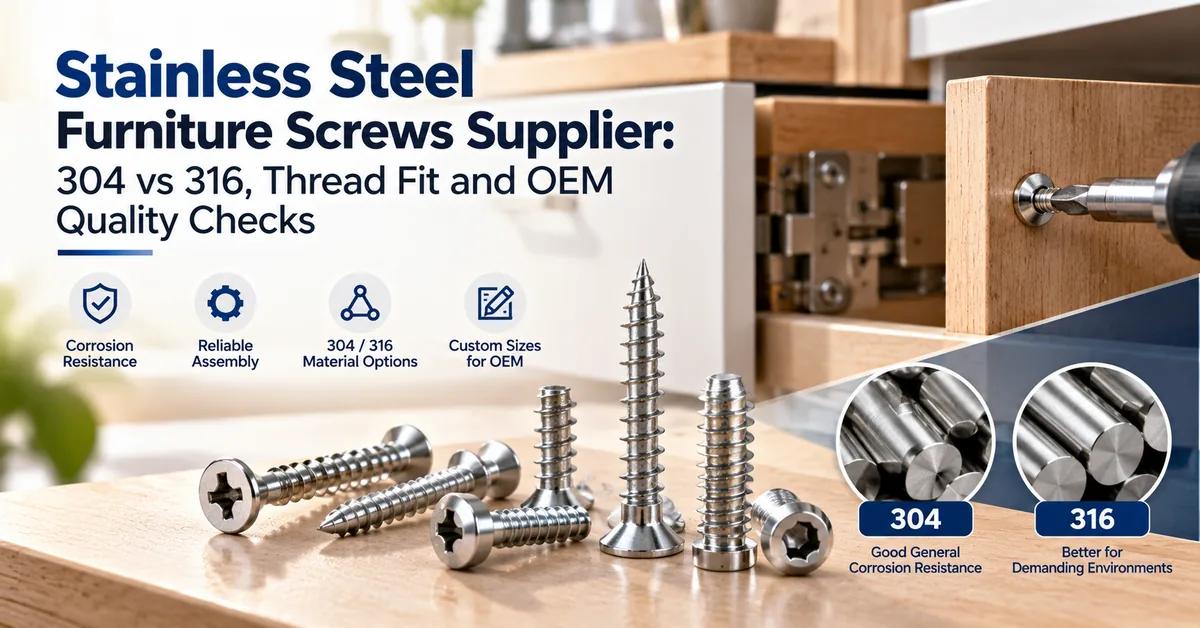
Choosing the right stainless steel furniture screws supplier is not simply about finding attractive screw prices or a product labeled "stainless steel." For furniture manufacturers, cabinet brands, and OEM purchasing teams, the correct fastener must match the furniture material, assembly process, operating environment, and quality expectations.
An unsuitable stainless steel screw can cause unexpected problems. A screw may resist corrosion but damage an MDF panel during installation. Another may have the correct diameter but an incompatible thread profile. In humid environments, selecting an inappropriate stainless grade can also lead to staining or localized corrosion.
The most effective sourcing approach is to specify the stainless steel grade, screw geometry, mating materials, assembly requirements, and inspection criteria before approving bulk production.
This guide explains how to compare 304 and 316 stainless steel furniture screws, select appropriate screw types, verify quality, control purchasing risks, and prepare a complete OEM request for quotation.
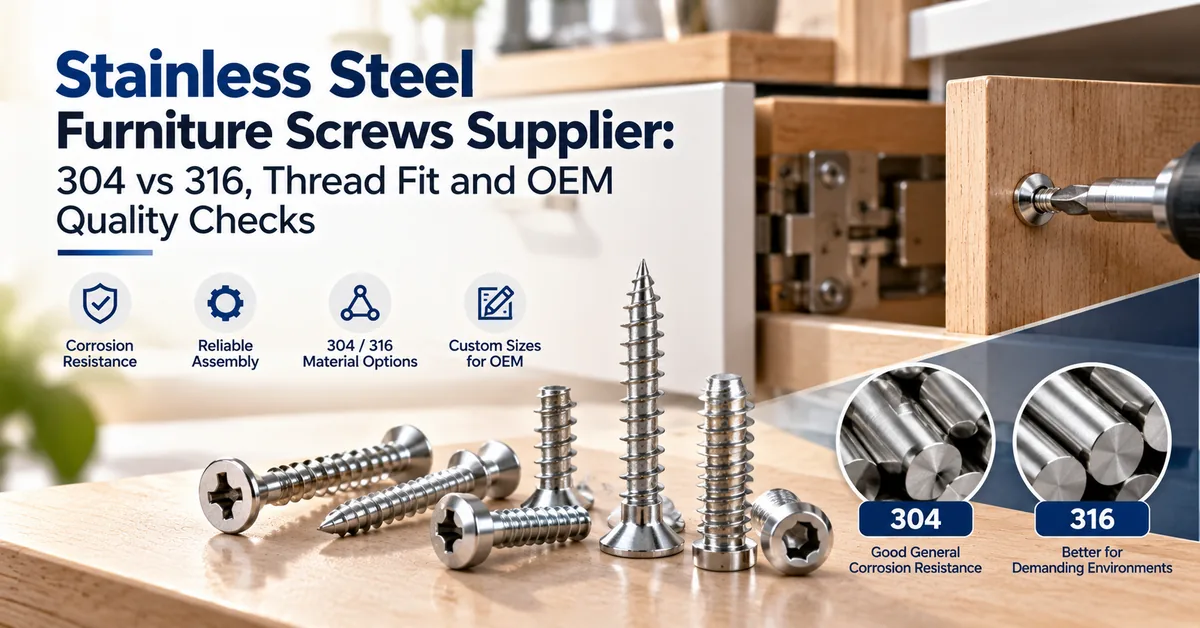
1. Why Choose Stainless Steel Screws for Furniture Manufacturing?
Stainless steel furniture screws are corrosion-resistant fasteners used to connect wooden panels, metal fittings, brackets, threaded inserts, and other furniture components.
Their corrosion resistance comes primarily from a chromium-rich passive film that forms on the steel surface. Unlike conventional zinc-plated carbon steel, stainless steel does not depend solely on a separate zinc coating for corrosion protection.
However, stainless steel is corrosion-resistant, not completely corrosion-proof.
Its performance depends on the selected alloy, manufacturing condition, surface condition, and exposure environment.
Main Advantages for Furniture Applications
Stainless steel screws may provide several benefits when properly specified:
-
Corrosion resistance: Suitable grades can offer protection against moisture and environmental exposure.
-
Clean appearance: Stainless finishes are useful for exposed fasteners in modern furniture.
-
Material consistency: Specifying an identified steel grade helps buyers control repeat purchasing.
-
Assembly flexibility: Different designs can support wood panels, metal fittings, and threaded furniture connectors.
-
Long-term maintenance considerations: Appropriate material selection may reduce corrosion-related replacement and maintenance requirements.
These benefits depend on product specifications and the complete assembled joint.
Which Furniture Manufacturers Need Stainless Steel Screws?
Typical buyers include kitchen cabinet manufacturers, bathroom furniture brands, outdoor furniture producers, commercial furniture contractors, and manufacturers of modular furniture that may experience moisture exposure.
However, stainless steel is not automatically necessary for every indoor furniture product.
For dry residential wardrobes or office cabinets, properly specified coated carbon steel screws may provide sufficient performance at a lower purchasing cost.
Buyers should therefore start with the application rather than assume that the more expensive material is always preferable.
For related fastener configurations, explore the JHFIX furniture and Chicago screw collection.
2. 304 vs 316 Stainless Steel Furniture Screws: Which Grade Should You Choose?
One of the most important decisions when sourcing stainless steel furniture screws is selecting the appropriate material grade.
The two commonly discussed grades are 304 and 316.
Both belong to the austenitic stainless steel family, but their corrosion behavior and alloy compositions differ.
304 Stainless Steel Furniture Screws
Grade 304 stainless steel is widely used in general manufacturing applications where corrosion resistance and practical material costs are important.
It is often considered for indoor furniture, selected kitchen cabinet installations, and other applications without severe chloride exposure.
Potential applications include:
-
Indoor cabinets and wardrobes.
-
Stainless steel furniture brackets and fittings.
-
Residential furniture assembly.
-
Selected moisture-exposed interior furniture.
The actual suitability depends on the local environment, cleaning conditions, and design requirements.
316 Stainless Steel Furniture Screws
Grade 316 contains molybdenum, which generally improves resistance to localized corrosion in chloride-containing environments compared with conventional 304.
This makes it a potential option for more demanding applications, such as coastal furniture installations or components exposed to certain cleaning and moisture conditions.
However, 316 stainless steel can still experience pitting, crevice corrosion, staining, or other degradation under unfavorable conditions.
It should never be described as completely rust-proof or automatically suitable for every marine application.
304 vs 316 Stainless Steel Comparison
|
Selection factor |
304 stainless steel |
316 stainless steel |
|---|---|---|
|
Common classification |
Austenitic stainless steel |
Molybdenum-bearing austenitic stainless steel |
|
Corrosion resistance |
Suitable for many ordinary environments |
Generally improved resistance in chloride-containing environments |
|
Indoor furniture |
Often a practical candidate |
May be unnecessary unless exposure justifies it |
|
Kitchen and bathroom furniture |
Depends on actual moisture and cleaning exposure |
Worth evaluating for more demanding conditions |
|
Coastal furniture applications |
Requires careful exposure assessment |
Often preferred, subject to engineering validation |
|
Material cost |
Generally lower |
Generally higher |
|
Mechanical performance |
Depends on product grade and property class |
Depends on product grade and property class |
|
Purchasing requirement |
Confirm specified grade and product properties |
Confirm specified grade and product properties |
What About A2 and A4 Stainless Steel?
In European fastener specifications, A2 and A4 are frequently associated with stainless steels comparable to the 304 and 316 families.
However, buyers should not assume they are exact interchangeable material designations in every specification.
For instance, a designation such as A2-70 identifies a stainless steel group and mechanical property class under the applicable standard. It is more informative than writing only "stainless steel."
Specify the required grade and mechanical property class separately when the application requires them.
For custom purchasing projects, the JHFIX specialty and custom screw range provides a starting point for discussing material and geometry requirements.
3. How to Match Stainless Steel Furniture Screws to Different Applications
A professional stainless steel furniture screws supplier should evaluate the entire connection instead of recommending products solely by material grade.
Different furniture structures require different screw geometries, mating components, and installation methods.
Common Furniture Screw Types
|
Screw type |
Main characteristics |
Typical furniture application |
Key selection factor |
|---|---|---|---|
|
Stainless steel wood screws |
Thread geometry intended for suitable wood materials |
Solid wood furniture and selected wooden panels |
Thread profile, pilot hole, length |
|
Stainless steel machine screws |
Designed to engage compatible internal threads |
Metal fittings and threaded inserts |
Diameter, pitch, engagement |
|
Stainless steel furniture connector screws |
May include special head or male-female connector designs |
Beds, cabinets, modular furniture |
Connector geometry and assembly fit |
|
Stainless steel countersunk screws |
Head designed to seat within an appropriate countersink |
Flush furniture fittings |
Head angle and countersink dimensions |
|
Stainless steel pan-head screws |
Raised head with a bearing surface |
Brackets and furniture accessories |
Head clearance and contact area |
|
Custom stainless steel screws |
Geometry specified by drawing or sample |
Specialized OEM furniture assemblies |
Feasibility, tolerances, validation |
These are general fastener categories rather than a promise that every size, grade, and configuration is available as an existing JHFIX stock item.
Solid Wood Furniture
Solid wood applications require attention to wood species, density, grain direction, screw dimensions, and edge distance.
Some stainless steel screws may require appropriate pilot holes and controlled driving torque to reduce installation damage.
MDF and Particleboard Furniture
Engineered wood panels behave differently from solid timber.
Screw performance can be affected by panel density, internal structure, screw thread geometry, hole position, and the number of assembly cycles.
A screw that works well in solid hardwood may not provide the same holding performance in particleboard.
Sample testing in the intended board material is important before approving bulk production.
Metal-to-Metal Furniture Connections
When screws engage threaded metal inserts, nuts, or metal fittings, thread compatibility becomes especially important.
Buyers should confirm the nominal thread diameter, pitch, engagement length, component material, and tightening procedure.
Stainless steel threaded connections may also require consideration of galling, particularly when mating stainless surfaces are assembled with high friction or unsuitable tightening conditions.
Explore JHFIX machine and socket screws for related fastening designs.
4. What Technical Specifications Should Buyers Confirm Before Ordering?
A reliable stainless steel furniture screws supplier should be able to discuss product specifications, materials, assembly requirements, and inspection criteria.
The following table provides a practical checklist for OEM furniture purchasing.
Stainless Steel Furniture Screw Specification Checklist
|
Technical item |
What buyers should specify |
Why it matters |
|---|---|---|
|
Stainless steel grade |
304, 316, or another approved grade |
Corrosion resistance and material identification |
|
Mechanical property class |
Applicable class and specification |
Mechanical suitability |
|
Nominal diameter |
Required screw diameter |
Hole and mating-component fit |
|
Screw length |
Overall length and measurement reference |
Prevents penetration or insufficient engagement |
|
Thread geometry |
Wood thread, machine thread, or custom design |
Installation and holding performance |
|
Thread pitch |
Applicable pitch or thread standard |
Compatibility with mating threads |
|
Head type |
Countersunk, pan, socket, or other |
Seating and tool access |
|
Drive type |
Cross recess, hex socket, or another design |
Driver compatibility |
|
Surface condition |
Required finish and appearance |
Visual quality and corrosion considerations |
|
Inspection requirements |
Dimensions, thread, material, functional tests |
Bulk production consistency |
There is no universal screw diameter, length, or tightening torque suitable for every furniture assembly.
The correct values must come from the furniture design, the material being joined, and the intended installation process.
Why Thread Design Matters as Much as Material Grade
Stainless steel corrosion resistance does not automatically guarantee reliable fastening.
A poorly matched thread can damage the surrounding material, require excessive installation force, or provide inadequate holding performance.
For wood-based furniture, buyers should evaluate pilot-hole requirements, thread geometry, installation depth, and the risk of splitting or stripping.
For machine-threaded connections, the correct pitch and mating-thread specification are essential.
5. How Should Stainless Steel Furniture Screws Be Quality Tested?
Furniture manufacturers sourcing bulk screws need confidence that approved sample performance can be reproduced in production.
An effective quality-control plan should address both individual fasteners and their installed performance.
Material Verification
The supplier should confirm the stainless steel grade required by the purchasing specification.
Depending on the contract, verification may involve material certificates, traceable production records, or appropriate material identification tests.
Buyers should not rely solely on surface appearance or a magnet test to identify stainless steel grades.
Dimensional and Thread Inspection
Critical dimensions include screw length, diameter, thread profile, head geometry, and drive dimensions.
Thread gauges and suitable measuring instruments can be used according to the product specification.
For screws intended to mate with insert nuts or threaded connectors, functional checks using actual mating components may also be required.
Mechanical and Installation Testing
Useful application-specific checks may include:
-
Installation torque and driving behavior.
-
Screw-head and drive recess integrity.
-
Thread engagement with mating components.
-
Pull-out or withdrawal resistance in the specified panel.
-
Failure behavior under the intended loading conditions.
The acceptance criteria must reflect the furniture design rather than an assumed universal strength requirement.
Corrosion Assessment
If an OEM furniture project requires corrosion testing, the test method, environmental exposure, duration, and acceptance limits should be agreed before production.
Testing should consider factors such as moisture, chloride exposure, surface cleanliness, and assembly geometry.
Stainless steel corrosion resistance is not defined by a single salt spray duration.
Relevant International Standards
Two useful references for stainless steel fastener discussions are:
ISO 3506-1:2020 — Specifies mechanical and physical properties for covered corrosion-resistant stainless steel bolts, screws, and studs with defined grades and property classes.
ISO 3506-4:2025 — Addresses specified grades and hardness classes of corrosion-resistant stainless steel tapping screws within its defined scope.
Not every furniture wood screw or customized fastener automatically falls within these standards. Buyers should verify applicability based on the actual thread and product design.
Referencing a standard also does not mean that a specific supplier's product has been independently certified to it.
6. Common Problems When Sourcing Stainless Steel Furniture Screws
Even when a supplier offers the required material grade, problems can occur during bulk purchasing and assembly.
Problem 1: Selecting the Wrong Stainless Steel Grade
Using a grade without considering the actual environment may lead to unexpected corrosion or unnecessary purchasing costs.
Solution: Define the operating environment, moisture exposure, cleaning conditions, and appropriate material grade before requesting quotations.
Problem 2: Screws Strip the Furniture Panel
Incorrect thread geometry, pilot-hole dimensions, or installation torque may damage MDF, particleboard, or wood.
Solution: Test representative screws in the actual panel material and establish suitable installation parameters.
Problem 3: Stainless Screws Bind During Tightening
Certain stainless steel threaded connections may experience galling, particularly when friction and assembly conditions are unfavorable.
Solution: Verify the mating materials, thread condition, tightening method, and any approved anti-galling measures.
Problem 4: Product Quality Changes Between Batches
Different material specifications, manufacturing revisions, or inadequate inspection control can cause inconsistencies.
Solution: Maintain approved drawings, clear material requirements, controlled revisions, and defined inspection records.
Problem 5: Incorrect Screws Are Packed in Furniture Kits
Mixed screw lengths, similar-looking head types, or incorrect quantities can cause furniture assembly complaints.
Solution: Use clear part identification, a controlled bill of materials, appropriate packaging, and final quantity verification.
For complete furniture hardware programs, buyers can explore JHFIX custom screw bag packaging.
7. How to Evaluate a Stainless Steel Furniture Screws Supplier
Selecting a supplier should involve more than comparing unit prices and product photographs.
A useful B2B supplier evaluation should cover the following areas.
|
Supplier evaluation |
Questions procurement teams should ask |
|---|---|
|
Product availability |
Can the required screw type and dimensions be supplied? |
|
Stainless steel grades |
Can the specified material and property requirements be confirmed? |
|
Technical support |
Can drawings, samples, and assembly requirements be reviewed? |
|
Manufacturing capability |
Which production processes are performed or coordinated? |
|
Inspection |
What inspection and testing activities can be documented? |
|
Customization |
Can nonstandard heads, threads, and lengths be evaluated? |
|
Samples |
Can representative samples be approved before production? |
|
Packaging |
Are bulk, counted, and customized packaging options available? |
|
Order terms |
Are MOQ, lead time, payment, and shipping responsibilities clear? |
|
Repeat orders |
How are specifications, revisions, and quality issues controlled? |
Why Supplier Experience Matters
Furniture screws are small components, but they interact directly with larger furniture structures.
A supplier familiar with furniture hardware can help buyers evaluate connecting screws alongside threaded inserts, nuts, brackets, and other assembly components.
This can be particularly valuable for furniture brands purchasing multiple hardware types for one product.
Nevertheless, buyers should verify the supplier's actual capability for the specific screw grade and configuration under consideration.
8. OEM Stainless Steel Furniture Screws: From Drawings to Bulk Production
Custom furniture projects may require screw dimensions or designs that differ from standard catalog products.
A structured OEM process helps reduce misunderstandings.
Step 1: Submit drawings or samples. Provide the screw specification, intended furniture material, mating components, environmental requirements, and target order quantity.
Step 2: Confirm technical feasibility. Review material grade, geometry, production process, installation method, and critical tolerances.
Step 3: Discuss quotation details. Confirm unit pricing, tooling requirements where applicable, sample scope, MOQ, lead time, and packaging.
Step 4: Approve representative samples. Verify dimensions, material requirements, installation performance, and furniture assembly compatibility.
Step 5: Establish production specifications. Record approved drawings, revisions, inspection requirements, and packaging instructions.
Step 6: Verify production and shipment. Inspect against agreed acceptance criteria before arranging delivery.
For custom projects, buyers should clarify whether a material grade, finishing process, or testing activity is available before committing to a production order.
9. Why Consider JHFIX for Furniture Screw Sourcing?
JHFIX provides fasteners, furniture connecting hardware, custom screw solutions, and packaging services for international B2B customers.
Its manufacturing business, Jiangmen Jinhe Hardware Products Co., Ltd., describes capabilities including cold heading, tapping, stamping, assembly, packaging, and quality-control processes.
JHFIX also works with Jiangmen Shenxin Trading Co., Ltd., its authorized international sales and export partner.
For furniture manufacturers and OEM buyers, relevant purchasing discussions may include:
-
Furniture screw geometry and material specifications.
-
Matching screws with furniture connectors and insert nuts.
-
Customized screw designs and sample development.
-
Multi-component hardware sourcing.
-
Customized packaging and assembly kits.
-
Production specifications and inspection requirements.
Buyers can review JHFIX manufacturing and company information and the furniture hardware product range.
Specific stainless steel grades, product availability, testing, production quantities, and delivery arrangements require confirmation for each project.
10. What Determines Stainless Steel Furniture Screw Pricing?
When comparing suppliers, buyers should consider total procurement costs rather than unit prices alone.
Important cost factors include material grade, screw dimensions, thread geometry, manufacturing complexity, order volume, inspection requirements, packaging, and freight.
The required corrosion resistance should be justified by the application. Specifying 316 stainless steel for a dry indoor product without a clear need may increase material costs unnecessarily.
On the other hand, selecting a less suitable grade for a demanding environment may create replacement costs or customer complaints.
Custom head designs, special threads, and tighter tolerances may also affect manufacturing and tooling requirements.
For repeat orders, consistent product specifications and appropriate quality control can be as important as the initial quotation.
11. RFQ Checklist for Bulk Stainless Steel Furniture Screws
Before requesting a quote, prepare the following information.
|
RFQ field |
Required information |
|---|---|
|
Product application |
Cabinet, wardrobe, bed, table, or other furniture |
|
Screw type |
Wood screw, machine screw, connector screw, or custom design |
|
Material |
Required stainless steel grade and property specification |
|
Technical drawing |
Dimensions, thread, head, drive, tolerances, and revision |
|
Furniture material |
Solid wood, MDF, particleboard, plywood, metal, or mixed materials |
|
Service environment |
Indoor, humid, outdoor, coastal, or other conditions |
|
Functional requirements |
Mating components, installation method, required tests |
|
Quantity |
Initial order and expected repeat demand |
|
Packaging |
Bulk, counted bags, kits, or private-label packaging |
|
Delivery requirements |
Destination and preferred delivery schedule |
A complete RFQ allows a potential stainless steel furniture screws supplier to evaluate the actual project requirements and prepare a more meaningful quotation.
Need stainless steel furniture screws for an OEM project?
Contact JHFIX to discuss your drawings, material requirements, samples, and bulk purchasing needs.
12. Frequently Asked Questions
1. What does a stainless steel furniture screws supplier provide?
A supplier may offer wood screws, machine screws, furniture connector screws, and custom fasteners in suitable stainless steel grades. Depending on its capabilities, services may also include technical review, samples, manufacturing coordination, inspection, and packaging.
2. Is 304 stainless steel suitable for kitchen cabinets?
304 may be appropriate for many kitchen cabinet applications, but suitability depends on moisture, cleaning chemicals, chloride exposure, and the location of the screw. The actual environment should be assessed before approving the material.
3. When should I choose 316 stainless steel furniture screws?
316 is worth evaluating where additional resistance to chloride-related corrosion is needed, including certain coastal or demanding moisture-exposed applications. It is not automatically necessary for all indoor furniture.
4. Are A2 and 304 stainless steel screws the same?
A2 is a stainless fastener grade-group designation, while 304 identifies a stainless steel alloy grade. They are commonly associated but should not be assumed to be exactly interchangeable without checking the applicable specification.
5. Can stainless steel screws be used in MDF or particleboard?
Yes, when the screw design and installation conditions are appropriate. The supplier and furniture manufacturer should consider thread geometry, hole dimensions, panel characteristics, and holding-performance requirements.
6. Are stainless steel screws stronger than carbon steel screws?
Not necessarily. Mechanical performance depends on the specific material grade, processing condition, geometry, and property class. Stainless steel should not be selected solely on the assumption that it is mechanically stronger.
7. How can buyers verify stainless steel screw quality?
Buyers can request material documentation, dimensional inspection, thread verification, and agreed functional test results. Additional corrosion or mechanical testing should be based on the intended application and purchasing specification.
8. Can JHFIX manufacture custom stainless steel furniture screws?
JHFIX provides custom screw and OEM/ODM development services. Buyers can submit drawings or samples for technical review. Availability of particular stainless grades, dimensions, tooling, and testing should be confirmed for each project.
9. What affects MOQ and lead time for custom furniture screws?
MOQ and lead time depend on the screw design, material availability, manufacturing process, tooling, finishing, inspection, and order quantity. Buyers should request a project-specific quotation rather than assume a universal minimum order or delivery schedule.
10. What should I provide when requesting a stainless steel furniture screw quotation?
Provide the screw drawing or sample, required material grade, furniture application, panel material, thread specifications, expected order quantity, inspection requirements, packaging instructions, and delivery destination.
Conclusion
Choosing the right stainless steel furniture screws supplier requires a careful balance of corrosion resistance, material specifications, fastening performance, manufacturing consistency, and purchasing cost.
For furniture manufacturers and OEM brands, the most important step is matching the screw to the real application. Grade 304 may suit many general-purpose environments, while 316 can offer advantages where more demanding corrosion conditions justify its selection. Neither grade can compensate for incorrect thread geometry, unsuitable installation conditions, or inconsistent quality control.
A dependable sourcing process combines clear technical drawings, representative sample testing, agreed inspection criteria, and controlled repeat production.
JHFIX supports international buyers with furniture screws, fastening components, customized hardware solutions, and packaging services for suitable OEM projects.
Contact JHFIX to discuss your stainless steel furniture screw specifications, material requirements, custom designs, and bulk quotation.