
What buyers really mean when they search for a supplier export to Europe
When sourcing teams look for a supplier export to Europe, they are usually not asking for a glossy catalog. They want to know whether a factory can ship consistently, document products properly, and survive the practical friction of cross-border trade: paperwork, packing, communication, and repeatability. That is especially true in fasteners, where a screw that looks ordinary on a booth tray can still become a problem if the dimensions, finish, or paperwork do not match the buyer’s channel requirements.
For distributors, furniture makers, and OEM buyers, the question is less about whether the part exists and more about whether the supplier can support European buying patterns. Can they handle mixed product ranges? Can they supply standard items and non-standard customization? Do they understand that an export customer may need traceable documentation, stable packaging, and clear response times, not just a low unit price? Those details decide whether a transaction becomes a long-term supply line.
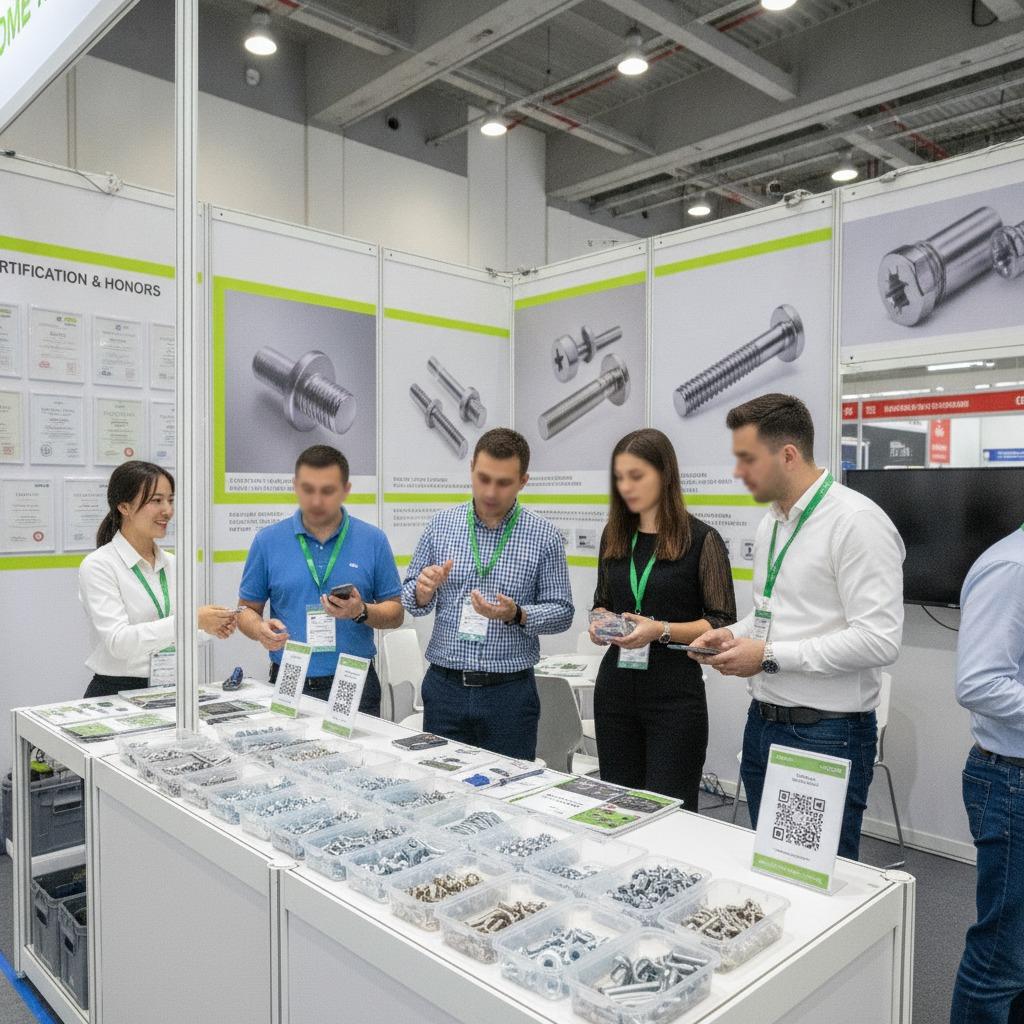
A quick read on the product side: screws, fasteners, and mixed hardware ranges
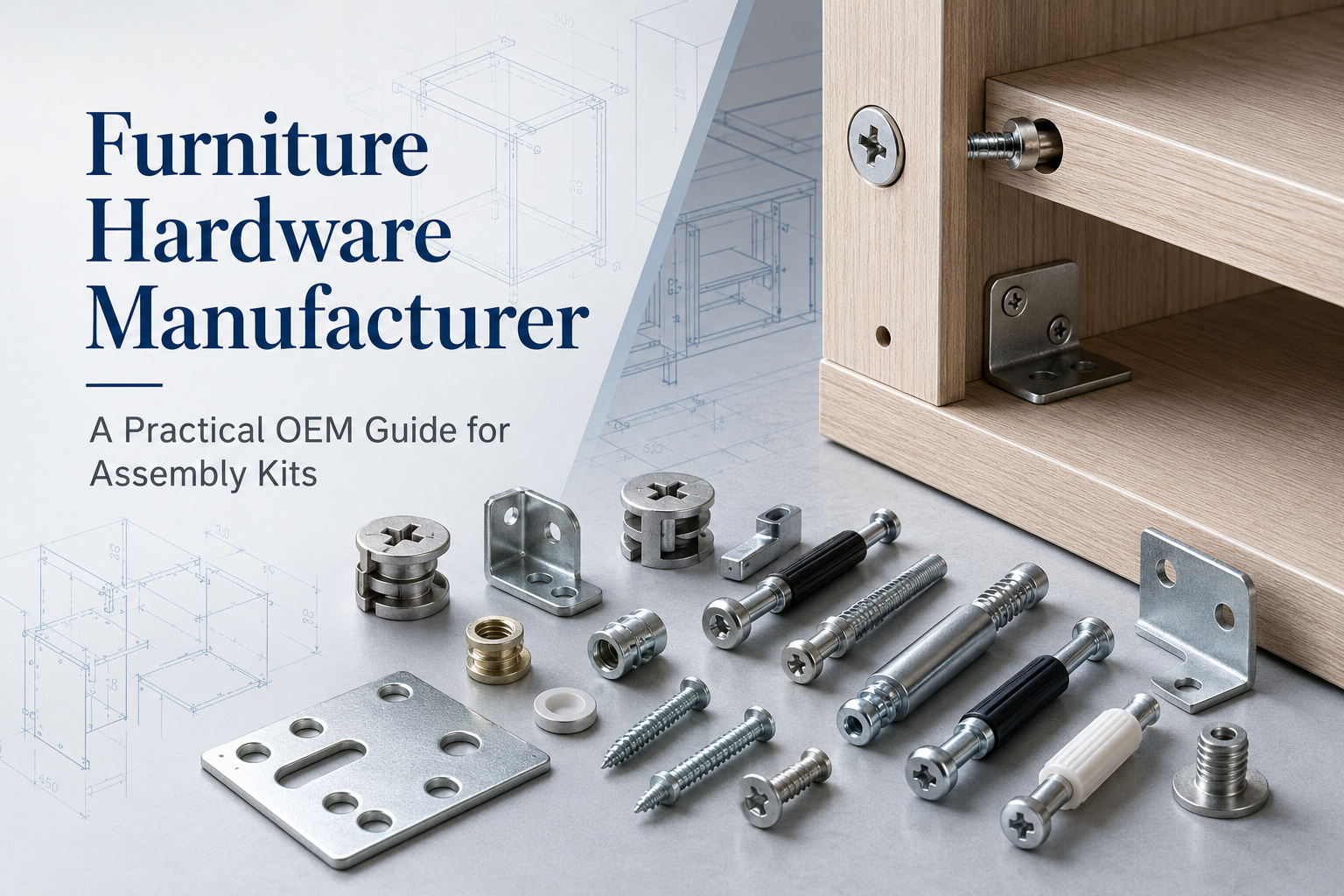
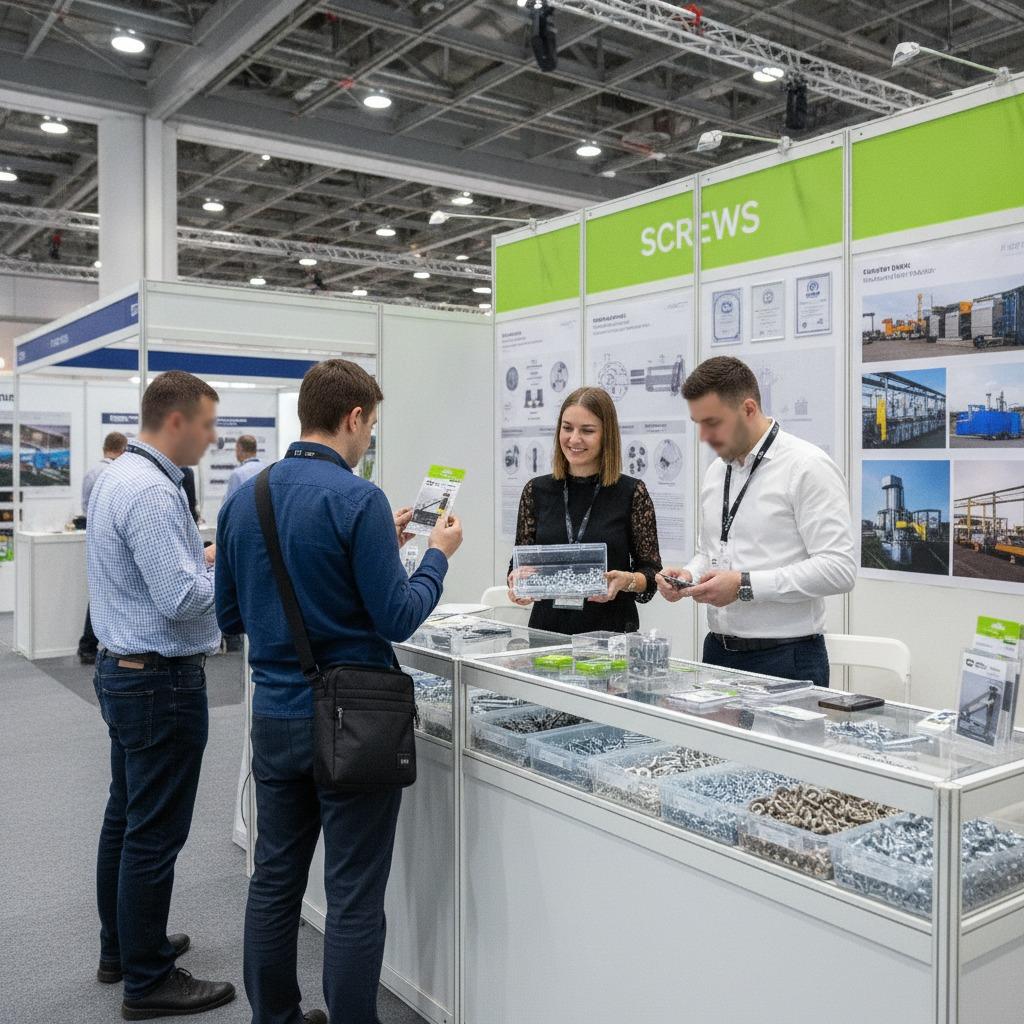
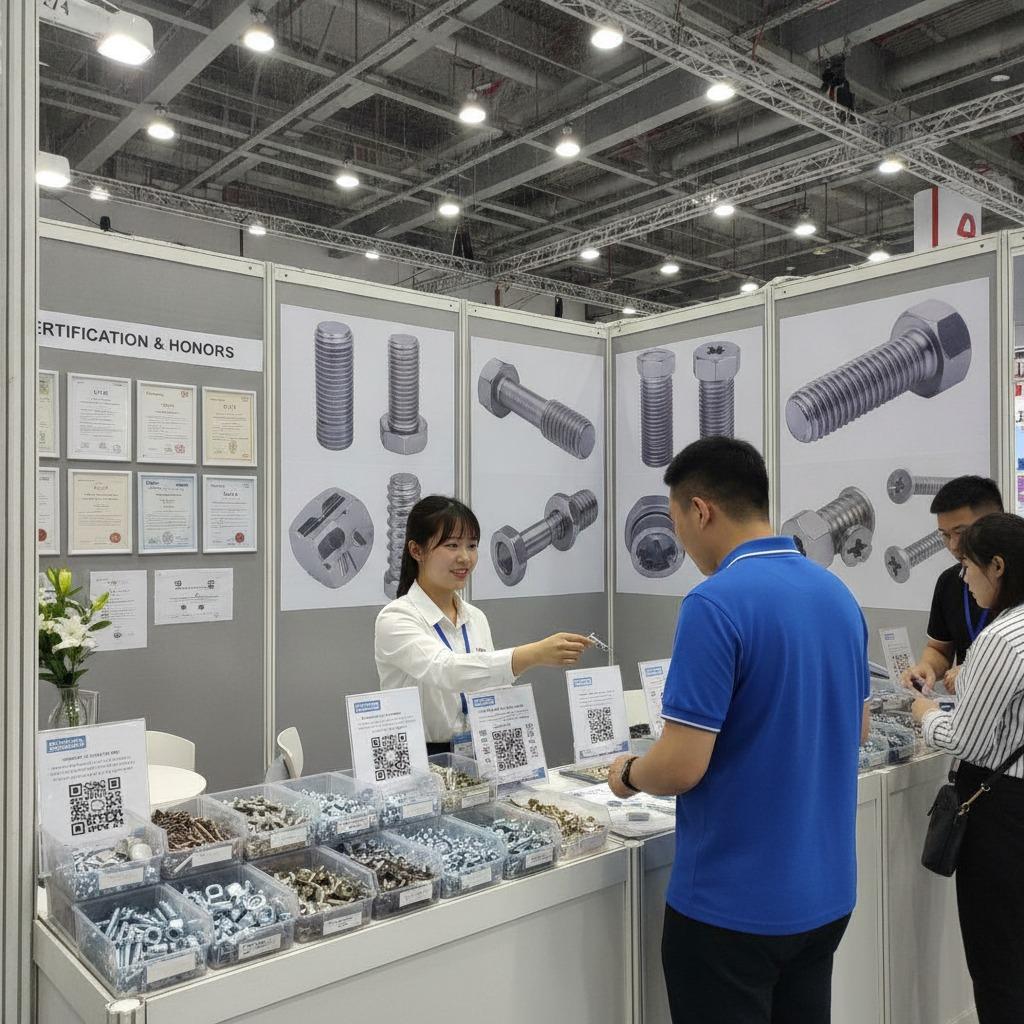
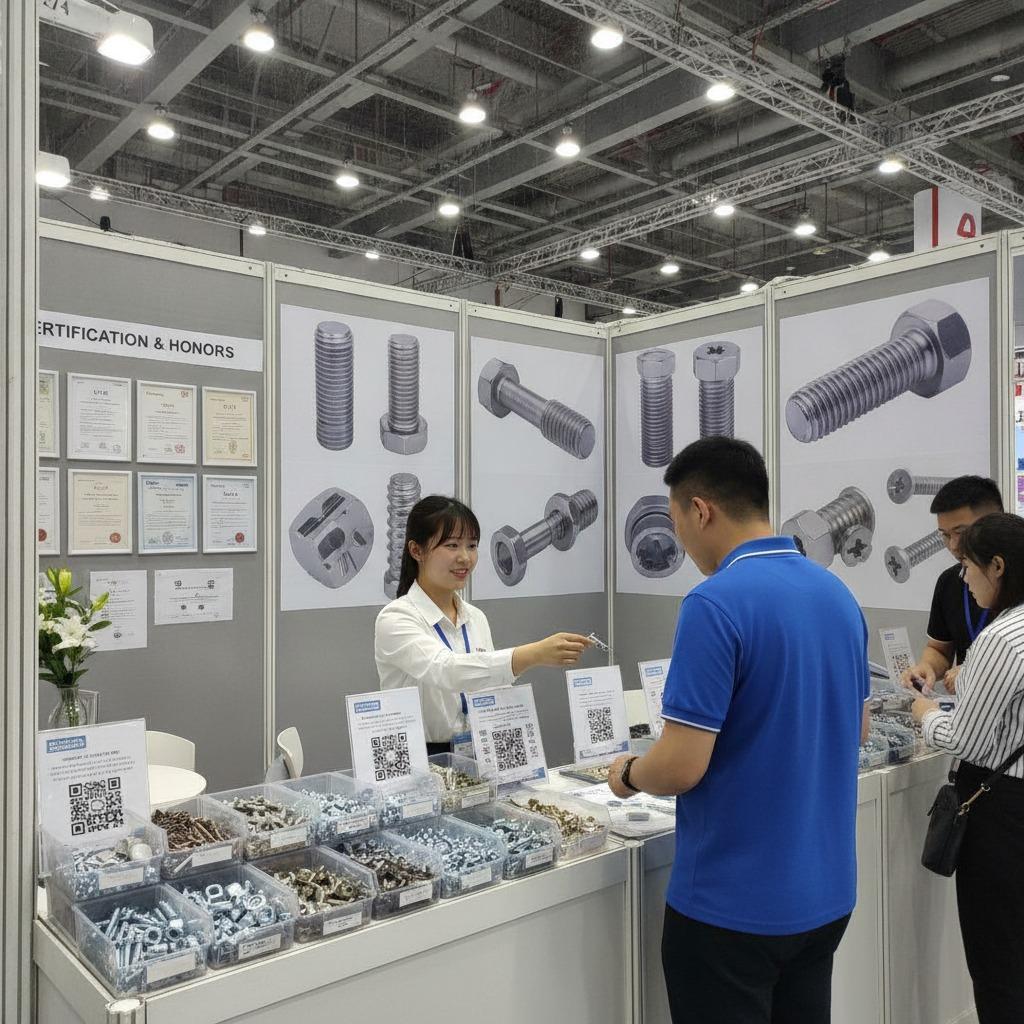
The booth materials from Jiangmen Jinhe Hardware Co., Ltd. show a practical fastener portfolio rather than a single specialty item. Visible products include screws and a broader assortment of metal fasteners and hardware components: bolts, washers, threaded inserts, anchors, and related fixing accessories. The display also suggests a mix of standard and sample-board presentation, which is useful for buyers comparing small differences in head style, finish, and use case.
That matters because export buyers often source in families, not in isolated SKUs. A Europe shipping supplier that can group related items by application is usually easier to work with than a vendor that only handles one narrow part type. In assembly supply, a single project may need a machine screw, a washer, an insert, and a packaging format that fits local distribution. The more organized the range, the easier the purchasing conversation.
What Jiangmen Jinhe Hardware says it offers
According to the company information provided, Jiangmen Jinhe Hardware Co., Ltd. was founded in 2016 in Jiangmen City, Guangdong Province. The company states that it covers 4,000 square meters and focuses on machine screws, self-tapping screws, micro screws, and precision screws made from stainless steel, iron, and aluminum. It also says it works to GB, DIN, ANSI, BS, JIS, and ISO standards, and serves sectors such as electronics, medical devices, automation, home appliances, furniture, and building materials.
For a buyer evaluating an international supplier Europe, those claims are relevant because they point to both product breadth and export familiarity. The company also says it provides foreign trade services, import and export qualifications, logistics support, warehousing, and supply chain services. Just as important, it states that it inspects products before delivery and provides documentation. Buyers should still verify exact specifications, but the service frame is the kind export customers usually want to hear.
Why documentation matters more than many first-time buyers expect
In Europe, the product may be simple, but the supply chain is not. A fastener order can be delayed by vague labeling, mixed lots, incomplete paperwork, or a mismatch between catalog description and packed goods. That is why an export supplier with organized sample bins, QR-code information cards, and an apparent compliance wall can be worth more than a slightly cheaper quote. None of that replaces product verification, of course, but it does suggest the supplier is used to being audited by customers.
Selection criteria that matter for export buyers
If you are comparing suppliers, start with the basics and do not let the conversation drift too quickly into price. The right European export supplier should be able to answer practical questions about material options, finish types, packaging, and the ability to keep repeat orders consistent. For screws in particular, ask how they manage production variation across standard and precision parts, and whether they can support mixed-size orders without confusing labels or commingled bins.
It also helps to separate what is confirmed from what is assumed. The product display suggests cold heading, threading, and surface finishing are likely involved, but buyers should not treat that as a specification sheet. Ask for the actual process route for each item, especially if the application is sensitive to corrosion, load, or appearance. A bright zinc finish may be fine in one use case and wrong in another.
Common mistakes when sourcing from an international supplier Europe
One common mistake is treating fasteners as interchangeable commodities. In practice, the same general screw category can still vary in head geometry, drive type, coating, and substrate compatibility. Another mistake is assuming export ability means every product is already optimized for a European channel. Sometimes it is not. A supplier may have the production capacity, but not the labeling discipline or carton logic that downstream distributors expect.
Buyers also overfocus on samples. Samples are useful, but they are not a substitute for batch consistency. A tray full of tidy fasteners at a booth is a good sign, not a guarantee. Ask how the company handles inspection, documentation, and issue response. Jinhe states that it responds to customer issues within 30 to 60 minutes and provides solutions within 2 hours; that is the kind of service promise worth testing in real communication, not just reading on a profile page.
Practical advice for sourcing teams
For sourcing managers, the best next step is to request a product list with exact dimensions, grades, coatings, and packing details. If you need custom parts, ask whether the supplier supports non-standard customization and what information they need to quote accurately. For distributors, ask for carton counts, sample availability, and whether mixed-SKU export packing is possible. For engineers, request drawings or technical sheets rather than relying on a booth sample.
If the supplier is truly export-ready, they should be comfortable discussing standards, documentation, logistics, and after-sales communication without overpromising. The strongest vendors in this category are usually not the loudest. They are the ones that answer clearly, send documents promptly, and keep the product range organized enough that your team can reorder without chasing three departments.
FAQ: short answers buyers usually need
Can a fastener supplier handle Europe-bound orders?
Often yes, if they have export qualification, documentation discipline, and stable packaging. Confirm the details before you commit.
Are booth samples enough to approve a supplier?
No. Samples help narrow the field, but buyers still need exact specifications, inspection terms, and packing confirmation.
What makes a supplier easier to work with across borders?
Clear communication, organized product grouping, basic logistics support, and consistent documentation usually matter more than a polished sales pitch.
A sensible next step
If you are evaluating Jiangmen Jinhe Hardware Co., Ltd. or a similar supplier export to Europe, start with one focused inquiry: ask for the exact screw or fastener specification you need, the available finish options, packaging format, and the documentation that will travel with the shipment. That simple request reveals far more than a brochure ever will.