
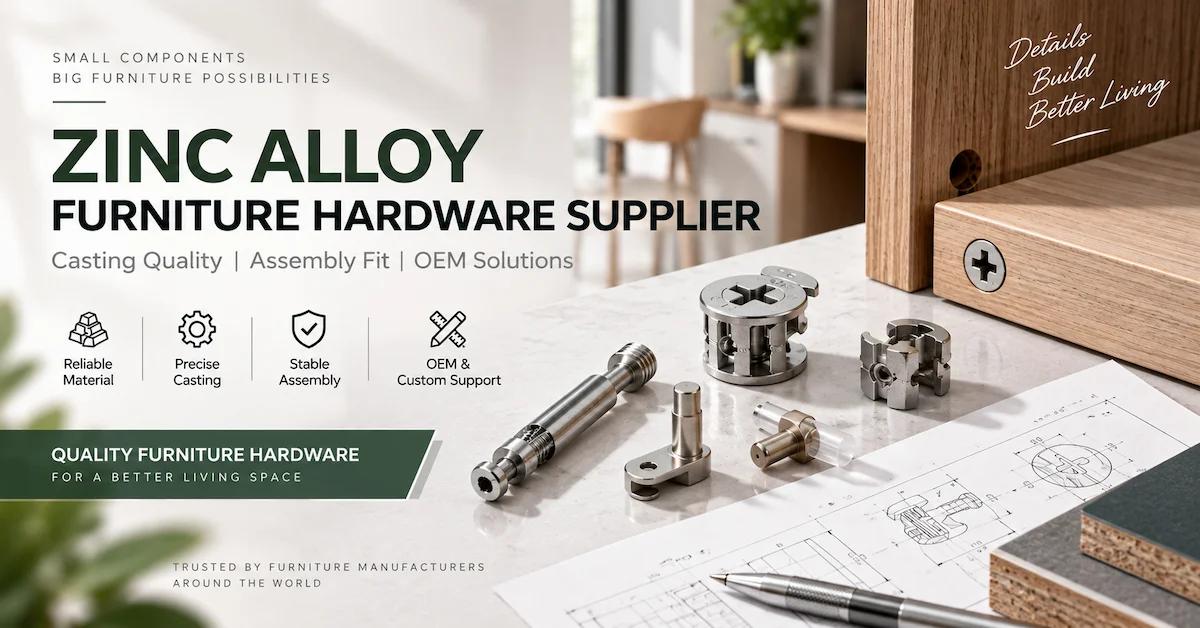
Choosing a reliable zinc alloy furniture hardware supplier is an important decision for furniture manufacturers, cabinet factories, ready-to-assemble (RTA) furniture brands, and international hardware distributors. Although zinc alloy components are often small, their material quality, dimensional accuracy, and assembly compatibility can directly affect finished furniture production.
A poorly matched cam lock may prevent a connecting bolt from engaging correctly. A shelf support with inconsistent dimensions may not fit its prepared cabinet hole. Casting defects or unsuitable surface finishes can create additional quality problems during assembly and use.
For OEM buyers, the best sourcing strategy is to evaluate materials, manufacturing quality, mating components, and inspection requirements before approving bulk orders.
This guide explains how to select zinc alloy furniture fittings, compare alloy grades, identify casting defects, establish quality-control requirements, and evaluate suppliers for customized furniture manufacturing projects.
1. What Is Zinc Alloy Furniture Hardware?
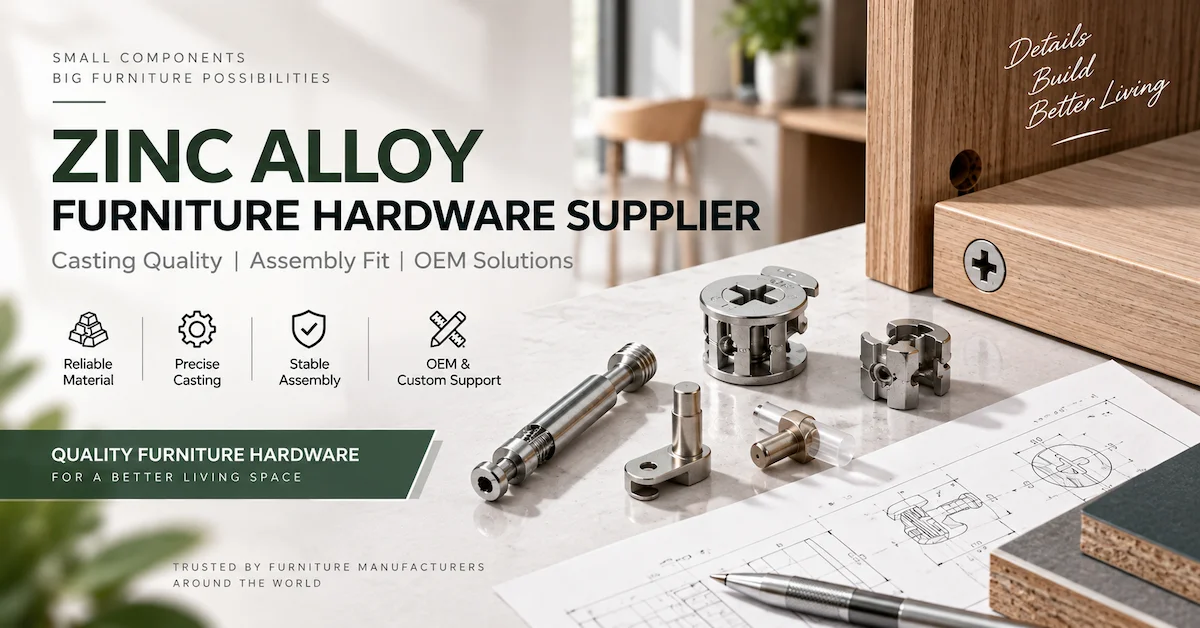
Zinc alloy furniture hardware refers to furniture fittings manufactured from zinc-based metal alloys. Common applications include cam lock bodies, concealed connectors, shelf supports, decorative fittings, and selected cabinet hardware components.
Zinc alloys can be suitable for these products because certain grades offer good castability, allowing manufacturers to produce intricate shapes with controlled dimensions and defined engagement features.
Typical applications include:
-
Cam locks for flat-pack cabinets and wardrobes.
-
Shelf supports for wooden and glass shelving.
-
Concealed connectors for modular furniture.
-
Decorative and positioning fittings.
-
Customized hardware for OEM furniture assembly.
However, zinc alloy is not suitable for every furniture component. Steel bolts, stainless steel fasteners, plastic sleeves, and other materials may be necessary depending on the connection design.
An important distinction: Zinc alloy hardware and zinc-plated steel hardware are not the same. Zinc alloy describes the component's base material, while zinc plating is a surface treatment applied to another material, commonly steel.
Buyers should always confirm both the base material and surface finish.
JHFIX furniture hardware includes connecting components, cam locks, shelf supports, and related fittings for furniture manufacturing applications.
2. Common Zinc Alloy Furniture Hardware Products
Different furniture applications require different connector structures, dimensions, and material properties.
| Product type | Typical applications | Important buying considerations |
|---|---|---|
| Zinc alloy cam locks | Flat-pack cabinets, wardrobes, desks | Cam diameter, locking geometry, bolt compatibility |
| Shelf supports | Cabinets, bookshelves, display furniture | Pin diameter, panel fit, support geometry |
| Concealed connectors | Modular furniture and panel connections | Installation position, mating components |
| Decorative fittings | Visible cabinet and furniture components | Surface finish, appearance consistency |
| Custom zinc alloy components | OEM furniture projects | Drawings, alloy grade, tooling, tolerances |
Zinc Alloy Cam Locks
Cam locks are widely used in RTA furniture systems. They typically work with connecting bolts to join prepared furniture panels.
The locking process depends on the internal cam profile, connecting-bolt head, insertion depth, and panel drilling arrangement.
Even connectors with similar external dimensions may not be interchangeable.
JHFIX offers cam locks and connector sets for furniture assembly applications.
Its HI-CB0012 three-in-one furniture connector listing describes a combination of carbon steel, zinc alloy, and plastic components.
This illustrates why each component's material and dimensions must be confirmed separately.
Zinc Alloy Shelf Supports
Shelf supports are used to position or support shelves inside cabinets, wardrobes, and storage furniture.
JHFIX lists an L-shaped zinc alloy cabinet shelf support intended for cabinet applications involving wooden plywood and glass shelves.
When selecting these fittings, buyers should verify hole diameter, insertion depth, shelf thickness, support position, and panel material.
The product's appearance or material designation alone does not establish its load capacity.
3. Zamak 3 vs Zamak 5: Choosing the Right Zinc Alloy
A professional zinc alloy furniture hardware supplier should help buyers clarify the required alloy grade when material composition affects the application.
Zamak 3 and Zamak 5 are commonly discussed zinc die-casting alloys.
| Feature | Zamak 3 | Zamak 5 |
|---|---|---|
| General characteristics | Balanced casting properties | Higher strength and hardness in some comparisons |
| Castability | Suitable for complex shapes | Suitable for many precision castings |
| Dimensional characteristics | Good dimensional stability | Requires application-specific evaluation |
| Surface finishing | Supports various finishes | Supports various finishes |
| Selection priority | Balanced manufacturing requirements | Specific mechanical requirements |
Zamak 5 is not automatically better than Zamak 3. The appropriate grade depends on the component's geometry, loading conditions, manufacturing requirements, and approved testing.
For example, a cam lock designed for repeated engagement may require different performance considerations from a decorative furniture fitting.
OEM buyers should specify the required material grade in drawings or request an engineering review when the appropriate grade has not yet been determined.
ASTM B86 is one technical reference covering specified commercial zinc and zinc-aluminum alloy castings. Buyers should check the applicable edition and grade designation when using it in procurement specifications.
JHFIX publicly identifies zinc alloy for selected fittings, but buyers should confirm the exact alloy grade for their individual orders rather than assume every product uses a particular Zamak grade.
4. How Casting Quality Affects Furniture Hardware Performance
Many shaped zinc alloy components are manufactured using die-casting processes.
This manufacturing approach can produce complex geometries, but the finished quality depends on material control, tooling design, casting conditions, and subsequent processing.
For OEM procurement, three areas deserve particular attention.
Component Geometry
Wall thickness, corners, recessed features, and functional surfaces influence how a casting is manufactured and how it performs.
A cam lock with an unsuitable internal profile may not engage the connecting bolt correctly, even when its outer diameter meets the drawing.
Critical engagement surfaces should therefore be identified during design review.
Casting Defects
Potential casting defects include:
-
Porosity or internal voids.
-
Cracks and incomplete filling.
-
Excessive flash around parting lines.
-
Surface blisters or irregularities.
-
Dimensional distortion.
The effect of a defect depends on its location and severity.
A minor appearance mark on a concealed surface may be acceptable, while a defect affecting a locking feature could make the component unsuitable.
Tooling and Production Consistency
Custom components may require tooling development and sample adjustments before mass production.
Buyers should confirm who is responsible for tooling, casting, surface finishing, inspection, and engineering changes.
A supplier's product range does not by itself prove that every manufacturing operation is conducted in-house.
5. Dimensional Accuracy and Furniture Assembly Compatibility
Dimensional consistency is one of the most important requirements when sourcing zinc alloy furniture connectors.
A cam lock, connecting bolt, and prepared panel must function as one assembly.
If the parts do not fit correctly, furniture manufacturers may experience loose joints, difficult installation, damaged panels, or production rework.
Critical Dimensions to Confirm
For cam-lock systems, check:
-
Cam diameter and body height.
-
Internal locking profile.
-
Matching bolt dimensions.
-
Panel hole diameter and depth.
-
Connecting-bolt installation position.
-
Required locking rotation.
For shelf-support fittings, check insertion diameter, support projection, contact position, and panel-hole compatibility.
Test the Actual Furniture Assembly
Samples should be tested with representative MDF, particleboard, plywood, or other specified panel materials.
A connector that performs correctly in a precision test fixture may behave differently when installed in a production-drilled furniture board.
The sample approval process should verify insertion, alignment, locking function, and any defined mechanical requirements.
JHFIX's furniture connecting bolts and dowels can be considered alongside matching cam-lock components when planning a complete furniture connection system.
6. Surface Finishes and Corrosion Protection
Surface treatment affects furniture hardware appearance and may contribute to corrosion protection when an appropriate coating system is specified.
Common finishing options for suitable zinc alloy components can include nickel-based decorative finishes, chrome-related systems, painting, and other approved coatings.
The correct choice depends on the underlying alloy, component geometry, intended environment, and customer requirements.
A bedroom wardrobe may have different exposure conditions from bathroom furniture or kitchen cabinets.
Buyers should specify whether their priority is decorative appearance, color consistency, coating adhesion, or resistance to a particular environment.
If corrosion testing is required, ISO 9227 provides salt-spray testing methods.
However, the standard does not establish one universal pass/fail requirement for every furniture fitting.
An effective purchasing specification must also define the applicable test conditions, duration, and acceptance criteria.
Do not assume that a bright metallic finish or a claim of being waterproof demonstrates verified corrosion performance.
7. Quality Control Requirements for OEM Furniture Hardware
Reliable bulk supply requires consistent inspection against approved specifications.
The following table provides a practical quality-control framework for furniture OEM buyers.
| Inspection stage | Key requirements |
|---|---|
| Material verification | Confirm specified alloy and relevant documentation |
| Dimensional inspection | Check critical dimensions and tolerances |
| Casting inspection | Examine cracks, flash, filling defects, and surface condition |
| Functional testing | Verify cam engagement, shelf-support fit, and assembly |
| Surface inspection | Check finish appearance and agreed coating requirements |
| Packaging inspection | Verify part codes, quantities, labels, and protection |
| Final acceptance | Compare production parts with approved samples |
Why Functional Testing Matters
Dimensional inspection cannot always identify every assembly problem.
A cam component may satisfy its external measurement requirements but fail to engage a particular connecting bolt.
Therefore, buyers should consider assembly testing using the intended mating components.
For shelf supports, functional approval should reflect the actual panel, shelf material, installation conditions, and required loading arrangement.
Establish Inspection Criteria Before Production
Buyers should agree on critical defects, acceptable cosmetic variation, inspection frequency, and any required test reports.
Sampling methods may be based on applicable acceptance-sampling standards, such as ISO 2859-1, where appropriate.
However, sampling is not a guarantee of defect-free production.
The inspection plan should match the component's actual technical and commercial risks.
8. OEM Customization: From Drawings to Bulk Orders
Furniture manufacturers frequently need customized zinc alloy components instead of standard catalog fittings.
Possible requirements include special connector dimensions, nonstandard engagement profiles, specific finishes, compatible bolts, or customer-defined packaging.
A practical development process includes the following stages.
Step 1: Submit drawings or samples. Provide the component drawing, actual application, board material, critical dimensions, and mating components.
Step 2: Confirm material and manufacturing requirements. Define the alloy grade, finish, tolerances, and any required test conditions.
Step 3: Review manufacturing feasibility. Discuss whether the requested geometry can be produced and whether tooling or design adjustments are necessary.
Step 4: Approve samples. Evaluate appearance, dimensions, mating-part compatibility, and functionality in actual furniture assemblies.
Step 5: Confirm bulk production requirements. Agree on approved drawings, sample references, inspection criteria, packaging, quantity, and schedule.
Step 6: Inspect and release the order. Verify that production parts follow the approved specification before shipment.
JHFIX describes an OEM/ODM workflow involving drawings or samples, technical communication, quotation, sampling, production, inspection, and shipping.
Buyers can review JHFIX's company and manufacturing information before submitting a customization inquiry.
9. MOQ, Pricing, and Total Procurement Cost
The lowest quoted unit price does not always represent the most economical purchasing decision.
Furniture hardware procurement costs can include component production, tooling, finishing, inspection, packaging, logistics, and additional expenses caused by incompatible or defective parts.
Important quotation factors include:
-
Zinc alloy grade and material consumption.
-
Product size and geometry.
-
Tooling and development requirements.
-
Surface treatment.
-
Order quantity and production complexity.
-
Inspection and testing requirements.
-
Packaging and labeling.
-
Delivery arrangements.
Standard components and custom castings may have different minimum order quantities and lead times.
Buyers should request product-specific commercial terms rather than assume that one published MOQ applies across an entire catalog.
For repeat orders, consistent specifications and approved samples can help reduce unnecessary changes and improve purchasing control.
10. OEM Hardware Kits and Private-Label Packaging
Furniture brands frequently purchase complete installation kits instead of individual components.
A typical hardware kit may combine zinc alloy cam components, connecting bolts, screws, shelf supports, nuts, plastic sleeves, and installation accessories.
The kit should be controlled through a bill of materials (BOM) that defines every part number, specification, and quantity.
Incorrect hardware counts can cause assembly failures even when the individual components meet their specifications.
For private-label buyers, additional requirements may include branded packaging, barcodes, product instructions, carton labels, and component separation.
JHFIX offers bag packaging, box packaging, and other hardware packaging categories.
These options can be discussed as part of a furniture OEM supply project, subject to the approved BOM and packaging requirements.
11. How to Evaluate a Zinc Alloy Furniture Hardware Supplier in China
Before selecting a supplier, overseas buyers should verify both technical suitability and commercial reliability.
A useful supplier qualification checklist includes:
| Evaluation area | Questions to ask |
|---|---|
| Product suitability | Does the supplier offer the required fittings and configurations? |
| Material control | Can the requested zinc alloy grade be confirmed? |
| Engineering | Can drawings, samples, and mating parts be reviewed? |
| Manufacturing | Who performs casting, finishing, assembly, and inspection? |
| Quality control | Are critical dimensions and functional requirements verified? |
| Customization | Can project-specific specifications be evaluated? |
| Repeat supply | How are approved specifications and changes controlled? |
| Packaging | Can hardware be packed according to the customer BOM? |
| Export services | Are quotation, commercial documents, and shipping responsibilities clear? |
A supplier should be assessed against the actual project rather than general marketing descriptions.
For example, a company supplying standard cabinet fittings may not automatically be qualified to produce a custom casting with tightly controlled functional surfaces.
Ask for relevant samples, technical documentation, and confirmation of the manufacturing arrangement.
12. Why Consider JHFIX for Furniture Hardware Sourcing?
JHFIX supplies furniture hardware, screws, nuts, connecting components, and hardware packaging solutions for overseas B2B customers.
Its furniture hardware range includes cam locks, connecting bolts, shelf supports, and mounting fittings.
Selected product listings specifically identify zinc alloy components, making them relevant for buyers researching zinc alloy furniture fittings.
JHFIX also describes drawing-based customization, sample review, production coordination, quality inspection, and packaging services.
For projects requiring multiple components, buyers may discuss compatible hardware arrangements and packaging configurations rather than sourcing every part independently.
The manufacturing company is Jiangmen Jinhe Hardware Products Co., Ltd., while international sales and export services are supported by its authorized trading partner, Jiangmen Shenxin Trading Co., Ltd.
Details of this arrangement are available through JHFIX Global Sales & Export.
Exact alloy grades, manufacturing routes, available customization, certifications, MOQ, lead times, and performance requirements must be confirmed for the specific project.
13. RFQ Checklist: What Should Buyers Send to JHFIX?
A complete request for quotation helps the supplier evaluate product feasibility and prepare an appropriate offer.
| RFQ item | Information required |
|---|---|
| Product type | Cam lock, shelf support, connector, or custom fitting |
| Application | Cabinet, wardrobe, desk, shelving, or other furniture |
| Drawing or sample | Dimensions, revision, and reference sample |
| Material | Required zinc alloy grade or material preference |
| Critical tolerances | Functional dimensions and allowable variation |
| Mating components | Connecting bolts, sleeves, or associated parts |
| Surface finish | Appearance, color, or coating requirements |
| Quality requirements | Inspection and testing conditions |
| Order volume | Initial quantity and repeat-order forecast |
| Packaging | Bulk, bag, box, or custom hardware kit |
| Destination | Target market and shipping requirements |
Providing mating components and representative furniture panels is especially useful for projects involving cam locks or shelf supports.
If the requested part replaces existing hardware, include photos of the installed assembly and explain any problems with the current design.
Looking for a zinc alloy furniture hardware supplier for your next OEM project?
JHFIX can review relevant drawings, product configurations, sample requirements, and purchasing specifications.
Contact JHFIX to Request an OEM Furniture Hardware Quotation
14. Frequently Asked Questions
Is zinc alloy suitable for furniture cam locks?
Yes, suitable zinc alloy grades are used for certain cam-lock bodies and shaped furniture connector components. However, performance depends on alloy selection, geometry, casting quality, mating-bolt compatibility, and assembly conditions. Buyers should approve the complete connector system before placing bulk orders.
What is the difference between Zamak 3 and Zamak 5?
Both are zinc-based casting alloys with different compositions and mechanical characteristics. Zamak 5 may offer higher strength and hardness in certain comparisons, while Zamak 3 provides balanced casting properties. The better choice depends on the product design and technical requirements.
What casting defects should OEM buyers check?
Important concerns include cracks, excessive flash, incomplete filling, significant porosity, surface defects, and dimensional distortion. Inspection should focus on defects affecting fit, appearance, and mechanical function according to agreed acceptance criteria.
Can zinc alloy shelf supports be used for glass shelves?
Certain fittings are intended for glass-shelf applications, but suitability depends on support geometry, shelf thickness, contact conditions, panel construction, and loading requirements. Buyers should verify the complete installed assembly rather than assume a universal load capacity.
Does JHFIX offer customized zinc alloy furniture hardware?
JHFIX lists selected zinc alloy fittings and provides an OEM/ODM inquiry process. Buyers can submit drawings, samples, material requirements, and expected quantities for evaluation. Specific manufacturing feasibility and commercial terms must be confirmed.
What determines MOQ and lead time?
MOQ and lead time depend on product design, tooling needs, material requirements, production quantity, finishing, inspection, and packaging. Standard products and newly developed custom components may have different requirements.
Can JHFIX supply matching screws and furniture connectors?
JHFIX provides multiple furniture hardware and fastener categories, including cam locks, connecting bolts, screws, and nuts. Buyers should specify the complete assembly to confirm which components can be supplied in compatible configurations.
What should international buyers verify before bulk production?
Buyers should confirm drawings, materials, critical dimensions, mating components, functional tests, approved samples, inspection criteria, packaging, and commercial terms. A controlled approval process helps reduce assembly problems and repeat-order variation.
Conclusion
Choosing a reliable zinc alloy furniture hardware supplier requires more than comparing prices or product photographs. OEM buyers should evaluate material grades, casting quality, dimensional accuracy, surface finishes, assembly compatibility, and bulk-order inspection requirements.
For furniture manufacturers, the most valuable supplier is one that helps establish clear specifications and supports consistent component matching throughout the purchasing process.
JHFIX offers zinc alloy furniture fittings, related connectors, customized hardware options, and packaging solutions for B2B buyers.
Contact JHFIX to discuss your drawings, sample requirements, and OEM zinc alloy furniture hardware project.