
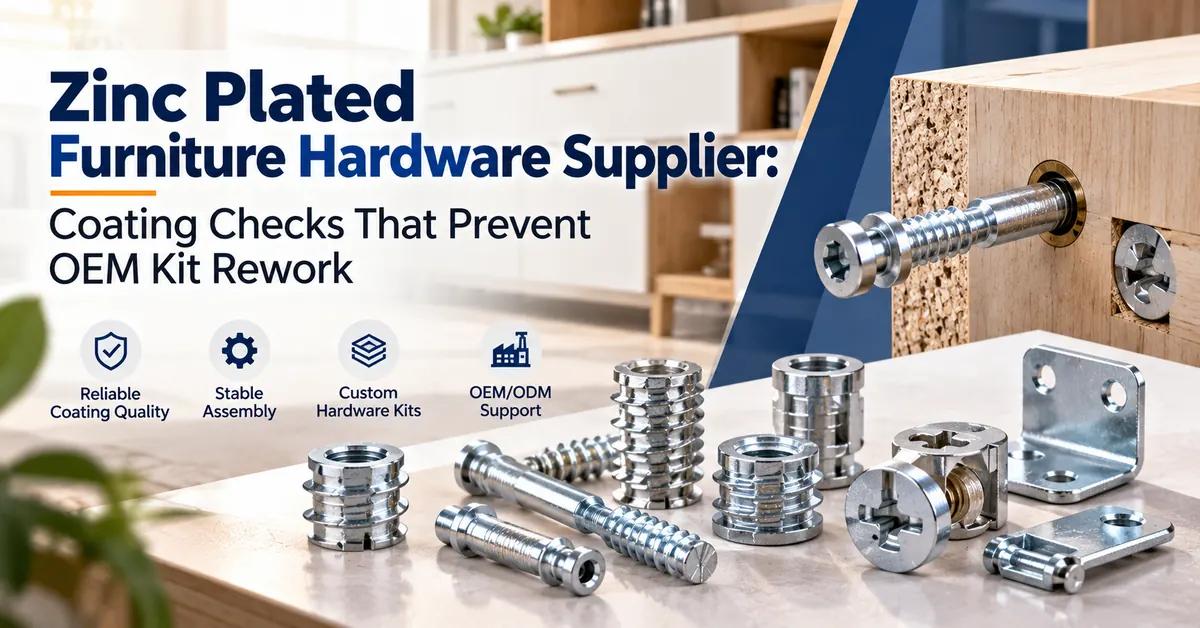
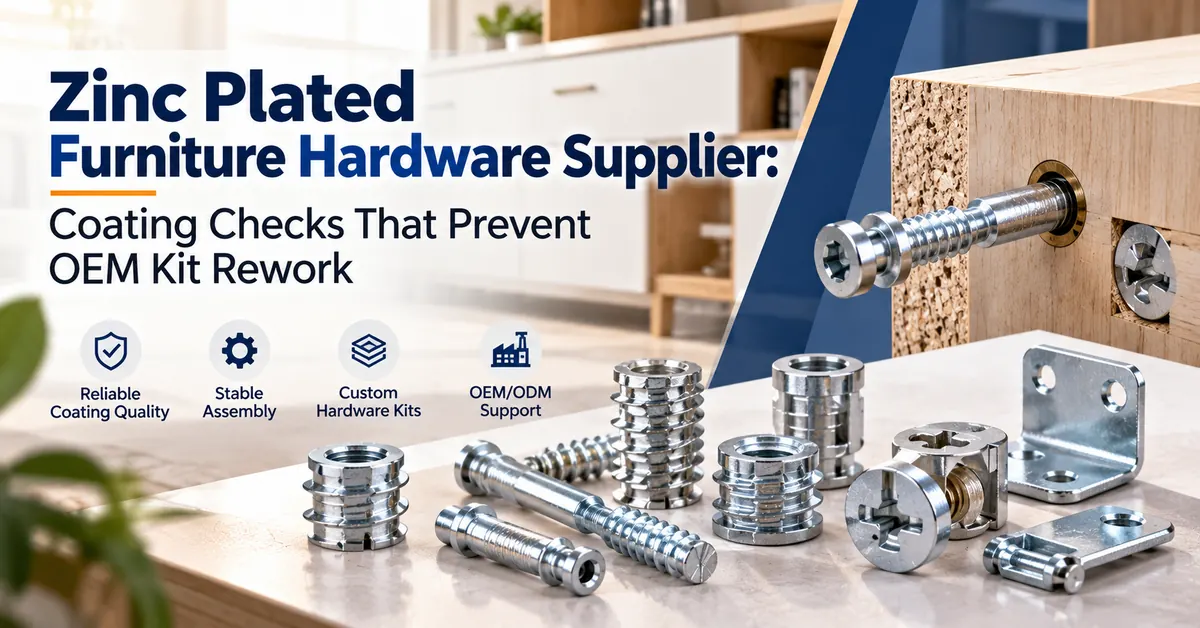
Choosing a reliable zinc plated furniture hardware supplier means looking beyond shiny surfaces, low unit prices, and product photographs. For furniture manufacturers and OEM brands, consistent coating quality must work together with accurate dimensions, compatible connectors, dependable assembly performance, and controlled packaging.
A zinc-plated cam bolt may look acceptable but fail to engage correctly with its matching connector. A mounting bracket may meet dimensional requirements yet develop surface corrosion during humid storage. Even when individual components pass inspection, inconsistent finishes or mixed hardware kits can create assembly delays and customer complaints.
The best purchasing approach is to specify the base material, coating system, functional dimensions, inspection criteria, and packaging requirements before approving bulk production.
This guide explains how to evaluate zinc plated furniture hardware, establish coating quality requirements, compare material and finish options, and select a supplier capable of supporting repeatable OEM furniture production.
1. Why Zinc Plated Furniture Hardware Is Common in OEM Manufacturing
Zinc plating is widely used on steel furniture hardware because it can provide corrosion protection and a consistent appearance at a practical cost.
During electroplating, a layer of zinc is deposited onto the steel surface. Zinc can provide sacrificial protection to the underlying steel, while supplementary passivation or sealing treatments may improve corrosion performance.
However, the results depend on the complete coating system, not simply whether a product is described as zinc plated.
For furniture manufacturers, zinc-plated steel hardware is commonly considered for:
-
Cabinet connecting bolts and dowels.
-
Furniture assembly screws and threaded components.
-
Steel mounting brackets and connecting plates.
-
Selected shelf support pins.
-
Steel insert nuts and other fastening accessories.
Buyers can explore these applications through the JHFIX furniture hardware product range.
When Is Zinc Plating a Suitable Choice?
For dry indoor furniture such as wardrobes, office desks, bedroom cabinets, and storage units, an appropriately specified zinc-plated steel component can provide a useful balance of surface protection, appearance, and manufacturing cost.
However, furniture used in bathrooms, humid kitchens, coastal environments, or poorly controlled storage conditions may require additional consideration.
A standard zinc-plated finish should not automatically be described as waterproof, suitable for marine environments, or corrosion-resistant for a guaranteed number of years.
The operating environment, coating specification, and acceptance criteria must be evaluated together.
2. Which Furniture Hardware Components Need Different Coating Checks?
Not every furniture component requires the same surface treatment or quality-control method.
A furniture hardware kit may contain steel screws, zinc-alloy cam bodies, plastic sleeves, mounting brackets, and threaded inserts. These components differ in materials, manufacturing processes, and functional requirements.
|
Hardware component |
Typical material considerations |
Critical quality checks |
Common applications |
|---|---|---|---|
|
Furniture connecting bolts |
Carbon steel with a specified finish |
Thread dimensions, bolt length, coating condition, cam engagement |
Wardrobes, cabinets, desks |
|
Cam lock connector sets |
Steel, zinc alloy, and possibly plastic components |
Cam-to-bolt compatibility, dimensional fit, component identification |
RTA furniture |
|
Steel mounting brackets |
Stamped steel with suitable surface protection |
Hole position, flatness, burrs, coating coverage |
Tables, cabinets, shelving |
|
Threaded insert nuts |
Steel or other specified metal |
Internal thread, external dimensions, retention in panel material |
Wooden furniture joints |
|
Shelf support pins |
Steel, zinc alloy, or mixed materials |
Diameter, insertion fit, surface finish, support performance |
Cabinets, bookcases, wardrobes |
This distinction is especially important for flat-pack furniture brands sourcing multiple hardware components for one product.
For example, JHFIX lists a three-in-one furniture connector configuration identified as HI-CB0012, combining carbon steel, zinc alloy, and plastic components with customizable finish options.
This illustrates why buyers should define the material and surface treatment of each component separately instead of assuming every part in the assembly has the same coating.
Explore the JHFIX cam locks and connector sets for relevant furniture fastening configurations.
Zinc Plated Steel Is Not the Same as Zinc Alloy
This is an important distinction when selecting a supplier.
Zinc plated steel means a steel component has been given a zinc coating.
Zinc alloy refers to the base material itself. It may be used to produce shaped or die-cast furniture components.
A zinc-alloy cam body and a zinc-plated steel connecting bolt can belong to the same furniture connector set, but they should not be described as identical materials.
Suppliers should clarify base material, coating, and functional requirements separately in their quotations and product specifications.
3. How to Specify Zinc Plating Before Requesting a Quotation
A common sourcing mistake is sending a drawing that specifies only "zinc plated" without identifying the required coating characteristics.
That description may be insufficient for products with specific corrosion, appearance, assembly, or repeat-order requirements.
A professional zinc plated furniture hardware supplier should work from an agreed technical specification rather than relying only on a finish description.
Recommended Zinc Plating Specification Table
|
Specification item |
What buyers should define or verify |
|---|---|
|
Base material |
Steel grade or other applicable material specification |
|
Coating type |
Electroplated zinc or another clearly identified coating system |
|
Coating thickness |
Minimum or specified thickness according to the applicable standard and design |
|
Passivation |
Required conversion treatment, color, and any restricted-substance requirements |
|
Appearance |
Acceptable color variation, stains, surface defects, and reference samples |
|
Corrosion requirements |
Test method, exposure conditions, duration, and acceptance criteria |
|
Critical dimensions |
Thread fit, hole fit, mating surfaces, and dimensions affected by coating |
|
Functional requirements |
Connector engagement, assembly performance, and relevant load requirements |
|
Documentation |
Approved drawings, inspection records, and agreed material or coating evidence |
This specification should be agreed upon before sample approval.
Why Coating Thickness Matters
Coating thickness is one factor influencing corrosion protection, but increasing thickness is not always the correct solution.
Excessive coating buildup on threads or other mating surfaces may interfere with assembly.
For example, coating buildup can affect the fit between a connecting bolt and its matching threaded insert.
A supplier should therefore consider both the required surface protection and the dimensional limits of the finished component.
The correct thickness should be established through the applicable coating specification, component geometry, and customer requirements.
Which Coating Standards Should Buyers Reference?
Three recognized references are particularly useful for technical discussions.
ASTM B633-23 addresses electrodeposited zinc coatings on iron and steel articles. It covers requirements relevant to coating classification, appearance, thickness, adhesion, corrosion protection, and associated processing considerations.
ISO 4042:2022 addresses electroplated coating systems for fasteners, including dimensional and coating-related requirements. It also discusses measures to reduce hydrogen-embrittlement risks, which deserve particular attention for susceptible high-strength steel fasteners.
ISO 9227:2022 describes salt spray test methods used to evaluate corrosion-related performance and coating quality.
Importantly, a salt spray test standard does not automatically establish how many testing hours a particular furniture component must withstand.
The buyer and supplier need to agree on the exposure duration, evaluation method, and acceptance criteria.
Salt spray performance should also not be treated as a direct prediction of real-world service life.
These standards provide technical references for specifying or evaluating products. Their mention does not imply that every JHFIX product has been individually certified or tested to each standard.
4. Zinc Plated vs Stainless Steel vs Nickel Plated Furniture Hardware
A furniture hardware purchasing decision should consider mechanical requirements, the operating environment, appearance, and overall cost.
The following comparison helps buyers understand the main differences.
|
Material or finish option |
Key characteristics |
Typical suitability |
Main purchasing concern |
|---|---|---|---|
|
Zinc plated carbon steel |
Steel substrate with protective zinc coating |
General indoor furniture bolts, screws, brackets |
Coating specification, corrosion conditions, dimensional fit |
|
Stainless steel |
Corrosion resistance depends on the selected grade and environment |
Selected humid or demanding applications |
Grade identification, strength, cost |
|
Nickel plated components |
Surface finish may provide decorative or functional benefits |
Visible fittings and selected premium hardware |
Substrate, coating system, appearance |
|
Zinc alloy components |
Base material suitable for certain complex connector shapes |
Cam locks and shaped furniture fittings |
Alloy specification, casting quality, functional fit |
No material or finish is automatically the best choice for every furniture product.
For instance, a zinc-plated steel bolt may be appropriate for a dry indoor wardrobe, while another application could require a different material or coating system.
The decision should reflect actual exposure and performance requirements, rather than appearance alone.
5. Five Common Coating and Assembly Problems in Bulk Furniture Hardware
Bulk furniture hardware procurement involves more than evaluating a few attractive samples.
The supplier needs to reproduce acceptable components across manufacturing batches.
Here are five issues buyers should address before approval.
Problem 1: White Corrosion Products Appear During Storage
Zinc-coated parts may develop white corrosion products when exposed to unfavorable moisture and storage conditions.
Possible contributing factors include trapped moisture, inadequate drying, condensation, and unsuitable packaging.
Recommended action: Review the approved finish, storage conditions, packing method, and corrosion acceptance criteria. Investigate the source of moisture instead of assuming that a shiny initial appearance guarantees storage stability.
Problem 2: Red Rust Appears Earlier Than Expected
Red rust on a steel component may indicate that the substrate has become exposed to corrosive conditions.
Potential contributing factors include unsuitable coating selection, local coating damage, inadequate coverage, or an environment more severe than the original specification anticipated.
Recommended action: Check the coating specification, actual exposure, handling damage, and applicable test results before determining the root cause.
Problem 3: Plating Interferes With Threaded Connections
Threaded furniture components require controlled mating dimensions.
Changes to coating thickness or component dimensions can contribute to difficult assembly, damaged threads, or incorrect engagement.
Recommended action: Verify the finished components with appropriate gauges and the actual mating hardware, not only their pre-plating dimensions.
Problem 4: Furniture Kits Contain Inconsistent Finishes
An OEM hardware kit may contain components from different production or finishing batches.
If finish appearance varies beyond the customer's specification, this can lead to complaints, especially when fittings remain visible after assembly.
Recommended action: Approve representative finish samples, define acceptable variation, and establish identification requirements for individual components.
Problem 5: Parts Pass Inspection but Fail During Furniture Assembly
A properly coated fastener may still fail to function because the mating parts or installation geometry are incorrect.
Cam bolt length, panel-hole position, bracket-hole spacing, and threaded insert dimensions can all influence assembly.
Recommended action: Perform functional checks using representative furniture components and approved drilling specifications.
The critical principle is that surface quality and mechanical compatibility must be verified independently.
6. What Quality Control Should a Zinc Plated Furniture Hardware Supplier Provide?
For OEM furniture manufacturing, the most useful quality-control process connects the approved drawing to actual production and shipment.
Buyers should clarify what inspection and testing services are available, which are performed internally, and which may be arranged through an external provider.
Stage 1: Pre-Production Sample Approval
Before bulk production, confirm the component design, materials, finish, mating hardware, and intended assembly.
The approved sample should represent the final production requirements rather than merely the closest available catalog item.
For furniture connector sets, assembly testing should use the intended panel material and drilling pattern.
Stage 2: Dimensional and Thread Inspection
Critical checks may include:
-
Screw and bolt length.
-
Thread size and pitch.
-
Hole diameter and spacing.
-
Connector engagement dimensions.
-
Insert nut internal threads.
-
Bracket geometry.
-
Dimensions affected by coating.
Inspection methods and tolerances should follow the approved drawing and applicable product requirements.
Stage 3: Coating Inspection
Depending on the product and order specification, relevant checks may include coating appearance, thickness, coverage, adhesion, and agreed corrosion testing.
Coating thickness can be assessed using an appropriate validated measurement method for the coating and substrate.
Where salt spray testing is specified, the report should identify the method, actual exposure conditions, duration, and observed results.
Buyers should request actual evidence of conformity rather than rely on claims such as "anti-rust" or "excellent corrosion resistance."
Stage 4: Functional Assembly Verification
Finished hardware should be evaluated in its intended application when functional performance is important.
For example:
A cam bolt should engage correctly with its designated cam.
A threaded insert should work with its intended mating bolt and installation method.
A furniture bracket should fit the specified mounting pattern without unacceptable deformation or interference.
These checks can identify problems that a coating inspection alone will not detect.
Stage 5: Final Lot and Packaging Inspection
Before shipment, verify part identification, quantities, finish consistency, labeling, packaging configuration, and any agreed lot traceability.
For recurring orders, approved drawings and revisions should be controlled so the supplier does not unintentionally substitute a similar-looking component.
A practical quality plan should state what is inspected, how frequently, the acceptance limits, and how nonconforming products are handled.
7. How to Prevent Quality Problems in OEM Furniture Hardware Kits
Many furniture brands purchase complete hardware kits rather than individual screws or fittings.
A typical kit may combine connecting bolts, cams, insert nuts, brackets, shelf supports, washers, and other accessories.
The components must be compatible and correctly counted.
Create a Controlled Hardware BOM
A Bill of Materials (BOM) should identify each component using a unique part number.
For every relevant metal component, the BOM or linked technical specification should identify the material, finish, size, quantity, and drawing revision.
For example, a furniture manufacturer may require different connecting bolts and brackets for two visually similar cabinet models.
Packaging those parts without clear identification can create costly assembly problems.
Prevent Mixed Parts and Finish Damage
The kit design should consider how the components are stored and transported.
Separating parts into labeled bags may help reduce mixing. Suitable packing materials can also help limit unnecessary metal-to-metal contact and surface damage.
For shipments exposed to changing temperatures or humidity, packaging should be evaluated against the actual transport and storage conditions.
Verify the Complete Kit
A useful final verification process checks:
-
Component identification and quantity.
-
Compatibility with the furniture model.
-
Finish requirements.
-
Packaging integrity.
-
Label and revision information.
-
Representative assembly where required.
JHFIX provides hardware packaging options for different purchasing and distribution requirements.
Explore custom bag packaging and furniture hardware kits to see relevant packaging configurations.
For furniture brands, well-controlled hardware kitting can reduce manual sorting and help maintain more consistent assembly processes.
8. How to Evaluate a Zinc Plated Furniture Hardware Supplier for OEM Orders
An effective supplier assessment should go beyond the lowest quotation.
A zinc plated furniture hardware supplier should be evaluated on technical communication, manufacturing coordination, inspection capability, component compatibility, packaging control, and repeat-order consistency.
Can the Supplier Support Several Furniture Hardware Categories?
Manufacturers often need connecting bolts, insert nuts, brackets, shelf supports, and assembly screws in one purchasing program.
Having access to related product categories can simplify component coordination, although buyers should still confirm that the exact items and specifications are available.
Can the Supplier Confirm the Finishing Process?
Ask whether finishing is performed internally or coordinated through a qualified external provider.
A supplier does not necessarily need to operate its own plating line to supply suitable parts, but responsibility for coating specifications, inspection, traceability, and corrective actions should be clear.
Can the Supplier Support Custom Drawings and Samples?
OEM furniture programs may require nonstandard bolt lengths, specific connector geometries, custom holes, or finish requirements.
The supplier should review technical drawings and confirm feasibility, tooling requirements, samples, costs, and approval procedures.
Can the Supplier Maintain Consistency Between Orders?
Repeat purchasing introduces additional risks if materials, coatings, tooling, or suppliers change without approval.
Buyers should ask how the approved specification is controlled and whether any proposed changes require customer confirmation.
Can the Supplier Provide the Required Export and Packaging Support?
Bulk international procurement may require clear product identification, agreed packaging, export documents, and coordinated shipment planning.
These requirements should be established at the quotation stage, not immediately before dispatch.
9. How JHFIX Supports Furniture Hardware Sourcing and OEM Projects
JHFIX supplies industrial fasteners and furniture hardware for international B2B customers.
Its manufacturing business, Jiangmen Jinhe Hardware Products Co., Ltd., describes capabilities including cold heading, tapping, stamping, assembly, packaging, and quality-control processes.
The company also supports OEM/ODM coordination and customized hardware requirements.
For international orders, Jiangmen Shenxin Trading Co., Ltd. serves as its authorized export and trading partner.
The available scope of any particular coating, testing process, MOQ, or custom specification should be confirmed during the technical and commercial review.
Relevant JHFIX Product Categories
For buyers preparing a zinc-plated furniture hardware program, the following categories provide useful starting points:
|
Product requirement |
JHFIX product category |
|---|---|
|
Cabinet connectors and cam fittings |
|
|
Connecting bolts and dowels |
|
|
Threaded insert nuts and other nuts |
|
|
Cabinet shelf supports |
|
|
Furniture mounting hardware |
Buyers can also review the JHFIX manufacturing and company information before discussing product specifications.
Recommended OEM Development Process
For customized furniture hardware, a structured purchasing process can include six stages:
-
Submit drawings and specifications: Identify each part, material, thread, coating, application, and expected order volume.
-
Review technical feasibility: Confirm relevant manufacturing, finishing, assembly, and inspection requirements.
-
Receive a quotation: Clarify unit pricing, tooling, MOQ, expected lead time, and packaging.
-
Approve samples: Check dimensions, finish requirements, mating components, and functional assembly.
-
Confirm production documentation: Record the approved drawing revision, inspection plan, packaging requirements, and any agreed changes.
-
Arrange inspection and shipment: Review the agreed acceptance requirements and export arrangements.
This process helps manufacturers identify potential problems before committing to repeat production.
10. What Determines the Cost of Zinc Plated Furniture Hardware?
The lowest unit price does not necessarily produce the lowest overall purchasing cost.
For zinc-plated furniture components, pricing may depend on the base material, dimensions, production method, coating specification, order quantity, inspection requirements, and packaging configuration.
Several cost factors deserve attention.
Component design: Nonstandard dimensions, complex forming, or unusual threading requirements may increase tooling or production complexity.
Coating system: Different coating thicknesses, supplementary treatments, and testing requirements can affect processing costs.
Order volume: MOQ and unit pricing depend on the specific product and manufacturing arrangement.
Inspection requirements: Functional testing, coating measurements, and documentation should be included in the project scope where needed.
Packaging: Individual bags, complete furniture kits, labels, cartons, and private-label packaging involve different preparation requirements.
Quality-related losses: Incorrect parts, rejected coating batches, rework, and interrupted assembly can create costs beyond the initial purchase price.
For recurring OEM programs, a clear and repeatable specification is often more valuable than achieving a small one-time price reduction.
11. RFQ Checklist for Bulk Zinc Plated Furniture Hardware
Before contacting a supplier, prepare a structured request for quotation.
|
RFQ information |
What to provide |
|---|---|
|
Product category |
Connecting bolt, insert nut, bracket, screw, shelf support, or kit |
|
Technical drawing |
Dimensions, tolerances, drawing number, and revision |
|
Base material |
Required material or material grade |
|
Coating specification |
Zinc plating type, thickness, treatment, and applicable standard |
|
Appearance requirement |
Approved sample, color, and allowable variation |
|
Application |
Furniture type, panel material, and assembly method |
|
Quality requirements |
Dimensional inspection, coating checks, and functional tests |
|
Order quantity |
Initial volume and expected repeat demand |
|
Packaging |
Bulk cartons, labeled bags, component kits, or private label |
|
Delivery information |
Destination, delivery terms, and required schedule |
If your project includes multiple furniture components, provide the complete BOM and explain which parts must be assembled or packed together.
For nonstandard products, drawings and physical samples can help suppliers clarify technical details before preparing a quotation.
Need zinc plated furniture hardware for an OEM furniture project?
Contact JHFIX to discuss your drawings, coating requirements, and bulk quotation.
12. Frequently Asked Questions
1. What does a zinc plated furniture hardware supplier provide?
A zinc plated furniture hardware supplier may provide screws, connecting bolts, insert nuts, brackets, and other furniture components with specified zinc coatings. Depending on its capabilities, the supplier may also coordinate custom designs, samples, inspection, hardware kits, and packaging. Buyers should confirm the exact scope for each product.
2. Is zinc plated furniture hardware suitable for kitchen cabinets?
It can be suitable for certain kitchen cabinet applications, but the decision depends on exposure to moisture, cleaning products, temperature changes, and other environmental conditions. Hardware near sinks or frequently damp areas may require a different coating specification or material.
3. Is zinc plated steel the same as zinc alloy hardware?
No. Zinc plated steel has a steel substrate with a zinc coating. Zinc alloy is the component's base material. Their manufacturing processes, properties, and applications may differ. A furniture connector set can contain both material types.
4. What coating thickness should furniture hardware have?
The appropriate coating thickness depends on the component design, the applicable standard, the intended environment, and functional tolerances. Buyers should not apply one coating thickness to every component without checking the specific application and mating dimensions.
5. How do I check corrosion resistance before bulk purchasing?
Specify a suitable test method, exposure duration, acceptance criteria, and sample requirements. Where salt spray testing is appropriate, buyers may reference ISO 9227. The resulting test data should be assessed against the agreed product specification rather than interpreted as a guaranteed service-life prediction.
6. Why do zinc plated furniture fasteners sometimes develop white rust?
White corrosion products may form when zinc surfaces are exposed to unfavorable moisture or storage conditions. The contributing factors can include condensation, trapped humidity, unsuitable packaging, or coating-related issues. Investigation should consider the actual finish and exposure conditions.
7. Can zinc plating affect furniture connector assembly?
Yes. Coating buildup can change critical dimensions or influence the fit of threaded and mating components. Buyers should verify finished-part dimensions and perform assembly checks using the intended connectors, screws, and furniture materials.
8. Can JHFIX support customized zinc plated furniture hardware?
JHFIX describes OEM/ODM manufacturing and customized hardware services. Buyers can submit drawings, samples, material specifications, and coating requirements for review. Availability, finishing options, tooling, testing, MOQ, and lead time should be confirmed for the specific project.
9. How can buyers prevent incorrect parts in furniture hardware kits?
Use a controlled BOM, unique component identifiers, clear quantity requirements, and approved packaging instructions. Separating similar-looking components and checking the packed kit against the intended furniture model can help reduce assembly errors.
10. What should I send when requesting a bulk furniture hardware quotation?
Provide product drawings or samples, base material, dimensions, coating requirements, expected order quantity, quality criteria, packaging instructions, and delivery destination. For complete furniture hardware kits, include the BOM and any important assembly compatibility requirements.
Conclusion
Selecting the right zinc plated furniture hardware supplier requires more than comparing finish appearance and unit prices. Furniture manufacturers and OEM buyers need to evaluate base materials, coating specifications, dimensional compatibility, corrosion requirements, inspection procedures, and packaging consistency.
For bulk furniture production, coating quality and assembly reliability must be considered together. A properly specified zinc-plated component can support consistent manufacturing, while uncontrolled variations in coating, dimensions, or mixed hardware kits may lead to rework and customer complaints.
JHFIX supports B2B customers sourcing furniture connectors, screws, nuts, brackets, and related hardware, with OEM/ODM development and packaging coordination for suitable projects.
If you are preparing a new furniture hardware program or reviewing an existing supplier, start with clear drawings, an approved coating specification, representative samples, and a defined quality plan.
Contact JHFIX to discuss your zinc plated furniture hardware requirements, OEM specifications, and bulk purchasing needs.